Key Takeaways
- For kids bottles, lock straw, lid, seal and coating specs before sampling; changing one part after approval can add 7-12 days
- A practical MOQ for customized drinkware is often 1,000-3,000 pcs per color, with sample lead time around 7-10 days
- Use AQL 2.5 for major defects and AQL 4.0 for minor defects on final inspection, not a casual spot check
- Ask for migration and material compliance files early; REACH, LFGB or CPSIA paperwork delays shipments more often than production does
You are not buying a generic bottle. You are buying something that ends up in a child’s hand, goes through a parent’s dishwasher 200 times, and lands back on your desk the minute it leaks, smells off, chips, or fails a 1.2 m drop test. That changes the factory conversation fast. “Send catalog and best price” is the wrong question to ask; we see that line on RFQs every week, sometimes with the PO typo carried all the way into sampling.
A better approach is to run the order like a project on the line: freeze the bottle spec, sign off decoration against a Pantone target, confirm the compliance file, inspect the first run, and check packing before we ship. In Zhejiang, this is where margin is won or lost, down to a 0.3 mm logo shift or a carton drop issue QC pulled at final inspection. A decent factory will show its process here, not just a nice catalog. We’ve seen this go sideways when a supplier looked fine on paper but ran more like a canteen bottle shop than a stable long-term production partner.
Start with one realistic PO
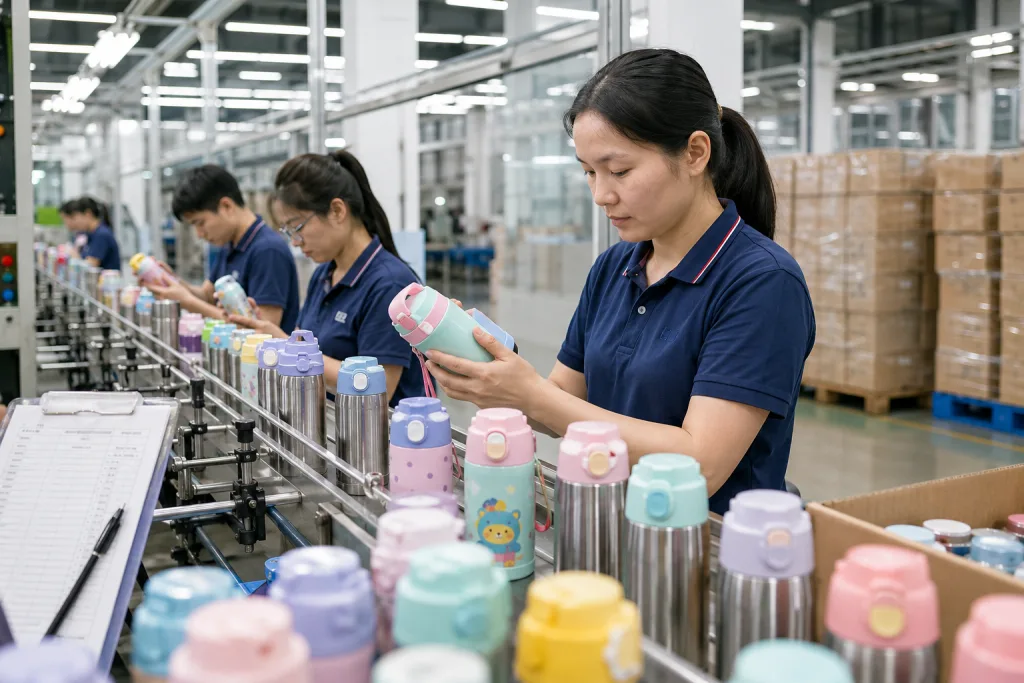
Set the scene properly. You are a European distributor buying for a back-to-school retail launch. The item is a 450 ml insulated kids bottle with a flip straw lid, powder coating, a one-color logo, and an individual box. First PO: 3,000 units across 3 colors, which usually means 1,000 pcs per color on the line. You want one factory to own the full build: molding control, stainless body forming, painting, logo, assembly, packing, and export. That is the right starting point. Chasing the lowest quote from three random canteen vendors usually looks cheap on paper, then goes sideways when the lid fit is off by 0.3 mm or the box drop test fails.
The first conversation needs detail, not slogans. Send a short brief with bottle capacity, body diameter, target age group, material preference, insulation need, leakproof requirement, cleaning requirement, logo method, packaging standard, destination market, and compliance scope. If you also buy adult lines, say it on day one. We run into this often: a buyer starts with one kids SKU, then asks six months later for a custom canteen and a custom growler set using the same color card. A factory that can cover that family is worth more than a one-SKU workshop. Frankly, “who is cheapest today” is the wrong question to ask.
- Example target spec: 18/8 stainless steel inner and outer, 0.4 mm inner wall, 0.5 mm outer wall, silicone straw tip, PP lid, powder coat 60-80 micron, 6 hours hot / 12 hours cold.
- Commercial baseline: MOQ 1,000 pcs per color, FOB Ningbo, sample in 8 days, mass production in 35 days after deposit and artwork approval.
- Factory reality: a Zhejiang, China plant producing 300,000-500,000 units per month can usually absorb this order without pushing your lead time into peak-season risk.
This is where the search terms stop being SEO words and start affecting your shipment. A canteen manufacturer focused on promo metal bottles is often not the right canteen factory for child-safe lids and bite valves; we have seen buyers flag straw pull-force and small-part risk after pre-production samples. A canteen distributor or canteen suppliers selling stock canteen promotional items might quote in 24 hours, but stock-item teams often do not run child-specific QC well. You need a team that can take a custom drinkware concept and hold it in repeat production, from incoming PP resin check to final AQL pull before we ship.
Specify the bottle before price
Most sourcing mistakes start with a weak RFQ. If you ask for “kids bottle, custom logo, best price,” the factory will quote what the line already runs easiest, not what your project needs. Then you compare prices that do not match: one is single-wall steel, one is Tritan, one is vacuum insulated, and each lid has different parts count. We have seen this go sideways from one typo on a PO—“SS bottle” with no wall spec—and the buyer flagged the gap only after sampling.
For a kids project, structure comes first. Price comes second. Lock the construction points that drive safety, daily use, and complaint rate before you ask for final FOB. This is the right question to ask first, because a 0.3 mm wall difference or one extra silicone ring changes both cost and return risk.
What you should lock first
- Body material: 18/8 stainless steel, Tritan, or food-grade PP. For premium retail, stainless is the usual choice. On our side, buyers often ask for 304 stainless and then cut cost later, but the math does not work if the target is gift-box retail.
- Lid system: screw lid with straw, push-button lid, or spout lid. Push-button lids look good, but they have more moving parts and higher failure risk. QC pulled the sample more than once for weak spring action after 3,000-cycle testing.
- Seal design: number of silicone rings, hardness, and replacement fit. A loose gasket causes most leak claims. We usually check gasket compression by hand and with a leak tester before mass run.
- Surface finish: powder coat, spray paint, UV print, or bare steel. Powder coating hides handling marks better. On the line, a matte powder coat will forgive small scuffs that bare steel shows right away.
- Decoration method: silk screen, heat transfer, digital print, laser engraving. Kids graphics often need wrap printing, which affects carton packing and scratch risk. We ship plenty of wrap-print bottles, but once the print area gets close to the shoulder radius, rejection goes up fast.
Ask the kids drink bottle manufacturer for two prices: stock mold and new mold. If you want a canteen customizable from an existing mold, tooling cost may be zero. If you need a new cap shape or carry handle, mold cost can run from USD 2,500 to USD 8,000 depending on cavity complexity. We normally quote both options side by side with MOQ and lead time, such as 12 days for stock-lid sampling vs 18 days for a modified cap. A lot of buyers push back on mold cost at first, then come back after they see the stock lid does not fit their retail brief.
For reference, a 450 ml double-wall stainless kids bottle with straw lid, powder coat, and one-color print may land around USD 3.10-4.60 FOB China at 3,000 pieces. Add around USD 0.12-0.35 for upgraded packaging and USD 0.08-0.25 for more complex logo work. If a canteen vendor quotes far below the market, check whether they quietly downgraded steel grade, reduced wall thickness, or excluded testing. We have seen 0.35 mm inner walls quoted against a 0.4 mm approved sample, and that saving does not look smart once dent claims start.
Sampling tells you the truth
Catalogs never show leaks. Samples do. That is why this stage matters more than the brochure. You are checking color and logo position, but that is not enough. You are checking whether a child can open the lid with small hands, whether the bottle seals after an 8-hour invert test, and whether the factory can hold details on the line.
Ask for at least three sample types. Less than that is the wrong question to ask.
- Structure sample: check grip diameter, lid opening force, straw flow, and carry handle strength. We usually check grip with a caliper in mm and flag lids that need two hands to open.
- Pre-production sample: check final coating, final logo, and retail packaging. QC pulled one last month where the PO had the logo width typed as 45 mm instead of 54 mm.
- Golden sample: the signed reference kept by both you and the factory for mass production comparison. Put the approval date on it and seal it in a labeled bag, or this step goes sideways fast.
Run simple checks yourself. Fill with water, invert for 8 hours, shake 30 times, open and close the lid 200 cycles, and wash the parts 5 times. Then look hard. If the logo fades, the gasket twists, or the straw smells, fix it now. A decent canteen supplier should not push back on this. We run adjustments on silicone hardness, vent hole size, or hinge pin tolerance, then we ship a resubmission.
A buyer who approves a sample without testing the lid has approved future claims.
At this stage, ask engineering questions, not sales questions. Is the straw food-grade silicone or TPE? What is the coating adhesion result under cross-hatch test? Is the paint BPA-free? What resin grade is used in the cap? Can the bottle pass a 1.0 meter drop test in the gift box? QC should answer with data, not guesswork. If the factory cannot answer, it is probably a trading layer or a canteen distributor with weak technical control.
For broader sourcing, this is where you judge whether the same partner can support a customized canteen line, customizable growler options, or other customizable drinkware later. Clean sample revisions usually mean cleaner scale-up. We have seen 7-10 days for sampling in Zhejiang when the mold room, printing, and packaging teams are aligned; 12 days vs 18 days tells you a lot. If the buyer flagged the same lid issue twice and the factory still misses it, the math does not work.
Compliance is part of sourcing
For kids products, compliance starts on day one, not the day before we ship. This is where orders go sideways. Standards change by market and bottle structure, but one buyer mistake shows up again and again: they assume every 304 stainless bottle is compliant by default. It is not. QC pulled this exact issue on a straw bottle sample last season—the steel body was fine, but the logo ink, soft straw, silicone seal, and printed color box all needed separate review.
If you ship into Europe, ask early about REACH and LFGB-related food-contact readiness where applicable. For North America, discuss CPSIA-related concerns for children’s products, California Proposition 65 exposure warnings if relevant, and any retailer-specific restricted substances list. If the bottle includes plastic components, ask for the resin declaration. If there is a removable bite element, ask how the factory checks small-part risk for the intended age group. We have seen buyers ask this after mold sampling, which is the wrong timing; by then the bite piece may already be too small by 3 mm.
- Minimum file pack to request: stainless steel grade declaration, plastic resin declaration, silicone declaration, test report history for food-contact items, coating or ink statement, factory audit status such as BSCI or ISO 9001.
- Packaging file pack: carton spec, barcode layout, drop test requirement, polybag warning compliance if used.
- Inspection standard: approved defect list with photos and AQL levels.
A capable canteen factory or canteen manufacturer should tell you fast what is already on file and what needs fresh testing. Ask for dates, not vague answers. Fresh third-party testing usually takes 5-10 working days depending on scope. We usually see 6 working days for one simple food-contact set, versus 10 days if coated parts, printed straws, and packaging ink all go into the lab set. Budget it. If your PO value is USD 12,000-18,000, spending USD 400-900 on the right testing is cheap insurance. The math does not work any other way. One held shipment or marketplace takedown costs more.
You should also confirm where production happens. Some canteen manufacturers in China assemble in one workshop but outsource coating, printing, or packaging. That is not a deal breaker, but it adds control points. On one program, the buyer flagged a shade shift between lid pad print and carton print because two suppliers matched different Pantone references off the same PO typo. If your canteen customized program needs strict consistency, get visibility on every outsourced step and who signs off at each point on the line.
Control production, not just delivery
After sample approval and deposit, 7 out of 10 buyers go quiet until ex-factory date. That is where small misses turn into full cartons of claims. For a kids bottle order, we run production control at three gates: pre-production, inline, and final inspection. Skip one, and the line usually pays for it later.
Before mass production, sign off a pre-production sheet with color Pantone, logo artwork, bottle weight tolerance, carton marks, barcode type, and packing method. Put numbers on it. If body weight tolerance is ±5 g, write ±5 g, not “as sample.” If you sell to Amazon or a retail chain, also lock FNSKU, carton label location, pallet rule, and carton gross weight. We have seen a 24-pack master carton hit 18.6 kg on the floor scale and get flagged before loading; the product was fine, the carton spec was wrong.
During inline production, inspect the pain points while the line is still running, not after 12,000 pcs are packed:
- Welding and vacuum: poor vacuum rates cause insulation failures that do not show on the outside. QC pulled the sample, ran the vacuum check, and found heat loss after 6 hours.
- Powder coating: check color drift, orange peel, pinholes, and edge exposure. We usually catch edge exposure first around the bottle shoulder radius.
- Lid assembly: hinge spring, button response, gasket seating, straw cut length. A 2 mm straw cut error sounds small until the buyer flags poor water flow.
- Print position: wrap graphics on tapered bodies shift easily by 2-4 mm. This is the wrong question to ask late in production, because once the jig is off, rework gets expensive fast.
For final random inspection, use a written standard. AQL 2.5 for major defects and AQL 4.0 for minor defects is common for drinkware. Major defects include leakage, wrong logo, exposed sharp edge, missing parts, failed vacuum, or incorrect barcode. Minor defects include small paint dots, slight color deviation, or carton scuffs within tolerance. We ship against the written standard, not against memory. Last month an inspector caught one PO with the barcode suffix typed wrong by 1 digit.
If you buy through canteen suppliers or canteen vendors instead of direct from the canteen factory, confirm who owns the QC call. Too often the middle layer says “factory checked already,” which usually means nobody checked to your standard. A solid kids drink bottle manufacturer in Zhejiang or wider China should accept a third-party inspection before balance payment. If they push back, take it as commercial information. We have seen this go sideways more than once.
Packaging decides the complaint rate
Buyers will spend 2 weeks on body color and 5 minutes on packing. Then the shipment lands with scratches on the paint, a dented shoulder, or a crushed spout cover. For kids’ bottles, packing is product quality. We’ve seen QC pull a sample from a drop test carton and find the damage came from a loose straw brush rubbing the bottle wall, not from the bottle itself.
For retail, the common pack styles are color box, kraft box with label, and open-window box. For e-commerce and distributor canteen orders, shelf look is not the main issue; transit protection is. You may need an egg-crate divider, a molded pulp tray, or a PE bag between the bottle and accessories so parts do not rub during line-haul. If the lid carry loop sits 8-12 mm above the shoulder, carton compression becomes a real risk, and this is the wrong question to skip just because the unit box looks fine on screen.
- Basic cost range: plain white box USD 0.10-0.18, printed color box USD 0.22-0.45, molded pulp insert add USD 0.08-0.16.
- Useful carton targets: 5-layer export carton, burst strength suitable for sea shipment, gross weight under 15-18 kg.
- Transit testing: ask for carton drop test from 76 cm to 1 meter depending on channel requirement.
This is also where the broader product line needs to make sense. A canteen promo order of 3,000 pcs may be fine in bulk pack. A custom canteen or customized growler retail program usually is not. If you plan a full customizable canteen, customized canteen, or customized growler range, lock the outer box footprint across SKUs early. We ship faster when 450 ml and 600 ml packs share one master carton pattern, and the warehouse math works better for canteen distributors and growler accounts.
Packing instructions belong on the PO, not buried in WeChat or email. Write down the unit pack style, insert type, accessory packing, barcode location, carton quantity, shipping mark, pallet rule, and photo approval before sealing. We’ve had a buyer flag a claim because the PO said “24 pcs/ctn” and the chat screenshot said “20 pcs/ctn”; that kind of typo goes sideways fast. Serious canteen manufacturers or canteen suppliers will issue a packing spec sheet, stamp it, and sign it back.
After shipment, build the next order
The first order is not done when the container sails. It is done when you know what to repeat on the line and what to fix before PO-2. Review the project with numbers, not gut feel. What was the approved FOB price? How many days from deposit to inspection pass—28 days or 35? What defect rate came out in final QC at AQL 2.5? Did QC pull the sample and find seepage after 30 minutes in the vacuum tank test? Were there leakage complaints in the first 60 days of sell-through? Did the packaging hold up after warehouse drop handling from 80 cm? This is the right review. If you skip it, you did not qualify a kids drink bottle manufacturer; you just shipped one batch that happened to pass.
Ask the factory for a post-order report with hard figures: production quantity, overrun quantity, defect summary, rework actions, and remaining component stock by color and lid type. We usually send this after final balance, and it should show line loss, like 186 scratched bodies out of 10,240 units, not soft language. If you have repeat colors, reserve them now; we have seen Pantone drift after 3 months when the powder lot changes. If the lid mold ran clean with no flash on the spout hinge, discuss annual volume and price breaks. In many China supply relationships, moving from 3,000 units to 10,000 units across mixed colors can reduce FOB cost by 4-9% simply through more efficient coating runs and packaging procurement. Buyers push back on this point, but the math does not work the same on a 3,000-piece run.
This is also the stage to broaden the account. If the factory handled your kids line well, start adjacent programs with shared parts or packaging standards: customizable drinkware for school campaigns, a custom growler for outdoor retail, or a canteen custom stainless line for corporate gifting. We ship these mixes off one booking all the time, and one carton spec change from 62 x 42 x 28 cm to 60 x 40 x 26 cm can save space fast. That is where terms like canteen manufacturer, canteen supplier, canteen vendor, canteen distributors, distributor canteen, and distributor drinkware stop sounding like SEO and start acting like a sourcing plan. You cut vendor count and keep one audited source for quality records, compliance files, and shipping coordination.
The better factories in Zhejiang, China do not push every SKU in the catalog. They tighten the next spec, cut cost that should not be there, and keep complaint rates under control. We have seen this go sideways when a supplier chases 20 new items before fixing one bad straw fit at 0.3 mm tolerance. That is the difference between a transactional supplier and a manufacturing partner worth keeping.
Need a kids bottle quote you can trust?
Send your target spec, quantity, market, and packaging requirement. We will review feasibility, MOQ, testing scope, and lead time before you place the PO.
Frequently asked questions
What MOQ should I expect from a kids drink bottle manufacturer?
For an existing mold, a practical MOQ is usually 1,000 pieces per color and 3,000 pieces per order, though some China factories will accept 500 pieces per color with a surcharge. If you need a new lid or custom body mold, the factory may ask for 3,000-5,000 pieces to justify setup and tooling. Decoration also affects MOQ. A one-color silk screen logo is easier at low volume than full-wrap heat transfer. If you want mixed SKUs such as a kids bottle plus custom canteen or customizable drinkware items in one PO, ask whether the supplier can combine production under one export shipment. That often improves carton utilization and gives you better freight economics.
How do I compare quotes from different canteen manufacturers fairly?
Force all suppliers to quote the same specification sheet. That means exact capacity, steel grade, wall thickness, lid material, gasket material, coating type, logo method, packaging, testing scope, MOQ, and trade term such as FOB Ningbo. Without that, one canteen manufacturer may quote 0.4/0.4 mm body walls while another uses 0.5/0.5 mm, or one includes a drop-tested color box while another quotes a plain white box. For kids products, ask each supplier to state whether the price includes leak testing, vacuum testing, and replacement spare gaskets. A price gap of USD 0.25-0.40 per unit can be perfectly normal once these details are aligned. Compare total landed risk, not just the headline number.
What tests matter most for a kids bottle order?
Start with the tests that match the failure modes buyers actually see. For insulated stainless kids bottles, ask for leakage test, vacuum retention check, coating adhesion, odor check, and basic drop resistance in unit packaging. For destination compliance, discuss food-contact testing relevant to your market, such as REACH-related substance control, LFGB-oriented requirements, or CPSIA concerns if the item is marketed for children. If the lid has a straw or bite component, ask about migration data and material declarations for silicone, PP, or Tritan. A fresh third-party test program can cost USD 400-900 and take 5-10 working days. That is small compared with the cost of a rejected shipment or retailer claim.
Is it better to buy direct from a canteen factory or through canteen distributors?
Direct factory buying usually gives you better control on spec changes, QC, and price transparency, especially once your volume reaches 3,000-5,000 pieces per order. You can talk directly about wall thickness, mold status, paint line scheduling, and AQL standards. That said, a good canteen distributor can still help if you need low MOQs, multi-factory sourcing, or local inventory support. The key question is control. Ask who handles sample approval, who books third-party inspection, who owns compliance files, and who signs off rework decisions. If the distributor can answer those clearly and quickly, they may add value. If they only forward messages, you are paying margin without gaining control.
What lead time is normal for customized drinkware from China?
For a standard kids bottle using an existing mold, expect 7-10 days for a logo sample and around 30-40 days for mass production after deposit, artwork approval, and sample signoff. In peak season, especially before back-to-school and holiday shipping windows, lead time can stretch to 45-55 days. New tooling for a customized canteen or customizable growler lid can add 20-35 days depending on mold complexity and revisions. Packaging development adds time too. If you need printed boxes, barcode checks, and drop-test validation, build in another 5-7 days. The safest approach is to lock artwork and packaging before the workshop schedules coating and assembly.