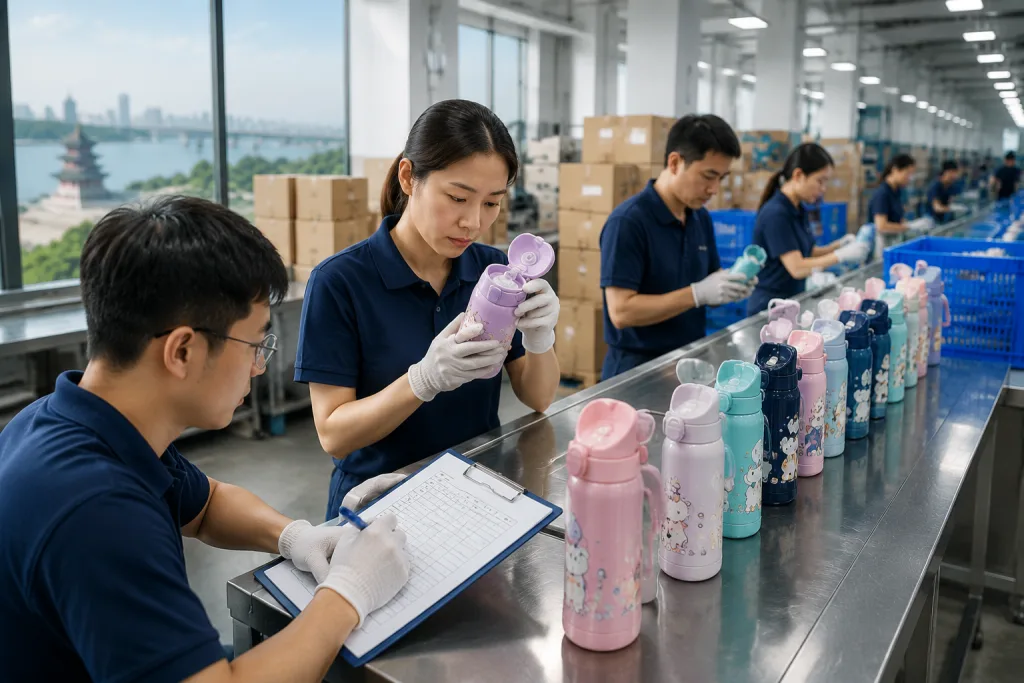
Key Takeaways
- For a custom kids bottle, realistic MOQ is often 3,000-5,000 units per color, with samples ready in 7-10 days and bulk lead time around 30-45 days.
- AQL 2.5 for major defects and 4.0 for minor defects is a common inspection level for B2B custom drinkware orders from China.
- Typical FOB China pricing for a 12 oz stainless kids bottle with straw lid runs about USD 2.80-4.60 depending on steel grade, print method, and packaging.
- REACH, LFGB, CPSIA-relevant component checks, and ASTM-related drop or use testing matter more for kids bottles than for a standard custom canteen.
You are not buying a generic bottle when the user is a child. You are buying a compliance file, a leak-risk profile, a decoration call, and a production schedule that still has to arrive from China in one piece. We have seen this go sideways: a lid passed the bench test, then leaked after a 1.2 m drop test because the silicone ring sat 0.3 mm off groove. That is why picking a kids drink bottle factory is different from sourcing a standard sports bottle or a low-risk promo canteen.
A practical buyer usually starts with a short brief: 12 oz or 14 oz, easy-carry handle, no spill in a school bag, logo on body, and a target landed cost with room for margin. On the line in Zhejiang, that brief turns into 20-plus decisions on straw fit, wall thickness, printing method, carton drop resistance, and MOQ. This is the wrong question to ask if you only ask for the cheapest unit price. If you are new to custom drinkware, run one order from concept to final inspection first; QC pulled the sample, checked torque on the cap, and that small trial order usually tells you more than 3 sales calls.
Start with one realistic order brief
Say you are a North American or European buyer placing a first PO with a kids drink bottle factory in Zhejiang. The item is a 12 oz double-wall stainless steel bottle for kids age 4 to 9, with a flip straw lid, carry handle, powder-coated body, one-color logo, and one kraft box per unit. Target volume is 5,000 units split into 2 body colors. On our line, that usually means 2 powder batches, 2 carton marks, and 1 logo screen if the print stays in one position.
It reads simple on paper. It is not simple in production. A child-use bottle is different from a standard custom canteen or customizable growler because the lid has moving parts, the straw has hygiene risk, and the logo has to survive repeated washing and drops from a school desk. QC pulled a sample last month with a straw bite-valve flash at 0.3 mm, and the buyer flagged it right away. If you sell through a canteen distributor, distributor drinkware channel, or school program, the factory also has to control carton labels, barcode scan accuracy, and retail-pack consistency. This is the wrong question to ask: “Can you make it?” The better question is, “Can you run it clean at 5,000 units without opening new risk?”
- Body material: 18/8 stainless steel inside handles acidic drinks better than low-grade substitutes. We still check the weld area after vacuum with a light test.
- Wall structure: single wall cuts cost but sweats on the desk; double wall gives insulation and better shelf value. For kids bottles, buyers usually pick double wall once they see the condensation issue.
- Lid system: PP lid with silicone seal and PE or silicone straw is common. The hinge pin and seal fit matter more than the catalog photo.
- Decoration: silk screen costs less, while UV print or transfer supports more colors. We normally confirm logo size in mm before screen making so the PO does not come in with a typo.
- Packaging: plain box, color box, or PDQ tray changes unit cost and carton drop risk. A 24-drop carton test tells you more than a nice mockup.
New buyers in China often ask for everything in one shot: low MOQ, full-color print, 10 SKUs, and fast delivery. We ship complex programs from Zhejiang, but the math doesn't work on every combination. If the first PO is 5,000 units, do not break it into 10 colors and 4 lid variants. We have seen this go sideways. Start with 2 colors, 1 lid, 1 print position, 1 carton standard. That gives a canteen manufacturer or canteen supplier a fair chance to hold quality, keep the assembly line stable, and hit the promised ship date instead of turning a 25-day plan into a 40-day cleanup.
Choose materials before discussing logo
Buyers often spend 2 weeks on artwork and 20 minutes on resin, steel, seals, and fit. That order is wrong. On kids bottles, material choice comes first because a compliance failure or drop-test failure found after mass production can burn 12 days fast, and we have seen QC pull lid samples for odor before the logo file was even approved.
A reliable kids drink bottle factory in China should break the bill of materials down line by line, not talk in general terms. For a 12 oz insulated kids bottle, we usually expect the spec sheet to read like this after the line checks wall thickness with an ultrasonic gauge:
- 0.4 mm 304 stainless steel outer wall
- 0.4 mm 304 stainless steel inner wall
- food-contact PP lid
- LFGB-grade silicone sealing ring
- PE or silicone straw
- powder coating at 60-80 micron thickness
If you are sourcing a custom drinkware program for Europe, ask about REACH and LFGB at quotation stage, not after sampling. If the goods are for North America, ask for material declarations and migration or content testing tied to your sales channel. For mass retail, compliance teams often ask for CPSIA-related checks on substrates, coatings, and accessible components. That is standard. We have had buyers flag a straw supplier change at sample stage because the resin grade on the PO did not match the first declaration.
You do not want to discover in week 5 that the straw resin is acceptable for one market but not another. That delay costs more than pushing hard during quotation, and this is the wrong question to ask late.
Buyers also mix up product categories. A custom growler, customized growler, or distributor growler brief usually cares more about body volume and thermal retention. A custom canteen or customizable canteen for general outdoor use often focuses on weight and clip-on carry options. A kids bottle is different: lower open-close force, fewer pinch points, and tighter spill control. We test some lids with torque readings around 1.2-1.5 N·m for easier use by small hands. If a canteen factory says it makes kids bottles, ask for children’s SKUs and test records. A catalog page proves nothing.
At BottleForge Industrial, for example, a practical baseline for custom children’s stainless bottles is MOQ 3,000 units per model with production capacity above 300,000 units per month in Zhejiang, China. That scale matters. Stable material sourcing is easier when we run the same resin, seals, and steel every month instead of buying spot lots for each PO, and the math does not work well when a factory jobs out every small order.
Quote the order the right way
Move from concept to an RFQ a factory can price without guessing. Send only a reference photo and “best price,” and the number will move later after the engineer opens the BOM. We see this every week. A clean RFQ with measurable specs lets the line, purchasing team, and costing staff work from the same sheet:
- capacity: 12 oz or 350 ml
- body size tolerance if fixed by packaging
- single or double wall
- steel grade: 201 or 304 outside, 304 inside
- lid style and straw material
- print method and print area in mm
- unit packaging style
- destination market: EU, US, Canada
- target Incoterm: FOB Ningbo or EXW Zhejiang
For a 5,000-piece order, a realistic FOB China price range for a 12 oz insulated kids bottle is usually USD 2.80 to 4.60. The spread is normal. The wrong question to ask is “what is your lowest price” before the spec is locked. On our side, three items move cost fast: steel specification, lid complexity, and packaging. A plain one-color silk screen with a kraft box can sit near the low end. Add a custom lid color matched on a Pantone chip, full wrap print, and a color gift box with a die-cut insert, and the quote climbs fast. We have seen buyers miss a 0.3 mm wall spec on the drawing, then flag the revised price later.
If you are building a broader line that includes custom canteen, customized canteen, customizable drinkware, or a customizable growler, ask the factory to quote shared components across SKUs. One lid used on 3 bottle bodies usually cuts mold count, spare-part stock, and assembly risk on the line. We ship programs like this often. It matters if you are a canteen distributor, one of several canteen distributors, or a distributor canteen program manager serving multiple private-label clients. The math does work here, but only if the neck finish stays consistent.
Sample cost and development timing
For existing molds with your decoration only, pre-production samples often cost USD 50 to 150 each and can be ready in 7 to 10 days. If you need a new lid mold or a handle change, tooling can range from USD 2,000 to 8,000 and add 20 to 30 days. That timing is real. QC pulled a sample last month because the straw fit was loose by 0.6 mm after a handle revision, and that alone pushed approval back 4 days. Experienced canteen manufacturers in China will usually credit part of tooling back when your volume reaches an agreed threshold.
Do not approve a quote until you confirm spare straws, extra seals, barcode labeling, carton marks, and drop-test packaging upgrades. These are small line items on paper and common fight points later. We have seen a PO typo on carton mark artwork hold a shipment for 2 days, and extra silicone seals added after approval will change both unit cost and carton count.
Approve samples like a quality manager
After the quote is approved, the sample stage is where disciplined buyers split cosmetic approval from engineering approval. You need both signed off. A logo sample tells us little about mass production if nobody checked fit, function, and the paperwork that controls the line.
For a kids bottle sample, test these points before sign-off:
- Leak test: invert for 30 minutes and shake lightly after filling with water. On our side, QC usually sets the sample on clean kraft paper, because one drop shows fast.
- Straw flow: confirm a child can drink without excessive suction force. We have seen buyers flag a soft silicone straw that collapsed after a hot water test.
- Cap action: open-close cycle at least 200 times on sample validation. Count it, do not estimate. This is the wrong question to ask only at mass production stage.
- Coating adhesion: perform tape test and light scratch review. A 3M tape pull and a fingernail check catch issues early.
- Odor: check the lid, straw, and seal after hot water rinse. If the smell stays in the PP lid after 10 minutes, we have seen this go sideways.
- Thermal retention: if insulated, verify against the stated claim using a simple internal protocol. Use the same fill volume each time, not a half-full bottle one day and a full bottle the next.
Ask the kids drink bottle factory to issue a sample approval sheet with photos, dimensions, net weight, packaging spec, and approved Pantone references. If there is any custom print, include logo position dimensions in millimeters, like 32 mm from the bottom weld line and 18 mm off center. We ship against paper. If it is not written down, the line will make its own decision.
This is also the stage to confirm factory process controls. Ask whether they run incoming inspection on steel and plastic parts, in-process leak testing, and final random inspection by AQL. A serious canteen vendor or canteen supplier should answer with numbers, not sales talk. A useful reply sounds like this: 100% vacuum check on insulated bodies, 100% leak test after lid assembly, and final sampling under ANSI/ASQ Z1.4 with AQL 2.5/4.0. QC pulled the sample, measured body height with a digital caliper, and logged the result. That is the level you want.
If you are used to buying generic canteen custom items, this may feel strict. Good. Returns on children’s products get expensive fast, and one leak video in a review thread can hurt more than a shipment that lands 12 days instead of 18.
Control production before it controls you
After sample approval and deposit, bulk production starts. For a 5,000-unit order using standard components, normal lead time from a Zhejiang factory is about 30 to 45 days. If the order includes new tooling, custom PMS-matched powder coat, or peak-season congestion before October, plan on 45 days, not 30. We’ve seen factories promise 18 days for a new custom children’s bottle, and this is the wrong promise to trust. Usually they are skipping pilot checks, pushing work to outside shops, or betting the buyer will absorb a late shipment. On our line, even a new silicone seal mold trial can cost 2 to 3 days if the fit is off by 0.3 mm.
The safest approach is to set clear checkpoints before mass production runs:
- Pre-production meeting: confirm BOM, artwork, carton marks, and test standard. We usually mark this against the signed sample and the latest PO, because one typo in a carton mark can hold the whole batch.
- Mid-line check: inspect body finish, print registration, lid fit, and assembly. QC pulled the sample at this stage more than once and caught logo drift over 1 mm before the full lot was packed.
- Pre-shipment inspection: verify AQL, barcode, assortment, and packing quantity. Count cartons, scan labels, and weigh a few master cartons so the math works before booking.
If you work with several canteen vendors or canteen suppliers, you already know where trouble starts: uncontrolled substitutions. A lid factory sends a similar seal. A straw supplier changes hardness from 60 shore to 70 shore. A coating subcontractor shifts gloss without telling anyone. The buyer flagged one batch like this for odor after opening the lid bag. None of those changes are acceptable without approval when the product is for children. We’ve seen this go sideways fast.
Put that into the PO terms. State that no material, component, sub-supplier, artwork, or packaging change is allowed without written approval. Then ask for the backup documents: material spec sheets, packaging spec, and inspection criteria. We normally tie those to the approved BOM version and sample sign-off sheet, with MOQ and color code listed on the same page so the line does not guess. This matters whether your broader sourcing mix includes customized drinkware, customized growler, custom growler, or standard custom canteen lines.
For buyers shipping to Amazon or major retail distribution, add carton rules early: FNSKU location, suffocation warning if applicable, country-of-origin marking, and carton weight cap. A factory can pass product quality and still miss the inbound appointment because the outer carton is 2 cm oversize or 1.5 kg over the limit. We ship plenty of retail packs, and this is where buyers lose time for no good reason. Set the carton spec before production, not after QC.
Inspect, ship, and manage the first reorder
Before final payment, book the pre-shipment inspection after at least 80% of the goods are packed and sealed. On a 5,000-piece PO, QC usually samples by carton count against the agreed AQL level, and yes, QC pulled the sample from mixed stacks, not just the front row by the warehouse door. Major defects on a kids bottle are clear: leaking lids, missing seals, sharp edges over the parting line, broken hinges, failed print, or the wrong barcode on the unit box. Minor defects are lighter stuff such as scuffs, slight color shift within tolerance, or carton mark misalignment by a few mm.
Your inspection checklist should cover:
- count by SKU and color ratio
- vacuum or insulation spot check
- leak test on random samples
- drop check on packaged unit
- odor review after unpacking
- logo position and print adhesion
- master carton dimensions and gross weight
For logistics, buyers often ship FOB Ningbo because the trucking route from Zhejiang is routine and the port booking options are better. From Hangzhou to Ningbo port, we usually run a same-day or next-day handover depending on the truck slot, and the line cares about cutoff time more than your factory ex-date. US West Coast transit is often 18 to 30 days on water. Europe is usually 30 to 40 days, depending on routing and customs. Build your launch calendar around vessel departure, transshipment risk, and customs clearance. This is the wrong question to ask: “When does the factory finish?” The buyer flagged this before on a PO, booked a promo off the ex-date, and the math didn't work.
The last step gets skipped on too many first orders: the reorder review. After the first shipment lands, collect defect rate, customer complaints, leakage rate, and packaging damage data; on one kids bottle program, the buyer came back with 0.6% leakage and corner crush on 14 cartons out of 312. If field claims are under 1.0% and inspection passed cleanly, lock the BOM and turn the item into a repeatable program. Then widen the range with a canteen customized family, add a customizable canteen size, or build matching distributor drinkware sets for your canteen manufacturer network, canteen distributor accounts, or canteen vendors in different markets. We've seen this go sideways when buyers change the straw, handle, and carton spec all at once on the reorder.
A good first order from China should not feel heroic. It should feel controlled, documented, and boring. On the factory floor, boring means the torque tester reading is stable, the barcode scans, and the pallet count matches the packing list. For B2B procurement, boring is usually profitable.
Send your kids bottle spec for a factory review
Share your target size, MOQ, market, and artwork. We will check feasibility, compliance points, and a realistic FOB quote from Zhejiang, China within 2 business days.
Frequently asked questions
What MOQ should I expect from a kids drink bottle factory in China?
For an existing kids bottle model with standard lid components, a practical MOQ is usually 3,000 to 5,000 units per SKU. Some China factories will quote 1,000 units, but the price often jumps 12% to 25%, and color or packaging options get restricted. If you need a new mold for a lid, handle, or bottle base, factories may ask for 5,000 to 10,000 units to justify tooling and line setup. In Zhejiang, many B2B programs work best when you start with 5,000 units across 2 colors, 1 lid type, and 1 print method. That keeps material purchasing stable and makes QC easier on a first order.
How much does a custom kids stainless bottle usually cost FOB China?
A common FOB China range for a 12 oz or 14 oz double-wall stainless kids bottle is about USD 2.80 to 4.60 per unit at 5,000 pieces. Simple silk-screen decoration, standard PP straw lid, and kraft box keep cost down. Full-wrap print, color-matched molded parts, gift box packaging, and spare accessories push the price up. Single-wall plastic or tritan styles can be lower, while premium insulated versions with special finishes can exceed USD 5.00. Always ask whether the quote includes packaging, extra straws, carton marks, barcode labels, and testing support. Those small lines can change landed margin more than buyers expect.
Which compliance documents should I ask for on children’s drinkware?
Ask for the material declaration and test support based on your market, not a generic statement. For Europe, buyers commonly ask about REACH and LFGB-related food-contact compliance. For North America, importers often request documentation tied to food-contact materials plus checks relevant to children’s products, coatings, and accessible components. If you sell through larger retail channels, also ask about ASTM-related use or abuse testing where applicable to your program. At minimum, request test reports for body material, lid resin, silicone seal, straw material, and finished-product migration where needed. Also confirm factory audit status such as BSCI or ISO-style systems if your compliance team requires it.
How long does a first custom order take from sample to shipment?
If you use an existing mold and only customize color, logo, and packaging, expect about 7 to 10 days for samples and 30 to 45 days for bulk production after approval and deposit. New tooling for a custom lid or handle usually adds 20 to 30 days before bulk can start. During peak season in China, especially from August to November, add buffer for coating lines, packaging suppliers, and vessel booking. A realistic first-order calendar is 45 to 70 days from approved artwork to FOB shipment. If a factory offers much less, ask exactly which steps are compressed, because testing, sample approval, and packaging prep still take real time.
How do I reduce leakage and return risk on a kids bottle program?
Start by validating the lid system, not just the bottle body. Require 100% leak testing after lid assembly and ask for component specs on straw, seal, and hinge parts. During sampling, run your own 30-minute inversion test, repeated open-close cycles, and odor check after hot-water rinse. In production, lock the approved BOM so the factory cannot change seals or straw resin without written approval. For inspection, use AQL with leak test, print adhesion, and packed drop checks included. Many return problems come from tiny component substitutions, not the stainless body itself. For a first order, it is smart to keep to 1 lid structure and 2 body colors until field claims stay below 1%.