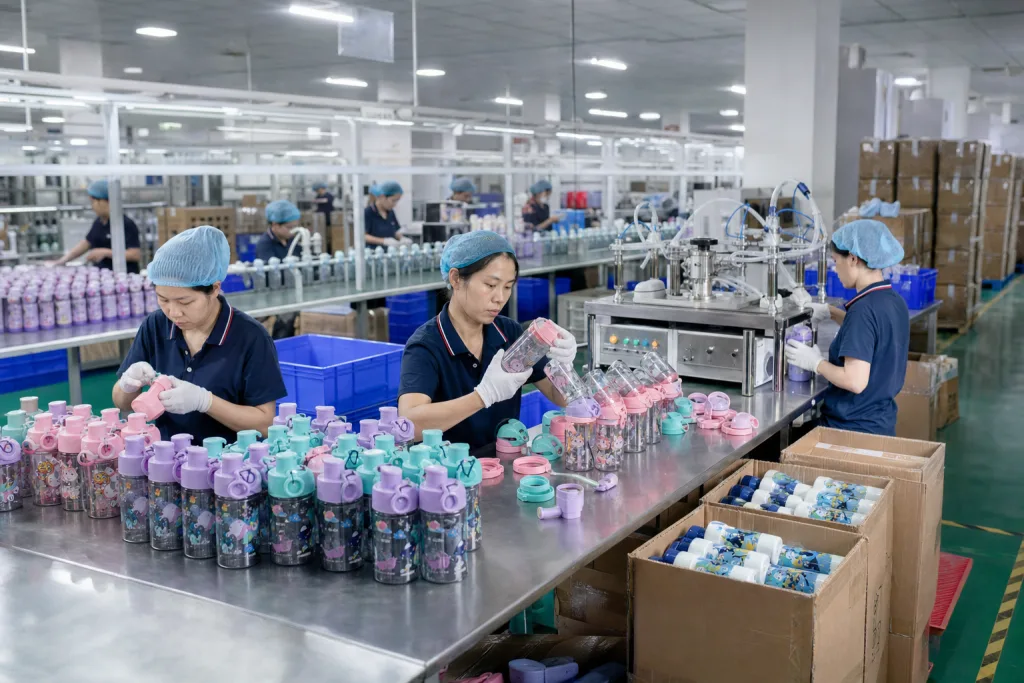
Key Takeaways
- Lock 4 decisions first: material, lid system, decoration method, and packout; changing any of these after sampling can add 12-25 days
- For most B2B programs, MOQ starts around 1,000 pcs per color for stock molds and 3,000-5,000 pcs for new tooling in China
- Use AQL 2.5 for major defects and require 24-hour leak tests plus coating adhesion checks before shipment
- A realistic lead time from Zhejiang factory approval to FOB shipment is 30-45 days for repeat orders and 45-60 days for new custom setups
You do not buy a kid bottle the way you buy a generic sports bottle. A kids drink bottle custom project carries tighter safety targets, less room for leakage, and the usual internal fight over target age, print method, and unit price. We see this on the line all the time. One weak call early on—spout style, coating, logo process, or carton pack—turns into claims, a late launch, or margin loss after QC pulled the sample and found a lid torque gap of 0.3 N·m.
Most buyers coming to Zhejiang or the wider China market already know the basic shape they want. The real job is locking the first 3 specs in the right order, then leaving the right items open until sampling: seal structure, material grade, and decoration position. This is the wrong question to ask if the team starts with "what is the cheapest bottle?" We have seen that go sideways after a PO typo changed 350 ml to 550 ml. If you also buy general custom drinkware, work with a canteen manufacturer, or source through canteen suppliers and distributor drinkware channels, the same logic still applies, but kids bottles punish vague specs faster and usually within the first pilot run of 500 pcs.
Start with the four hard choices
If you want a clean buying process, lock four choices before you ask for final pricing. First is body material: stainless steel, Tritan, PP, or glass with sleeve. Second is lid architecture: straw lid, flip spout, screw cap, or push-button. Third is branding method: silk screen, heat transfer, digital print, or laser on metal parts. Fourth is packout: polybag, egg-crate divider, white box, PDQ, or retail gift box. We run this check at RFQ stage because once the sample room cuts a new insert, even a 2 mm logo shift starts costing money.
These four decisions set the numbers fast: unit cost, testing scope, drop resistance, leak rate, carton size, and production speed. Buyers still send the same sketch to ten canteen vendors before they freeze the basics. This is the wrong question to ask. You get ten quote sheets, but they are not lined up on the same spec, so the math doesn't work. Last month a buyer flagged one “high” offer, then we found it included LFGB testing and a 24-hour leak test, while two cheaper quotes did not.
For example, a 350 ml single-wall Tritan kids bottle with a straw lid may land around USD 1.65-2.40 FOB China at 3,000 pcs depending on decoration and packaging. A 316-inner stainless vacuum bottle in 350 ml with a lock lid may run USD 3.80-5.90 FOB at the same volume. That gap is normal. On the line, the vacuum body adds welding, vacuuming, and heat retention checks, while the Tritan version moves faster through assembly. Both are valid. They solve different problems.
- Material affects odor resistance, weight, and durability. A 350 ml Tritan body often ships about 120-150 g lighter than stainless.
- Lid system affects leakage risk and replacement part complexity. QC pulled the sample on one push-button lid because the spring was out by 0.3 mm.
- Decoration affects scratch performance and color consistency. We have seen digital print Delta E drift get flagged against a tight Pantone target.
- Packout affects freight cost and retail readiness. A retail gift box can push carton cube up enough to change the freight math.
If you already source customizable drinkware, custom canteen, or even customizable growler projects, you know tooling changes get expensive once artwork and cartons are approved. We have seen this go sideways over small things, like a PO typo on lid color or a barcode moved after the white box dieline was signed. In Zhejiang, most disciplined factories will push you to freeze these four first because it saves both sides time. That pushback is correct.
Choose material by age and use case
Material choice starts with the child’s age and the way the bottle gets used on the ground. Trends do not matter much here. A nursery SKU that gets dropped off a 0.75 m desk has different needs than a school bottle stuffed into a backpack with books. For younger children, buyers usually ask us for lower unit weight, easier one-hand use, and fewer dent claims. That is why we run a lot of Tritan or PP bodies with silicone seals. For premium school lines or gift programs, stainless steel sells better because it holds temperature and looks stronger on shelf. This is the wrong question to ask: “Which material is best?” The better question is which material-lid setup gives you the fewest complaints after 6 months.
Tritan or copolyester fits 350-500 ml bottles when you need a clear body, lower freight weight, and mid-market pricing. Typical wall thickness is 2.0-2.5 mm, and QC usually checks the gate area first for stress marks after drop testing. It is a poor fit if your market expects long insulation hours; the math does not work. PP is usually cheaper, but buyers should check odor retention and hand feel, because we have had buyers flag a “plastic smell” after sea transit. 304 stainless steel is the standard option for insulated bottles, and some buyers ask for 316 inner wall where juice, milk, or tougher water specs are a concern. Common wall thickness is 0.4 mm inner / 0.5 mm outer for vacuum bottles, and the line usually checks weld consistency at the bottom before vacuum sealing.
If you are buying from a canteen factory or comparing canteen manufacturers in China, ask these questions at RFQ stage, not after the PO is issued. We have seen this go sideways when a buyer approved the drawing but missed the straw material callout.
- Which food-contact materials are used for body, straw, gasket, and mouthpiece?
- Can the supplier provide REACH, LFGB, FDA, or CPSIA-related test support depending on your market?
- What is the bottle weight tolerance, for example plus or minus 3%?
- Has the mold been running for more than 50,000 shots, or is it a fresh tool?
For Europe and North America, match compliance to the destination market instead of accepting a generic “food grade” line on a quote sheet. A serious canteen supplier in Zhejiang should explain this clearly. We ship to both regions, and the document set is not the same. If a supplier cannot explain the difference between a raw-material declaration and finished-product testing, treat that as a warning sign. Last month, QC pulled the sample from one project because the test file covered the resin only, not the final straw assembly.
For kids lines, the safest commercial choice is usually not the cheapest material. It is the material-lid combination with the lowest return rate.
Lids decide your complaint rate
Buyers usually stare at the bottle body first because that is what sits on shelf. On the line, lid issues create more claims. We have seen a clean 304 stainless body pass final check, then fail the program because the straw seat was 0.3 mm loose or the lock button stuck after assembly. That is the wrong place to save cost. the lid system decides your complaint rate more than the bottle body does.
For kids bottles, the usual options are straw lids, flip-up spouts, screw caps, and one-touch lock lids. Straw lids sell well for ages 3-8 and are easy for kids to use, but the part count goes up fast: straw tube, bite valve or nozzle, gasket, hinge, and sometimes a carry handle. More parts mean tighter tolerance control, and we have seen this go sideways when one silicone gasket runs 0.2 mm thin. Screw caps are simpler and usually leak less. Some retail buyers still push back and say school kids want one-hand use.
Ask your canteen customizable or canteen customized supplier for actual test standards, not sales talk. QC pulled the sample and the test sheet should show:
- 24-hour inverted leak test
- 1 m drop test with water fill
- Handle pull test, often 5-10 kg force
- Button life test, often 3,000-5,000 cycles
- Straw insertion and pull force check
If the project will run through a canteen distributor network or to canteen distributors serving schools, replacement parts need to be discussed early. We usually quote spare straws or gaskets at 1-2% of order quantity, packed by inner bag with lot code. One buyer flagged this only after the PO was issued, and then the carton count changed. That small add-on saves a pile of after-sales emails.
We usually tell new buyers to accept a slightly higher lid cost if it removes one repeat failure point. The math doesn't work the other way. Paying USD 0.08-0.18 more for a better seal, a thicker hinge pin, or a stronger carry loop is often cheaper than returns, replacement freight, and school-channel complaints. We ship this way across a customized canteen program, a customized growler order, or a full line of customized drinkware from China.
Decoration and packaging shape the margin
Decoration is where margin gets won or lost. Marketing wants shelf pop; the line pays for it later if the artwork is too fussy. On kids bottles, bright graphics do sell, but tight registration on a curved body can push reject rate from 2% to 6% in one run. We’ve seen this go sideways. The better question is not “what looks best?” It is “what still looks clean after shipping, dish rack bumps, and 3 months of school use at an acceptable defect rate?”
On stainless bottles, powder coating plus silk screen is still the commercial standard on the programs we run, usually with artwork positioned off the weld line by 8-10 mm. Digital print handles gradients and more colors, but ask for scratch test data and lot-to-lot color shift, not just a nice sample photo. QC pulled the sample on one order last year because the panda blue drifted against the approved Pantone. On Tritan or PP, pad print and silk screen are still the usual choice for simpler graphics. Full-wrap heat transfer looks strong on shelf. The math doesn’t work on every project, because scrap and unit cost climb fast.
Typical adders you may see from a canteen manufacturer or canteen vendors in China:
- 1-color silk screen: USD 0.05-0.12 per bottle
- Laser marking on metal part: USD 0.03-0.08
- Heat transfer wrap: USD 0.18-0.45
- Individual white box: USD 0.18-0.35
- Retail color box with insert: USD 0.35-0.90
Packaging shifts margin faster than new buyers expect. A standard export pack may fit 24 pcs per carton, while a gift-box program can drop to 12 pcs; that change hits freight cost per unit right away and usually adds carton size testing. We ship plenty of promo orders where a plain box plus barcode label is enough. Retail is different. The buyer flagged one PO because the outer carton BMC dropped below target after the insert design changed, so drop resistance and shelf presentation both had to be reworked.
This is where experienced distributor canteen buyers usually beat new importers. They ask for carton dimensions, net and gross weight, barcode placement, FNSKU needs, and pallet loading before artwork sign-off, sometimes before the first pre-production sample. That saves time. It also avoids silly mistakes, like a PO typo on barcode orientation that forces 3,000 labels to be reprinted. That discipline matters just as much on a customizable canteen project as on a custom growler line.
MOQ, tooling, and lead time realities
A lot of sourcing trouble starts with bad MOQ and timing assumptions. On our side in Zhejiang, if you run an existing bottle body, a stock lid, and just add a logo, the normal opening point is 1,000 pcs per color on selected models. That is workable for most test orders. Once the buyer asks for a new lid, a swing handle, or a fresh bottle outline, the job moves to tooling fast. We have seen this go sideways over a 0.3 mm lid-fit change that looked small on the drawing but needed a new mold insert.
New injection molds for lids or cap parts can cost anywhere from USD 2,000 to 12,000 depending on complexity and cavity count. Blow molds or stainless forming tools add more. This is why “test the market” and “build an exclusive program” should be priced as two different projects; the math does not work if you mix them. For a first PO, we usually push buyers to stay on an existing platform and put the budget into graphics, packaging, and compliance instead of fresh tooling.
Lead time needs clean inputs too. For a lot of kids drink bottle custom orders, we see buyers ask for “as fast as possible.” Wrong question. The line runs to approvals, not hope, and one missed barcode on the carton file can burn 3 days. A normal schedule looks like this:
- Sample revision: 7-12 days
- Artwork and carton approval: 3-5 days
- Material prep: 7-10 days
- Mass production: 20-30 days
- Inspection and booking: 3-7 days
In real terms, a stock-based custom program usually lands at 30-45 days. If packaging, components, or tooling get heavier, you are usually at 45-60 days. A factory in China promising 15 days for everything is often chasing the PO first and solving the schedule later. QC pulled one order last season where the approved print file and the cup body color chip did not match, and that alone pushed shipment from 12 days to 18 days.
If you buy through canteen suppliers, canteen vendor groups, or distributor growler channels, check who actually controls the production slot. A trader is fine if the chain is clear. If not, you will not know where your order sits when peak season hits. A solid plant should give you a hard number like 300,000 units per month across bottle lines, plus a straight answer on peak loading, line count, and MOQ by model. We ship programs where the buyer flagged “factory direct” on the PO, but the goods were still queued behind two other accounts because no slot was reserved.
Quality control should be written, not implied
Quality control should look boring in writing. That is the point. Do not accept loose wording like “same as approved sample” or “export standard.” Put the checkpoints into the PO, artwork approval, and inspection protocol, line by line. We have seen one PO carry a typo on lid gasket color, and 6,000 pcs ran in the wrong shade before the buyer flagged it. This matters even more when you buy from multiple canteen manufacturers or split customized drinkware and accessories across two suppliers. If it is not written, the argument starts at shipment time.
A workable B2B QC setup for kids bottles should cover 3 stages: incoming material check, in-line inspection on the line, and final random inspection before loading. At shipment stage, plenty of buyers use AQL 2.5 major / 4.0 minor, with zero tolerance for critical defects. Write down what “critical” means instead of assuming both sides read it the same way: leakage, sharp edges over a 0.5 mm burr, accessible loose small parts where relevant, wrong material declaration, mold contamination, or failed odor testing. QC pulled a sample last month with silicone smell after sealing; the math does not work if that issue is found after carton sealing.
Ask your canteen supplier or canteen factory to document:
- Vacuum retention test for insulated models, with target hours and test temperature written on the report
- Coating adhesion cross-hatch or tape test, including the test method used on the painted body
- Dishwasher claim validation if marketed as dishwasher safe, such as cycle count before print loss
- Weld quality and bottom stability, checked on a flat plate so rocking is caught early
- Color tolerance against approved PMS reference, not “close enough” under mixed lighting
- Barcode scan rate and carton mark accuracy, because one wrong digit can hold 1 pallet
If your goods are going to Amazon, school retail, or mass market, add packaging checks to the same file. A bottle can pass function inspection and still miss shipment over the insert. We have seen cartons stopped for missing warning text and for French copy that did not match the approved artwork. If you source broader custom drinkware, a customized growler, or a custom canteen family from China, use the same rule across every SKU: bottle, lid, straw, insert, carton. This is the wrong question to ask: “Is your quality good?” Ask what gets checked, how often, and who signs it.
Ask about factory systems too. BSCI, ISO 9001, and third-party social audits do not guarantee perfect product quality, but they do show whether the supplier already runs with structured customer documents, revision control, and traceable records. On our side, that usually means lot coding back to material batches and a signed inspection sheet at each station. That matters once orders move from 1,000 pcs trial runs to 20,000 pcs repeat orders.
How to compare suppliers without wasting months
The market is crowded, and half the labels are marketing. One company calls itself a canteen manufacturer, another a canteen distributor, another a distributor drinkware specialist, and another a canteen vendor. We do not judge by the title. We check who owns the mold, who runs the line, who books the lab test, and who pays if QC pulled the sample and found a lid leak at 0.2 bar. This is the right question to ask.
If you are comparing suppliers in Zhejiang or other parts of China, keep the scorecard tight. Use five weighted criteria: spec accuracy, speed, transparency, quality discipline, and landed cost. We usually tell buyers to score each one out of 20, for a 100-point sheet. Low price should not beat weak answers on materials, testing, or production control; the math does not work if the PO misses a 3 mm straw length change and you lose 18 days on a remake.
Use a simple supplier scorecard
- Specification control: Did they quote against your exact drawing, capacity, and package, or did they send a standard 500 ml option that does not match the file?
- Response quality: Did they answer with measurements, tolerances, and test plans, or only with sales language and no wall thickness data?
- Sampling discipline: Were revisions tracked clearly with dates and comments, with sample V1, V2, V3 marked on the carton and seal ring update noted?
- Commercial clarity: Are mold cost, sample refund terms, and FOB terms explicit, down to carton size, MOQ 3,000 pcs, and who pays courier on approval samples?
- Risk handling: Can they support REACH, LFGB, ASTM, CPSIA-related workflows where needed, and show which test item goes to which lab?
A buyer new to kids drink bottle custom does not need 50 suppliers. You need 3 serious quotations, 1 approved golden sample, and 1 written QC standard. That is enough. We have seen this go sideways when a buyer keeps collecting catalogs for 6 weeks but never locks the spout hardness spec or drop-test method.
If you later expand into canteen custom, customizable growler, or a broader line of customizable drinkware, keep the same discipline. Strong sourcing is not about collecting catalogs. It is about cutting unknowns before deposit, tooling, and ship date are locked. On our side, that usually means one signed sample board, one packaging mockup, and one AQL 2.5 inspection sheet before we ship.
Get a workable kids bottle sourcing spec fast
Send your target capacity, lid style, artwork, and quantity. We will review MOQ, compliance points, and FOB options from our Zhejiang, China production team.
Frequently asked questions
What is a realistic MOQ for kids drink bottle custom orders?
For stock molds with custom logo and standard colors, a realistic MOQ is usually 1,000 pcs per color or 3,000 pcs total, depending on the bottle and lid combination. If you need a new mold, special Pantone matching, or retail gift box packaging, MOQ often moves to 3,000-5,000 pcs. Stainless insulated models with multiple painted parts may require higher MOQ than simple Tritan bottles because setup and color batching are more expensive. In China, some Zhejiang factories will accept lower trial quantities, but the unit price can increase by 8-20%. If a supplier offers very low MOQ with fully custom tooling, check whether they are quoting a sample-stage promise rather than a production reality.
Which material is best for a custom kids bottle: Tritan, PP, or stainless steel?
It depends on your channel and price target. Tritan is often the best balance for lightweight school bottles in the 350-500 ml range. It gives good clarity, lower freight weight, and FOB pricing often around USD 1.65-2.40 at mid volumes. PP can reduce cost further, but buyers should check odor retention and visual quality carefully. Stainless steel is the premium choice when you want insulation and higher shelf value; expect roughly USD 3.80-5.90 FOB for many vacuum models at 3,000 pcs. For B2B buyers in Europe and North America, the best material is the one that meets your compliance needs, survives your claim environment, and fits your target margin after packaging and freight.
How do I reduce leakage complaints on kids bottles?
Start with lid design, not the bottle body. Specify a 24-hour inverted leak test, a 1 m drop test with water fill, and button or hinge cycle testing of at least 3,000 cycles. Ask the factory to confirm gasket material, straw fit tolerance, and handle pull strength, usually 5-10 kg force. For first production, request spare seals or straws equal to 1-2% of order quantity. Also define what counts as a critical defect in your AQL standard. Many buyers save only USD 0.05-0.10 per unit by choosing a cheaper lid, then lose far more in returns. If you are using a canteen supplier or canteen distributor, make sure they can trace which factory built the lid components.
What tests and certificates should I ask a China supplier for?
Ask for documents tied to your destination market, not generic claims. For Europe, buyers often discuss REACH and LFGB-related testing paths. For the US, FDA food-contact support may be relevant, and some programs also look at CPSIA or ASTM workflows depending on product positioning and packaging. Beyond compliance paperwork, ask for finished-product tests: leak test, drop test, coating adhesion, odor check, vacuum retention for insulated models, and barcode verification if retail packed. If the supplier says 'food grade' but cannot explain material declarations versus finished-goods testing, that is a problem. BSCI or ISO 9001 are useful factory system indicators, but they do not replace product-specific test reports.
Should I buy direct from a canteen factory or through a trading company?
Both models can work, but you need role clarity. Buying direct from a canteen factory often gives better control over lead time, engineering changes, and QC feedback. It also helps when you need repeat orders, spare parts, or mold maintenance. A trading company can still be useful if they manage multiple factories well and consolidate custom drinkware programs, especially if you also buy custom growler or custom canteen products. The key questions are who owns the tooling, who books the production slot, who handles testing, and who pays for remake risk. If the seller cannot answer those directly, you may face delays or finger-pointing later. For larger programs, insist on knowing the actual factory location in Zhejiang or elsewhere in China.