Key Takeaways
- Set leakage, coating, and odor standards before sampling; 0.65% AQL major defects is cheaper than a 5% return rate
- Typical MOQ for kids drink bottle bulk is 1,000-3,000 pcs per color, with 30-45 day lead time after sample approval
- A $0.18 cheaper bottle can become $0.60 more expensive after rework, air freight, and retailer chargebacks
- For Europe and North America, confirm REACH, LFGB or FDA contact compliance, and ASTM/CPSIA points before mass production
You rarely lose money on a kids drink bottle order from one big disaster. It usually leaks out in small, dull places: a straw starts dripping after 3 days, the lid color is off by 1 shade between batches, the logo fails after 20 dishwasher cycles, or the master carton comes in 8 mm taller than plan and your freight rate jumps. We ship this every week. The real issue in kids drink bottle bulk buying is that the quoted unit price looks clean, then production waste, QC sorting, and after-sales claims start eating margin. We’ve seen this go sideways over a typo on a PO color code.
For buyers in Europe and North America, the fix is simple on paper and strict on the line. If you source from Zhejiang or another China base, you need a tighter spec sheet than you would for standard bulk drinkware. Kids products are less forgiving, and this is the wrong question to ask if you only focus on FOB price. A factory running 600,000 units/month can still ship avoidable defects if your tolerance, test method, packaging callout, and compliance points are vague. QC pulled the sample once on a lid fit issue at 0.3 mm, and the buyer flagged it right away.
Where kids bottle orders fail first
The first place these orders fail is a bad assumption: a kids bottle is not just smaller drinkware bulk. It runs differently on the line. A kids lid usually has 3 to 5 assembled parts, more mouth contact, and takes harder abuse in real use—bags, desks, floor drops. If you also buy canteen wholesale, bulk canteen, or wholesale drinkware for adult programs, do not copy that QC sheet over. We’ve seen this go sideways. The complaint map is different.
The most common production failures are predictable:
- Straw or spout leakage when bottles are tilted in school bags
- Weak handle joints breaking after drop tests
- Paint chipping on powder-coated bodies after transport abrasion
- Odor complaints from silicone parts after first wash
- Thread mismatch between lid and body from mixed tooling lots
- Retail pack damage because inner trays are too thin for parcel handling
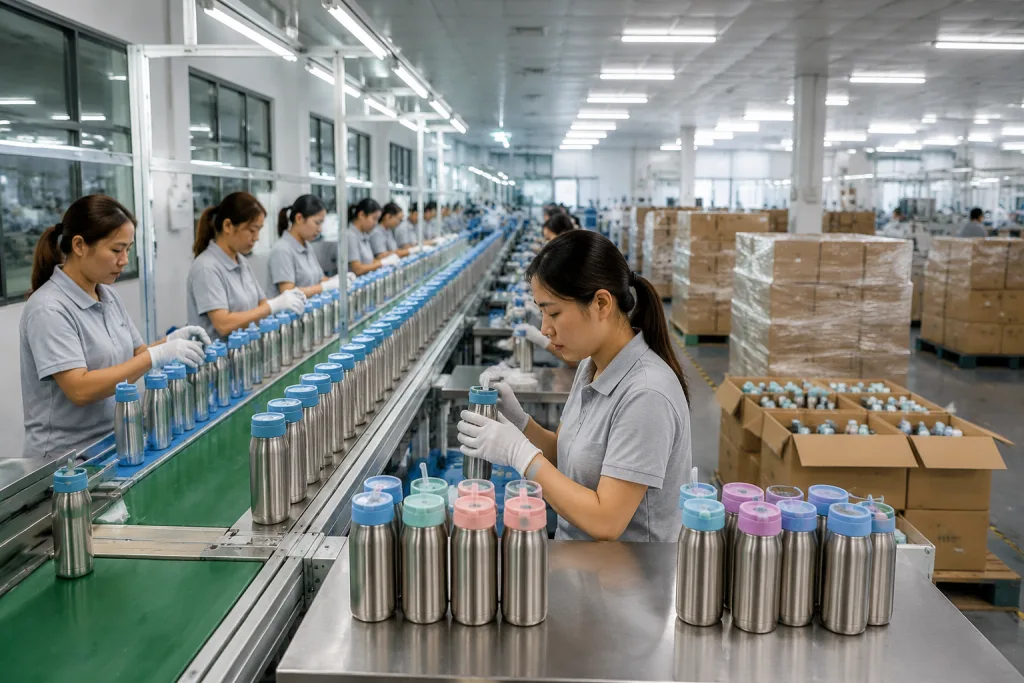
In China, especially around Zhejiang, a lot of factories run stainless vacuum bodies well but get loose on accessory control. That is where claims start. On one project, QC pulled the sample and the 0.4 mm 18/8 stainless body was fine, but the PP lid, TPE mouthpiece, and silicone seal stack-up was drifting by 0.3 mm between tooling lots. Small number, big headache. Most returns come from the lid assembly, not the bottle body, and this is the wrong question to ask if you only compare steel grade.
If you are buying a broader line that includes wholesale canteen, growler bulk, wholesale growler, or even beer tumbler bulk, split your approval process by use case. Kids SKUs need their own checks for bite resistance, leak testing, and small-part risk review. We usually ask buyers to approve a defect library during sampling: real photos of lid gaps, Pantone shift, burrs at the straw hole, and off-center logos. One buyer flagged a PO typo that mixed two lid versions, and the thread fit issue showed up 12 days later at assembly. Get the defect limits agreed early, or the acceptable/not acceptable argument starts after goods are packed.
When a supplier says “same as previous order,” ask which previous order: adult sports bottle, canteen bulk, or children’s straw bottle. In QC terms, those are different product families.
Leakage is usually a spec problem
Buyers often call leakage a workmanship issue. Sometimes QC did miss it on the line. More often, the problem starts in the spec sheet. If your PO only says “leakproof lid,” that tells the factory nothing a technician can test. For kids drink bottle bulk, write the method, pressure, time, and pass standard into the order. This is the right question to ask.
A practical leakage spec looks like this:
- 100% inline air-pressure or vacuum check for assembled lids
- Sample water inversion test: 70 kPa internal pressure, 5 minutes, zero visible leakage
- Tilt test at 45 degrees for 30 minutes after hot water fill
- Drop test from 1.0 meter, 3 orientations, then repeat leakage test
You also need to lock down the sealing material. Silicone hardness in the 50-60 Shore A range is common, but the final point has to match the groove design and compression gap. We check this with a Shore A durometer and a cut sample from first article. Too soft, and the ring rolls during assembly. Too hard, and seal compression drifts lot to lot. We have seen PSI pass, then 12 days later the buyer flags leaks after school use because the gasket took a set.
Ask how the straw housing is built: ultrasonic welding, overmolding, or mechanical snap-fit. The risk is different for each process. Snap-fit is cheaper, but tolerance stack-up gets touchy once the lid body, straw seat, and silicone parts all meet in one assembly. If your MOQ is 2,000 pcs per color and your quoted FOB Ningbo price is USD 2.35 versus USD 2.58, the saving is only USD 460. The math doesn't work if one retailer chargeback hits the shipment. QC pulled the sample on one run last year because a 0.15 mm rib variation was enough to open a leak path after drop test.
This matters more if you source mixed categories like drinkware wholesale, bulk growler, and beer growler bulk from one vendor. A supplier can be strong on stainless body production and still outsource lids to another workshop 40 km away. We have seen this go sideways. You need to know who owns the lid tooling and who does 100% assembly inspection. For a children’s program, require a golden sample signed against lid torque, straw fit, and seal compression dimensions. Put the torque range in writing too—on sport lids we often run 0.8-1.2 N·m as the control point.
Coatings, colors, and logos go wrong quietly
Another expensive failure shows up in bulk, not in the sales sample: cosmetic drift. We see this all the time on kids bottles. Color is a buying trigger, and retailers flag mixed shades fast, sometimes on one pallet of 1,200 pcs. On stainless bodies, powder coat thickness is typically around 60-80 microns. Below that, edges start flashing silver after a tape pull or carton rub test. Above that, threads drag and lid fit gets tight; on our line, QC pulled a sample at 88 microns and the cap torque was already off.
Your spec should name the finish and the test method, not just “blue” or “matte pink.” Use Pantone references where possible, then set acceptable variation under D65 light and write the limit into the PO. A handheld color meter beats arguing over photos on WhatsApp. For logos, pick the process by sales channel and artwork detail:
- Silkscreen: lower cost, usually USD 0.05-0.12 per color, good for simple art and solid spot colors; MOQ is easier to manage on repeat orders
- Heat transfer: better for multi-color graphics, but test adhesion carefully after curing and after 50 wash cycles; we have seen small character edges lift first
- Laser engraving: durable on stainless, less useful for bright kids branding; good for premium lines where the buyer wants a clean metallic mark
Dishwasher claims get handled badly. “Dishwasher safe” is the wrong question to ask. Ask for the exact method: top rack or bottom rack, water temperature, detergent type, and how print loss gets judged. Ten cycles means little. Fifty cycles is a more realistic screen for print loss. We ship against written standards because one buyer once approved a sample, then rejected bulk after 12 cycles with a citrus detergent the factory never tested. The same discipline applies if you also buy beer tumbler wholesale, beer tumbler in bulk, or best wholesale drink bottle programs with shared decoration vendors.
In Zhejiang, coating lines vary a lot. One month the factory runs clean and steady; next month, in peak season, curing time gets cut by 3-5 minutes and the problem stays hidden until cartons reach the warehouse. You get good gloss and weak adhesion. We have seen this go sideways. Add a cross-hatch adhesion test and a transport abrasion check to your QC plan. Put logo position tolerance in millimeters, not “centered”; ±1.5 mm is clear, and the line can check it with a jig. If your brand has licensed artwork, approve color chips before bulk, not after the first 200 pieces are already packed.
This is where experienced buyers separate a sample-room promise from a production standard. Your PO should say what happens if ΔE is outside tolerance, if logos ghost, or if matte texture shifts lot to lot. We have even seen a PO typo turn “cream white” into “clear white,” and nobody caught it until the first approval sample hit the table.
Material compliance can derail the whole PO
For kids drink bottle bulk, a compliance miss shuts down the PO fast. We have seen one missing LFGB item on a silicone straw hold a container for 12 days at destination, then add retest fees and relabel work. If you sell into Europe, ask for REACH screening and, where relevant, LFGB contact compliance. For North America, FDA food-contact expectations are standard, and children’s item programs may need ASTM and CPSIA-related review based on the lid design, printed parts, and age grading on the artwork. This is the wrong question to ask: “Is the bottle food safe?” Ask which exact parts were tested, on which date, against which BOM revision.
The weak point is usually not the stainless steel body. On our line, QC pulled the sample and the body passed, but the name-label ink failed migration on a 2-color print run. The risk sits in the accessory pack: silicone straw, PP lid, TPE bumper, printed pouch, or decorative label. A clean 18/8 bottle does not save the project if one soft part fails. The same issue shows up in adjacent categories like alcohol flask bulk, alcohol flask wholesale, alcohol flask wholesale bulk, beer growler wholesale, and growler wholesale. Buyers often focus on the metal shell and miss the coating, seal ring, or print. We have seen this go sideways more than once.
Set three rules early:
- No material substitutions after sample approval without written sign-off
- All test reports must match the final BOM, color, and production date
- Lab reports from old adult bottle programs cannot be reused for a kids SKU
Ask about BSCI or a similar social compliance audit at the start if your retail customer requires it. It is not a product test, but it still blocks onboarding; one buyer flagged this after the PO was already typed, and the factory code on the form did not match the audit file. A reliable China supplier should provide ISO-managed process records, recent audit status, and a BOM that matches the shipment carton by carton. We usually check this back to supplier lot numbers on the silicone and lid resin. If the factory cannot trace a silicone lot to the finished production lot, traceability is weak. Then a claim lands 4 months later, and the math doesn't work.
Packaging mistakes destroy landed cost
Buyers miss the real cost on kids drink bottle bulk when packaging gets decided late. We see this on the line all the time: approval drags, then the factory falls back to a plain white box, carton size is guessed, and freight math breaks. Unit price looks clean. Landed cost does not.
Start with the sales channel, not the bottle. A club-store 2-pack, a specialty retail gift box, and an Amazon FBA unit pack are three different jobs, and this is the wrong question to leave until after mold approval. For DTC, ask for shipper drop performance, barcode position by mm, suffocation warning copy, and FNSKU labeling if applicable. QC pulled a sample last month where the FNSKU covered the age-grade icon, and the buyer flagged it before booking. For wholesale, carton consistency and pallet stacking matter more than a glossy insert.
A practical carton spec includes:
- Master carton gross weight under 12 kg for easier handling
- 5-ply export carton with burst strength matched to stacking load
- Divider or molded pulp where painted surfaces can rub
- Carton drop test and seal tape standard defined before mass packing
This matters even more if your container also includes canteen bulk, drinkware wholesale, wholesale growler, beer growler in bulk, or alcohol flask in bulk. Mixed-SKU loading looks efficient on paper. We have seen it go sideways once carton footprints drift by 20 mm to 30 mm and the stack starts wasting cube. A USD 0.07 saving on inner packaging can turn into a freight penalty if your carton dimensions move from fitting 2,400 pcs in a 40HQ down to 2,080 pcs.
Ask your Zhejiang supplier for packed carton dimensions during quotation, not after deposit. We usually send outer carton size, gross weight, and loading count for 20GP, 40GP, and 40HQ with the first quote, because the math does not work without pack-out. A decent factory should also suggest simple fixes, like changing the insert thickness or carton orientation, without exposing the product. If they quote bottle size only and skip packed dimensions, they are quoting too early.
Sampling that looks good but proves nothing
A lot of failures start at sampling. The buyer signs off on a clean-looking pre-production piece, but that bottle was hand-touched at the sample bench, not run on the line at normal speed. That is where problems hide: loose hinge pins, uneven powder coat around the shoulder, seal flash at 0.3 mm, and logo drift after curing. For kids’ articles, this is where claims begin. We have seen this go sideways.
Use a staged approval path:
Reference sample
Check shape, capacity, basic usability, and target FOB cost. Think of this as an appearance and direction sample only. It is not enough for final approval, even if the buyer flagged “looks perfect” on the first photo set.
Pre-production sample
Built with actual tooling, final materials, and intended decoration process. This sample should come off production-style equipment, not just hand assembly with bench fitting. Test this one for leakage, odor, abrasion, and drop resistance. QC should pull the sample after normal curing and assembly, not after extra polishing.
Mass-production sample
Taken from the first production run and approved before the balance continues. We usually ask for pieces from the first 300 units, because that is when you catch fit issues fast—before 5,000 pcs stack up behind the capping station.
For a lot of programs, lead time is 7-10 days for stock-color samples, 12-15 days for custom logo samples, and 30-45 days for bulk after approval. Standard MOQ is often 1,000 pcs per color for existing molds and 3,000-5,000 pcs if you need unique lid colors or packaging formats. If a supplier promises custom tooling, custom color, and retail packaging in 18 days, be skeptical. The math does not work. Tool trial, color matching, and carton proofing alone can eat 8 days.
This applies to related categories too, whether you buy beer tumbler wholesale bulk, beer growler wholesale bulk, or alcohol flask wholesale bulk. Always ask which parts are made in-house and which are subcontracted. This is not a small detail. A factory may run stainless body forming in-house but send lid assembly outside, and that changes control points at pilot run. We ship plenty of programs like this, and the buyer pushback is usually the same: “Why did the sample seal fine, but bulk leaks?” That is the wrong question to ask. Ask where each part was made and assembled.
The purchase order must carry the engineering
The last failure mode is simple: the team relies on old email threads instead of putting the real engineering into the PO and QC file. For kids drink bottle bulk, the PO should work like a control sheet on the line, not a loose price confirmation. We have seen this go sideways when a buyer approved a 3 mm logo shift in chat, but the printed PO never showed the tolerance. Most factory disputes in China start there. The spec was discussed, then lost.
Your PO package should include:
- Approved artwork with dimensions and logo position tolerances, such as +/- 1.5 mm from the centerline
- Material callouts for body, lid, straw, seals, and bumper, for example 304 stainless body and food-contact silicone seal
- Color references for each molded and coated part, tied to Pantone or signed chip samples from the line
- Packaging layout, carton marks, and barcode rules, including scan direction and master carton drop height
- Inspection plan with AQL levels, usually 2.5 major and 4.0 minor, or tighter if needed
- Performance standards for leakage, drop, odor, and coating adhesion, with the actual test method written in
For a high-stakes order, run pre-production inspection and final random inspection. That is the safe setup. For retailer programs, buyers often work to AQL with zero tolerance for critical defects, especially sharp edges, accessible small parts, or contamination. QC pulled the sample more than once for a burr at the straw bite area, and that single point matters. A late claim on one children’s SKU can damage your broader wholesale drinkware business, including bulk growler programs, wholesale canteen lines, and beer tumbler wholesale assortments.
A capable supplier in Zhejiang should take this documentation without drama. It protects both sides. If a factory pushes back on test methods, carton specs, or defect criteria, this is the wrong question to ask: "Why are they being difficult?" Better ask what they are trying to leave open after deposit. We ship cleaner projects when the PO locks carton size, barcode placement, and defect photos up front. Last month a buyer flagged a PO typo on carton mark wording after sampling, and fixing it then cost one day; fixing it after 5,000 sets were packed would have cost a week.
That is the difference between a smooth reorder and a project that keeps burning management time long after the container leaves China. Boring production wins. We run for repeatable QC and shipment dates you can trust.
Need a tighter kids bottle sourcing spec?
Send your target size, lid style, compliance market, and order quantity. We will review MOQ, factory risk points, and a practical QC checklist for your China program.
Frequently asked questions
What MOQ should I expect for kids drink bottle bulk?
For existing molds, a normal MOQ is 1,000 to 3,000 pcs per color per size. If you need custom lid color, retail gift box, or new accessory tooling, MOQ can move to 3,000 to 5,000 pcs. Some China factories quote 500 pcs, but that is usually for stock parts with very limited customization. If your program includes custom Pantone matching, printed straws, or mixed carton assortments, ask whether MOQ applies by body color, lid color, or total order quantity. Those are not the same thing. Also confirm whether sample costs are refundable against the bulk order. A low MOQ with weak process control is rarely a bargain in children’s drinkware.
How do I reduce leakage claims before mass production?
Do not rely on a general “leakproof” promise. Put a leakage protocol into the approved spec: inversion test, pressure test, hot-fill tilt test, and post-drop retest. Require 100% lid assembly inspection and ask who owns the lid tooling if parts are outsourced. During pre-production, test at least 20-30 units per colorway, not just one showroom sample. For final inspection, use AQL with zero critical defects and tighten the major defect threshold if your channel is retail or e-commerce. In practice, spending an extra USD 0.03 to 0.08 per unit on better seals or tighter assembly control is cheaper than handling a 2% to 5% consumer complaint rate.
Which compliance documents matter most for Europe and North America?
For Europe, buyers typically ask for REACH screening and often LFGB-related food-contact support depending on the program. For North America, FDA food-contact expectations are common, and children’s product positioning may trigger ASTM or CPSIA review points. The key issue is that reports must match the final bill of materials, colorants, coatings, and soft parts. Do not accept an old report from an adult sports bottle if your kids bottle uses a different straw, silicone mouthpiece, or printed label. Ask for reports tied to the exact SKU or material family, with recent dates and traceable supplier information. If your retail customer requires BSCI or similar social audits, confirm that before placing the PO.
What lead time is realistic for a custom kids bottle order from China?
A realistic schedule is usually 7-10 days for basic samples, 12-15 days for custom logo or color confirmation, and 30-45 days for mass production after sample approval and deposit. If the order needs new tooling, allow another 20-30 days depending on lid complexity. Peak season can add 7-14 days, especially if coating lines or packaging suppliers are overloaded in Zhejiang or nearby manufacturing clusters in China. Ask the factory to break lead time into body production, accessory sourcing, decoration, packing, and inspection. A single headline number is not enough. The more custom the packaging, the more you need milestone dates instead of one promised ship window.
Can one supplier handle kids bottles plus canteens, tumblers, growlers, and flasks?
Yes, many suppliers offer broad drinkware ranges, including canteen wholesale, beer tumbler bulk, growler wholesale, and alcohol flask bulk. The question is not catalog range; it is process ownership. A factory may make stainless bodies in-house but outsource lids, straws, powder coating, or gift boxes. That is manageable if they control incoming QC and traceability. Ask which product families are truly core. Kids bottles need tighter accessory control than standard canteen bulk or beer growler wholesale programs. If you place mixed-category orders, request separate QC standards by SKU type and confirm carton planning early. One vendor can simplify purchasing, but only if their documentation is as organized as their sample room.