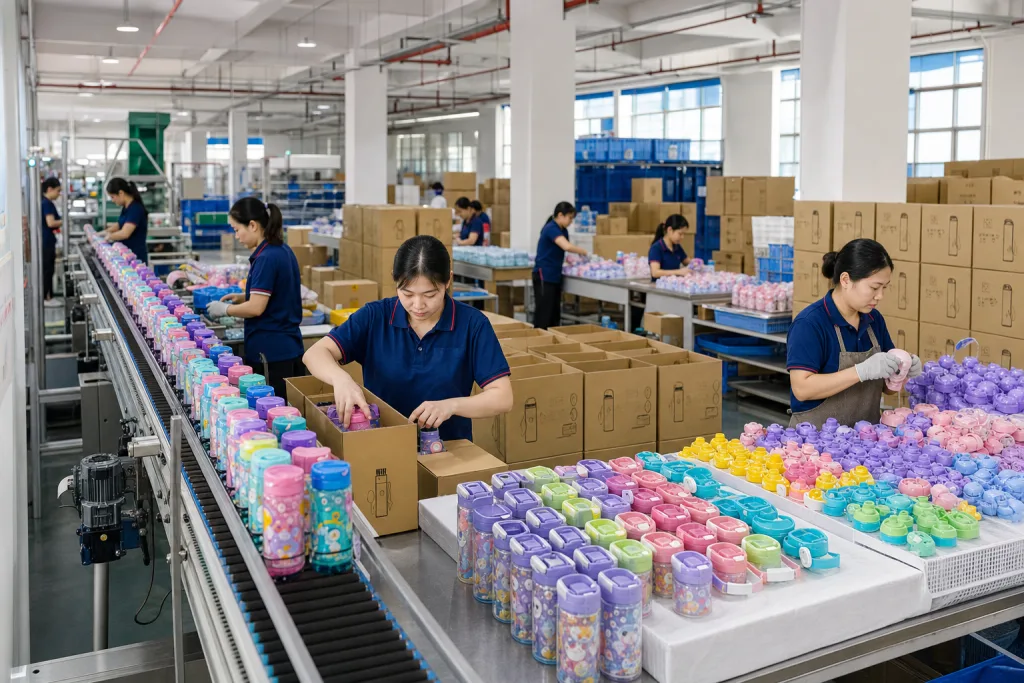
Key Takeaways
- For most PP or Tritan kids bottles, practical MOQs start at 3,000-5,000 units per color, with custom decoration often adding 7-12 days
- A leak test standard of 0.2 bar for 30 seconds and a drop test from 1.2 meters reduce school-use complaint rates noticeably
- Typical FOB China pricing for 350-500 ml custom kids bottles runs about USD 1.20-3.80 depending on material, lid complexity, and print method
- For Europe and North America, ask for REACH, LFGB or FDA contact-material evidence, plus CPSIA or ASTM-related testing where child-use claims apply
If you buy for a school district or import children’s products, you already know the problem: two kids bottles can look almost the same in a photo and fail in different ways once they hit classrooms, lunch bags, and the returns table. We have seen a USD 1.65 quote turn into a bad buy after a 1.2 m drop test, when QC pulled the sample and found a leaking lid, a scratched logo, or a carton size that wrecked the freight plan.
The clean way to buy kids bottle wholesale bulk is to read the spec sheet like an engineer, not a catalog shopper. This is the wrong question to ask: “Which one looks nicer?” Ask for thread size, wall thickness in mm, decoration method, and master carton count per MOQ 3,000. Once you read those lines properly, you can compare a children water bottle manufacturer in Zhejiang, China against another supplier on facts, not samples alone.
Start with bottle body material
The first line on the spec sheet is the body material. It drives cost, drop performance, freight, and what claims you can print on the box. For a bulk children water bottle program, we usually quote 4 body options: PP, Tritan, single-wall stainless steel, and, once in a while, recycled-content blends. For younger users, PP and Tritan are the normal start because the finished bottle stays lighter than steel; on our line, a 400 ml plastic body often comes in 120-180 g, which small hands manage better than a steel body over 220 g.
PP is the low-cost workhorse. A 400 ml PP bulk kids bottle with a simple flip lid may land around USD 1.20-1.80 FOB Zhejiang, China at 5,000 units. The tradeoff is surface feel and stiffness. PP scuffs faster, and transparent PP never gives the same clean look as Tritan after carton rub. We see this at incoming inspection: QC pulled the sample after a 60-cycle abrasion check, and the PP body showed whitening near the shoulder. Tritan costs more, often USD 1.80-2.90 FOB for similar size and lid setup, but the shelf look is stronger for a children water bottle wholesale retail line. Buyers ask if the extra USD 0.40-0.80 matters. For retail, it usually does.
Stainless steel makes sense if insulation or premium positioning is the brief, but the math does not work for every school project. Weight goes up. Freight goes up. Dent claims go up if the bottle wall is thin. A 12 oz single-wall stainless kids bottle often starts near USD 2.40-3.80 FOB before complex printing, and we have seen buyers flag shoulder dents after a 76 cm drop test packed 24 pcs per carton. That is not a steel problem by itself; it is often a packing spec problem.
- PP: lower cost, lighter carry weight, lower clarity; good for value programs and large MOQ school orders
- Tritan: clearer body, tougher hand feel, better shelf presentation; a safer bet for branded retail and promo projects
- Stainless steel: premium look and stronger price point, but heavier, with higher freight and tooling considerations
If a children water bottle supplier only says “food-grade plastic,” that is the wrong answer. You need the exact resin callout, whether the straw is silicone or PE, and whether the lid gasket is removable. We have even seen a PO typed as “TRITON” instead of Tritan, then the buyer pushed back after sample stage. That one material line affects testing, daily cleaning, spare-parts planning, and whether the product team will fight with after-sales six months later.
Capacity, dimensions, and child handling
Capacity looks simple. It is a daily-use decision. For kindergarten and early primary programs, 350-450 ml is the range we push most often. Once a bottle goes above 500 ml, kids start fighting the one-hand open test, and a full bottle gets heavy enough that drop claims go up. We have seen this on the line during cap-torque checks at 1.2-1.8 N·m. For older elementary grades, 500-600 ml works better, especially for a bulk school water bottle project tied to sports, bus routes, or field use.
Read the full dimension line, not only volume. A bottle can be 450 ml and still miss the job if the body diameter is too wide for a backpack side pocket. Practical body diameter is often 65-72 mm. Once you pass 75 mm, fit complaints rise fast. One buyer flagged this after a 76 mm sample would not slide into a standard mesh pocket. Height matters too. A tall narrow bottle tips faster on a classroom desk than a shorter body with a wider base, and QC pulled that sample during a simple push test.
Weight needs a hard look. A 400 ml Tritan bottle may weigh 120-160 g, while a comparable single-wall steel model can run 180-260 g. On one PO, the buyer typed 140 g max and missed that the steel option was already over. This is the wrong question to ask if you only compare piece price. The math doesn't work once you multiply that weight gap by 20,000 units and then by airfreight or parcel shipping.
What this means for your order
When a children water bottle distributor or importer asks us to quote a custom school water bottle, we usually tell them to lock 4 dimensional points before artwork approval. We use a caliper, check against the actual bag or cubby spec, and save one round of sample remake:
- Body diameter against lunch bag or backpack pocket size, usually checked at 65-72 mm
- Overall height against classroom cubby height, because 1 bottle at 235 mm can fail where 210 mm passes
- Handle size for a child’s grip, typically 22-28 mm clear opening
- Net weight target by age group and shipping model, especially if parcel cost breaks at the next 50 g tier
A bottle that fits a render but not a school bag is a design mistake, not a logistics mistake.
At BottleForge Industrial in Zhejiang, China, most custom kids bottle projects start with one of our 3 standard body diameters, because that avoids extra mold cost and keeps lead time around 25-35 days instead of 45-60 days for a fully new body. We run this way for a reason. We have seen custom bodies go sideways after one small base-radius change at sample stage.
Lid structure decides complaint rate
If one spec line predicts returns, it is the lid structure. Buyers spend time on the bottle body, then the complaints show up from the top assembly: leaks, cracked buttons, chewed straws, spouts with residue trapped under the seal. On our line, QC pulled more lid-related samples than body defects on one 8,000-piece school program. For a bulk kids water bottle order, the lid is not a side part. It is the product.
The common builds are screw lid with direct drink spout, flip straw lid, push-button lock lid, and sports cap. Younger kids usually handle a flip straw lid faster; they do not need much instruction. The tradeoff is part count. One flip-straw set can run 6 to 9 parts once you include the spring, pin, straw, seal ring, and cover, and we have seen this go sideways during repeat cleaning tests. A direct screw spout lid is simpler, faster on assembly, and usually survives longer on the line test bench, but some retail buyers flagged it as less eye-catching on shelf.
Ask your children water bottle factory for three specific tests:
- Leak test: 0.2 bar air pressure or inverted water test for 30 seconds minimum
- Cycle test: 3,000-5,000 opening cycles for push-button or hinge components
- Drop test: 1.0-1.2 meter drop, filled condition, on at least 6 faces depending on design
Ask one more thing: how is the straw retained? This is the right question. A friction-fit straw often loosens after 200 to 300 pull-and-clean cycles, and the buyer flagged it on a PO last year after classroom use. A better setup uses a defined retention groove with measurable pull force, checked with a force gauge instead of finger feel. Removable silicone mouthpieces also need a hard review for age grading and cleaning instructions, because small-part risk is where claims start.
For a children water bottle custom program, lid colors can blow up SKU count fast. A body in 4 colors with 3 lid colors is already 12 combinations, and that is before you split straw colors or print names on the cap. The math does not work if the MOQ is 1,000 per colorway and the buyer wants mixed cartons. We ship plenty of custom sets like this, but carton assortment, spare-lid support, and warehouse bin space need to be settled early. A good children water bottle vendor should say that before the PO typo turns 12 combinations into 21.
Decoration, branding, and artwork limits
Most buyers searching custom kids water bottle or custom logo kids bottle start with the logo file. Fair enough. But on kids bottles, print method should follow use on the ground, not a nice mockup from marketing. These bottles get dropped off desks, knocked against lunch boxes, and scrubbed harder than adult promo tumblers. We’ve seen QC pull samples with scuff marks after a 20-cycle rub test, so if the logo has to last, this is the first question to fix.
For plastic bottles, the usual methods are silkscreen, heat transfer, in-mold label on some constructions, and pad print for lids. Silkscreen is the standard pick for 1-2 color logos and usually adds only USD 0.05-0.12 per unit at MOQ 3,000 pcs. Heat transfer fits multi-color graphics, gradients, and mascot art, but it usually adds USD 0.12-0.25 and needs tighter line control for placement and adhesion. We run a jig to check print position because the buyer flagged a 2 mm shift once, and they were right.
For stainless parts, laser engraving holds up well, but you get no color. That is the trade-off. If you need a bright school logo, powder coat plus screen print is often the better route, but this is the wrong question to ask if nobody has tested scratch resistance on the actual finish. We’ve seen this go sideways after carton drop tests, where the body was fine and the printed area took the hit.
Questions to settle before PO
- Maximum print area in mm, not “large logo area” language
- Pantone matching tolerance and whether it applies on body, lid, and strap equally
- Abrasion resistance method, such as tape adhesion or rub test
- Artwork seam visibility on curved bodies
This is where terms like children water bottle customizable, children water bottle customized, and custom made kids bottle confuse buyers. A lot of factories say yes to customization, but they mean bottle color and logo print only. Real customization usually means new tooling: a custom strap, a lid-top insert, or a full new mold. The math doesn’t work if your order is small. Tooling can move from USD 800 for a small insert to USD 6,000-12,000 for a new lid or body mold, and we’ve even seen a PO typo turn “strap color custom” into “strap mold custom,” which changed the whole quote.
If you are a children water bottle promotional buyer running school fundraising or district branding, ask for a pre-production sample with the actual print, not a digital mockup. Simple step. We ship these after artwork approval and check them against the signed Pantone callout, because arguments usually start when the first bulk carton lands and the logo looks different under classroom lighting.
Compliance paperwork and quality control
For kids products, compliance is not something to sort out after the price is set. It needs to be built into the quote on day one. A credible children water bottle manufacturer or children water bottle manufacturers group should ask your target market in the first 10 minutes, because EU paperwork, US paperwork, and children’s-use claims do not sit in the same bucket. We’ve seen POs delayed 12 days because the buyer wrote “kids use” on the artwork file but asked for an adult-bottle test set.
For EU programs, ask about REACH and, depending on the material and customer requirement, LFGB-related food-contact testing. For the US, ask for FDA contact-material compliance support and discuss CPSIA elements if the bottle is marketed specifically for children. If the product includes decorative coatings, inks, or accessible painted parts, review heavy metal and migration testing before mass production, not after the first sample lands on your desk. Some importers also request ASTM-related evaluations based on product claims and age use. QC pulled a sample last month where the Pantone print was fine, but the painted logo area still triggered an extra migration review.
On quality control, do not accept “100% checked” as a serious answer. Ask for the real process. On our line, that means incoming material inspection, in-process patrol checks every 2 hours, and final random inspection under AQL standards. A common standard is AQL 2.5 for major defects and 4.0 for minor defects, but your tolerance may be tighter if you supply school districts directly. This is the wrong question to ask: “Do you inspect everything?” The better one is, “At which station do you catch leaks, burrs, and print defects?”
Useful QC checkpoints for children water bottle bulk orders include:
- Odor check after molding and assembly
- Leak test sampling by lot
- Print adhesion and color verification
- Carton drop and barcode scan check
- Assembly burr and sharp-edge inspection around spouts and handles
Our factory area in Zhejiang runs around 600,000 units per month across drinkware lines, but that number means little without a hard QC gate. We run go/no-go checks on spout fit and edge feel before packing, and QC will hold a lot over a 0.3 mm burr if needed. Capacity without process control just makes defects faster, and we’ve seen this go sideways at factories that chase output first and claims later.
MOQ, packaging, and landed cost math
Most first-time buyers stare at unit price and miss the bigger cost drivers. For kids bottle wholesale bulk, MOQ, carton design, barcode setup, and loading density can shift real landed cost by 10-20% even if the FOB quote looks sharp. We’ve seen this go sideways: a buyer pushed 3 cents off bottle price, then lost 14 cents per unit on oversized cartons after the drop test spec forced thicker inserts.
Typical MOQs from a children water bottle supplier in China are 3,000 units for standard bodies with stock colors, 5,000 units if you want custom Pantone matching on both body and lid, and higher for exclusive molds. Custom packaging brings its own MOQ, usually 1,000-3,000 pieces per design for color boxes, inserts, or hangtags. On our line, one color box revision can delay print booking by 2 days if the PO shows the wrong barcode suffix.
Then check the packing spec hard. A bottle packed 24 units per master carton sounds standard, but the math doesn’t work if the carton size wastes space. We run cube checks on the sample table with a tape measure before mass production. In one case, rotating the lid position and folding the handle cut carton height by 18 mm, which let the customer load several hundred more units in one 40HQ. That matters for a children water bottle distributors network and for importers trying to keep warehouse slotting clean.
If you sell into retail or Amazon FBA, barcode work needs to be locked early. FNSKU, suffocation warning placement, country-of-origin marking, and carton labeling are not small details. QC pulled the sample once because the origin mark was under a silicone boot and the buyer flagged it right away. Warehouse rework is expensive, and relabeling 5,000 units by hand is the wrong cost to argue about.
A practical quote comparison should include:
- FOB price by quantity break: 3,000 / 5,000 / 10,000 units
- Tooling charge, if any
- Print charge by method and color count
- Packaging cost per unit
- Sample charge and refund policy
- Lead time for sample and mass production
For standard bulk kids water bottle projects, sample lead time is often 5-7 days with existing molds, and mass production is 25-35 days after deposit and artwork approval. Around Chinese New Year, add 10-20 days. Zhejiang factories feel that crunch fast. We ship late January orders every year that would have moved 12 days earlier if artwork had been signed off before the holiday rush.
How importers shortlist the right factory
Comparing children water bottle suppliers, children water bottle vendors, or a potential children water bottle distributor partner, the cheapest unit price is usually the wrong filter. We’ve seen buyers save $0.12 on the first PO, then lose 12 days on rework because the lid fit drifted by 0.4 mm on the second run. The better question is simple: who can ship the same result across three or four POs without giving you a new headache each time.
Start with the sample. Then push past it. Ask which parts are made in-house and which are bought outside. A factory may mold the bottle body on its own line and source lids from a partner, and that is not a deal breaker, but someone still has to own dimensional control and corrective action when QC pulled the sample and found thread mismatch. Ask for BSCI if social compliance matters to your account, ask for routine production photos from the line, and confirm they accept third-party inspection before shipment. If they dodge that part, we’ve seen this go sideways.
For school district buyers, communication discipline matters almost as much as compliance. If a supplier cannot send a spec confirmation sheet listing body material, volume, net weight, packing detail, print method, and test plan, claims handling will be messy too. We had one PO where the buyer flagged a typo on color code “PK-07” vs “PX-07” before production; that single sheet saved a full carton remake.
Use this shortlist logic:
- Can they quote clearly with full specifications, including MOQ, bottle height in mm, and carton pack-out?
- Can they support compliance documents for your market, not just say “FDA safe” in the email?
- Can they explain defect criteria in plain terms, such as scratch length, logo offset, or leak test standard?
- Can they manage repeat orders without changing material or finish silently between PO1 and PO3?
- Can they ship on a realistic lead time like 35 days, not a sales promise that turns into 48?
A dependable children water bottle factory in China should be comfortable talking about resin grade, gasket Shore hardness, AQL, and carton cube. This is normal factory talk. If a seller keeps dragging the conversation back to “best price,” you are probably not talking to the right team for a serious custom children water bottle program.
Get a spec-driven quote for your kids bottle program
Send your target size, material, logo method, compliance market, and quantity. We will quote MOQ, FOB pricing, lead time, and packaging options clearly.
Frequently asked questions
What is a normal MOQ for kids bottle wholesale bulk orders?
For standard models, most factories in China quote 3,000 units as an entry MOQ, especially for one bottle size with 1-2 stock colors. If you need custom Pantone body and lid colors, custom strap color, or retail packaging, 5,000 units is more realistic. Fully new molds usually require a higher commitment or a tooling fee. For school district programs, you can sometimes mix 2-4 colors within one 5,000-unit order if the same artwork and packaging apply. Always ask whether MOQ is per model, per color, or per print design, because those are very different commercial terms.
Which material is best for a bulk school water bottle program?
For most school use, Tritan and PP are the practical choices. PP is lower cost, often around USD 1.20-1.80 FOB for a simple 400 ml bottle at 5,000 units, and works well for budget-driven programs. Tritan usually costs about USD 1.80-2.90 FOB for similar sizes but gives better clarity, a stronger perceived value, and better shelf appeal. Stainless steel looks premium but increases weight and freight cost. If your users are younger children, a lighter 350-450 ml plastic bottle usually creates fewer handling complaints than steel. The best choice depends on age group, budget, branding goals, and whether retail appearance matters.
How do I verify a children water bottle manufacturer is safe and compliant?
Ask for the exact material declaration first, not just a statement saying food grade. Then request test support relevant to your market: REACH and sometimes LFGB-related evidence for Europe, and FDA contact-material support for the US. If the bottle is marketed specifically for children, discuss CPSIA-related considerations and accessible coatings or printed parts. You should also ask for a QC plan with AQL levels, leak testing, and drop testing. A reliable factory will explain what is tested on raw material, during assembly, and before shipment. If they cannot provide a clear spec sheet and document list before deposit, treat that as a warning sign.
What decoration method lasts longest on custom kids water bottles?
For plastic kids bottles, simple silkscreen is cost-effective and acceptable when the logo is 1-2 colors and the bottle is not heavily abused. It usually adds about USD 0.05-0.12 per unit. For more complex graphics, heat transfer gives better visual range but costs more, often USD 0.12-0.25, and needs stronger adhesion control. On stainless parts, laser engraving is the most durable but has limited color impact. If you expect rough school use, ask for an actual pre-production sample and request rub or tape adhesion test results. A nice mockup is not proof of durability.
How long does a custom kids bottle order usually take from China?
If you use an existing mold, pre-production samples usually take 5-7 days after artwork and color confirmation. Mass production for 3,000-10,000 units typically runs 25-35 days after deposit and sample approval. Custom packaging may add 3-7 days, and new tooling can add 20-40 days depending on whether the change is only a lid insert or a full new bottle body. You should also add buffer around peak periods in China, especially before and after Chinese New Year, when lead times can stretch by another 10-20 days. Serious buyers build freight booking time into the schedule from the start.