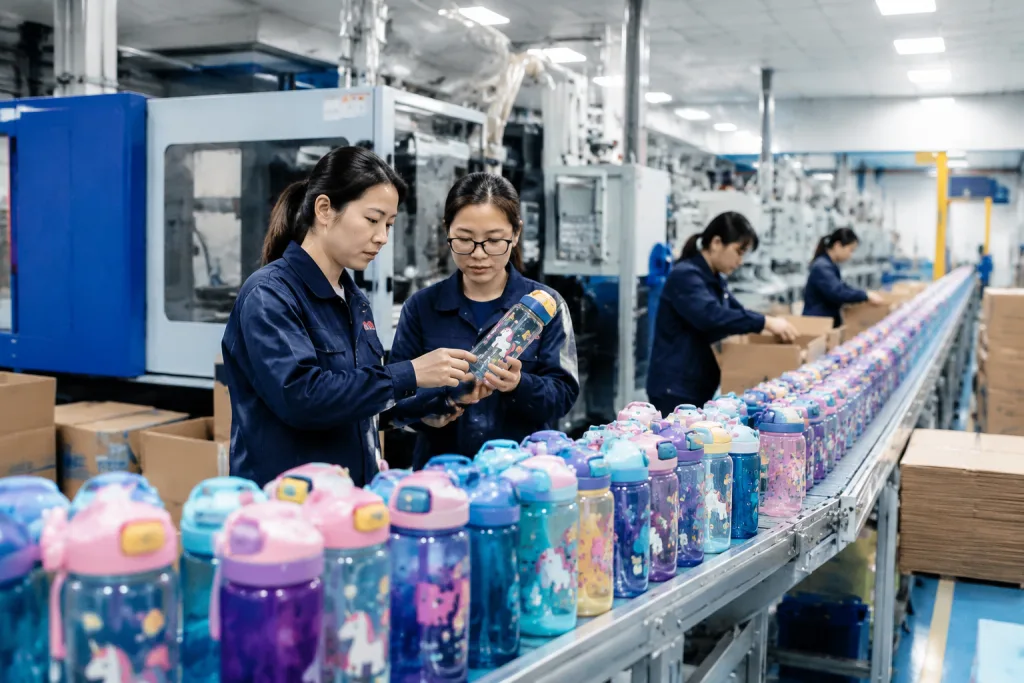
Key Takeaways
- For most custom kids water bottle projects, practical MOQ starts at 3,000 to 5,000 units per color per model, with 25 to 35 days production time
- PP, Tritan and 18/8 stainless steel each solve different buyer problems; wall thickness and lid construction matter more than catalog photos
- AQL 2.5 for major defects and 4.0 for minor defects is a reasonable inspection baseline for bulk school water bottle orders
- Decoration method affects complaint rate: silkscreen is lower cost, while laser or UV print usually holds up better after 200 to 500 wash cycles
You are not buying “a bottle.” You are buying leakage rate, complaint volume, carton count, test paperwork, and one basic result: whether a child can use it for 2 weeks without snapping the lid or losing the straw. We’ve seen buyers focus on a pretty rendering and miss the 1.8 mm hinge pin, the 12 kg handle pull test, or the extra 0.6 kg per carton that hits freight. That is the wrong question to ask. A kids bottle vendor should be checked line by line on the spec sheet and against a sealed sample from the line, not a low opening quote.
For school district buyers and kids-product importers, the trouble usually sits in small points: straw valve hardness, handle pull strength, print adhesion after 500 rubs, and whether the supplier in Zhejiang, China can show REACH, LFGB, or CPSIA-related testing the same day the buyer flagged it. QC pulled samples for this exact issue last month after a PO typo mixed two lid versions in one order. A capable children water bottle manufacturer in China should make verification easy, with clear numbers on MOQ, lead time, and quality control.
Start with bottle body material
The first line on the spec sheet should be the body material. It sets the testing route, drop result, unit weight, and freight math. We get school buyers asking for a bulk children water bottle quote before they even fix PP, Tritan, or stainless. That is the wrong question to ask. A serious kids bottle vendor should pin down the use case first, because the line, tooling choice, and even carton weight change from that one decision.
For entry-level campus programs and promo orders, PP bodies are the standard because they stay light and cheap. On our side in Zhejiang, a simple 500 ml PP kids bottle usually lands at USD 1.10 to 1.80 FOB China, depending on the lid build, print method, and whether the MOQ is 3,000 pcs or 10,000 pcs. Tritan looks clearer on shelf, feels stiffer in hand, and buyers often flag it as the safer premium option even before they read the test report. A 450 to 600 ml Tritan body often runs USD 1.60 to 2.80 FOB. Stainless steel fits projects that need better abuse resistance or insulation, but the math moves fast on both cost and weight. A single-wall stainless kids bottle may start around USD 2.20, and vacuum insulated versions can move to USD 3.80 to 6.50.
Ask for actual thickness, not just material names. We have seen two bottles both called “Tritan” with a 40 g weight gap because one body was cut thinner at the shoulder radius. On the floor, we check this with an ultrasonic thickness gauge, not by guesswork. For example:
- PP body: 1.8 to 2.5 mm
- Tritan body: 2.0 to 2.8 mm
- Single-wall stainless: 0.4 to 0.5 mm
- Vacuum stainless inner/outer: usually 0.35 to 0.45 mm each wall
If you are buying children water bottle wholesale for younger users, weight matters more than importers first assume. A 500 ml insulated steel bottle may weigh 280 to 380 g, while a Tritan version can be 110 to 160 g. That is not a small gap. We have had one EU buyer push for insulated steel for a kindergarten set, then switch after holding the pre-production sample for 30 seconds. For early primary ages, the extra 170 g to 220 g gets noticed fast.
A good children water bottle factory will tell you when your target price and your target material do not match. We have seen this go sideways: the buyer wants stainless at PP pricing, the supplier says yes, and QC pulled the sample later with wall thickness under spec. If a supplier says yes to everything, slow down.
For most district tenders and broad retail programs, Tritan or food-grade PP is the better balance on cost, safety, and handling. Stainless still makes sense for some accounts, especially gift sets or winter markets, but only if the budget and age group support it. If a 5-year-old is the end user, we would question steel first and approve it second.
Lid design decides complaint rate
The lid is where claims start. Not the body. In our factory, most issues on a bulk kids bottle or bulk kids water bottle come from four points: leaking seals, snapped carry loops, torn bite valves, and lids a 6-year-old cannot open with one hand. We check the lid first on the line. A capable children water bottle supplier should treat it as the main engineering item, because this is where complaint rate moves.
There are three common routes:
- Flip-top straw lid: easy for kids in class, common for school programs, but it gives the most leak claims if silicone seal compression is off by even 0.3 mm. QC pulled samples last month with warped hinge pins on this style.
- Screw cap with spout: fewer moving parts, lower warranty risk, and easier to keep stable in mass production. Some buyers say it feels slower for younger users, and that pushback is fair.
- Push-button pop lid: convenient and feels more premium, but it has more internal parts, more assembly steps, and tighter tolerance control on the spring seat and latch.
Ask for seal material and hardness. Food-grade silicone is standard, often around 50 to 60 Shore A. Too soft, and the ring rolls after hot-fill exposure. Too hard, and it will not seat cleanly after 2,000 cycles. Ask whether the straw is PE, silicone, or TPE, and whether replacement parts are available. For a children water bottle customizable program, spare straws and seals cut after-sales cost fast. We ship these in PE bags of 50 sets, and schools reorder them more often than buyers expect.
You should also ask for simple mechanical data:
- Handle pull test: 10 to 15 kg force without cracking
- Latch cycle test: 2,000 to 5,000 openings
- Leak test: filled, inverted 30 minutes and vibration test 1 hour
- Drop test: 3 to 5 drops from 1.0 to 1.2 m depending on age target
For a custom school water bottle, ask if the lid can run in school colors with a two-color injection option. It looks good on a sample board, but the math does not work for every PO. Mold setup can rise by USD 800 to 2,000 depending on the design, and MOQ usually gets tighter once you split colors. Some children water bottle suppliers in China avoid new tooling by changing only the decorative outer part, which is the cheaper route. We have also seen a buyer flag a navy lid that came closer to Pantone black after resin mixing on trial shots.
For schools, simpler lids usually win. Fewer parts mean fewer failures, especially in large children water bottle bulk orders going to 12 or 20 campuses at once. Fancy lids look good in a meeting. On the ground, basic screw or flip-top designs usually come back with fewer complaints.
Capacity, dimensions, and age fit
Capacity looks simple on the PO, but size has to match the age group, lunch bag width, cup holder fit, and carton loading. We hear buyers ask a children water bottle vendor for 500 ml as the default spec all the time. This is the wrong question to ask. Last month one buyer’s school bag sample only cleared a 70 mm side pocket, so the 500 ml option failed before we even ran the drop test.
For preschool and lower primary, 350 to 450 ml is the safer band in most programs. A full bottle in that range stays easier for small hands to carry, and spill complaints drop fast once the filled weight stays under control. For primary school, 450 to 600 ml is the common target. For sports-day or all-day campus use, 650 ml can work, but only if the diameter still feels right in hand. On the line, QC pulled a 600 ml sample last week that looked fine on paper but felt too fat at 78 mm.
Watch these dimensions closely:
- Body diameter: 65 to 75 mm is easier for children to grip
- Height: usually 160 to 230 mm
- Mouth diameter: 35 to 55 mm depending on cleaning requirement
- Carton quantity: often 24 to 60 pcs per outer carton
If you are sourcing a custom children water bottle for school packs or lunch kits, ask for nesting efficiency in the export carton, not just bottle volume. A 3 mm reduction in lid width can sometimes improve carton count by 8 to 12%. That changes the freight math on 20,000 units. We have seen a 40HQ plan go sideways because the buyer flagged color first and ignored carton density until final packing review.
A professional children water bottle distributor or manufacturer should also raise age grading early. If the product is for children under 3, the risk review changes fast. Small detachable parts, bite-through components, and carry strap retention need a harder check. We test strap pull on the force gauge, and this is where weak clip designs get exposed. For school district buyers, the safer route is often to specify ages 4+ unless there is a clear early-years requirement.
Many children water bottle manufacturers in Zhejiang and broader China can adjust size with existing molds only within a narrow window. Usually we can tweak height a few mm with inserts, but a real diameter change means tooling. For a fresh body mold, USD 3,000 to 8,000 is normal for plastic; more if the lid structure is custom. We have even seen a PO typo lock in the wrong height, 185 mm instead of 195 mm, and then artwork had to be redone. Settle dimensions early, before artwork approval.
Printing, branding, and decoration life
Branding is where a children water bottle customized order either sells cleanly or starts getting complaint photos by week 4. Buyers usually stare at logo position and miss abrasion life. That is the wrong question to ask. If the bottle is for schools, fundraisers, museums, or licensed kids products, the print method needs to match how kids drag it across desks, drop it into cubbies, and jam it into backpacks. On our line, QC pulled samples with nice-looking artwork that failed after a simple fingernail scratch on the shoulder area.
Common decoration options include silkscreen, heat transfer, UV print, IML for some plastic parts, and laser marking for stainless components. The right choice comes down to MOQ, artwork detail, and how long the bottle needs to stay presentable in use:
- Silkscreen: low setup cost, good for 1 to 2 colors, often USD 0.05 to 0.15 per color per unit; we run this most on 3,000 to 10,000 pcs orders where the logo is simple and the print area stays flat
- Heat transfer: good for full-wrap graphics, often USD 0.18 to 0.45; works better when artwork crosses curves, but the buyer usually needs to accept a wrap gap of 2 to 4 mm
- UV print: sharp gradients and small details, usually better for premium children water bottle promotional projects; looks good, but we have seen this go sideways on rough textures where ink build is uneven
- Laser: durable on coated or stainless parts, limited visual style on plastic; strong choice for lids, collar rings, or 304 stainless parts where buyers want life over color pop
Ask for test standards on the print itself. Not just a nice photo. A working baseline is:
- Adhesion tape test: no peeling after 3M tape pull; we normally check right after curing and again after 24 hours
- Rub test: 50 to 100 dry rubs, and preferably wet rub testing; a cotton cloth with a 1 kg load gives a cleaner read than a casual hand wipe
- Dishwasher statement: clearly declared as hand wash only or tested for specific cycles; if the PO says “dishwasher safe” with no cycle count, the buyer flagged it later more than once
If you need a custom logo kids bottle for school district distribution, do not promise dishwasher durability unless the factory has real validation. Many prints survive hand wash well but fade after 20 to 50 dishwasher cycles. That is normal. The mistake is selling 50 cycles as 200. We have had buyers push back after PTA distribution because the artwork dulled on the front panel while the bottle body was still fine.
For a custom made kids bottle retail program, ask for a pre-production sample with final artwork, not a digital mockup. A solid children water bottle distributor or children water bottle vendor should show seam position, logo wrap gap, Pantone tolerance, and print registration before mass production. We usually mark the wrap gap and seam on the sample by hand, and if registration is off by 0.5 mm on small characters, it shows fast. For most projects, Pantone matching within a visually acceptable range is realistic. Exact match across PP, silicone, and painted metal is not. The math does not work because each material takes ink and pigment differently.
Compliance files and factory controls
This part is not the fun part. It matters more. If a children water bottle manufacturer cannot send the compliance file set up front, the project is weak even if the sample looks clean on the table. We tell buyers to ask before deposit, not at shipment, because we have seen one missing report hold a container after the carton marks were already printed.
The file stack changes by market and by bottle build. For Europe, ask for REACH, food-contact compliance under the applicable EU requirements, and LFGB if your channel asks for it. For the US and Canada, check the relevant food-contact testing and any children-related requirements that fit the item, including the base material and the logo decoration. If the bottle is for younger children, discuss CPSIA points and labeling early. This is routine work for a solid children water bottle factory in China. On our side, the buyer usually flags prints first, but the lab often pulls risk from ink, straw valves, and soft-touch coatings.
Ask how the factory controls the line, not just what sits in a PDF report. This is the right question. A real answer should mention the gram scale, the thread gauge, the vacuum leak tester, or the torque check fixture, because that is what catches trouble before packing.
- IQC on resin, color masterbatch, steel grade, silicone seals
- IPQC on bottle weight, wall thickness, thread fit, print registration
- FQC on leak test, assembly check, appearance sorting
- OQC before shipment based on AQL 2.5/4.0
If you are buying from Zhejiang, China, ask whether audits such as BSCI, SEDEX, or ISO 9001 are current. They do not guarantee a perfect order. They do show whether the factory runs with records or just talks well on email. We run retained samples by PO number, incoming material traceability by lot, and inspection sheets signed on the line; last month QC pulled a sample because the PO said "sage green" but the approved chip was 1 shade darker.
Always ask for capacity in units. If the supplier says they are a major children water bottle manufacturers group, ask what that means on a monthly plan. A clear answer sounds like 300,000 to 500,000 units per month for mixed kids bottle lines, not vague talk. The same goes for lead time: 7 to 10 days for samples, 25 to 35 days for repeat orders, and 35 to 50 days for new-tooling projects. If a factory cannot break this down by molding, painting, and packing days, the math does not work.
MOQ, packaging, and landed cost
The last line on the quote is the one buyers should cost first: total landed cost. We’ve seen a low FOB price from a children water bottle supplier turn into a bad buy once the packout was bulky, the carton failed a 76 cm drop, or the bottles needed hand-fitting for straws after arrival. This is the wrong question to ask too late.
For a standard bulk school water bottle project, realistic MOQs on the line are usually:
- Existing mold, standard color: 1,000 to 3,000 pcs
- Custom body or lid colors: 3,000 to 5,000 pcs
- Full custom tooling project: often 5,000 to 10,000 pcs minimum
Packaging changes add cost faster than most buyers expect. A plain polybag with an egg-crate carton is the low-cost option. A printed window box, barcode sticker, insert card, and master carton mark pack can add USD 0.20 to 0.65 per set, and we’ve shipped jobs where the buyer flagged a 3 mm box height increase because it changed pallet loading. If you sell retail or through a children water bottle distributors network, shelf presentation matters. If the bottles go straight to schools, simple packs usually make better sense. The math doesn’t work if you dress up a low-price promo bottle like a retail SKU.
Ask for packed dimensions and gross weight per carton before you place the PO. Freight is driven by CBM, not just piece price. Example: a 500 ml Tritan bulk kids water bottle packed 48 pcs per carton might ship in roughly 0.075 to 0.095 CBM. Switch to a wider lid plus a retail box, and the same 48 pcs can jump enough in volume to wipe out the bottle savings. QC pulled samples on one project where the new lid diameter added 12 mm, and the carton count stayed the same but freight cost moved the wrong way.
Questions worth asking before PO
- What is the MOQ by color and by print design?
- Can one order split into 3 to 5 assorted lid colors?
- What carton drop standard is used?
- Can FNSKU, suffocation warning, or bilingual labels be applied?
- What spare parts ratio is offered, such as 1 to 2% extra straws or seals?
A practical children water bottle vendors shortlist should stop at suppliers who can put FOB, packing details, sample timing, and defect policy on one clean sheet. We run into this all the time: if a factory misses a carton size, leaves out gross weight, or even copies the PO with a color typo, the order usually gets messy later. If they cannot organize the basics, they will struggle with the order.
Send your kids bottle spec for review
Share your target capacity, lid style, compliance market, packaging, and order quantity. We will review the spec sheet and quote practical MOQ, lead time, and FOB pricing.
Frequently asked questions
What MOQ should I expect from a kids bottle vendor for a custom school order?
For an existing model with one standard color, many factories in China can start around 1,000 to 3,000 pieces. Once you ask for custom Pantone body color, custom lid color, and logo print, a more realistic MOQ is 3,000 to 5,000 units per design. If you need a fully custom mold, expect 5,000 to 10,000 units minimum, sometimes higher if the lid has multiple moving parts. For school district buying, you should also ask whether the MOQ is per color, per artwork, or per PO total. That changes pricing. A practical vendor in Zhejiang should state MOQ clearly and tell you whether mixed colors in one carton are allowed.
Which material is best for a custom kids water bottle: PP, Tritan, or stainless steel?
It depends on age group, budget, and how the bottle will be used. PP is the value option and often works well for promotional or entry-level school programs at roughly USD 1.10 to 1.80 FOB. Tritan usually gives the best balance for many importers because it is clear, lightweight, and feels more premium, often around USD 1.60 to 2.80 FOB. Stainless steel is stronger and can be insulated, but it is heavier and often starts above USD 2.20 FOB for single-wall models. For younger children, weight matters more than buyers expect. A 500 ml Tritan bottle may weigh 120 g, while an insulated steel version can exceed 300 g.
What compliance documents should a children water bottle manufacturer provide?
At minimum, you should ask for material declarations and recent food-contact test reports tied to the actual materials and decoration used. For Europe, buyers commonly review REACH-related information and often ask for LFGB or equivalent food-contact support. For North America, food-contact compliance expectations vary by substrate and market, and children-targeted programs may also need CPSIA-related review for accessible components, inks, or coatings. You should also ask for factory audit status such as BSCI, SEDEX, or ISO 9001, plus an inspection standard like AQL 2.5/4.0. A solid supplier in China should be able to send documents before deposit, not after production starts.
How do I reduce leakage and breakage in bulk kids bottle orders?
Start with lid simplicity. Flip-top straw lids are popular, but they need better sealing control than screw caps. Ask for silicone seal hardness, straw material, and opening-cycle data. Good baseline checks include a 30-minute inverted leak test, a 1-hour vibration test, and 3 to 5 drops from 1.0 to 1.2 meters with no functional failure. Also request handle pull-force data of at least 10 kg if the bottle has a carry loop. In mass production, require in-line leak testing and a final random inspection using AQL 2.5 for major defects. If a vendor cannot explain their leak-control process clearly, you should expect claims later.
How long does a children water bottle customized project usually take?
For an existing bottle with standard tooling, sampling usually takes 7 to 10 days if you only need color and logo confirmation. Mass production often takes 25 to 35 days after sample approval and deposit. If the project includes new packaging, multiple print positions, or mixed-color lids, add several days. A fully custom children water bottle customized project with new tooling normally needs 35 to 50 days for mold development and sample refinement before mass production even starts. During peak season, especially before back-to-school programs, you should build in at least 1 extra week. Buyers who lock artwork late usually create their own shipment delays.