Key Takeaways
- For a custom kids water bottle project, set drop-test, leak-test, and odor limits before deposit; MOQ commonly starts at 3,000 to 5,000 units per SKU.
- Most print and lid failures trace back to underspecified materials, decoration method, or torque control—not just poor workmanship.
- Ask every children water bottle factory for CPSIA, REACH, LFGB or FDA material declarations plus AQL 2.5 inspection standards.
- A Zhejiang, China supplier with 500,000+ units/month capacity and 25-35 day lead time is only useful if tooling, packaging, and labeling are locked early.
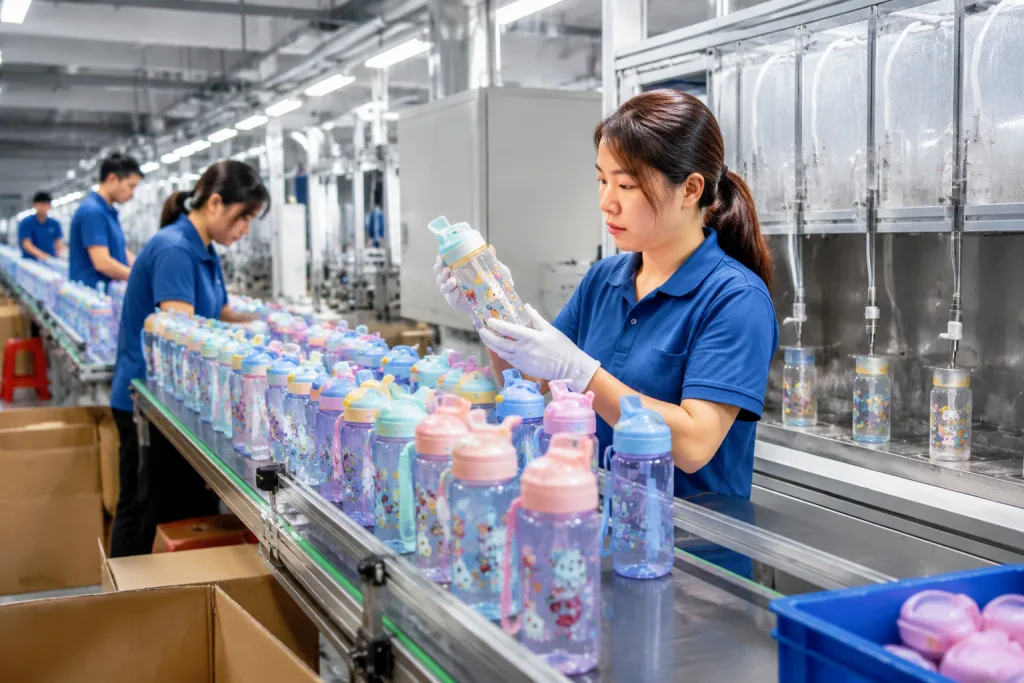
You usually do not have a kids bottle problem at the quoting stage. The sample on the table looks clean, the price lands inside target, and every children water bottle supplier says the same thing: safe materials, bright printing, on-time shipment. The trouble shows up later on the line. Lids crack after a 1.2 m drop test, straws pick up odor after 3 weeks, logo ink scuffs in master cartons, or a shipment gets held because the school label copy on the PO was wrong by 1 line. This is where a weak kids bottle supplier list gets expensive fast.
If you buy for a school district, import program, or retail brand, a catalog of children water bottle manufacturers is not enough. You need a screen for failure modes before mass production starts. We run into this every season in Zhejiang: buyers ask for the lowest unit price, but this is the wrong question to ask. The suppliers worth shortlisting are the ones that will talk plainly about resin grades, test methods, AQL limits, and corrective action, and then back it up when QC pulled the sample and found a 0.8 mm flash line on the spout.
Start with the failures, not the catalog
A strong kids bottle supplier list is not a spreadsheet with 20 factory names and one FOB column. It is a short working list of factories that stop the failures we see in a bulk children water bottle program before the first container ships. New buyers often compare sample look, carton size, and unit price. Wrong focus. On the line, claim rates usually come from five places: leaks at the lid thread, body breakage after a 1.2 m drop, odor from resin or silicone, decoration wear after wash testing, and missing compliance files that hold the shipment.
For school tenders and importer programs, the safer way to buy a bulk kids bottle or bulk school water bottle is to write those failure points into the spec sheet. If you leave gaps, the factory will fill them with the cheapest assumption that still gets the PO confirmed. We have seen this go sideways. That can mean PP instead of Tritan, 50A silicone when you expected a firmer seal, a single-wall body that dents under a 12 kg carton stack, or a straw structure that keeps moisture after cleaning.
When you evaluate a children water bottle manufacturer or children water bottle vendor, ask for details that show process control, not sales talk. QC pulled the sample is one thing; stable mass production is another:
- MOQ: 3,000-5,000 units per colorway is typical for a custom plastic kids bottle; 1,000 units may be possible for stock molds with simple logo printing.
- Lead time: 7-10 days for pre-production sample, 25-35 days for bulk after approval.
- Capacity: ask not only for monthly output, but how 6-cavity or 8-cavity injection molds and how many assembly lines are reserved for kids SKUs.
- QC method: incoming material checks, in-line leak test, final AQL 2.5 or tighter.
At BottleForge Industrial in Zhejiang, China, buyers move faster once they stop asking for "best price" and start asking how a children water bottle factory controls hinge stress, thread tolerance, and print adhesion. Last month a buyer flagged lid wobble at 0.3 mm on a pre-production sample, and that was the right call. That is the difference between a vendor list and a supplier list you can ship against.
Lids fail first when specs stay vague
The lid is where most bulk kids water bottle programs break down first. Buyers spend time on 304 stainless or bottle shape, then gloss over the cap. We’ve seen returns start from thread engagement, hinge fatigue, bite valve wear, or a flip-top that looked fine at approval and then failed after 200 open-close cycles or one 0.75 meter desk drop. QC pulled that sample too late.
What actually goes wrong is simple: the lid got signed off on looks, not function. A children water bottle customized for school use needs a written lid spec with seal hardness, thread profile, and hinge stop angle. Without that, one run ships with a 2.0 mm silicone seal and the next swaps in a cheaper 1.6 mm seal that leaks once cartons are laid flat in transit. We ship that way all the time. This is the wrong question to ask if you only ask for “no leak.”
What to lock before mass production
- Cycle life: ask for 1,000 open-close cycles on flip-top lids as a baseline, then confirm the hinge pin area shows no whitening or crack start under magnification.
- Leak test: 100% air-pressure or inverted water test during assembly; define acceptable failure rate at 0 major leaks, and have the line record rejects by hour.
- Drop test: 3 drops from 1.0 meter with no cap fracture and no sustained leakage; we usually test on tile, not only carton board, because that’s where weak latch arms get exposed.
- Torque range: specify cap application torque so threads do not strip or loosen in transit; for screw caps, the capping machine setting needs a locked range, not operator feel.
- Spare parts policy: confirm whether replacement straws, seals, or lids can be reordered at 1,000-2,000 pieces; buyers often push back here, then come back 6 months later asking for 1,200 seals from an old PO.
If you are buying children water bottle custom or custom made kids bottle programs, ask the supplier whether the cap uses virgin PP, ABS, or Tritan components, and where the hinge stress concentrates. Ask where the gate sits on the mold, too. These are engineering questions, not decoration. If the sales side cannot answer and needs 2 days to check with tooling, the mold probably was not debugged properly. We’ve seen this go sideways.
A cheap lid can erase your entire margin faster than a $0.12 body upgrade ever will.
Plenty of children water bottle suppliers in China can copy a silhouette. Far fewer can explain how gate position, wall transition, and ejector layout raise crack risk in a kids cap, or why a 0.3 mm wall jump near the hinge becomes a failure point after repeat use. That supplier stays on the shortlist.
Odor, taste, and mold complaints are predictable
School buyers and importers hear the same 3 complaints on repeat: "the bottle smells," "the straw tastes like plastic," and "the lid gets black spots." We see this in children water bottle wholesale orders every season. The usual problem is not the bottle alone. It is that odor and hygiene requirements were never written down in a testable way, so the line runs to a basic standard and QC pulls the sample too late.
For a custom children water bottle or children water bottle promotional order, the material stack decides a lot more than buyers expect. Body resin, masterbatch, seal silicone, straw compound, and even packaging ink all change the smell profile after bottles sit sealed in export cartons for 30-45 days. If units go into polybags before they finish venting on the rack, the first container opening smells rough. We have seen a PO typo switch clear silicone to a cheaper compound, and the buyer flagged it as "plastic taste" after arrival.
The mold complaint is usually a design fault, not a cleaning fault. This is the wrong question to ask. Do not ask whether a child will clean the bottle well; ask whether the lid has dead ends, a 3 mm elbow, or a fixed mouthpiece that traps water after washing. We've seen this go sideways on flip-top lids where the gasket channel stayed wet overnight.
- Choose materials carefully: Tritan or food-grade PP are common for bodies; food-grade silicone for seals; PE or silicone straws depending on design. On our side, we also check whether the straw wall thickness is stable at 1.5-2.0 mm, because thin spots pick up odor faster after hot fill or dishwashing.
- Request odor evaluation: sealed 24-hour room-temperature odor check after production, plus hot-water contact check if relevant. A simple 60°C water test catches issues fast, and it is cheaper than arguing over a container claim later.
- Design for cleaning: removable straw, fewer hidden cavities, and lid parts that can be disassembled without special tools. If the buyer needs a brush just to reach the valve seat, the math doesn't work.
- Packaging control: require bottles to cool and ventilate before polybagging. We usually ask for at least 12 hours on open trays after printing, not straight from the line into bags.
Any serious children water bottle manufacturer or children water bottle distributor should be ready to provide material compliance documentation for FDA-contact claims, REACH, and where needed LFGB. If you sell into North America, ask about CPSIA relevance for the finished item and substrate testing around coatings or accessible components. If a supplier answers with only a raw-material paper and no finished-item file, push back.
When buyers in Zhejiang source from nearby factories in China, odor claims often trace back to rushed packing in the last 2 days of the month. It sounds small. It is not. Once units sit in containers for 20-35 days at high temperature, trapped volatiles show up fast, especially in lids and straws packed warm.
Printing looks great until cartons start moving
Decoration failures are easy to prevent, yet we still see them knock out custom logo kids bottle orders. The usual cause is simple: the approved artwork looks sharp on a hand sample, then the line runs a print method that does not hold up once cartons start shifting. QC pulled one sample last month after a 3M tape test and the ink lifted on the second pull. That order was already packed.
For a custom kids bottle, custom kids water bottle, or custom school water bottle, ask the supplier which print method fits the bottle surface, how the bottle will be used, and what price ceiling you need to hit. This is the right question. We run silkscreen on straightforward logos, but curved bodies, soft-touch coatings, or fine gradients usually need heat transfer, IML, pad print, UV print, or laser marking on stainless parts.
Questions that expose weak print control
- What adhesion test is used: tape test, rub test, or dishwasher simulation?
- How many rub cycles are accepted before visible wear?
- Is Pantone matching controlled on each run or only at sample stage?
- Will the print contact adjacent bottles or dividers inside the master carton?
For a children water bottle customizable program, ask for a packaged abrasion test, not only a loose sample on the desk. Carton vibration is where this goes sideways. If the fit inside the master carton is too tight by even 2-3 mm, bottles rub each other during trucking from Zhejiang to port, then again after 18 days on the water, and the buyer flags the scuffing before unloading is even finished.
Expect unit cost differences. A simple one-color silkscreen may add $0.06-$0.12 per unit. More durable decoration can add $0.15-$0.40 depending on area and complexity. The math does not work if you save $0.08 and eat a claim on 8,000 printed pieces. Good children water bottle vendors will say that directly, even if the PO typo says “same as sample” and nothing else about abrasion standard.
Compliance gaps sink school and import projects
A bottle can pass a quick visual check and still be dead on arrival for import. We see this on the line. A children water bottle supplier treats compliance like back-office paperwork, then the buyer gets stuck after deposit because the warning copy, test scope, or retail claims were never locked. School district buyers and importers should screen this before sampling, not after. This is the wrong question to ask: “Can you make the bottle?” Ask what file set is ready before PO release, especially for child-use claims, promo giveaways, or retail packs with hang tags.
Split compliance into three buckets and check each one on its own: material compliance, finished-product testing, and social or factory audits. They do not cover each other. A resin declaration does not replace migration testing. A BSCI audit does not prove a straw is food-safe. ISO-style process paperwork does not fix a carton label printed 6 mm off-center or a PO typo in the country-of-origin line. QC pulled the sample, but the file still failed.
- Material documentation: FDA food-contact statements, REACH SVHC declarations, and where applicable LFGB support documents.
- Mechanical testing: leak, drop, handle pull, bite-valve durability, and small parts review where applicable.
- Packaging checks: barcode placement, warning marks, country-of-origin labeling, and carton drop integrity.
- Inspection standard: define AQL, for example critical 0, major 2.5, minor 4.0.
If you are using a children water bottle distributors network or buying from a children water bottle wholesale channel, ask one blunt question: is the report tied to this exact model, or is it a carry-over file from a similar SKU? We have seen buyers get a report for one lid, then switch the straw, color masterbatch, or logo ink and assume the paperwork still holds. It does not. The buyer flagged this once over a silicone spout hardness change from 50 to 60 Shore A, and the old report was useless.
Good suppliers in China will tell you what they support in-house and what must go to an outside lab. Better suppliers in Zhejiang will also push back when the spec itself creates risk. We do that. If the artwork is not frozen, the age grade is still open, or the master carton mark has two versions, approving the pre-production sample is asking for trouble. The math doesn't work if you save 3 days up front and lose 18 days reprinting inserts and cartons after inspection.
Capacity claims mean little without execution detail
Plenty of buyers build a kids bottle supplier list around price and claimed capacity, then get hit with a late shipment. A factory can say 800,000 units per month all day, but that number means little if your order needs a new mold insert, Pantone color matching within 0.5-1.0 Delta E, retail gift box packing, and FNSKU or district-specific carton labels. We’ve seen this go sideways on one PO where the carton mark had a school district code typo, and the line lost 2 days fixing outer cases.
For a children water bottle bulk or bulk kids bottle order, the real schedule risk usually sits in four spots: mold readiness, color approval, printing queue, and hand assembly. Kids bottles carry more manual work than a standard sports bottle. Straws need fit checks, silicone stoppers need pull tests, charms get hand-loaded, sleeves need alignment, and multi-part lids slow the line. This is the wrong question to ask: “What is your monthly output?” Ask what happens at each process step.
Ask every children water bottle distributor, factory, or trading partner the same operational questions:
- Sampling: 7-12 days for color and logo sample, 15-20 days if new tooling is involved.
- Mass production: 25-35 days for repeat orders, 35-45 days for first custom runs.
- MOQ: 3,000 units per size is common; mixed colors may require 1,000 per color.
- Backup plan: what happens if one cavity has flash or one print line goes down?
At BottleForge Industrial, our Zhejiang team normally plans kids bottle orders by process, not just by PO date: injection, aging, print, assembly, inspection, and export pack. We run the schedule backward from ex-factory date and put hours on each gate. QC pulled the sample after aging last month and found lid color shift under a light box, so artwork approval moved by 1 day before printing started. That matters because a late fix on artwork or inner-box language usually costs 3-5 days even if the bottle body is already packed in trays.
If your importer program needs a reliable children water bottle suppliers pool, do not stop at references. Ask for a real production timeline with approval gates, sample sign-off points, and who owns each step from mold trial to carton drop test. If a supplier cannot show that in one sheet, the math doesn’t work. That is how you separate factories that quote from factories that ship.
How to build a shortlist that survives production
If your goal is a practical kids bottle supplier list, keep it tight. You do not need 25 names on a spreadsheet. You need 3 to 5 qualified sources that can run your exact spec, your compliance file, and your volume plan without rewriting the quote later. For school districts, we’ve seen the cleaner setup work better: 2 bottle platforms, fixed lid options, and upstream control on artwork, carton marks, and replacement parts. This is the wrong question to ask if you start with “who is cheapest.” Start with who can hold the spec. On the line, a 0.3 mm wall-thickness gap changes drop performance fast.
A good RFQ package for a children water bottle vendor needs specifics: body size, target age group, intended use, drop requirement, leak requirement, print method, packaging format, and destination market. Put the numbers in. Say 350 ml for ages 4-7, 1.2 m drop test, inverted leak test for 2 hours, 1-color silk screen, 24 pcs per carton, US market. If you only ask for a "custom kids bottle quote," you get 4 quotations built on 4 different assumptions, and the math doesn't work. We’ve had buyers flag a price gap, then we found one factory quoted PE bag packing and another quoted window box packing at 18 cents more per unit.
- Step 1: eliminate suppliers that cannot provide model-specific compliance documents. A general FDA file is not enough if the straw, seal ring, and color masterbatch do not match the actual model.
- Step 2: compare lid construction, wall thickness, and sealing design, not just shape. Ask for section photos or cut samples; QC pulled one sample here last month with a silicone ring seated 1 mm off.
- Step 3: require pre-production sample approval against a written checklist. Include logo size, Pantone match, gross weight, leak test result, and strap pull test if the bottle has a handle.
- Step 4: set inspection terms, rework rules, and packaging standard before deposit. Put carton drop, barcode position, and AQL level in writing before the PO gets stamped.
- Step 5: keep one backup source in China for urgent repeats or component replacement. We ship repeat lids and straws faster when the backup already has approved drawings and color chips.
For importers buying children water bottle manufacturers or children water bottle factory output from Zhejiang and other China clusters, the strongest long-term relationships usually start with a narrower first order: maybe 3,000-5,000 units, two colors, one print location, and one packaging format. That first run shows you more than a sales deck will. You see how the supplier handles a logo shift, a carton mark typo, or a leak complaint at pre-shipment. We’ve seen this go sideways on larger launches; a 20,000-unit opening order gives you less room to correct the first molding or packing mistake.
If a supplier can walk you through likely failure modes before you ask, pay attention. That usually means they have already seen the claims, the returns, and the container issues. A solid team will ask you back about spout bite-through risk, handle pull force, print abrasion, and whether the bottle has to fit a lunch bag pocket at 90 mm width. Experience is not a slogan here. It shows up in the questions, in the sample notes, and in small catches like spotting a PO typo before the line runs 5,000 wrong lids.
Build a safer kids bottle sourcing shortlist now
Send your target size, material, logo method, and annual volume. We will review likely failure points, MOQ, and lead time before you place a risky PO.
Frequently asked questions
What should be on a kids bottle supplier list before I request pricing?
Start with 3 to 5 suppliers, not 20. For each one, collect MOQ, lead time, model-specific compliance documents, main bottle materials, lid construction, decoration options, and inspection standard. For a typical custom kids water bottle program, MOQ is often 3,000 to 5,000 units per SKU, sample time is 7 to 10 days, and bulk lead time is 25 to 35 days. Ask whether the quote is based on PP, Tritan, or stainless components, and whether leak testing is 100% in-line or sample-based. If you buy for schools, add packaging requirements, origin labeling, and barcode needs before comparing FOB prices. Otherwise your supplier list will look complete but still be hard to quote accurately.
How do I compare children water bottle manufacturers without visiting China?
Use a document-and-sample process that forces each factory to answer the same technical questions. Request one stock sample, one custom pre-production sample, a draft production timeline, and copies of recent material or product test reports tied to the same model family. Ask about AQL standards, drop-test height, leak-test method, and print adhesion testing. A factory in Zhejiang, China may quote slightly higher than another supplier, but if it can show 500,000 units monthly capacity, 30-day repeat lead time, and clear corrective action records, that matters more than saving $0.08 per unit. Also verify whether the company is the actual children water bottle factory or a trading firm managing outside production.
What is a realistic target price for bulk kids water bottle orders?
It depends on material, size, and decoration, but for planning purposes a simple 400-500 ml plastic kids bottle with stock mold and one-color print may land around USD 1.20 to 2.20 FOB China at 3,000 to 5,000 units. A more complex children water bottle customized with flip lid, straw, carry handle, and retail box can move into USD 2.50 to 4.50 or higher. Stainless kids bottles cost more. Do not compare only unit price. A cheaper quote may exclude mold charges, Pantone matching, third-party testing, spare seals, or individual polybags. The right way is to compare total landed risk: material grade, defect allowance, packaging, lead time, and replacement policy.
Which tests matter most for a custom school water bottle project?
For school use, prioritize leak testing, drop testing, print adhesion, and material compliance. A practical baseline is 100% leak check during assembly, 1.0 meter drop test with no cap fracture, and print rub or tape adhesion testing on decorated surfaces. For straws and mouthpieces, ask for durability review and cleaning access. On paperwork, request FDA-related food-contact support, REACH declarations, and any market-specific documentation your importer needs. If the product is promoted for child use, review warning language and any accessible small components carefully. Also set final inspection to AQL critical 0, major 2.5, minor 4.0 unless your program requires tighter control. That gives your third-party QC team a clear pass-fail rule.
How can I reduce risk on my first order with a children water bottle supplier?
Keep the first order simpler than your long-term target. Choose one proven bottle mold, 2 colors maximum, 1 print location, and straightforward export packaging. A first PO of 3,000 to 5,000 units is often enough to test execution without overexposure. Require a signed specification sheet covering resin, color, logo placement, leak standard, drop requirement, carton marks, and spare-part policy before deposit. Then approve a pre-production sample that matches those details exactly. If possible, book an in-production or pre-shipment inspection using AQL 2.5. The goal is not just getting bottles made. It is learning how the supplier handles deviations, communication delays, and corrective action before you scale to 20,000 units or more.