Key Takeaways
- For school programs, a practical MOQ is usually 1,000 to 3,000 units per SKU, while custom color plus custom logo often starts at 3,000 units
- PP, Tritan, and 18/8 stainless steel each fit different age groups, drop risks, and cleaning routines; wall thickness can vary from 0.35 mm to 0.5 mm on steel bodies
- A realistic production lead time from Zhejiang, China is 25 to 40 days after sample approval, with 7 to 12 days for pre-production samples
- Ask for REACH, LFGB or FDA contact-material evidence, plus AQL 2.5 final inspection and 24-hour leak testing before shipment
If you are sourcing for a school district or building a private-label kids line, finding a factory is the easy part. China has 3,000-plus drinkware listings on the common B2B platforms. The real problem is picking a supplier that ships a safe, durable, age-appropriate bottle instead of turning your PO into a claim file. A kids bottle supplier directory only helps if you read the details behind the photo: MOQ, testing scope, leak rate, lid structure, spare parts policy, and carton discipline. We’ve seen this go sideways over a 1 mm thinner body wall and a misspelled color name on the PO.
Most buyers start with artwork and price. Wrong order. First match the bottle to the job: school cafeteria, retail shelf, promotional giveaway, or e-commerce bundle. In Zhejiang and other China production clusters, two bottles can look the same on screen and still run differently on the line, from wall thickness to resin grade to the compliance file behind it. QC pulled samples before where one version passed drop test at 1.2 m and the other cracked at the shoulder. That is why supplier screening saves money early, before tooling, sampling, and mass production.
How to read a supplier list
A supplier directory looks simple until you line up 5 factories and every profile says the same thing: BPA-free, food grade, fast delivery, custom logo, competitive price. For a school district buyer or importer, that copy is noise unless it ties back to plant control. Ask for batch traceability on resin, a mold list with cavity count, current compliance files, and a defect-control record that is more than a polished PDF. On our side, QC pulled one sample last month because the lid hinge pin sat 0.4 mm proud of spec. That tells you more than any slogan.
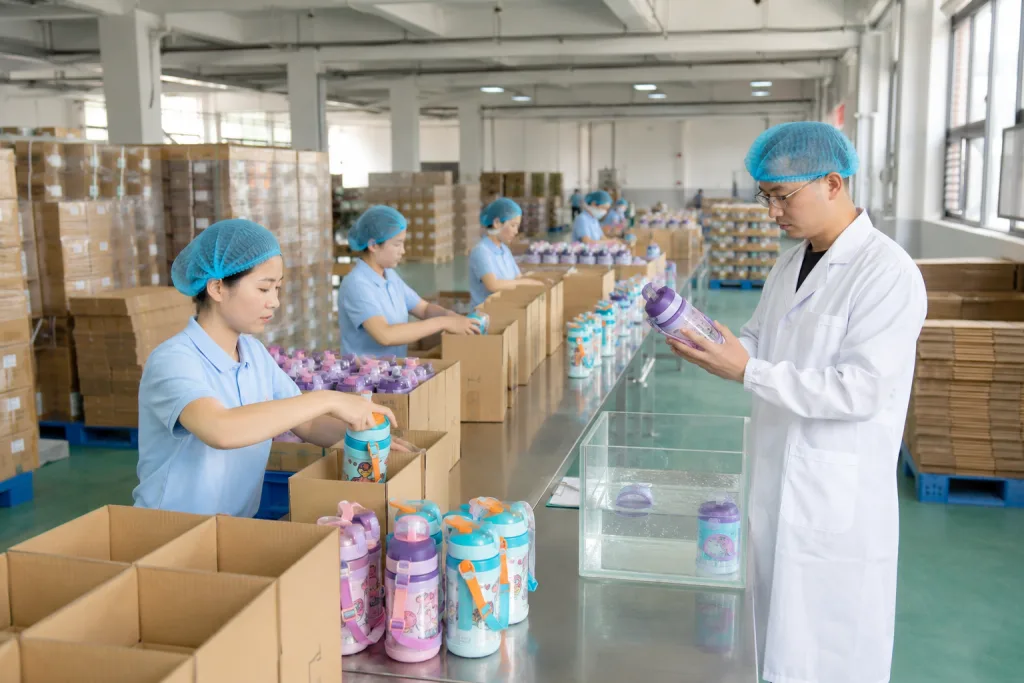
First, split trading companies from actual factories. This is the right question to ask. A children water bottle manufacturer or children water bottle factory should answer plant questions without going back and forth for two days: monthly output, mold count, injection machine tonnage, number of assembly lines, and the in-house leak-test standard. At BottleForge Industrial in Zhejiang, China, for example, a normal custom kids water bottle project runs with MOQ from 1,000 pieces for stocked molds, monthly capacity above 300,000 units, and lead times around 30 days for repeat orders. Those are usable numbers. “Fast delivery” is not. If the sales rep cannot tell you whether they run a 160T or 260T injection press, we’ve seen this go sideways.
When you review a kids bottle supplier directory, compare suppliers on these points first:
- Factory type: manufacturer, exporter, or children water bottle distributor
- Core materials: PP, Tritan, stainless steel, silicone components
- Decoration methods: silk screen, heat transfer, UV print, laser marking
- Compliance scope: REACH, LFGB, FDA, CPSIA or ASTM references for child-use products where applicable
- MOQ logic: by color, by logo, by packaging type, or by full custom mold
- QC method: IQC, in-process checks, AQL final inspection, drop and leak tests
That gives you a clean first cut. Then you can spot who is built for custom programs and who only ships generic children water bottle wholesale. We ship both kinds, and the gap shows up fast: one supplier can handle a 3-color print with barcode stickers matched to the PO, while another misses a carton mark because “kids botle” was typed on the order sheet and nobody on the line caught it.
Head-to-head bottle spec comparison
If you are comparing a bulk children water bottle program, start with the spec table, not the catalog cover. Lowest FOB is the wrong question to ask. The bottle has to match the age group, take daily abuse, and stay inside your complaint budget. On our line, QC pulled a 500 ml sample last month with a loose gasket seat at 0.6 mm shift, and that one detail mattered more than a few cents on price.
| Type | Typical FOB China | MOQ | Use-case fit | Main watchout |
|---|---|---|---|---|
| Single-wall Tritan 450-600 ml | USD 1.60-2.80 | 1,000-3,000 | Bulk school water bottle, clubs, fundraising | Scratch visibility, odor transfer from poor gasket material |
| PP bottle with flip lid 350-500 ml | USD 1.10-2.00 | 2,000-5,000 | Lower-cost children water bottle promotional orders | Heat resistance limits, hinge fatigue |
| 18/8 stainless insulated 350-500 ml | USD 3.20-5.80 | 1,000-2,000 | Premium retail, winter use, custom school water bottle | Weight, dent risk, higher freight cost |
| Squeezy PE sports bottle 400-600 ml | USD 0.85-1.50 | 3,000-5,000 | Short-cycle events, sports day | Perceived value is lower, cap fit consistency matters |
For school district use, a 450 to 500 ml body usually lands best. It gives enough volume for a school day and still fits smaller hands. We see fewer complaints with a body diameter around 65-70 mm because kids can grip it without squeezing hard. Straw lids sell fast on presentation, but they add 2 extra cleaning points and more leak claims once the straw valve is not seated right. Flip spouts with a removable silicone seal are the safer middle ground for a custom kids bottle program. We ship more of that setup for district tenders for a reason.
For importers serving mass retail, Tritan usually gives the cleanest balance between shelf appearance, impact resistance, and print area. Premium lines still favor stainless because the shopper feels the value in hand. But watch the weight and the carton drop test. A 0.4 mm outer wall and 0.35 mm inner wall are common on insulated kids bottles; below that, the math doesn't work. You might save USD 0.08-0.12 per unit, then lose it on dent complaints after a 76 cm drop on the corner. We have seen buyers flag that after the first shipment.
When buyers ask for a children water bottle customizable line, they usually mean this: keep the existing body mold, change the color, logo, strap, or packaging, and skip the cost and 25-35 day delay of a full new mold.
Which bottle fits which program
The right product depends on the program. A school district, a museum gift shop, and a children water bottle distributor may each buy 5,000 units, but the spec sheet on the line looks different. We have seen buyers use one template for all three and the math does not work.
School district and PTA orders
For bulk school water bottle programs, the safe bet is easy cleaning, low leak risk, and a cost that passes procurement review without a long debate. Single-wall Tritan or PP usually fits better than vacuum stainless. Target FOB China around USD 1.30 to 2.40 for a decorated 450-500 ml bottle with one-color print, individual polybag, and export carton. If you need names, class codes, or variable data, expect added handling cost, because the line has to sort files one by one and QC pulled the sample more than once on mixed-name orders.
Retail and importer programs
If you are building a children water bottle custom line for retail, visual consistency drives the decision. Buyers ask for Pantone matching against the cap and body, barcode control, shelf-ready packaging, and cleaner finish quality; we check that with a color card and a 1.5 mm print-position tolerance before we ship. A children water bottle manufacturer that also handles inserts, hangtags, and FNSKU labels saves days. This is where many children water bottle vendors fail. The bottle passes, but the packaging is loose, or the buyer flagged one PO typo on the outer carton mark and the whole pallet had to be relabeled.
Promotional and event use
For children water bottle promotional campaigns, cost and speed drive the order. Stock colors, one-position logo print, and standard OPP bag packing usually keep lead time below 20 to 25 days. We run these jobs fast when artwork is clean and the MOQ stays practical, usually 3,000 to 5,000 pcs per color. This is a good place for a bulk kids bottle or bulk kids water bottle order when the buyer wants lower unit cost, not long-life performance. Asking for premium stainless here is the wrong question to ask.
Use-case fit is why a directory listing alone is not enough. The same children water bottle suppliers may be solid for one channel and weak for another, and we have seen this go sideways after one inspection finding on packaging, not the bottle itself.
Customization without expensive mistakes
Most projects do not need a new mold. For a custom children water bottle, the low-risk route is to pick an existing body and change the decoration, color, lid trim, carry loop, straw, or packaging. We run this way on most OEM orders because the math works: a stocked mold can save USD 2,000 to 8,000 in tooling and cut development time by 20 to 35 days. On our line, a lid color swap and logo proof usually move faster than any new cavity work on the CNC side.
Here is the practical customization ladder:
- Level 1: stock color + 1-color logo, MOQ 1,000
- Level 2: custom Pantone body + logo + hangtag, MOQ 2,000-3,000
- Level 3: custom logo kids bottle with printed box, spare straw set, and insert card, MOQ 3,000
- Level 4: new lid or new body mold, MOQ often 5,000-10,000 plus tooling
If you need a children water bottle customized for younger children, start with grip diameter, spout material, and part count. This is the right question. We have seen 45 mm to 50 mm body diameters work better for smaller hands, and QC pulled the sample once when a bite valve felt too hard after durometer testing. For older primary-school users, buyers usually care more about branding area and whether the strap clips on fast before class.
Ask every children water bottle vendor for a decoration recommendation based on actual use, not just artwork size on a template. Silk screen still works for simple logos and tight budgets, but 300 dishwasher cycles will wear it faster than buyers expect. UV print gives stronger shelf impact for retail packs. Laser marking fits some stainless models, but not every painted surface; we have seen coating burn marks around the logo window when the setting was off by 0.2 mm. For a custom school water bottle that rides in backpacks, logo abrasion matters more than on a display piece.
Good children water bottle manufacturers in Zhejiang usually push back when artwork placement risks peeling or distortion. The buyer flagged this once on a tapered bottle shoulder, and they were right to ask. If a supplier says yes to every logo position without checking the draft angle or print wrap, we have seen this go sideways.
Compliance and QC that matter
Kids drinkware gets checked harder than a standard office tumbler, and it should. If you are sourcing from children water bottle manufacturers or children water bottle distributors, ask which reports are already on file and which ones must be booked by SKU, Pantone color, or destination market. We have seen one lid pass on natural PP and fail again after the buyer switched to a bright yellow masterbatch at 2% dosage.
For Europe, ask about REACH and LFGB-related material compliance. For the US, ask for FDA food-contact declarations and, where relevant to your program, CPSIA-related considerations for accessible coatings or components. If the product is sold into channels that require child-use documentation, settle that point at RFQ stage, not after sampling. This is the wrong question to ask late. A common fight starts when the buyer writes “kids bottle” on the PO, the line runs a food-safe bottle, and the retailer later asks for a child-use protocol that was never quoted.
QC should include more than a visual look-over:
- Incoming inspection: resin, steel grade, silicone parts, color masterbatch; QC pulled the sample and checks steel with an XRF gun before the batch goes to the line
- In-process checks: thread fit, cap torque, print registration, weld quality; we usually log cap torque in N·cm and check print offset against the artwork
- Leak test: 100% vacuum or inverted water test for assembled lids; for straw lids, we often hold the vacuum test for 30 seconds per piece
- Drop test: commonly 3 to 5 drops from 80 to 120 cm depending on pack and spec; the buyer flagged one program after a hinge crack showed up on drop 4
- Final inspection: AQL 2.5 major, 4.0 minor is common for export orders; carton marks, odor, scratch depth, and accessory count all get checked
If you are buying children water bottle bulk for schools, ask for spare-part policy as well. A 2% extra cap or straw allowance can reduce after-sales pain more than a 3% unit price cut. The math doesn't work if one missing straw shuts down 500 school units after delivery. In China, factories that plan for spare sets, barcode labels, and replacement lids before shipment are usually easier partners over the long term.
Price, MOQ, and landed cost reality
Buyers ask for a bulk kids water bottle quote and line up the ex-factory or FOB price first. That is the wrong question to ask. For school programs and importer orders, landed cost usually moves on three shop-floor items: carton size, defect exposure, and whether we ship the bottle fully assembled or nested. On one 500ml kids bottle, nesting cut carton cube by 0.018 m³ per master carton, which changed the freight math fast.
A PP bottle at USD 1.15 FOB China looks sharp on paper, then the buyer flagged a 4% lid break rate and no spare parts in stock. The math doesn’t work. A Tritan bottle at USD 1.95 FOB can land cheaper if defects stay under 1% and the line packs tight with no wasted headspace. QC pulled the sample on one run because the lid hinge pin sat 0.6 mm off center. Carton count matters. Cubic volume matters more. Freight charges empty space every time.
Typical commercial ranges for children water bottle wholesale projects from Zhejiang, China look like this:
- Stock model + one-color print: 1,000 units MOQ, 15-25 day lead time
- Custom body color + custom packaging: 2,000-3,000 units MOQ, 25-35 day lead time
- New mold development: 5,000+ units, 45-70 day development plus production
If you source through children water bottle distributors in North America or Europe, replenishment is often faster and the paperwork load is lighter. You will usually pay more per unit. We ship direct from a children water bottle factory in China when annual demand gets past 10,000 to 20,000 units across 2 or 4 SKUs, and that is usually where the savings start to show. We have also seen this go sideways when a PO typo changed cap color from Pantone 2985C to 2895C and the local distributor caught it faster than the factory route would have.
For procurement teams, the best question is not “Who is the cheapest children water bottle supplier?” It is “Which supply model gives us the lowest complaint-adjusted landed cost?” That is the number to defend internally. If returns stay below AQL 2.5 and the cube is under control, the cheaper quote on page one is often not the cheaper shipment that lands.
How to shortlist suppliers fast
If you are using a kids bottle supplier directory, do not blast 30 factories. Shortlist 5, sample 3, qualify 2. That is enough in most cases. We have seen buyers lose 12 days just comparing mixed quotations from 18 suppliers, then start over because 6 of them quoted without bottle weight or carton size. A tight filter gets cleaner answers and cuts wasted sample rounds.
Use this shortlist method:
- Step 1: send the same RFQ sheet to all suppliers with target volume, market, capacity, decoration, packaging, and required certificates. Put the same table in every email. If one buyer writes “500ml” on one RFQ and “17oz” on another, the line will quote two different tools.
- Step 2: remove any supplier that cannot state MOQ, lead time, and material spec clearly within 48 hours. This is the wrong question to soften. If they dodge basic numbers now, the math does not work later. We usually expect answers like MOQ 3,000 pcs, 35 days, 304 stainless or Tritan, not vague sales talk.
- Step 3: request two similar project references, even if customer names are masked. Ask what bottle size shipped, what print method ran, and what market it went to. The buyer flagged one case with “EU test passed” but no actual LFGB report date.
- Step 4: buy production-like samples, not showroom samples only. Ask for the actual lid structure, straw setup, logo process, and export carton. QC pulled the sample once and found a 1.5 mm strap mismatch between the sample and mass-production drawing.
- Step 5: confirm inspection standard, payment term, and carton spec before PO. Do it before deposit. We have seen this go sideways over a simple PO typo—“24 pcs/ctn” became “24 sets/ctn,” and the freight quote was wrong from day one.
School district buyers should pay close attention to replacement support and repeatability. Ask how the factory handles missing spouts or cracked lids 6 months later, not just first shipment quality. Importers should watch packaging control and barcode accuracy, then check color consistency across repeat runs with a Pantone reference on the line. Whether you call them children water bottle suppliers, children water bottle vendors, or a children water bottle distributor network, the same rule applies: if the supplier cannot answer technical questions cleanly before order, they will not get more organized after deposit.
That is the real value of a good directory process. It helps you find more than a custom kids bottle source. It helps you find a supplier that ships reorders on a predictable cycle, with the same carton count, the same cap fit, and fewer surprises at final inspection.
Shortlist the right kids bottle factory faster
Send your target market, volume, bottle type, and artwork plan. We will recommend workable specs, MOQ, testing scope, and a realistic China lead time.
Frequently asked questions
What MOQ should I expect for a custom kids water bottle order?
For an existing mold with a standard lid, MOQ is usually 1,000 to 3,000 units per SKU. If you want a custom Pantone body, printed box, and custom logo kids bottle decoration, expect 2,000 to 3,000 units. If you need a new lid mold or a fully custom made kids bottle, MOQ often starts at 5,000 to 10,000 units, plus tooling. For school district projects, many China factories in Zhejiang will quote 1,000 units on simple stock models, but the unit price is usually 8% to 15% higher than at 3,000 units. Always ask whether MOQ applies by color, by logo, or by packaging style, because that changes the real minimum.
Which material is best for a bulk school water bottle program?
For most school use, Tritan or PP is the practical choice. Tritan gives better clarity, stronger perceived value, and good impact resistance, usually at USD 1.60 to 2.80 FOB China for 450-600 ml. PP can save cost, often landing around USD 1.10 to 2.00 FOB, but it may feel less premium and can show hinge wear on some lid designs. Stainless steel works well for premium or cold-weather programs, but it raises unit cost to roughly USD 3.20 to 5.80 and adds weight. If easy cleaning and low leak claims are your priority, choose a simple wide-mouth or flip-spout design with fewer removable parts.
How do I verify that a children water bottle manufacturer is a real factory?
Ask questions that a trading company struggles to answer in detail. Request monthly capacity, number of assembly lines, typical lead time, mold ownership status, and leak-test method. A real children water bottle factory should also provide production photos or live video, carton specs, and a clear explanation of QC checkpoints. Useful signs include in-house sampling, knowledge of AQL 2.5 inspection, and realistic answers like 25 to 40 days for production instead of vague promises. If the supplier cannot explain whether the bottle uses Tritan, PP, or 18/8 stainless, or cannot separate MOQ for logo versus MOQ for color, treat that as a warning sign.
What compliance documents should I ask for when importing kids bottles?
For Europe, start with REACH-related material compliance and, where needed, LFGB food-contact evidence. For the US, ask for FDA food-contact declarations. If the bottle is positioned clearly for children, clarify whether your retail channel also expects CPSIA-related documentation for accessible parts or coatings. Do not assume one generic “test report” covers every color, lid, and market. Ask what material each report applies to and when it was issued. Good factories in China usually keep a document set by component type: body resin, silicone seal, paint or coating, and packaging. That saves time when you need market-specific files before shipment.
Is it better to buy through children water bottle distributors or directly from China?
It depends on volume and internal staffing. If you need 500 to 2,000 units quickly, a children water bottle distributor can reduce lead time and admin work, especially for repeat stock models. If your annual demand is 10,000 units or more across multiple SKUs, buying direct from a children water bottle manufacturer in China usually gives you better cost control and more customization options. Direct sourcing works best when you can manage artwork approvals, compliance review, and inspections properly. The price gap can be meaningful: direct factory buying may save 15% to 35% versus local distribution, but only if you control defects, packaging accuracy, and freight planning.