Key Takeaways
- For school and retail programs, ask for 24-hour leak testing and 1.0 m drop testing on at least 32 samples per SKU before shipment.
- Typical MOQ for a custom kids water bottle is 1,000-3,000 pcs per color, with 25-35 day lead time after sample approval in Zhejiang, China.
- Use AQL 2.5 for major defects and AQL 4.0 for minor defects if you want practical pre-shipment control without overpaying for inspection.
- For logo durability, require tape test plus 500-cycle rub test; a USD 0.08-0.25 decoration upgrade often saves a failed promotional run.
You usually spot a bad kids bottle promotional order too late: cartons land at your warehouse, lids seep after a 1.2-meter drop test, logos scratch off after one school week, or QC pulls a lab report with a coating you never signed off on. School district buyers and importers do not need 12 more color options. You need fewer surprises.
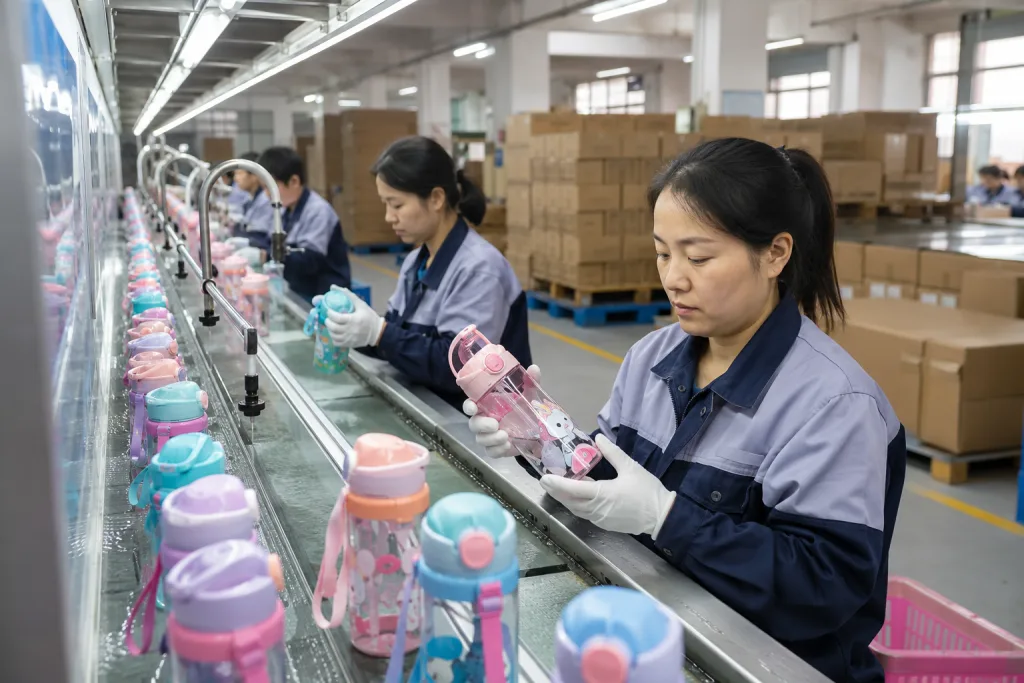
At BottleForge Industrial in Zhejiang, China, we run into the same problem across bulk kids bottle and bulk school water bottle projects, whether the PO is 3,000 pcs or 30,000. The bottle body is rarely the main risk. The trouble sits in the small stuff: straw valves that do not seal, odor migration after hot-fill simulation, print adhesion that fails the 3M tape test, drop resistance at the shoulder, master carton count, and paperwork errors like a wrong item code on page 2. Spec those points early. This is the right place to be picky.
Leaks start at the lid
The first thing that fails on a custom children water bottle order is usually not the print or the paint. It is leakage, and most of the time the problem starts in the lid seal stack-up. Buyers approve a clean pre-production sample, then the line runs with a 50A gasket instead of 60A, a softer straw, or thread tolerance drifting by 0.2 mm. Kids are rough on bottles. They squeeze them, flip them upside down, and throw them into backpacks, so a small seal issue shows up in 3 days, not 3 months.
If you buy from a children water bottle factory or children water bottle manufacturer in China, get the closure spec in writing. “PP lid with silicone ring” is not enough. Ask for gasket shore hardness, straw material, vent design, and whether the lid is assembled by hand or with a closing fixture on the line. QC pulled the sample on one order last year and found the straw tube was cut 4 mm short, which broke the seal under tilt. A flip-top with a bite valve does not behave like a screw cap with a direct-spout insert, and this is the wrong place to stay vague.
- Ask for tests: 24-hour inverted leak test, hot water leak test at 60°C, and vacuum or air-pressure spot checks.
- Set dimensional tolerance: thread fit, sealing surface flatness, and straw cut length.
- Define usage: school-age children, lunch bag transport, carbonated drinks not allowed.
For a bulk children water bottle program, we usually recommend a simple lid family. One body, one cap platform, one spare gasket set. The math works better. We have seen mixed-cap programs go sideways because operators loaded the wrong valve insert at assembly and the buyer flagged leaks after arrival. If your children water bottle customized project needs a pop-up spout, ask the supplier to show cycle testing data from the hinge tester. A lid that passes 500 open-close cycles is worth more than a prettier cap that cracks at 80.
Most leak complaints are process failures disguised as design failures. If the seal is correct but capping torque swings from 12 kgf·cm to 18 kgf·cm, you still own the returns.
A practical acceptance rule for bulk kids water bottle shipments is zero major leaks in inspection samples and no more than 2 minor seepage cases per 200 tested units. That is tighter than a generic factory standard, and school district buyers usually ask for it. We ship to that rule on lid-sensitive programs because once backpacks get wet, the argument about whether the leak is “minor” is already lost.
Odor and taste complaints are avoidable
If you buy children water bottle promotional products for schools, camps, or museum stores, odor complaints can kill the program even when the bottle passes compliance. We see this on the line: silicone parts packed too soon after molding, a dark color masterbatch with a strong carrier smell, or a recycled-content claim pushed onto the wrong bottle build. Parents call it “plastic smell.” Your distributor calls it returns. QC pulled one sample last month that passed migration but still failed a simple warm-water sniff test after 24 hours.
For a bulk kids bottle project, watch the material stack, not just the bottle body. Tritan, PP, food-grade silicone, and 18/8 stainless steel do not behave the same after molding, printing, and packing. A stainless body with a PP lid and silicone straw usually gives the cleanest taste, but the math doesn't work for every promo budget. A single-wall PP or Tritan custom school water bottle is fine if the resin source stays consistent and the factory controls odor at molding and packing. We run incoming checks by lot, and a 0.3 mm change in silicone straw wall can affect both smell retention and assembly fit.
What to specify before deposit
- Food-contact declaration covering EU REACH where applicable and relevant U.S. food-contact requirements.
- No added fragrance in packaging, no scented inserts, and no solvent-heavy cleaning near packing line.
- Aging test with warm water hold for 24 hours, then sensory check on random samples.
- Individual polybag type or paper wrap type, because some cheap bags transfer odor in hot containers.
At our Zhejiang facility, we tell buyers not to chase the lowest resin quote if the order is children water bottle wholesale for institutional use. Saving USD 0.05 per unit on raw material can turn into a claim that wipes out the margin on 3,000 pieces. If your target price is under USD 2.00 FOB China for a decorated 500-600 ml bottle, be blunt about the spec. A simple wide-mouth PP or Tritan bottle with one-color print is achievable. A soft-touch coating, extra molded parts, and a premium straw system at that price is where we’ve seen this go sideways. One buyer flagged odor on arrival, and the root cause was the inner polybag, not the bottle.
Children water bottle suppliers should also confirm whether the product is dishwasher safe, top-rack only, or hand-wash only. This is not a small label detail. If the bottle is sold as dishwasher safe without checking print adhesion and material performance, the complaint cycle starts fast. We test with 65°C wash exposure on decorated samples because a logo that looks fine at final inspection can fade by cycle 6.
Decoration fails faster than buyers expect
The third failure mode is logo failure. We see this a lot. A custom kids bottle leaves the factory looking clean, then the logo starts wearing off after fingernails, lunch boxes, dish soap, or sanitizer wipes. On one QC table last month, the bottle body passed, but the print on 3 out of 32 samples showed edge wear after a simple rub check. For kids bottle promotional orders, that matters because the logo is usually the whole point of the spend.
There is no single best decoration method, and this is the wrong question to ask. Match the process to the bottle material, the artwork, and how the bottle will be used. On stainless steel, powder coat plus laser marking holds up well, but the cost is higher and the line speed is slower by about 12 days vs 18 days only if coating capacity is tight. On PP or Tritan, we run silkscreen and heat transfer most often. UV print looks crisp on the sample board, but if surface treatment or curing is off by even 1 pass on the UV line, a heavily handled children water bottle custom order will come back with scratches fast.
- Silkscreen: lower cost, good for 1-2 colors, typical add-on USD 0.08-0.18 per unit.
- Heat transfer: better for multi-color graphics, typical add-on USD 0.18-0.35.
- Laser on coated steel: durable, clean look, usually USD 0.12-0.25 depending on area.
Do not sign off from a photo only. Ask your children water bottle vendor or children water bottle supplier for adhesion test records. A workable standard is cross-hatch or tape test, plus at least a 500-cycle dry rub test and 100-cycle wet rub test. If the item is for school distribution, ask for hand sanitizer and mild detergent wipe-down resistance. QC pulled one sample recently where the print looked fine in the carton, then failed after 20 alcohol wipes. The buyer flagged it before shipment, which saved a claim.
Another mistake in children water bottle customizable programs is placing the logo on curved grip zones or flexible panels. Then the art stretches and cracks. We have seen this go sideways on squeeze areas with a wall flex of only a few mm. Move the print to a flatter panel, or switch to a recessed logo area. If the brand guide calls for a large wraparound graphic, ask for a line trial sample from the actual production machine, not a hand-applied sample room piece. Those two samples do not behave the same.
Experienced children water bottle manufacturers in Zhejiang, China will tell you plainly: the cheapest print method often becomes the most expensive after claims. The math is simple. If your order is 5,000 units and your decoration upgrade adds USD 0.12 each, that is USD 600. We ship orders where one PO typo can already delay carton marks by 1 day; a failed shipment costs far more in rework, relabeling, and missed delivery dates.
Safety claims need paperwork discipline
School district buyers often treat the bottle as the whole project. That is the wrong question to ask. The paperwork ships with the product. We see delays when a children water bottle distributor, children water bottle distributors, or importer asks for compliance files after the line has started; then QC pulls the sample, the lab calendar is full, and a 28-day plan turns into 36 days.
For children water bottle bulk orders going to Europe or North America, lock the document list before you pay the deposit. For a 304 stainless bottle with a PP lid and silicone gasket, that usually means food-contact test reports, REACH-related declarations, CPSIA-related checks for children’s products in the U.S. where relevant to components and coatings, and packaging declarations. If your customer portal asks for BSCI or ISO-related factory documents, ask in week 1, not after mass production. We have seen buyers flag a missing audit expiry date on a portal upload and hold the PO for 7 days even though the bottle itself was ready.
Spec the file pack, not just the bottle
- Product spec sheet with dimensions, capacity, net weight, and material list by component.
- Lab test scope naming body, lid, straw, gasket, print, and coating separately where needed.
- Carton marks, barcode format, and country-of-origin statement.
- AQL plan for inspection: commonly 2.5 major, 4.0 minor for practical control.
If you buy from children water bottle vendors or children water bottle manufacturers through a trading chain, assign one party to own the full file set. One owner. One checklist. We have seen one silicone gasket declaration stop a 12,000-piece shipment at booking because the forwarder could not close the file pack. For importers handling Amazon or retail replenishment, confirm FNSKU, suffocation warning, age grading language, and drop-test requirements for the retail box if applicable. The buyer flagged a PO once because the master carton said “Made In Chian,” and yes, that typo delayed approval.
At BottleForge Industrial, our standard lead time for a custom made kids bottle run is typically 25-35 days after sample approval, but compliance document collection can add 5-10 working days if the spec changes late. We run this every month. A late logo color change on the coating or print is enough to trigger a new file request, and the math does not work if you expect the same ship date with a changed spec.
Drops, dents, and broken straws
Kids don't baby bottles. We see projects approved off a nice rendering, then the first PP sample hits the bench and the weak points show up fast. Single-wall stainless dents, clear bodies pick up scratch marks, loops tear at the gate, and hard straw stems split right at the base radius. QC pulled one sample last spring with a 1.2 mm crack after three drops. This is not rare. The wrong question to ask is whether the bottle looks premium on screen; the better question is what fails after 30 days of school use.
For a custom kids water water bottle going into schools, ask your children water bottle factory to state body wall thickness and critical component gauge on the drawing, not only on the quote. On stainless, common outer wall thickness might range from 0.4 mm to 0.5 mm for lightweight single-wall items. We've seen buyers push for 0.35 mm to hit a target FOB, and the math doesn't work once dent claims start. On Tritan or PP bottles, ask for body thickness in millimeters, then check ribbing around the handle or loop reinforcement with a caliper. A thin body can pass photo review and still fail on the line.
A practical QC plan should include:
- Drop test from 1.0 m on filled bottles, multiple orientations.
- Handle pull test, especially on integrated loops and soft straps.
- Straw insertion and removal cycle test.
- Cap opening cycle test and bite-valve tear check.
If your children water bottle customized program is for ages 4-8, skip decorative parts that can loosen and turn into a claim issue. Keep the part count low. We ship plenty of sets where the safe build is just body, lid, straw, and gasket, and those are easier to hold on assembly yield. Add charm accessories, overmolded grips, removable covers, or a separate bumper, and we've seen this go sideways with carton mismatch, missing parts, or fit issues. One PO even came in with the straw color code typed wrong, and 2,000 units had to be sorted by hand.
Buyers often ask whether a silicone bumper solves everything. It doesn't. It cuts noise and softens minor impact, but it will not save a weak hinge or a straw that is sitting proud by 0.8 mm. In Zhejiang, China, we usually tell customers to spend the extra cents on structural points first, then think about cosmetic add-ons. Not glamorous. Still, that's how we run a bulk school water bottle order through a full school year with fewer complaints.
Packing errors ruin good production
Sometimes the bottle is good and the shipment still gets rejected. Packing is the reason. We have seen mixed lid colors in one master carton, retail boxes crushed at the corner drop test, barcodes placed 18 mm off the approved panel, care cards left out, and cartons packed over 15 kg. QC pulled the sample, the bottle passed, then the buyer flagged the warehouse side. A children water bottle wholesale order can clear final assembly and still turn into relabeling fees, extra labor, and a missed vessel because the pack-out spec was loose.
For school district and importer orders, outer carton details decide whether receiving goes smoothly. Keep master cartons under about 12-15 kg where possible; the line handles them faster and warehouse teams complain less. Ask for carton dimensions before mass production, not after the PO typo is already locked, so you can calculate pallet count and container loading. We ship orders where one carton count change saves more freight than a $0.03 unit-price cut. That is the wrong question to ask if a buyer is only pushing unit cost.
- Define pack-out: State 1 pc per polybag or paper wrap, and add dividers if decorated surfaces can rub. We usually check divider fit with a quick shake test on the line.
- Confirm barcode rule: State UPC, FNSKU, or plain carton label, then run a scan test before mass packing. We use a handheld scanner at the sealing station.
- Use photo approval: Approve inner pack, retail box, master carton marks, and pallet wrap. One clear photo set avoids 2 rounds of argument later.
For children water bottle distributor programs, insist on a pre-shipment inspection after at least 80% of goods are packed. This is where warehouse mistakes show up. Inspecting loose bottles finds production defects, but it will not catch the costly packing misses. AQL is useful here because it forces a sampling method for assortment, labels, and carton condition. It does not promise perfection, and we have seen this go sideways when buyers inspect too early and miss a bad barcode batch from the last 20%.
Our factory in Zhejiang runs up to 300,000 units per month across multiple drinkware categories, and the packing line gets the toughest questions from experienced buyers. Fair enough. A custom school water bottle with a clean body and the wrong carton mark is still the wrong shipment. If your order ships to 6 schools or 12 retail destinations, ask for carton-by-carton assortment mapping before loading. We run this check against the packing list and pallet ID labels before the forklift starts container loading.
How to write a harder RFQ
The fastest way to cut failures is a tighter RFQ. Most bulk kids bottle problems start with one loose line on the inquiry, like “BPA-free kids bottle with custom logo.” We see that every week. A children water bottle vendor cannot price that cleanly or run it on the line without filling in the blanks later, and that is where orders drift. Your RFQ should leave no room for guesswork.
For a serious children water bottle promotional or custom kids bottle program, include the following minimum spec set:
- Capacity, body material, and target age group.
- Lid type, straw type, gasket material, and leakproof expectation.
- Decoration method, artwork area, color standard, and durability test requirement.
- Unit packing, carton count, barcode format, and carton weight limit.
- Compliance documents required for your destination market.
- Inspection standard, defect definitions, and approval sample reference.
Then ask your children water bottle suppliers to break out FOB China price, MOQ, tooling or screen charges, sample lead time, and mass production lead time as separate lines. Do not accept one lump-sum number. The math does not work if screen charges and sampling are buried. A typical custom kids water bottle quote might read: MOQ 2,000 pcs per color, sample time 7-10 days, production 30 days, FOB Ningbo or Shanghai, screen charge USD 35 per color per design. On our side, QC pulled a pre-production sample last month because the PO said “silicon ring” instead of “silicone ring.” Small typo, big headache. Clear quote lines make suppliers easier to compare.
If you are evaluating children water bottle manufacturer options, ask one more question: what went wrong on similar orders and how do you control it now? This is the right question to ask. Good factories will tell you straight: straw bite marks after drop test, logo scratch after 500 rubs, or lid torque drifting past 1.8 N·m on a new mold. Weak ones go quiet or promise zero problems. We have seen that go sideways.
You do not need a perfect bottle. You need a bottle you can repeat at 2,000 pcs, then 20,000 pcs, with risk under control, pricing that stays grounded, and shipping documents that match the cartons at final inspection. We ship plenty of orders where QC finds one barcode position off by 3 mm and fixes it before loading. That is procurement, not luck.
Send your kids bottle spec for a risk review
We will check leak points, decoration method, compliance files, MOQ, and packing details before you place a custom kids water bottle order.
Frequently asked questions
What MOQ should I expect for a custom kids water bottle order?
For most custom kids water water bottle projects, expect MOQ around 1,000-3,000 pcs per color or design, depending on body material and decoration. A plain existing mold with one-color silkscreen may start at 1,000 pcs. A stainless or more complex straw-lid design is often 2,000-3,000 pcs. If you need a custom color match, retail box, and multi-color artwork, the practical MOQ usually moves up, not down. Also ask whether MOQ is per SKU, per lid color, or per total order. Some children water bottle manufacturers in China quote a low total MOQ, then apply hidden minimums for each component. Tooling is separate if you want a new mold.
How long does production take for children water bottle customized orders?
A realistic schedule is 7-10 days for pre-production samples and 25-35 days for mass production after final approval and deposit. If you need fresh lab testing, special packaging, or peak-season booking before back-to-school, add 5-15 days. In Zhejiang, China, the longest delays usually come from artwork changes after sample signoff or from compliance documents requested late. If your project includes multiple carton assortments for different school programs, allow extra time for packing verification. Ask the supplier to break out the schedule by sampling, raw material purchase, production, packing, inspection, and vessel cutoff so you can see where risk sits.
Which material is best for a bulk school water bottle program?
It depends on your budget and complaint tolerance. PP and Tritan are common for lower-cost bulk school water bottle orders and usually land in a practical FOB range under stainless. They are lighter and often better for younger users. Stainless steel offers better taste neutrality and premium perception, but single-wall versions can dent and double-wall versions cost more. For promotional school distribution, many buyers choose a simple 450-600 ml PP or Tritan body with a leak-resistant lid and minimal part count. If odor sensitivity is a concern, ask for warm-water sensory testing. If durability matters more than looks, prioritize hinge strength, gasket fit, and drop performance over extra accessories.
What QC standard should I use for children water bottle wholesale orders?
A practical starting point is AQL 2.5 for major defects and AQL 4.0 for minor defects, with clearly defined defect categories. Major defects should include leaks, broken lids, sharp edges, wrong material claims, missing compliance marks, or unreadable required barcodes. Minor defects usually include light scratches, slight color variation within tolerance, or small print position shift. Add functional tests: 24-hour inverted leak test, 1.0 m drop test, cap cycle test, and print adhesion checks. Run inspection when at least 80% of units are packed. For higher-risk children water bottle promotional orders, require carton assortment checks and barcode scan checks during inspection, not after arrival.
How do I compare children water bottle suppliers beyond price?
Compare five things: factory capability, document readiness, process control, response quality, and cost transparency. Ask each children water bottle supplier for MOQ, monthly output, sample time, standard lead time, decoration options, and what defects they treat as critical. Request actual test report samples with component breakdown, not generic statements. Check whether they can support BSCI, ISO, or customer-specific audit paperwork if your channel requires it. Ask for packaging photos and inspection reports from similar export orders. A supplier that explains likely failure points upfront is usually safer than one that only says yes. On a USD 2.00-4.50 FOB item, clear process control often matters more than saving USD 0.10.