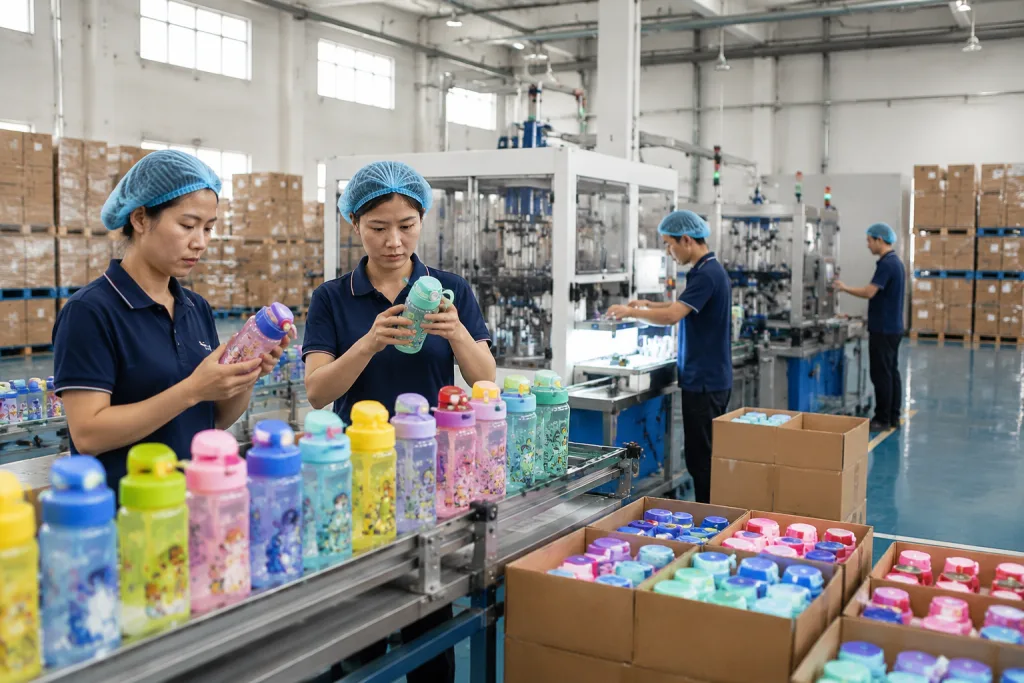
Key Takeaways
- For school use, 350-500 ml and body diameter under 75 mm usually reduce fit and handling complaints by 15-20%
- A practical MOQ for custom kids water bottle orders from Zhejiang, China is often 3,000 pcs per color, with 25-35 day production after sample approval
- Choose PP or Tritan lids with silicone seals tested to REACH/LFGB/FDA; leakage claims often trace back to gasket compression, not the bottle body
- Silkscreen is lower cost at roughly USD 0.08-0.18 per color, while laser or UV print can cut logo wear complaints on high-use bottles
You rarely lose a school or retail program because the bottle photo looked weak. You lose it in the spec sheet. We have seen straw lids leak after a 1.2-meter drop test into a backpack, bottle bodies miss classroom cup holders by 3 mm, and printed graphics start failing well before 50 dishwasher cycles. One EU importer even kicked back a file because the compliance pack was missing one test page. For kids bottle promotional products, this is the wrong question to ask: not “Does it look good?” but “Do all the specs work together on the line and after shipment?”
At our children water bottle factory in Zhejiang, China, we see the same problem again and again from school district buyers and importers in Europe and North America. Two bottles can look almost identical on screen and still come in 20% apart in weight, 0.3 mm apart in wall thickness, and 15-25 days apart in lead time. QC pulled samples last month where the PO said 63 mm base diameter, but the approved drawing was 66 mm. Small typo, big headache. If you are buying a bulk children water bottle program, those gaps hit freight cost, complaint rate, and repeat orders fast. We ship enough of these to know: the math doesn't work if the factory treats kids bottles like a standard promo tumbler.
Start with size and capacity
For school and promo orders, size is the first spec that changes the result. Buyers often start from shape or color, then the complaints show up later on capacity, diameter, and net weight. On our line, the working range for a bulk school bottle is usually 350 ml, 450 ml, and 500 ml. Below 350 ml, older kids say it does not last through the school day. Above 600 ml, younger users struggle with one-hand grip, extra bag weight, and desk space. We have seen a 620 ml sample get rejected in a school bid for that exact reason.
For a custom children water bottle program, ask for four numbers, not one: capacity, body diameter, bottle height, and net weight. That is the right question. A 500 ml bottle with a 72 mm diameter is not the same item as a 500 ml bottle with an 80 mm diameter. The wider body sits better on a desk, but the buyer flagged it when it would not fit the side pocket on a standard school bag. We usually check this with a go/no-go sleeve at the sample table. For school district tenders, we usually suggest:
- 350-400 ml for kindergarten and lower primary
- 450-500 ml for primary and middle school
- Body diameter 65-75 mm for easier grip
- Net weight 110-180 g for single-wall plastic models
If you are buying children water bottle wholesale for a promotion, weight changes freight cost fast. A 35 g increase across 20,000 units adds 700 kg before cartons and pallets. The math does not work if you ignore that. It is enough to shift sea freight and warehousing numbers, and we ship these orders by the container, not by guesswork. At BottleForge Industrial in Zhejiang, our kids bottle MOQ typically starts at 3,000 pcs per model per color, so a small unit increase becomes a real cost on the PO.
A good kids bottle spec balances child handling, carton efficiency, and freight cost. If one number looks off, the total landed cost usually follows.
Material choices and wall thickness
Buyers ask for the “safest” kids bottle all the time. That is the wrong question to ask. The right spec depends on where the bottles will be sold, which test standard applies, and what unit price the project can carry. For kids bottle promotional products, we usually run 4 material routes: PP, Tritan, food-grade stainless steel 18/8, and glass with a silicone sleeve for older children only. For school giveaways, plastic wins in most POs because breakage claims stay lower and the math works at 3,000 pcs MOQ.
Tritan is a common pick for a custom kids bottle because buyers want a clear body and the line can hold good drop performance with the right thickness. PP is the lower-cost option for opaque bodies and lids, and it molds cleanly on standard injection tools. Stainless steel lasts longer in repeated use, but once you move to double-wall vacuum, freight weight and unit cost jump fast; one 500ml sample at 298 g tells the story. Ask for wall thickness in mm, not only the material name. A Tritan body at 1.2 mm feels different from 1.5 mm in hand, and QC pulled samples before where the body flex was the first buyer complaint. Typical useful ranges:
- PP body: 1.5-2.0 mm
- Tritan body: 1.0-1.5 mm
- Single-wall stainless body: 0.4-0.5 mm
- Double-wall stainless outer/inner: 0.4/0.3 mm or similar
If you buy from children water bottle suppliers in China, ask whether the resin grade and color masterbatch are traceable lot by lot. Ask for the lot record, not a sales promise. This matters when a food-contact declaration has to match the production batch, or when the buyer flagged an odor issue on one shipment and not the next. Also confirm whether the body and lid use virgin material only. In children water bottle customized projects, mixed regrind might save a small amount per piece, but we have seen this go sideways with shade variation, black specks, and smell after hot-water filling.
For a children water bottle distributor or importer, the practical build is often a clear Tritan body, PP lid, and food-grade silicone seal. It shows the logo well, keeps cost under control, and ships with fewer breakage claims than glass. If sustainability is a key tender point, ask your children water bottle factory in China to list recycled content separately and back it with documents. Do not print vague green claims on the carton. We have seen buyers reject outer boxes for that alone, even after the bottle passed inspection at AQL 2.5.
Lid system decides complaint rate
Most bulk kids bottle complaints do not start on the bottle body. They start on the lid set: straw, spout, hinge pin, or silicone seal. On our line, QC pulled a sample last month where the 1.8 mm hinge web whitened before the bottle body showed any issue. A serious children water bottle supplier should show lid cycle data and a leak standard, not just a material report. The lid looks simple on a spec sheet. In daily use, it decides whether the program stays quiet or turns into claims.
For children water bottle promotional programs, the common lid types are screw cap, flip-top straw lid, push-button lid, and sipper spout. For school use, we usually push buyers toward a screw cap with carry loop because it has fewer moving parts and lower complaint risk. A flip-top straw lid is easier for kids, but the line gets more complex fast: more molds, more silicone pieces, more sealing points. We have seen buyers flag a lid assembly with 4 silicone parts because cleaning became a retail complaint. Ask direct questions, not broad ones:
- How many silicone parts are inside the lid assembly?
- What is the leak test method: inverted 30 minutes, vacuum, or shake test?
- What is the hinge life test target: 3,000, 5,000, or 10,000 cycles?
- Can the straw be removed for cleaning?
- Is the bite valve soft silicone or rigid PP?
For custom school water bottle tenders, we normally recommend a leak standard of no visible leakage after inverted 30 minutes and a random shake test at room temperature. For children water bottle custom orders headed to retail, ask for a drop test too: 1.0-1.2 m with water filled, 3 drops on different sides. This is not over-spec. It is the basic check. We run drop tests with the bottle filled to the nominal volume, and the weak point is often the hinge ear or latch, not the body. A lid that passes only static testing can still crack after 3 real playground drops.
Do not ignore spare parts policy. If you are working with children water bottle vendors or children water bottle distributors, a 1-2% free spare lid allowance on larger orders cuts after-sales friction fast. The math does not work on full bottle replacement if the problem is one small lid part. On a 10,000 pcs order, 100 spare lids is cheap insurance, and we ship them in an outer carton marked by lid color so the warehouse does not mix SKUs. This spec line looks boring. It saves arguments later.
Safety paperwork buyers actually need
For kids products, compliance is not a marketing extra. It decides whether we ship. School district buyers, importers, and any children water bottle vendor need the document list nailed down before tooling and sampling move too far. On our line, this usually starts with a signed spec sheet and PO check at sample approval. The file set changes by market and bottle build, but “food grade” on its own is the wrong answer.
For Europe, buyers usually ask for REACH and LFGB-related food-contact testing where applicable. For North America, FDA food-contact compliance is standard, and some programs also ask for CPSIA-related checks on coatings or accessible parts. If the bottle is sold as a children’s consumer product, warning label review and age grading may sit on the checklist too. For stainless steel models, ask for the steel grade declaration, usually 18/8 or SUS304 for contact surfaces. For plastic models, ask for resin identification and migration test references. QC pulled one sample last month where the lid resin on the BOM did not match the lab submission, and that sort of mismatch is exactly what delays approval.
A competent children water bottle manufacturer should also understand factory process standards. Buyers usually check the boring parts first, and that is fair. We run those checks before bulk starts:
- AQL inspection standard, often 2.5 major / 4.0 minor
- BSCI or equivalent social compliance if required by brand policy
- ISO-based quality process or internal traceability system
- Third-party lab reports tied to actual SKU construction
If you are sourcing a custom logo kids bottle from Zhejiang or elsewhere in China, make sure the test report matches the final decoration and color. A bottle body that passes in clear natural material does not automatically cover an opaque printed version. We have seen importers lose 10-14 days because testing had to be repeated after a last-minute color change; one case stretched from 12 days to 24 because the buyer flagged a new Pantone after sample sign-off. On the factory floor, that usually means the silk-screen plate is already made and the lab sample is now obsolete. For children water bottle manufacturers, best practice is simple: lock artwork, resin color, and accessory list before sending samples for formal tests.
You do not need every possible certificate. You need the right documents for your market, matched to the actual finished bottle, before mass production is more than 30% through. We have seen this go sideways when a PO typo changed the straw lid code after testing.
Decoration methods and logo durability
With kids bottle promotional products, logo decoration drives resale value and complaint rate at the same time. Buyers often look only at print cost per piece. That is the wrong question to ask. The real check is whether the logo still looks clean after 30 school-bag rub cycles, top-rack dishwashing, and daily hand contact around the grip zone. The methods we run most often are silkscreen, heat transfer, UV print, water transfer, and laser engraving on metal surfaces.
For a bulk kids bottle order, silkscreen is still the cleanest choice for artwork with 1-2 spot colors. Typical added cost is around USD 0.08-0.18 per color depending on size and position. It runs fast on the line, and registration is easier to hold with a steel screen fixture, but the ink system has to match the substrate or the print will scratch. We have seen PP bodies pass tape test and still fail after bag abrasion. UV print gives better gradients and small detail, usually at USD 0.20-0.45 per unit depending on coverage. Heat transfer works for full wrap graphics, but ask for adhesion data and dishwasher resistance data before you approve the sample.
For children water bottle customizable designs aimed at school identity programs, ask your factory for:
- Maximum print area in mm
- Logo position tolerance, often +/- 2-3 mm
- Pantone matching method
- Abrasion test standard
- Dishwasher recommendation: top-rack only or hand wash
If your project is a custom made kids bottle for a district fundraiser or museum gift shop, keep artwork away from seam lines, heavy curvature, and finger-contact zones. That one layout decision cuts scuffing complaints fast. QC pulled the sample last month on a 500 ml body because the logo crossed a mold parting line and the buyer flagged edge lifting after 12 days of use. For stainless products, laser marking has strong permanence but less color impact. For plastic, a molded logo lasts longer than print, but the math does not work on small runs because tooling cost needs larger volumes to make sense.
Children water bottle wholesale buyers sometimes ask for each bottle to carry an individual student name. Yes, we ship those jobs with variable data labels or digital print. They also create handling risk. A typo on one Excel name list can turn into 300 wrong bottles, so build in at least 5-7 extra production days and lock the final spreadsheet before production starts. If you are shipping to Amazon or other retail channels, confirm barcode placement and FNSKU labeling at packing stage, not after production, because relabeling 24 bottles per carton after sealing is where this goes sideways.
Packing, MOQ, and freight math
First-time buyers often leave packing to the last line on the spec sheet. That is a mistake. Packing drives carton drop performance, warehouse handling, and freight cost. A children water bottle distributor supplying schools may choose bulk pack to cut unit cost by USD 0.08-0.15. A retail importer may need an individual color box with a barcode panel sized to 50 × 30 mm. Same bottle, different packing, different job on the line.
For a bulk children water bottle shipment, common packing formats are:
- 1 pc per polybag, 24 or 48 pcs per export carton
- Egg-crate divider for printed or coated bottles
- Individual kraft box for retail or gift programs
- Barcode sticker on unit, inner, and outer carton
Ask for outer carton size, gross weight, and loading quantity per 20GP and 40HQ. Get the numbers before you compare unit price. We ship cartons at 58 × 39 × 42 cm every week, and 1.5 cm of wasted headspace adds up fast. A bottle that saves USD 0.06 on unit price can still land higher if carton efficiency is poor. If one design loads 18,000 pcs in a 20GP and another loads 22,000 pcs, the math does not work in favor of the cheaper quote on a 30,000 pc run.
MOQ also needs a hard read. A children water bottle supplier may quote 3,000 pcs MOQ, but that often means one color, one print position, one logo file. We have seen POs with a typo that turned 1 logo into 4 logo versions, and the buyer flagged the upcharge after sampling. If you split into 4 colors with separate logos, the effective MOQ may become 1,000 pcs per color only if stock components are available. For fully custom children water bottle customized projects with new mold parts, practical MOQ can jump to 5,000-10,000 pcs. This is the wrong question to ask: “What is your MOQ?” Ask instead, “What is the MOQ by color, lid, print, and packing?”
From Zhejiang, China, a realistic lead time for repeat models is often 25-35 days after deposit and pre-production sample approval. New mold or heavy customization can push that to 45-60 days. During peak season before back-to-school, add another 7-10 days. We run into delays on small lid parts more than bottle bodies; one silicone valve at 2.3 mm can hold the whole order. If you work with children water bottle vendors that promise very short lead times, ask whether all parts are made in-house or sourced from several workshops. We have seen this go sideways when one lid component becomes the bottleneck.
Sampling, QC, and reorder control
The safest custom kids water bottle order is the one you lock down before mass production, not the one you argue over after the goods land. Sampling and QC need to match the spec sheet line by line, because complaints usually start with one missed detail: a 2 mm logo shift, a loose straw fit, a cap color signed off from screen art instead of a real part. For school and importer programs, we usually run the sequence like this: digital rendering first, then a blank sample, then a pre-production sample with the actual color and logo, then mass production approval.
For a custom children water bottle order, do not approve from photos alone if the project value is meaningful. We have seen this go sideways. Ask for 1 fully finished sample packed exactly to shipment standard, down to the inner bag and master carton. Then check the real points on the bench, not just the look: cap open-and-close torque, overnight leak test with water, odor after 24 hours sealed, print registration against approved artwork, and whether the carton barcode still scans after a drop test. QC pulled samples before where the PO typo was fixed on the bottle label but missed on the outer carton.
- Open and close torque of cap
- Leak test with water overnight
- Odor after 24 hours closed
- Print registration and color match
- Carton strength and barcode readability
A practical QC plan from a children water bottle factory should cover incoming material control, in-process checks, and final random inspection by AQL. On our line, visual defects, assembly fit, and print quality are usually checked every 1-2 hours, with go/no-go samples kept at the station for comparison. Final shipment inspection then follows AQL 2.5/4.0 or your own standard. If you are a children water bottle distributor supplying schools, ask for age-use notes and care instructions to go into each pack. This is not a small detail. It cuts misuse claims that are not factory defects, like bottles damaged by boiling-water fill on items rated for normal cold-drink use.
Reorder control matters just as much. Once your first bulk kids water bottle run is approved, lock the golden sample, Pantone references, packaging spec, and approved BOM in one file set. Keep the same SKU code for identical builds, and open a new code if you change the lid, seal, print method, or resin color. The wrong question is “Can we use the old code and just tweak it a bit?” That is how batch drift starts. We ship repeat orders smoother when the old sample is taped, dated, and stored in the sample room rack with the signed approval sheet.
At our Hangzhou, Zhejiang operation, repeat buyers usually care less about saving USD 0.03 on the ex-works price and more about getting the same bottle again in 30 days without surprises. That is the real value of a clear spec sheet. The math doesn't work if one cheap reorder turns into a school complaint, a relabel job, and a delayed container.
Send your kids bottle spec for a factory review
Share capacity, material, logo, target market, and quantity. We will review feasibility, MOQ, compliance, and lead time before you commit tooling or artwork.
Frequently asked questions
What is a normal MOQ for custom kids bottle orders?
For a standard stock model with custom print, 3,000 pcs per color is a realistic starting MOQ from many children water bottle manufacturers in China. If you use an existing bottle with one-color silkscreen, some factories can support 1,000-2,000 pcs, but unit price will be higher. For a custom made kids bottle with new mold parts, silicone colors, or exclusive lid tooling, MOQ usually moves to 5,000-10,000 pcs. Always ask whether MOQ applies per model, per color, per logo, or per shipment. Those are not the same thing, and misunderstanding them causes delays when you split one order into several school colors or retail assortments.
Which material is best for a bulk school water bottle program?
For most school programs, clear Tritan body with PP lid and silicone seal is the most balanced option. It gives good clarity, decent impact resistance, and a manageable unit weight, usually around 120-170 g for 450-500 ml. PP-only bottles can reduce cost further, especially for opaque colors, but they look more basic. Stainless steel is stronger and more premium, yet a vacuum model can double or triple unit cost and add weight. If your priority is low complaint rate and broad age suitability, start with 450-500 ml Tritan, 70-75 mm diameter, screw or simple flip lid, and full REACH/FDA support from your children water bottle supplier.
How long does production take for children water bottle customized orders?
If you choose an existing model and only add custom logo and color, normal lead time is 25-35 days after deposit and pre-production sample approval. During back-to-school peak, add 7-10 days. If your order includes new tooling, special packaging, or variable data names, lead time can extend to 45-60 days. Sampling usually takes 5-10 days for a print sample and 15-25 days if a new mold insert is required. Buyers in Europe and North America should also add lab test time if reports are not already valid for the final construction. The safest schedule is to lock artwork, compliance needs, and carton marks before mass production starts.
What compliance documents should I ask from a children water bottle factory?
Ask for documents based on destination market and actual bottle construction. For Europe, REACH and relevant food-contact testing are common; for many buyers, LFGB-related testing is also requested. For North America, FDA food-contact compliance is standard, and some children’s programs may need additional checks depending on coating or accessible components. Also request material declarations for Tritan, PP, silicone, or 18/8 stainless steel, plus recent third-party lab reports tied to the same lid, seal, color, and print method. On the factory side, ask about AQL inspection level, traceability by production lot, and social compliance such as BSCI if required by your policy. Generic old reports are not enough.
How do I reduce leakage and print damage complaints after delivery?
Choose a simpler lid, test the exact finished sample, and control packaging. A screw cap or low-part-count flip lid usually performs better than a complex push-button straw design. Require an inverted 30-minute leak test and a filled shake test on production samples, not just on tooling samples. For print, keep logos away from heavy contact zones, confirm adhesion to the actual substrate, and ask whether the bottle is hand wash only or top-rack dishwasher safe. Add carton dividers or individual polybags if bottles will rub during transit. On larger orders, 1-2% spare lids can be cheaper than handling full replacements. Most complaints come from lid assembly and packing decisions, not the bottle body itself.