Key Takeaways
- Lock material, lid, print method, and compliance first; changing any one after sampling can add 10-18 days
- Typical MOQ for kids bottle private labeling is 3,000 pcs/SKU, with FOB USD 1.55-4.80 depending on PP, Tritan, or stainless steel
- For school programs, ask for REACH, LFGB or FDA contact declarations, CPSIA support, and AQL 2.5 final inspection before shipment
- Silk screen looks cost-effective at 5,000+ pcs, while wrap print or stickers fail faster under dishwasher and playground use
You are not buying a bottle for a shelf photo. You are buying something a six-year-old will drop off a desk, bite on the spout, leave on a 48°C school bus seat, then bring back with juice film stuck inside the shoulder. That changes the buying logic fast. We have seen this go sideways: odor claims after 3 weeks, lids leaking in backpacks, silk-screen print rubbing off after 200 dishwasher cycles, or a school district asking for FDA and LFGB test reports that were never listed on the PO.
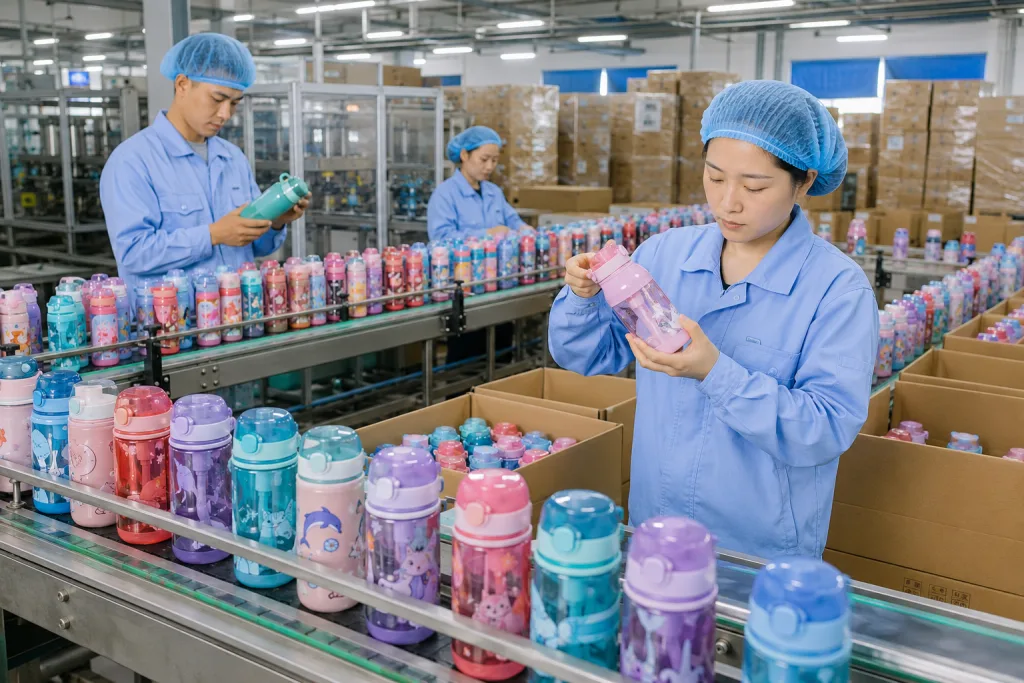
School buyers and importers usually get cleaner results when they lock 4 decisions early: bottle material, lid system, decoration method, and the compliance package. This is the right sequence. Once those are fixed, MOQ, FOB cost, and lead time are easier to quote without back-and-forth from the line. At our Zhejiang, China factory, kids bottle programs usually start at 3,000 units per color and run 30,000 to 80,000 units/month depending on decoration and lid assembly; on assembled straw lids, QC pulled the sample last week because the bite valve gap was 0.6 mm over spec.
Start with four buying decisions
Most mistakes in kids bottle private labeling start too early. Buyers ask about logo position before they lock the bottle build, and we’ve seen this go sideways on the line more than once. For school district tenders and importer programs, decide these four points first. This is the right question to ask.
- Material: PP, Tritan, single-wall stainless steel, or double-wall stainless steel.
- Lid system: straw lid, flip spout, screw cap, or push-button lock.
- Decoration: silk screen, heat transfer, UV print, laser, or molded logo part.
- Compliance package: market-specific tests and factory audit requirements.
These four choices set most of the business result: unit price, breakage rate, leak rate, carton size, and freight cost. On one 450 ml school order, the buyer flagged FOB first and stayed with simple PP construction at 5,000 pcs MOQ. On a North America retail project, the spec moved to Tritan body, child-safe silicone straw, hangtag, color box, and barcodes after QC pulled the sample and checked the fit on a 6 mm straw bore. Same bottle category on paper. Different job in the factory.
The trade-off is straightforward. Add more moving parts, and assembly time, defect risk, and tooling cost all go up. A basic 450 ml PP bottle with carry loop and one-color silk screen can ship in 25-35 days after sample approval. A custom kids water bottle with push-button lid, overmolded handle, two-color print, and retail packaging often needs 40-55 days. In Zhejiang, China, that is standard because springs, silicone straws, and printed cartons usually come from 3 separate qualified suppliers, and incoming QC checks each batch before we run.
If you buy for schools, pick durability over extra features. If you import for retail, add differentiation only where it survives real use. Kids are rough on bottles. We’ve had a buyer ask for a fancy lock lid, then reject it after a 500-cycle hinge test showed stress marks near the pin. The math doesn’t work if the bottle looks good in a catalog but fails after 20 days. A plain design with a 0.3% complaint rate usually makes more money.
Choose the bottle body wisely
The body material decides your cost floor and your complaint rate. Buyers sourcing bulk kids bottle or bulk school water bottle usually stack up three options first, and this is where the math starts. On our line, the first thing we check is bottle weight in grams against the approved sample, because 6-8 g missing from the body usually shows up later as dents, warp, or drop-test failure.
PP plastic
PP is the low-cost choice for promotions and short school programs. Light. Easy to mold. Color matching is also straightforward, especially for bright caps and bodies. Typical FOB for a 400-500 ml PP bottle is around USD 1.55-2.20 at 5,000 pcs. The weak point is surface feel and appearance after use: scratches show fast, clarity is lower, and the bottle does not look premium in hand. We have seen buyers push for thinner walls to save USD 0.04 per piece, then QC pulled the sample after a drop test and the whitening marks were obvious around the shoulder.
Tritan copolyester
Tritan is a common pick for children water bottle custom projects that need clear appearance, better odor resistance, and cleaner retail presentation. A 450-600 ml Tritan bottle often lands around USD 2.10-3.10 FOB at 3,000-5,000 pcs, depending on lid complexity. For a lot of children water bottle wholesale buyers, this is the best price-to-shelf-look option. We run these with tighter appearance checks because any gate mark, black speck, or flow line shows through the body right away; one black dot under 1 mm is enough for the buyer to flag it on transparent colors.
Stainless steel
Single-wall 18/8 stainless works if you need better impact resistance and a stronger shelf look. Double-wall vacuum bottles cost more and add weight fast, usually USD 3.60-4.80 FOB for common kids formats. For younger users, weight is the wrong thing to ignore. A 350 ml insulated bottle may already be enough. Bigger is not always better if a child carries it to school every day. We have seen 500 ml vacuum bottles hit 320-380 g before packing, and some school buyers came back with the same complaint: too heavy for small backpacks.
Ask for wall thickness data, not just material names. A stainless outer wall at 0.4 mm and inner at 0.3 mm behaves differently from a 0.5/0.4 mm build. For Tritan and PP, ask body weight in grams and drop-test conditions. Ask the drop height too—1.0 m onto vinyl tile is not the same as 1.2 m onto concrete. A serious children water bottle manufacturer or children water bottle factory should give you both. If they cannot, they are selling pictures, not process control.
For school use, the safest commercial choice is usually a 400-500 ml Tritan or PP body with simple straw or screw lid, not a large insulated bottle with many assembled parts.
Lid design decides complaint rate
Buyers spend time on body color, then the complaints land on the lid. That is the pattern. In our after-sales records for bulk kids water bottle orders, most leak claims trace back to the top assembly: straw seals rolled during assembly, hinge pins wearing out, silicone sitting proud by 0.5 mm, or cap threads starting off-angle on the line. The bottle body is rarely the issue. The buyer flagged a “bad bottle” once, and QC pulled the sample in 2 minutes—the leak was from a twisted straw gasket.
We usually see four lid routes on kids programs.
- Screw cap: lowest risk and simpler tooling. Fewer moving parts, easier washability, lower complaint rate. Good fit for younger users and school tenders where the math on returns does not work.
- Flip straw lid: easier for kids to drink from one-handed, but the seal stack gets more sensitive. Parents ask cleaning questions, and we check straw fit with a go/no-go gauge at assembly.
- Push-button lock lid: stronger shelf appeal, more parts inside, more things to miss on the line. Spring force and latch tolerance need tight control, or this setup goes sideways fast.
- Chug spout: better for older kids and simpler than a full straw system. Some schools still push back on exposed spouts for hygiene, so covered versions ship better in those accounts.
If you are sourcing from children water bottle suppliers or a new children water bottle vendor, ask for three hard checks: cycle test count, leak test method, spare-part control. We run 3,000 open-close cycles for flip and button lids as a baseline, and 100% of finished goods should pass a vacuum or inverted leak test. Our standard on one line is a 30-minute inverted test plus random 80 cm drop tests with water fill. This is the right question to ask, not “Can you match this lid shape?”
For children water bottle customizable projects, keep custom changes away from the sealing area. Put the logo on the body, cap badge, or handle tab. Leave the thread and gasket zone alone unless your annual volume can pay for 2 to 3 validation rounds, fresh molds, and leak re-testing. We have seen one PO with a cap-thread revision slipped in as a typo, and it cost 12 days instead of 3 for sample confirmation.
A reliable children water bottle supplier in China should tell you the silicone hardness used on the seal, often around 50-60 Shore A for bottle gaskets, and they should answer without guessing. If the reply is vague, expect batch-to-batch drift. Lid performance comes from tolerance control, assembly training, and outgoing inspection. On the floor, that means torque checks, gasket fit checks, and QC signing off AQL 2.5 before we ship.
Decoration must survive rough use
Logo decoration on a custom kids bottle has to match rough daily use, not just the render on a screen. School bottles get dragged across desk edges, dropped with a 0.6 kg lunch box, and scrubbed hard after juice or milk. We have seen pretty finishes fail after one week on the line test, so this is the wrong place to chase looks first.
For most custom logo kids bottle orders, the practical ranking is:
- Silk screen: best value for clean 1-2 spot colors, stable for 3,000 pcs upward, and easier to control on the line with a steel screen and fixed Pantone ink mix.
- Heat transfer or wrap print: better for full graphics, but the curing window is tight; QC pulled the sample on one school order because the film edge lifted after 50 tape pulls.
- UV print: sharp detail and good for short runs, usually with higher unit cost; if surface prep is weak, chips show fast around the shoulder radius.
- Laser marking: durable on stainless only, limited color effect, and usually cleaner on 304 stainless with a brushed finish than on coated bodies.
- Molded logo insert: the most durable option, but it needs tooling, sample approval, and volume commitment; below 5,000 pcs, the math doesn’t work for most buyers.
For a custom made kids bottle heading into schools, one-color or two-color silk screen on a slightly textured body usually holds up best. We run cross-hatch tape adhesion checks and wash simulation before mass production, and a decent Zhejiang factory should show that data, not only a mockup. If you need mascot art or educational graphics, ask for the test standard, number of cycles, and whether the print passed after backpack rub testing.
Do not assume dishwasher-safe means print-safe. The bottle body might survive top-rack washing, while the logo starts fading first after 12 days vs 18 days in two different ink systems we tested last season. For a children water bottle promotional product, that may be acceptable. For a children water bottle distributor supplying school districts or museum shops, the buyer will flag print wear fast, and repeat orders get hit first.
Packaging should match the sales channel. A children water bottle customized retail pack with window box, insert card, suffocation warning bag, and FNSKU label can add USD 0.28-0.65 per unit; we have also seen a PO typo where the buyer asked for 4-color box print on an item meant for plain carton shipment. Plain export carton with opp bag may add less than USD 0.08. Buyers chasing low FOB often over-spec packaging the end customer throws away in 10 seconds.
Compliance is not a paperwork afterthought
For kids products, compliance needs to be on the table before sampling starts, not 7 days before shipment. EU importers and North American school buyers usually ask for a market-specific file covering materials, food-contact safety, and product construction. This is where weak suppliers get exposed. A serious children water bottle manufacturer knows the gap between standard drinkware testing and children-product documents, and the line should know it before the first pre-production sample is built.
Common checkpoints include REACH for Europe, LFGB or food-contact declarations where required, FDA-related material declarations for the US market, and CPSIA support when the item is treated as a children’s product with relevant substrate and coating concerns. If the bottle has a strap, silk-screen print, or a decorative badge, ask what the lab tested item by item. We have seen QC pull a sample and find the raw body passed, but the printed logo ink and silicone seal were never included. That is the wrong question to ask: not “do you have a report,” but “what exact parts are covered on the finished unit?”
Ask your children water bottle distributors or factory for these specifics:
- Which lab runs the test and whether it is ISO 17025 accredited
- Whether reports are on finished goods or only on materials
- Date of reports; older than 12 months is often weak support for active programs
- BSCI, Sedex, or relevant social compliance status if your customer requires it
- AQL level used for pre-shipment inspection, usually AQL 2.5 for major defects and 4.0 for minor defects
If you are comparing children water bottle manufacturers in China, watch who can send a clean technical file in 24 hours instead of 4 days. That usually means tighter internal control. At BottleForge in Zhejiang, China, sample approval to mass production normally includes BOM lock, approved artwork, carton drop spec, test plan, and barcode list, and our team checks carton size down to 5 mm before we release the PO. It is boring paperwork. It saves money. We have seen one typo on a barcode list hold up a full school order.
For school tenders, ask if replacement lids or straws can be supplied for 1-2 years. Compliance matters, field service matters too. Buyers have flagged this after one semester when a straw valve tears and there is no spare stock. A bottle program does not fail in the lab only; it fails when spare parts are gone and the math does not work for the distributor.
MOQ, costing, and timeline trade-offs
Private-label buyers ask for the same 3 things on kids bottles: low MOQ, 6-8 colors, and fast lead time. The math doesn’t work on all three at once. On our line in Hangzhou, if you cut MOQ from 5,000 pcs to 3,000 pcs and still want custom lid colors, lead time usually moves from about 30 days to 38 days because color matching, material prep, and packing setup stop being efficient. That is the day-to-day reality for children water bottle bulk purchasing from China.
Typical structures look like this:
- Existing mold, standard color, one-color logo: MOQ 3,000 pcs per SKU, sample 5-7 days, bulk 25-35 days
- Existing mold, custom Pantone body and lid, custom packaging: MOQ 3,000-5,000 pcs, sample 7-12 days, bulk 30-40 days
- New color combinations across multiple lids: MOQ 5,000 pcs total with color split conditions, bulk 35-45 days
- New mold or major lid modification: tooling 20-35 days, T1/T2 sampling extra, bulk usually 50-70 days after approval
For a bulk school water bottle purchase, FOB unit price is the wrong first question. Check landed-cost drivers line by line: carton pack-out, net weight in kg, CBM, and defect allowance under your claim terms. We have seen a 500 ml stainless bottle come in at USD 1.40 above a Tritan version, then add another freight hit because master cartons jumped from 0.048 CBM to 0.061 CBM. If the school budget is fixed, that hits fast.
If you sell through retail or ecommerce, count the handling jobs too. Inner carton labels, carton marks, barcode stickers, FNSKU, and drop-test packaging all take hands on the packing table. QC pulled the sample on one order last year because the buyer flagged a PO typo on the carton mark, and 12,000 stickers had to be reprinted. A children water bottle vendor with a low FOB price may not be carrying that labor in the quote.
The clean way to compare offers is a line-by-line quote: body, lid, straw, seal, decoration, packaging, testing, plus spare parts with unit price. Ask for it early. If you later need a custom school water bottle program with name personalization, you can see whether the cost sits in the bottle, the print process, or the repacking step instead of guessing. We have seen this go sideways when buyers approve a total price but never check the seal or spare-straw cost.
If your annual forecast is above 30,000 units, lock in accessory support and reorder terms at the start. Ask about spare lid MOQ, extra straw ratio, and whether repeat orders can run with the same carton artwork without a new plate charge. On one school program, we ship 3% spare straws with each batch because that solved the buyer’s after-sales issue better than arguing over claim credits. That is where a good children water bottle supplier stops being just a one-off factory source.
Get a practical kids bottle quotation fast
Send your target market, capacity, lid type, and logo file. We will recommend the right construction, MOQ, test plan, and lead time from Zhejiang, China.
Frequently asked questions
What MOQ is realistic for kids bottle private labeling?
For existing molds, 3,000 pcs per SKU is a practical starting point in China. Some factories will say 1,000 pcs, but that often means higher unit cost, limited color choice, or mixed leftover components. For school district programs, 3,000-5,000 pcs usually gives better control over Pantone matching and packaging. If you want custom body color, custom lid color, logo print, and retail box, expect 5,000 pcs to be more efficient. New molds or custom functional parts normally need a larger volume commitment or separate tooling fees.
Which material is best for a custom kids water bottle order?
For most buyers, Tritan is the safest middle-ground choice. It gives better clarity and odor resistance than basic PP, while staying lighter and cheaper than stainless steel. A 450-500 ml Tritan kids bottle usually lands around USD 2.10-3.10 FOB at 3,000-5,000 pcs. PP works when budget matters most and the program is promotional. Stainless steel makes sense for premium retail, but a child carries the extra weight every day. If the bottle is for schools, simple Tritan or PP with a low-risk lid usually performs better than overbuilt insulated styles.
What tests and documents should school buyers ask for?
At minimum, ask for material declarations and finished-product test reports relevant to your market. For Europe, REACH and food-contact documentation are common checkpoints. For North America, buyers often ask for FDA-related material support and CPSIA-related documentation if the bottle is sold as a children’s product. Also ask for AQL inspection standards, usually AQL 2.5 major and 4.0 minor, plus leak-test and drop-test methods. If your organization requires social compliance, request BSCI or Sedex status before you approve the factory, not after production starts.
How long does a bulk kids water bottle order usually take?
If you use an existing mold and standard structure, pre-production sample time is usually 5-12 days depending on logo and packaging. Mass production then takes about 25-40 days after final sample approval and deposit. If you change lid components, request special colors across several parts, or add retail packaging with inserts and labels, add 5-10 days. New tooling or major engineering changes can push the total project to 50-70 days. Buyers who lock artwork, carton marks, and barcode files early usually save at least one week.
Should we choose straw lids or simple screw caps for school programs?
If your priority is the lowest complaint rate, choose a simple screw cap or a basic covered spout design. Straw lids are convenient, but they bring more parts: straw, bite valve or nozzle, silicone seal, and cleaning concerns. That means more leak risk and more spare-part requests. For younger students, simple usually wins. For older children or retail programs, straw lids can work well if the factory has documented cycle testing and 100% leak testing. Ask for at least 3,000 open-close cycles and an inverted leak test on finished goods before shipment.