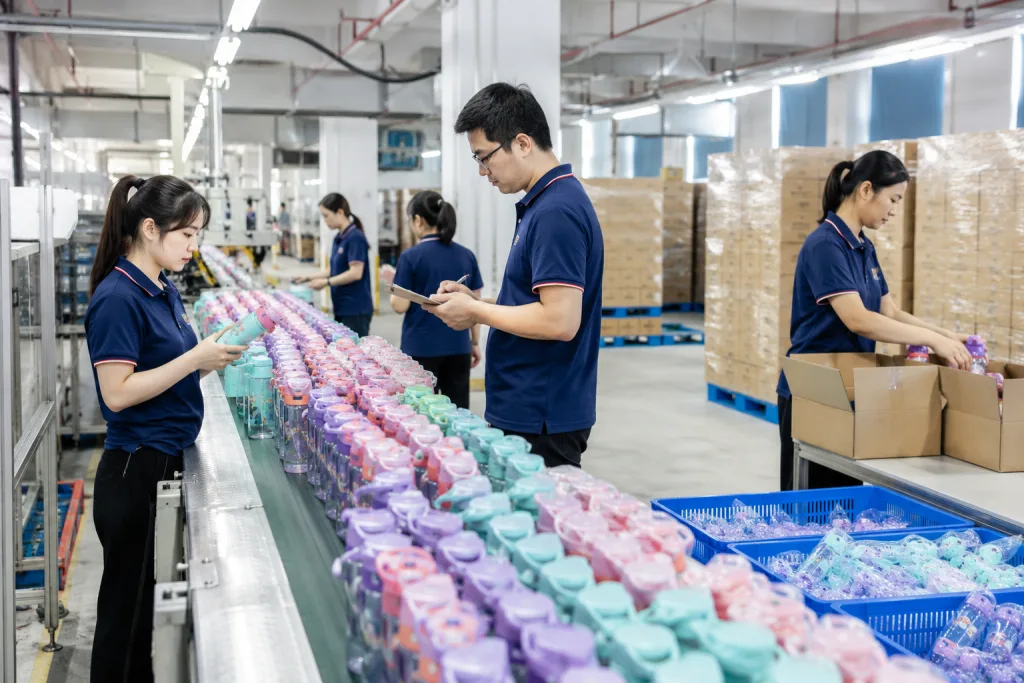
Key Takeaways
- For most school programs, 350-450 ml Tritan bottles with flip-straw lids hit the best balance of safety, weight, and FOB cost at 5,000 pcs MOQ
- 304 stainless vacuum kids bottles cost about USD 2.80-4.60 FOB versus USD 1.10-1.95 for single-wall Tritan, but cut condensation and improve cold retention by 6-12 hours
- Artwork and sample approval usually adds 5-7 days; mass production for kids bottle private label is commonly 25-35 days after deposit in Zhejiang, China
- Use AQL 2.5 for major defects and 4.0 for minor defects, with leak testing at 100% and migration compliance to REACH, LFGB, and CPSIA/ASTM where required
If you buy for schools or import kids products, the wrong bottle creates noise fast: leaking lids, odor complaints, broken straws, late artwork approval, and a carton size that wrecks your freight math. We have seen one 3 mm carton oversize push a buyer from the planned pallet pattern to a worse loading plan, and the math doesn't work after that. A kids bottle private label program looks simple until you have to balance child safety, age fit, compliance, decoration durability, and landed cost on the same PO.
You do not need vague sourcing advice. You need a practical way to compare a custom kids bottle for classroom use, retail shelves, or promotional distribution. From our factory in Zhejiang, China, we usually see buyers cut the shortlist after QC pulled the sample and checked three points on the line: material, lid system, and decoration method. Get those right, and the project moves faster—12 days for sample approval instead of 18 is common. This is the right place to start.
Start with the use case
School district buyers and kids-product importers often open with a bulk kids water bottle quote request. That is the wrong question to ask. A 380 ml bottle for a first-grade campus program runs on different logic than a bottle for museum gift shops, licensed merchandise, or a supermarket back-to-school promo. Before you compare a children water bottle manufacturer or children water bottle supplier, pin down the actual use case. On our side, we start with the sample table, caliper in hand, because 12 mm more height can decide whether the bottle fits a lunch bag pocket or gets returned.
- School daily use: weight, leak resistance, dishwasher tolerance, name-label area, and easy drinking drive the spec. Premium packaging does not. We usually see buyers ask for at least a 25 x 60 mm flat print area for student names.
- Retail private label: shelf appeal, Pantone accuracy, hangtag or color box, and margin target drive the decision. The buyer flagged one PO last season because the lid color was off by one shade under store lighting, so this part needs plain talk.
- Promotional distribution: FOB price, lead time, and transit breakage rate decide the order. If the drop-test math does not work on a 24-bottle export carton, the concept goes sideways fast.
For most bulk school water bottle projects, buyers in Europe and North America land on a 350-450 ml body, under 220 g total weight for plastic, and a carry handle that small hands can grab without slipping. We run fit checks with actual lunch bags from the market, not just CAD drawings. For retail, 500 ml can work, though many parents still buy the shorter bottle that fits backpack side pockets better; on the line, that usually means trimming body height by 15-20 mm instead of chasing headline capacity.
At BottleForge Industrial in Hangzhou, Zhejiang, we ask four things before quoting a custom children water bottle: age group, target market, compliance standard, and annual forecast. Those four inputs change the mold call, wall thickness, carton packout, and decoration method. QC pulled the sample on one 3-6 years program because the straw bite area felt too stiff for small kids, and that is exactly why a buyer sourcing a children water bottle wholesale program for 3-6 years old should not get the same recommendation as a buyer sourcing for teens.
You are not buying a bottle shape. You are buying a failure rate, a landed cost, and a user experience.
Head-to-head on core bottle specs
Compare a custom kids water bottle line with a spec table first. It cuts the sales pitch fast. On our side, QC pulled the sample and checks body weight on a digital scale before we even discuss decoration, because 15 g up or down changes both feel and freight.
Typical private label comparison
- Tritan single-wall: 350-500 ml, 2.0-2.5 mm body wall, 120-180 g, FOB USD 1.10-1.95 at 5,000 pcs. Best for school programs and value retail. We run this a lot for back-to-school orders because the bottle stays clear after drop tests better than basic PP.
- PP bottle: 350-500 ml, 1.8-2.2 mm wall, 90-140 g, FOB USD 0.85-1.50 at 10,000 pcs. Lowest entry price, with lower clarity and a less premium hand feel. Buyers still use it for giveaway projects where the math on Tritan does not work.
- 304 stainless single-wall: 350-500 ml, inner 0.4 mm / outer 0.4 mm, 170-240 g, FOB USD 1.90-3.20 at 3,000 pcs. Better durability, no insulation. The buyer usually likes the shelf look, then flags the higher carton weight after we send the packing sheet.
- 304 stainless vacuum: 350-500 ml, inner 0.4 mm / outer 0.45-0.5 mm, FOB USD 2.80-4.60 at 3,000 pcs. Best for premium retail and colder drinks. On the line, vacuum units need tighter weld control, so lead time and QC points both go up.
For a children water bottle bulk order, Tritan usually wins because it stays transparent, takes impact well, and keeps unit weight low enough for kids to carry all day. A 450 ml Tritan bottle at 135 g feels different from a 450 ml stainless one at 210 g. That gap matters in school use. It is the standard pick when a district wants a custom school water bottle for daily carry. Stainless fits premium shelves better and cuts odor complaints, but freight jumps and we have seen dent claims after drops on concrete from 1.2 m.
Lid style changes the result as much as body material. This is where buyers often ask the wrong question. They ask which lid looks better, but after-sales usually depends on part count and cleaning. A straw lid works well for younger kids, yet it adds silicone parts, a straw tube, and more leak-risk points; on one 8,000 pcs order, the buyer flagged cleaning complaints after first shipment. A spout lid is easier to wash and usually cuts claims by 2-3 points. For high-volume children water bottle promotional campaigns, fewer parts is the safer call.
If you are comparing children water bottle manufacturers in China, ask for exact body gram weight, lid resin grade, and leak test method. Ask for the actual number, not "standard quality." We ship those details in the quote sheet, and our leak test record shows pressure, test time, and sample size. Serious factories in Zhejiang will send them. A supplier that only sends photos and a rough price is not ready for a real private label program. We have even seen POs with the cap color code typed wrong, and that small miss turns into a full remake if no one checks it early.
Which option fits which buyer
Not every children water bottle customized project should use the same build. Buyer type decides the spec. On our line, the same 400 ml body can run two ways, but the wrong lid choice is what usually gets the buyer flagged at sample stage.
- School district or nonprofit program: Go with Tritan or PP, 400 ml, flip-spout or a plain straw lid, one-color logo, PE bag packing. Keep spare parts to 1 or 2 pieces max. We ship a lot of this format because the math works under budget pressure, and QC pulled fewer leak issues on simple caps than on push-button lids in one recent 5,000 pcs run. This is the safest route for a bulk children water bottle order.
- Kids brand private label: Choose Tritan with molded character detail or a soft-touch sleeve, 350-500 ml, plus retail hangtag or color box. Leave a clean name area at least 45 x 15 mm if personalization is part of the plan. This is where children water bottle customizable starts making sense on shelf, though we've seen this go sideways when the buyer wants 6 colors at a 1,000 pcs MOQ.
- Gift and promotional importer: Watch landed cost and proofing speed. A simple custom logo kids bottle in PP or Tritan with silk screen is usually enough. We can turn a basic visual sample faster because the screen mesh and logo position are straightforward, and there are fewer carton surprises.
- Premium retail importer: Stainless vacuum with powder coat and laser marking fits this channel if the retail price supports it. If not, this is the wrong question to ask. A 304 stainless body looks good, but if the shelf price cannot carry the added cost, the project stalls after sampling.
For younger children, a lower bottle center of gravity cuts tip-over on classroom desks. Shorter body. Wider base. We usually suggest a base diameter around 70 mm instead of a tall narrow shape. For ages 7+, slimmer bottles sit better in backpack side pockets. If you buy from a children water bottle factory, ask for drop test history and cap torque range, not just capacity. Last month one buyer asked only for 500 ml, then rejected the sample because the lid opening force felt too tight for small hands.
North American buyers often ask for a custom made kids bottle with silicone straw, carry loop, and printed names. It looks good on a mockup. Each extra part adds one more QC point. If your order is 8,000 pcs split into 4 colors, a more complex assembly can push lead time from 28 days to 38 days, and the line changeover is part of that. We have also seen simple PO errors here, like a name list typo that forced reprint on 600 units. For a school calendar deadline, that matters.
A good children water bottle vendor should tell you when to cut the spec back. Honest advice: if the bottle is mainly for school issue, skip metal badges, skip extra moving parts, and put the budget into leak-proof lids and durable print. We see parents notice lid leaks in the first week, not decorative trim. After 30 days of use, that is what children and parents remember.
Safety and compliance are not optional
Buyers sourcing a kids bottle private label program often spend the first 20 minutes on print colors and target price. Wrong priority. For kids products, compliance comes first, and the paperwork depends on where you sell. Europe may require REACH and, depending on market position, LFGB or food-contact declarations. North America may involve CPSIA-related review, California Proposition 65 screening where relevant, and ASTM-aligned testing depending on the product features and age grading. On our side, QC pulled a lid sample last month because the silicone seal hardness was 58 Shore A instead of the approved 60±5 range, and that is exactly why document control matters.
For a children water bottle custom order, ask for these items before deposit or at least before mass production starts:
- Material declaration for bottle body, lid, straw, and seal
- Food-contact test report from a recognized lab
- BPA-free statement tied to actual material grade
- Colorant or masterbatch compliance statement
- Factory audit status such as BSCI or ISO 9001
Testing should match the final product, not a similar bottle from last season. If you change pigment, logo ink, straw supplier, or soft-touch coating, retesting may be necessary. We have seen buyers push back on a new test fee for a lid color change from Pantone 2975 C to 2915 C, but the math does not work if the approved report no longer matches the shipped goods. A solid children water bottle supplier in China will say this clearly. Zhejiang factories that ship export orders every week usually know how retailers, customs brokers, and marketplace teams want the file set arranged.
Quality control should also be written into the PO. For kids bottles, we recommend AQL 2.5 major / 4.0 minor, 100% leak test, random carton drop check from 76 cm, barcode scan verification for retail orders, and odor inspection after 24-hour sealed storage. We run leak test on the line with 0.03 MPa air pressure, and the buyer flagged one PO once because “FNSK” was typed instead of “FNSKU” on the packing note. If you are buying a bulk kids bottle order for Amazon FBA or chain retail, specify FNSKU placement, carton max weight, and suffocation warning format early. Small line items cause missed vessel cutoffs.
Private label decoration without regret
A bottle can pass drop, leak, and migration tests, then die at retail because the logo starts lifting after two weeks in a school bag. For a custom kids bottle, the decoration has to fit the base material and how rough the end use is. We check this on the line with a 3M tape peel test after cure. This is the wrong question to ask: “Which print looks best?” Ask which print still looks clean after 60 days of daily use.
- Silk screen: Lowest setup cost, strong for simple logos, usually USD 0.05-0.12 per color per unit. Best for 1-2 color school and promotional jobs. We run this most on straight-wall plastic bodies because registration stays tighter, usually within about 1 mm if the artwork is simple.
- Heat transfer: Better for full-wrap graphics, usually USD 0.18-0.35 per unit. Good for character artwork but can scratch more easily. QC pulled the sample on one school program after 200 rubs in the carton and the buyer flagged edge wear fast.
- IML or molded graphic parts: Higher tooling and setup cost, better long-term durability on some plastic formats. Best fit is often PP or Tritan-style bodies built for that process, and mold changes are not cheap; we have seen tooling quotes jump by USD 2,000+ for one graphic insert revision.
- Laser engraving: Suitable mainly for stainless options, permanent but less colorful. Good for logos, names, and simple line art on 304 stainless, and there is no ink layer to chip off.
For a children water bottle customized project sold to kids, bright graphics help sell-through. Full-wrap prints bring risk. On curved bodies, we have seen 2 mm registration drift near the seam area, and that turns a nice proof into a complaint. Large prints also hide base-surface scratches until the goods hit store lights. For school issue bottles, a one-color logo plus a writable name panel usually works better than a busy design. The math doesn't work if you spend more on artwork and then lose reorders on durability.
Minimum order quantity changes with decoration. A stock-color body with one-color logo may start at 3,000 pcs. A fully matched Pantone body plus custom mold accessory can move MOQ to 5,000-10,000 pcs. At our Zhejiang, China facility, typical MOQ for an existing bulk kids water bottle model is 3,000 pcs per style, while a fully custom colorway with retail box is usually 5,000 pcs. One factory-floor detail buyers miss: once you add a custom color cap, custom straw, and printed box, the line needs separate material staging by lot number, so small mixed runs get expensive fast.
If you work with children water bottle distributors or multiple school accounts, ask your factory to standardize bottle body and change only the cap color or print. We ship this way all the time because replacement stock stays manageable. One buyer sent a PO with the cap color code typo'd by one digit, and we caught it before injection started; with a new mold program, that mistake goes sideways fast. A flexible children water bottle distributor program should not force you into a new mold every season.
Cost, MOQ, and lead time reality
Most buyers ask for price first. That is the wrong question to ask. For a serious kids bottle private label quote, send target capacity, material, lid type, decoration, packaging, market, and annual volume, or we are just guessing off one sketch and a two-line PO. On our side, the sales sheet also needs bottle height and neck size in mm before the line can check whether an existing mold fits.
Here is a practical FOB China range for existing models from export factories in Zhejiang:
- PP kids bottle: USD 0.85-1.50
- Tritan kids bottle: USD 1.10-1.95
- Single-wall stainless kids bottle: USD 1.90-3.20
- Vacuum stainless kids bottle: USD 2.80-4.60
Those prices usually assume standard export packing, no special insert, and MOQ from 3,000 to 10,000 pcs depending on model. If a buyer wants a custom color box, add USD 0.18-0.45. A spare straw set adds USD 0.06-0.12. A new cap or body tool can run from USD 2,000 to over USD 12,000. The math does not work for a 1,000-piece launch with a fully new mold. We have seen buyers push for “same bottle, new cap only,” then QC pulled the sample and found the hinge life failed at 3,000 cycles, so they went back to an existing platform.
Lead time needs a straight answer. Pre-production sample is 5-7 days for an existing model with logo. Counter sample with packaging is 7-10 days. Mass production is 25-35 days after sample approval and deposit. Before back-to-school, add 7-10 days buffer because the line gets packed and carton suppliers slip. We run around 400,000 units per month for kids and sports bottles, but that number means nothing if artwork approval lands late or the buyer flagged a Pantone mismatch after the first print proof.
If you compare children water bottle vendors, ask whether the quoted lead time includes packaging approval, third-party inspection booking, and export documentation. Ask who books inspection, and at what stage—pre-shipment at AQL 2.5 is common, but some factories quote 25 days and quietly leave that outside the clock. The cheapest children water bottle manufacturers often look cheap because those steps stay vague.
Questions to settle before you place
Before you issue a PO for a children water bottle wholesale or custom children water bottle program, settle the points that usually blow up later. We see the same gaps on the line: a logo position marked “centered” on the PO, no mm callout, then the buyer flags a 3 mm shift on mass production.
- Leak standard: define upside-down time in minutes, hot-fill or cold-only use, and whether the straw vent is allowed to release pressure under heat.
- Cleaning method: state top-rack dishwasher safe or hand-wash only, because PP parts that pass 50°C hand-wash use are not the same as repeated dishwasher cycles.
- Ages and warning copy: lock this early, especially for removable straws and small parts; QC pulled a sample last month where the age grade on the insert card did not match the outer box.
- Packaging level: confirm bulk carton, white box, PDQ, or retail gift box, plus carton drop standard and target gross weight in kg.
- Inspection plan: decide in-line, pre-shipment, or both; if you already run AQL 2.5, write it on the order instead of leaving it in emails.
For a children water bottle factory relationship to work, cut assumptions. This is the wrong question to ask: “Can you match the sample?” Ask for the signed bottle spec sheet instead. Confirm carton dimensions and gross weight. Confirm pantone references. Confirm logo position in millimeters. Confirm whether replacement lids can be ordered later at 1,000 pcs instead of full MOQ. We have seen this go sideways when the first PO says “lid same as approved one” and the approved one has no dated drawing.
The smoothest projects are not always from the biggest buyers. They are from buyers who lock the use case early and keep the spec honest. For a children water bottle customized line for schools, we usually run proven molds, simple 1-color decoration, and compliance files that match the destination market. For a premium custom kids water bottle for retail, spend where repeat sales are won: lid feel in the open-close test, surface finish after tape test, and print durability after 300 dishwasher cycles if that claim is on pack. Cheap decoration and premium positioning do not work. That is the gap between a bottle that ships once and a bottle that reorders.
Get a kids bottle spec review before you order
Send your target capacity, market, logo file, and quantity. We will recommend the right model, MOQ, compliance path, and FOB range within 1 working day.
Frequently asked questions
What is a realistic MOQ for kids bottle private label orders?
For existing models, a realistic MOQ is 3,000 pcs per style for stainless and around 5,000 pcs for Tritan or PP when you want custom colors and logo print. If you accept stock colors with a simple one-color logo, some factories in China can go lower, around 1,000-2,000 pcs, but your unit price will rise by 8-15%. For a new mold, MOQ usually starts at 10,000 pcs and tooling may cost USD 2,000-12,000 depending on lid complexity. If you are a school buyer testing a program, ask for an existing bottle platform first. That reduces both risk and lead time.
Which material is best for a custom school water bottle?
For most school use, Tritan is the safest all-around choice. It is lighter than stainless, clearer than PP, and typically costs USD 1.10-1.95 FOB on existing models at 5,000 pcs. A 400 ml Tritan bottle with a simple spout or straw lid works well for ages 5-12. PP is cheaper, often USD 0.85-1.50, but feels less premium and can scratch faster. Stainless is more durable in some conditions and avoids odor issues, but weight and cost increase. For classroom carry, lunch bags, and daily refills, many buyers in Europe and North America settle on Tritan unless insulation is required.
What compliance documents should I request from a children water bottle manufacturer?
Ask for material declarations for every food-contact part: body, lid, straw, mouthpiece, and silicone seal. Then request food-contact test reports relevant to your market, such as REACH-related documentation for Europe, LFGB where needed, and CPSIA-related review for North America if applicable. Also ask for BPA-free statements tied to actual resin grade, plus factory audit status such as BSCI or ISO 9001. If the product has new pigments, coatings, or printed inks, the final decorated sample may need testing, not only the base bottle. A serious children water bottle factory in Zhejiang or elsewhere in China should be comfortable providing these files before shipment.
How long does a bulk kids water bottle order usually take?
For an existing model, logo sample approval usually takes 5-7 days. If you need custom packaging or Pantone matching, allow 7-10 days. After approval and deposit, mass production is commonly 25-35 days. In peak season, especially ahead of back-to-school, add another 7-10 days. If you are shipping with third-party inspection, book that at least 5 days before estimated finish. Sea freight from China to Europe or North America is separate, so your total planning window is often 45-75 days depending on destination. The fastest projects are the ones with clear artwork files, confirmed barcode placement, and no last-minute cap changes.
How do I compare children water bottle suppliers beyond unit price?
Compare five things side by side: exact spec, defect standard, compliance file quality, lead time discipline, and replacement-part support. A quote that is USD 0.12 cheaper can become more expensive if lids leak at 2% or artwork scratches during use. Ask each supplier for body gram weight, wall thickness, lid material, leak test method, AQL standard, and carton dimensions. Request photos of in-line QC and packed pallets. Also ask whether spare lids or straws can be reordered at 1,000 pcs. Good children water bottle suppliers in China will answer in numbers, not adjectives. That is usually a better signal than a polished catalog.