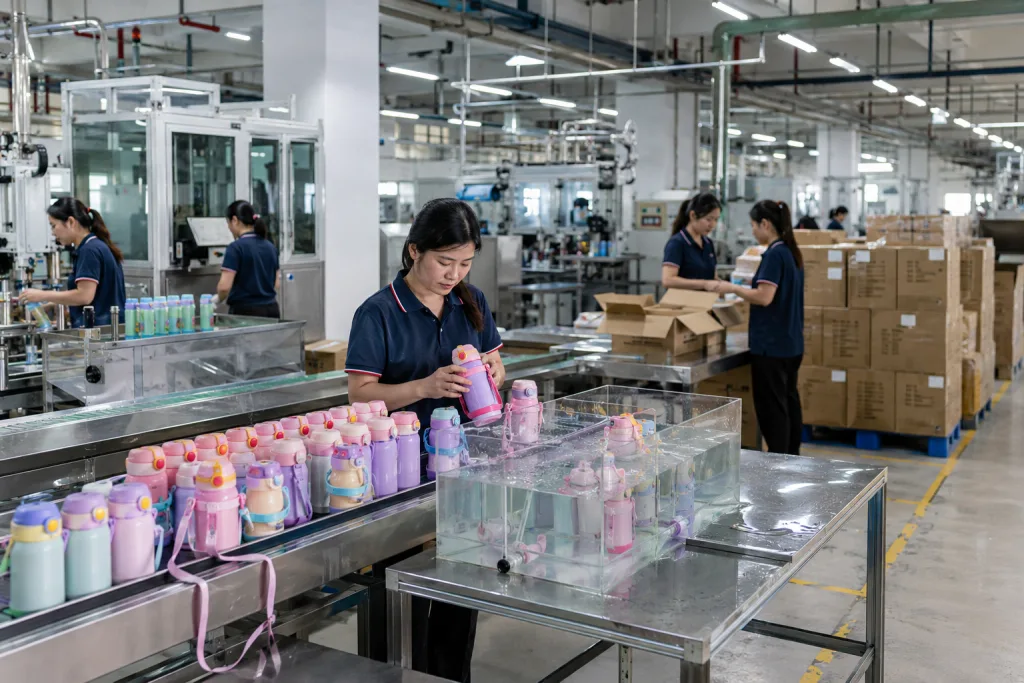
Key Takeaways
- Typical MOQ starts at 1,000-3,000 pcs per color for a standard kids bottle, while new molds usually require 5,000-10,000 pcs to make tooling economical.
- FOB unit price for a 350-500 ml PP or Tritan custom kids water bottle often moves by USD 0.18-0.65 based on lid type, print method, and packaging.
- Sample plus approval usually takes 7-14 days, mass production 25-40 days, and third-party testing adds 5-10 working days if booked early.
- A children water bottle factory with 600,000 units/month capacity can still miss your date if artwork approval slips by 3 days or packaging files arrive late.
If you buy for school districts or import children’s drinkware, the hard part is rarely the bottle shape. The hard part is getting a landed-cost number before artwork edits, drop-test requests, and carton changes start moving the quote. A kids bottle oem manufacturer should tell you in plain numbers what changes the FOB price, what pushes MOQ from 3,000 to 5,000 pcs, and where a 7-day sample lead time turns into 45 days after the buyer adds a new lid mold. We’ve seen this go sideways. One silicone straw dimension changed by 1.5 mm, and the costing had to be run again.
From Zhejiang, China, we see the same pattern every season. Buyers compare 4 or 5 samples, then lose 12 days on lid complexity and print method before anyone locks the compliance scope. If you need a bulk school water bottle, custom kids bottle, or children water bottle customized for retail, this is the wrong question to ask first: “What is your best price?” Start with the full cost and lead-time breakdown that matches how factories in China actually run the line. QC pulled the sample, the buyer flagged the handle fit, and the whole PO moved because one packaging spec was still blank.
What really sets bottle cost
Ask a children water bottle manufacturer for a quote and you usually get a standard FOB number first. Good starting point. Not the real picture. On bulk kids bottles, cost usually moves on five points: body material, lid construction, decoration, packaging, and testing. This is where buyers miss margin. We see it on the line every week when a PO looks cheap at first and then picks up cost after artwork, lid changes, and lab requests.
For body material, a simple single-wall PP bottle is still the low-cost option for school programs and children water bottle promotional orders. Tritan gives you better clarity and less odor pickup, but it often adds USD 0.20-0.45 per unit depending on bottle size and resin grade. Stainless steel for older kids or premium retail can add USD 1.20-2.80 over plastic, and freight math changes with it because unit weight jumps. A 500 ml steel body can run 0.12-0.18 kg heavier than a comparable plastic bottle. Buyers ask only for bottle price; this is the wrong question to ask.
Lid construction moves cost more than most buyers expect. A screw cap with a carry loop is cheaper than a push-button spout lid with a spring, lock, silicone straw, and bite valve because every extra part has its own mold, assembly step, and QC point. On a 400 ml custom children water bottle, the gap between a basic cap and a one-click flip lid can easily be USD 0.28-0.55 FOB. We have seen QC pull the sample for weak spring rebound after 3,000 press cycles, and then the cheap lid was not cheap anymore.
- Silkscreen: lowest cost for 1-2 spot colors, usually USD 0.03-0.08 per color per side. Good if your logo position stays simple and the print area is controlled within a clean 60-80 mm panel.
- Heat transfer: better for multicolor graphics, usually USD 0.10-0.22 each. Buyers use this when the mascot artwork has gradients that screen printing cannot hold.
- UV print: strong graphic detail, often USD 0.12-0.25 each. Looks sharp, but the buyer flagged scratch resistance once on a dark blue sample, so we ran extra tape testing before shipment.
- Wrap or shrink label: good for retail graphics, but needs artwork control and higher packaging complexity. Sleeve seam position and bottle shoulder shape have to match, or the line slows down.
Then there is packaging. An egg-crate carton pack is nothing like an individual color box with barcode sticker, instruction sheet, and polybag warning label. For a children water bottle wholesale program, retail packaging can add USD 0.18-0.60 per unit. If you are a children water bottle distributor serving schools, plain bulk pack is usually the fastest and cheapest path. We ship plenty of 24 pcs master cartons this way, and the math works. Fancy retail pack on a low-price school order usually does not.
In Zhejiang, China, buyers often focus on bottle body price and skip over test cost. For kids products, we have seen this go sideways. REACH, LFGB, CPSIA-related checks, phthalates, and migration tests can add several hundred to a few thousand dollars depending on market and materials. One lid with a soft straw can trigger extra chemical testing that a plain PP cap does not. If the PO has a typo on material spec or colorant callout, the lab sample may need to be remade, which costs time and money.
MOQ tiers that change your math
MOQ is not one fixed rule on our side. It moves with mold ownership, color count, lid color split, and packing format. A children water bottle supplier quoting 1,000 pcs often means 1,000 total on 1 stock body color, 1 stock lid color, and 1 print position. Ask for three body colors, two lid colors, and a custom box with a 3 mm E-flute insert, and the same line may move to 3,000 pcs fast.
For stock molds, these are realistic tiers for a kids bottle oem manufacturer in China:
- 1,000 pcs: simple logo order on an existing bottle and existing lid colors. We run these on shared stock components, so setup stays lean.
- 2,000-3,000 pcs: common for custom logo kids bottle orders with mixed colors or upgraded packaging. QC pulled one job last month at 2,400 pcs because the buyer added a window box after the PO was signed.
- 5,000 pcs: practical level for children water bottle custom color matching, especially if Pantone resin adjustment is required. Below this, the purge loss and masterbatch trial scrap start to hurt the math.
- 10,000 pcs and up: where custom made kids bottle projects start making sense if you need exclusive components. This is usually the point where a dedicated cavity plan and exclusive lid parts stop looking expensive.
Why does MOQ move so quickly? Because factories in Zhejiang have to cover injection molding setup, color purge loss, print setup, and packaging buys. If your order is 1,200 pcs split into 4 SKUs, the line sees 4 small jobs, not 1 clean run. We have seen buyers push back on this, but the math doesn't work once the pad printing plate, resin change, and carton MOQ all stack up.
Tooling economics are where buyers get caught. A new straw lid mold may cost USD 4,000-8,000. A full bottle plus lid set can range from USD 8,000 to USD 25,000 depending on cavities and mechanism complexity. If you are a children water bottle vendor planning only 3,000 pcs total, that tooling burden will make your unit cost look wrong from day one. We have seen this go sideways when a PO says "new lid" but the buyer only budgeted for sampling, not steel.
For school district buyers, the best value is often a stock bottle with custom graphics and custom carton labeling, not a fully new mold.
We usually tell buyers to split "must be unique" from "should look unique." This is the right question to ask. A custom school water bottle can still feel proprietary through color, artwork, and packaging without paying for 100% new tooling. On one 5,000 pc school program, we changed the sleeve art, carton mark, and silicone spout color, and the buyer got the look they wanted without opening a new mold.
Price ranges by common bottle type
You need real price bands before you ask for final quotes. At FOB Ningbo or Shanghai from a children water bottle factory in China, these ranges are normal for 2,000-5,000 pcs with compliant food-contact materials and standard export cartons. On our line, this usually means basic polybag packing, a 5-layer master carton, and no surprise add-ons after sample approval.
Entry school program bottles
A 350-500 ml PP squeeze or screw-cap bottle for bulk school water bottle orders usually sits at USD 0.65-1.10 FOB. Add a one-color logo and you are usually at USD 0.70-1.18. We ship a lot of these for event kits and school sports days. Municipal buyers push hard on price, and that is fair, but they still flag cap fit if the neck thread flashes even 0.2 mm.
Mid-range Tritan kids bottles
A 400-550 ml Tritan custom kids water bottle with flip straw lid usually runs USD 1.45-2.40 FOB. Add a silicone sleeve, gradient body color, and a retail box, and the range moves to USD 1.90-2.95. This bracket is common for children water bottle distributors selling to retail chains, museum shops, zoo stores, and back-to-school programs. QC pulled the sample more than once on these because straw bite-valve hardness was off, and that small detail changes complaint rates fast.
Premium insulated options
A 12-16 oz stainless steel kids bottle with vacuum insulation, powder coating, and straw lid usually falls between USD 3.20-5.20 FOB. Better carton inserts and stricter leak controls matter more in this category. The math doesn't work if you save USD 0.06 on packing and then lose bottles to denting or seepage. We have seen buyers focus on bottle price and miss the drop-test insert spec; then the line has to repack after transit tests fail.
Three hidden cost points deserve attention:
- Leak testing: some factories include 100% vacuum or air-pressure checks, while others only do AQL sampling. Ask which one you are paying for. We run upside-down hold tests on the straw lid, and that labor is not free.
- Straw and gasket sets: extra spare parts can add USD 0.05-0.18 per unit but reduce after-sales complaints. One extra gasket in a small PE bag is cheap insurance, especially on school orders.
- Barcode and carton marks: FNSKU, suffocation warnings, and retailer labels add labor cost when not finalized early. A single PO typo on outer carton marks can hold packing for half a day.
If you are buying children water bottle bulk for schools, ask for a quote table at 1,000, 3,000, and 5,000 pcs. This is the right question to ask. The price break is often only 4-12%, but carton fill improves, raw material planning gets cleaner, and production usually runs smoother at the higher quantity.
Lead times from sample to shipment
Lead-time trouble usually does not start on the line. It starts at approval stage. A solid kids bottle oem manufacturer should give you a dated schedule with dependencies and hold points, not one soft number. For stock molds, we run planning like this, and the first blocker is often a missing Pantone callout or a 2 mm logo shift on the artwork file.
- Day 1-3: quote confirmation, artwork brief, Pantone match, and packaging spec freeze; MOQ and carton marks should be locked here.
- Day 4-7: pre-production digital mockup and print layout approval; the buyer often flags logo size or straw color at this step.
- Day 7-14: physical sample or pre-production sample; QC pulled the sample and checks fit, leak test, and print position before photos go out.
- Day 15-18: buyer approval and deposit release; we have seen POs stall here over one typo in the ship mark.
- Day 19-45: mass production, assembly, in-line QC, packing; this window depends on the lid line queue more than the bottle body.
- Day 46-50: final inspection, booking, and cargo loading; AQL checks and container loading plan happen in this slot.
That means a normal children water bottle customized order usually needs about 30-45 days after sample approval. In back-to-school and holiday season, 45-60 days is the safer promise. At BottleForge Industrial, capacity can reach 600,000 units per month across drinkware programs, but that paper number does not clear the queue on one lid mold, one silk-print line, or one ultrasonic welding station. This is the wrong question to ask: total monthly capacity. Ask what the queue looks like for your exact cap and decoration process.
For custom mold projects, add development time. 3D drawing confirmation may take 3-7 days, mold making 20-35 days, first trial sampling another 5-10 days, and mold correction if needed 7-15 days. A new custom children water bottle often needs 55-90 days before mass production starts. We have seen this go sideways when the first T1 sample comes out with a loose straw fit or a handle gap over 0.5 mm, because then the tool shop has to cut steel again.
Freight planning matters too. Ocean transit from China to North Europe often runs around 30-40 days port to port, and to the US West Coast around 18-25 days, not counting customs and drayage. If you are a children water bottle distributor working to a school-term date, production is only half the calendar. We ship on time and still lose the season if booking is late by 12 days, or if the buyer waits until cargo-ready week to confirm the forwarder.
The practical fix is simple: approve artwork fast, freeze packaging files early, and book testing slots before the line finishes production. If FDA or LFGB testing starts after packing, the math doesn't work.
Compliance for school and kids markets
For kids products, a cheap quote without compliance detail is not cheap. It is incomplete. We’ve seen POs held 12 days because the target market was not defined before sampling, and one buyer’s PO even said “EU food grade” with no test scope attached. School buyers and importers in Europe and North America should lock the market standard before the PO is released.
For Europe, buyers usually ask for REACH, LFGB where relevant, and overall food-contact compliance. For North America, the brief often covers FDA food-contact positioning, CPSIA-related points for children’s products, and state-level chemical restrictions based on the retail channel. If the bottle has decorated surfaces, straws, bite valves, or printed sleeves, each material stack needs its own review; QC pulled one sample last month where the sleeve ink passed, but the bite valve silicone still needed a separate report.
A competent children water bottle supplier should tell you exactly what existing material reports cover and what still needs finished-product testing. That gap matters. Material declarations are not the same as a final assembled bottle test, and this is the wrong question to skip during RFQ review. On our line, the assembly sample and the loose resin cert are checked as two different documents for a reason.
- Standard lab checks: 5-10 working days after sample receipt, and another 1 day if the lab asks for a spare assembled lid set.
- Typical budget: USD 300-800 for focused testing, USD 1,000+ for broader retail protocols; below that, the math doesn’t work for most accredited labs.
- Factory QC baseline: AQL 2.5 for major defects and AQL 4.0 for minor defects is common, but buyers should confirm the plan and sample size before production starts.
For custom kids bottle orders, ask how the factory controls odor, leakage, print adhesion, and drop performance. This is where generic promo-bottle habits go sideways. A kids bottle gets dropped off desks, squeezed into bags, and chewed on straws. We run leak checks with a 0.02 mm feeler check on lid fit, and buyers often flag odor in new PP straw sets before anything else. We recommend written standards for:
- 24-hour leak test on assembled lids
- Dishwasher recommendation or hand-wash labeling clarity
- Drop test criteria, such as 1.0 meter with no functional lid failure
- Coating and print adhesion after tape test or rub test
Zhejiang factories that already ship to Europe and North America usually know these requirements. The question is not whether China can meet them. The real question is whether your RFQ spells out the test scope, pass criteria, and labeling callouts before pricing and sampling start; if not, the buyer flagged issue comes later, not earlier.
How to buy without schedule drift
If you are sourcing from children water bottle manufacturers for the first time, the biggest avoidable mistake is changing three variables after sampling. We see this on the line all the time: buyer approves a custom logo kids bottle, then swaps the lid, adds a retail box, and sends rev. B artwork after the sample room already cut the screen. The factory can still make it. The problem is your quote and lead time now belong to a different item, and that is how 12 days becomes 18 days.
Stay disciplined. Start with one approved bottle architecture: body, lid, straw, seal, decoration, and pack-out. Lock that base first, then ask for cost options around it. On our side, that usually means one BOM, one packing standard, and one drop-test method before we price any options. This matters for children water bottle vendors and children water bottle wholesale buyers serving 2 or 3 customers from one purchase plan, because one late change can throw off the full container mix.
A clean RFQ should include:
- Target volume in ml or oz
- Material: PP, Tritan, stainless steel, or glass where applicable
- Age positioning and market destination
- Expected order quantity by SKU and by color
- Print method and number of print locations
- Packaging spec: bulk, white box, or retail color box
- Required tests and social audit requests such as BSCI or ISO documentation
- Trade term: FOB, EXW, or DDP if discussed separately
Ask your children water bottle vendor for a cost sheet that separates mold amortization, unit price, packaging adder, and test fees. Put each line in USD and tie it to an MOQ, such as 3,000 pcs or 5,000 pcs. QC pulled a sample last month where the PO said "straw lid" but the carton mark said "spout lid"—small typo, expensive result. A factory that ships B2B export orders every week will break costs out cleanly. A factory chasing attention usually sends one round number, and we’ve seen this go sideways.
For school district and importer programs, the safest path is often a staged order: approve a pre-production sample, run a pilot order of 1,000-2,000 pcs if timing allows, then move to 3,000-10,000 pcs once leakage, user feedback, and packaging hold up. We run this route often for new lids because the math doesn't work on a rushed 20,000-piece order with an unproven seal. One leak test failure at 0.2 MPa is cheaper to catch in a pilot than after full production.
Whether you need bulk children water bottle supply, a children water bottle customizable retail line, or a custom school water bottle for a district rollout, cost control comes from reducing surprises. Chasing the last USD 0.03 from the opening quote is usually the wrong question to ask. The bigger savings come from holding spec, approving faster, and shipping the right bottle the first time.
Get a real kids bottle cost plan
Send your target volume, packaging spec, and compliance market. We will reply with MOQ tiers, FOB pricing ranges, and a workable China production timeline.
Frequently asked questions
What MOQ should I expect from a kids bottle OEM manufacturer?
For a stock bottle and stock lid, 1,000 pcs is possible if you keep to one or two existing colors and simple logo printing. Most practical B2B orders sit at 2,000-3,000 pcs because mixed colors, custom packaging, and extra QC steps create setup cost. If you want a fully custom made kids bottle with a new mold, 5,000-10,000 pcs is a more realistic starting point. In China, many factories will quote a lower MOQ to start the discussion, but the effective MOQ rises once you add Pantone color matching, retail boxes, spare straws, or multiple SKUs. Ask for MOQ by bottle, by lid color, and by packaging format, not just one headline number.
How much does a custom kids water bottle usually cost?
A basic PP bulk kids bottle for school use often runs about USD 0.65-1.10 FOB China at 2,000-5,000 pcs. A Tritan custom children water bottle with flip straw lid is more commonly USD 1.45-2.40 FOB, and stainless insulated kids bottles are usually USD 3.20-5.20 FOB. Printing, packaging, and testing can change those numbers fast. A one-color silkscreen may add only USD 0.03-0.08, while a color retail box can add USD 0.18-0.60. If the bottle needs a new mold, tooling may range from USD 4,000 for a simpler lid component to USD 25,000 for a full new bottle-and-lid set. Always compare at the same Incoterm, usually FOB.
What lead time is normal for children water bottle customized orders?
For an existing mold, plan 7-14 days for sample work and approvals, then 25-40 days for mass production after sample sign-off. If you add third-party testing, reserve another 5-10 working days unless the lab slot is already booked. During peak season, a realistic total is 35-50 days before shipment. For a fully custom children water bottle customized from a new mold, development can add 30-50 days before production starts. Ocean transit from China to Europe often adds 30-40 days, and to North America around 18-25 days port to port. If your delivery is tied to school term opening, work backward from the arrival date, not the PO date.
What compliance documents should I ask a children water bottle supplier for?
Start with the market destination and age positioning. For Europe, ask about REACH and food-contact compliance documentation relevant to the material set. For North America, discuss food-contact positioning and children’s product requirements that may apply to assembled items, inks, seals, and straws. Also ask for factory quality documents such as AQL inspection standards, and if relevant, BSCI or ISO records. The key point is to distinguish raw material declarations from finished-product test reports. A finished custom kids bottle may include body resin, silicone seals, pigments, coatings, print inks, and packaging materials. If any of those change, the previous report may not fully cover your shipment.
Is it better to use a stock mold or develop a custom school water bottle?
For most school district buyers and importers, a stock mold is the better commercial decision unless you have annual volume above 20,000-50,000 pcs and a clear reason to own the design. Stock molds cut development time by roughly 30-50 days and avoid tooling costs that can run from USD 8,000 to USD 25,000 for a new bottle program. You can still create a strong custom school water bottle through Pantone colors, silkscreen or transfer graphics, custom labels, and retail or institutional packaging. A new mold makes sense when you need functional exclusivity, such as a unique lid mechanism or safety-driven geometry that existing molds do not offer.