Key Takeaways
- For PP or Tritan kids bottles, MOQ usually starts at 3,000 units, while custom color lids and molds can push MOQ to 5,000-10,000 units
- A basic 400-500ml bulk kids water bottle often lands at USD 1.10-2.40 FOB China before testing, retail packaging, and tooling
- Standard repeat orders can ship in 25-35 days, but new custom children water bottle projects usually need 35-45 days plus sample approval time
- Third-party testing for REACH, LFGB, CPSIA, or ASTM can add USD 300-1,200 and 5-10 working days depending on scope
If you buy for a school district or import children’s products, bottle shape is usually the easy part. The quote is where deals slip. Buyers ask for unit price before lid style, material, test scope, and pack-out are locked, then the PO changes twice and the schedule moves from 12 days to 18 days on sample approval alone. We’ve seen this go sideways. On the line, even a 1.5 mm wall change or a switch from straw lid to spout lid can reset costing and carton count.
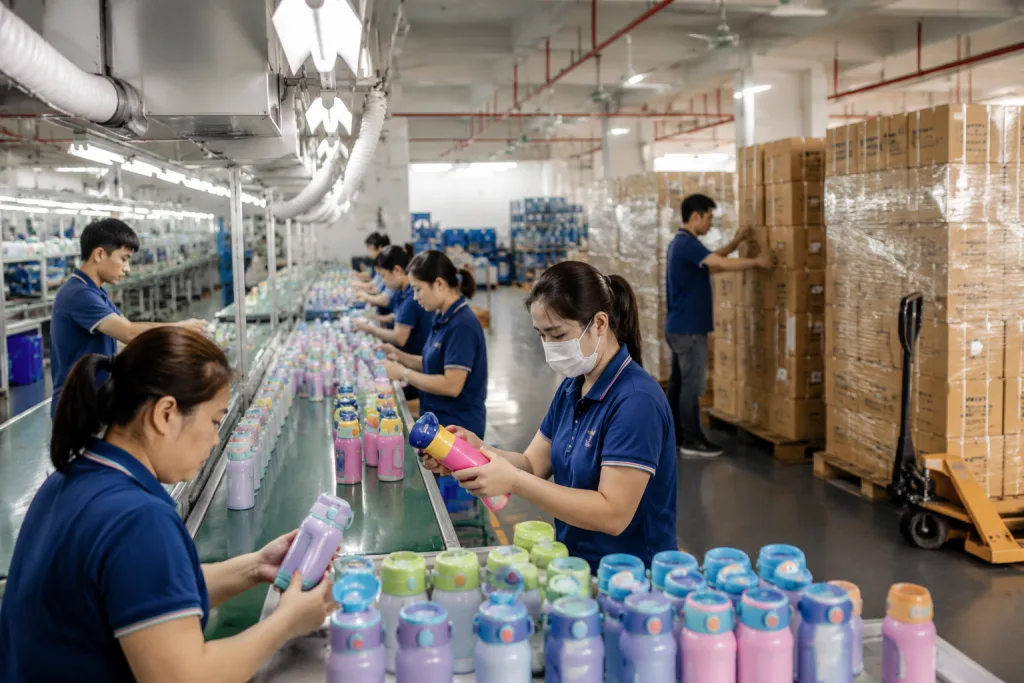
From Zhejiang, China, we see the same order pattern every season: the buyer needs a safe, durable bottle for children and still has to hit a school start date. That is the real job. A practical kids bottle manufacturer should quote numbers, then show the tradeoffs in plain language, not just send a neat PDF. At BottleForge Industrial in Zhejiang, typical MOQ starts at 3,000 units per colorway, with lead times from 25 to 45 days depending on decoration and testing. QC pulled the sample last month on a kids lid because the logo position was off by 2 mm, and the buyer flagged it right away. This is the wrong question to ask if you start with price only; the math doesn't work until spec, testing, and packing are fixed.
What sets the price first
You ask for a price, and we can quote fast. What slows it down is this: two custom kids bottle projects with the same 500ml capacity can land 40% apart on cost once we see the spec sheet. For school programs and importer orders, we check four things first: material, lid structure, decoration method, and pack-out. Last month a buyer sent us a PO with “Triton” typed instead of “Tritan,” and that one typo changed the whole costing discussion.
Material moves the number first. A single-wall PP or food-grade polyethylene bottle for lower-price children water bottle promotional programs will sit below a Tritan body with a silicone straw system. Stainless steel insulated bottles are a separate bracket, usually 2 to 3 times the FOB cost of a simple plastic school bottle. For most bulk school water bottle tenders, buyers end up choosing between PP and Tritan because both keep the unit weight low enough for freight; a 400ml PP body might run about 68g on the line, while Tritan is heavier but sells better if clarity matters. If you start by asking only for the cheapest bottle, this is the wrong question to ask.
- Body material: PP is the entry-price option in most cases; Tritan gives you better clarity and better drop performance. QC pulled a sample last week after a 1.2m drop test, and the PP body scuffed while the Tritan sample stayed cleaner.
- Lid complexity: A straight screw cap costs less than a one-click flip lid with straw, lock, spring, and carry handle. More parts means more assembly stations, more fit checks, and more chances for leak complaints.
- Decoration: One-color silk screen is still the low-cost route. Heat transfer wrap, IMD, or multi-position printing adds labor hours and raises scrap risk; on curved bodies, the buyer flagged logo shift above 1.5mm more than once.
- Pack-out: Bulk pack in export cartons is cheaper than individual color boxes, barcode labels, inserts, and retail-ready master cartons. A plain bulk pack might be 24 pcs per carton, while retail pack often cuts carton count and pushes freight up.
As a rough FOB China range from Zhejiang, a 400-500ml PP custom school water bottle with a simple spout lid may start around USD 1.10-1.45 at 5,000 units. A Tritan custom children water bottle with straw lid and one-color logo is more often USD 1.65-2.40 at the same volume. Add retail packaging and testing, and the budget jumps fast; we have seen landed math shift by 12% after barcode labels, drop-test requirements, and color boxes were added. That is why experienced children water bottle distributors ask us for a full cost sheet, not just the bottle price.
MOQ tiers that change your options
MOQ is not just a factory rule. It decides how far you can customize the bottle and whether the order runs like a stock SKU or a true custom kids bottle. Buyers ask for a small trial order, then add custom body color, custom lid color, logo print, hangtag, color box, and mixed carton assortments. The math doesn’t work. On the line, each added part change means another setup, another color check, and another approval sample.
At a practical children water bottle factory in China, MOQ usually breaks into tiers:
- 1,000-2,000 units: This usually works only with existing molds, standard colors already on hand, and simple custom logo kids bottle decoration. Good for market testing. We run these orders with stock parts, and QC pulled the sample against the approved print position before mass production.
- 3,000 units: A common starting point for a bulk kids bottle with body color selection and one decoration position. This is where buyers start asking for more, but one body color and one print location is still the safer setup.
- 5,000 units: You get more room for Pantone matching, mixed sizes, and better carton efficiency. At this level, we can plan cartons by CBM instead of forcing loose mixed packing that wastes space.
- 10,000+ units: This is where custom lid colors, packaging revisions, and better accessory pricing start to make sense. We’ve seen this go sideways below this level, especially when the buyer flagged a custom straw color after the PO was already released.
If you are a children water bottle distributor supplying schools, camps, or museum stores, split the brief into must-have custom points and nice-to-have ones. That is the right question. A stock body with a Pantone-matched lid and one-color logo may save 12 to 18 days compared with a fully custom set. For public tenders, that matters. We ship plenty of these programs, and the lead-time gap often comes from waiting on color chips, not from bottle blowing.
A low MOQ quote is often built on stock components. Ask whether the MOQ covers custom resin color, custom straw, custom gasket, and retail pack-out, or only logo printing.
For buyers in Europe and North America, a good children water bottle supplier should be plain about this. If you need children water bottle custom packaging and body color with no substitutions, 3,000 units may not be enough. In Zhejiang, our monthly output can reach 300,000 units across drinkware lines, but each lid system still has batch sizes needed for stable color and assembly yield. On some PP lids, we do not like to start below one full resin lot because shade drift shows up fast under D65 light check.
Tooling, samples, and approval costs
About 7 out of 10 school-district buyers we quote do not need a new mold. Importers ask for tooling, then after we check the logo size, pantone match, and carton brief, the job comes down to a packaging change or a different print method. New tooling is the expensive fix for a small branding issue. This is the wrong question to ask first.
With an existing mold from a children water bottle manufacturer, pre-production is usually simple: digital mockups, 1 or 2 physical logo samples, then one sealed approval sample. Standard sample charges in China usually run USD 50 to 150 per logo sample for standard items, and we often credit that back against the order. Express courier adds USD 30 to 80 by destination. On our side, QC pulled the sample after logo curing and checks print position against a steel ruler, usually within 1 mm tolerance.
New tooling is a different budget line. A new bottle body mold can range from roughly USD 4,000 to 12,000, while a complex lid mold with straw, button, and lock components can run higher. If your order volume is below 20,000 units in the first year, the math doesn't work unless the shape is tied to your brand or a licensed program. We've seen this go sideways when a buyer wants a fresh silhouette, then the PO lands at 8,000 pcs MOQ and the mold cost sits there with no scale.
Where buyers overspend
- Opening a new mold when an existing 350ml or 500ml bottle can be adapted. We run this check first against current neck finish and lid fit.
- Approving artwork without checking print area against safety marks and warning text. One common miss is a logo pushed 3 mm too low, right into the age warning line.
- Skipping pre-production assembly checks for straw fit, bite valve pull force, and leak testing. The buyer flagged leaks before; after that, we added a vacuum leak test on the line.
For a children water bottle customizable project, ask the vendor for a sample plan with dates: artwork proof in 2 days, pre-production sample in 7 to 10 days, revision in 5 days, final approval in 3 days after receipt. Ask who owns each step. Ask what happens if the logo file is wrong. Last month we got a PO with the lid color typo carried into sampling, and that alone cost 4 days. That level of detail matters more than a polished presentation. A children water bottle vendor that cannot explain the sample path usually cannot hold the mass production schedule either.
Lead time from PO to vessel
Lead time is where custom kids bottle orders slip. We hear “30 days” on the first call, then the PO lands with a lid color change, a barcode note, and a missing warning panel. That 30 days often skips sample sign-off, packaging approval, lab testing, and vessel booking. A proper schedule from a kids bottle manufacturer starts on the PO date and ends at cargo handover, not with finished goods parked in the warehouse. We’ve seen this go sideways after QC pulled the sample and found the straw hardness was off by 3 Shore A from the approved piece.
For repeat orders with approved parts, standard colors, and existing packaging, 25 to 35 days is doable in China. We run these faster because the mold set is ready, the print file is clean, and the carton spec is already on file. For a new custom children water bottle project, 35 to 45 days is the honest range. Add new retail packaging, third-party testing, or peak-season booking, and 45 to 60 days is the safer answer. Buyers sometimes push for 30 days on a fresh SKU, but the math doesn’t work if the first white sample still needs revisions.
- Day 1-3: PO review, artwork check, deposit, and confirmation of specification sheet. We also catch basic mistakes here, like a PO typo showing 350ml on the order and 380ml on the spec sheet.
- Day 4-10: Pre-production sample and packaging dummy if needed. On the line, this usually means checking cap fit, leak test, and carton size before we cut bulk print.
- Day 11-15: Buyer approval and raw material purchasing. If the silicone color chip is not signed back on time, raw material release stops right here.
- Day 16-30: Injection molding or bottle forming, printing, assembly, and in-line QC. We run neck-size checks with a go/no-go gauge, and QC logs defects by shift.
- Day 31-38: AQL final inspection, carton marking, and export booking. The buyer flagged weak master carton corners on one school program last year, so now we recheck drop resistance before booking.
- Day 39-45: Container loading and FOB release. A 40HQ does not wait for missing FNSKU labels.
If you ship against a school start date, add buffer. Ten days is safer than two. Europe and North America buyers often spend 6 days on internal approvals, then ask the children water bottle manufacturer to win those 6 days back in production. Factories in Zhejiang can run fast, but not magically. If your bottle needs FNSKU labels for Amazon FBA, bilingual warnings, or retailer-specific carton drops, say it at RFQ stage. This is the wrong question to ask at the end. Each item can add 2 to 5 working days if raised after packaging is already queued, and we’ve had carton files kicked back over a 5mm warning-text height issue.
Testing and compliance for children
A kids bottle is more than drinkware. Buyers and regulators treat it as a children’s product, so the testing scope changes both cost and lead time. School district teams usually ask first about leakage, impact resistance, and print wear after 500 rubs on the crock meter. Importers also have to check destination-market compliance, retailer manuals, and every claim printed on the box. We’ve seen this go sideways over one line on a PDQ tray.
For Europe, you may need REACH review, LFGB depending on market and material-contact expectations, and packaging compliance. For the US and Canada, buyers often ask about CPSIA-related considerations, ASTM references where relevant to child use features, and food-contact declarations. The exact program depends on bottle material, age grading, and whether the item includes parts that trigger additional concern, such as removable straws or decorative accessories. This is the wrong question to ask if you start with “what is the cheapest test?” Start with the full product build: bottle body resin, straw hardness at 50A or 60A, paint, decal, and any charm or carry strap.
Testing costs vary widely, but for practical budgeting:
- Basic food-contact and chemical scope: about USD 300-700
- Broader retailer-required package: about USD 700-1,200
- Test duration: usually 5-10 working days after lab receipt
Do not wait until mass production is finished to start testing. A solid children water bottle supplier should already know which resin grades, colorants, silicone parts, and prints are qualified, and which ones have failed before on the line. That cuts retest risk. We also suggest fixing inspection terms in writing: AQL 2.5 for major defects and AQL 4.0 for minor defects is common for drinkware, though some school procurement teams ask for tighter limits on leakage and print quality. Last month QC pulled the sample because the lid torque was 0.6 N·m below spec, and that kind of miss is cheaper to catch before 10,000 pcs are packed.
If a children water bottle wholesalers quote looks unusually low, check whether compliance testing, drop testing, and third-party inspection are excluded. They often are.
For children water bottle wholesale orders from China, the cheapest factory is not always the cheapest shipment after rework, retesting, and claims. We ship enough school-program orders to say this plainly: the math doesn't work if the first quote saves USD 0.08 per unit but you lose 12 days on retest and rework after a failed seal check.
How to quote apples to apples
If you ask 4 or 5 children water bottle manufacturers for pricing, force them to quote the same spec sheet. If not, one factory prices a bulk children water bottle in PE bags, another prices a fully custom school bottle with barcode labels, ASTM/FDA testing, and a retail box. That comparison is useless. We’ve seen a buyer flag a “cheap” quote, then find out the lid insert and drop test were missing.
Give every children water bottle supplier the same RFQ checklist:
- Capacity, target age group, and intended market
- Body material and lid type
- Leakproof requirement and straw or spout preference
- Pantone body and lid colors, or stock colors acceptable
- Logo method: silk screen, pad print, heat transfer, laser on metal parts
- Packaging: bulk pack, white box, color box, PDQ, or e-commerce mailer
- Carton drop test standard, pallet rules, and labeling format
- Compliance scope, inspection plan, and Incoterm such as FOB Ningbo or Shanghai
Ask for pricing at 3,000, 5,000, and 10,000 units. You will see fast where each children water bottle vendor gets competitive, and where the math doesn’t work. Ask for separate line items for tooling, sample charges, packaging, and testing. We run quotes this way every day. If a supplier sends one total number with no breakdown, that is a warning sign. Last month QC pulled the sample on one project and the quoted carton spec did not match the actual 5-layer carton.
For a custom kids water bottle order, ask one practical question: what can change without restarting the schedule? This is the right question. Logo color is often still open before printing starts. Body color usually is not once resin is mixed and the line is booked. On some PP bottles, even a lid color swap after color matching can cost 3 to 5 days. A school buyer waiting on committee approval needs that answer early. A children water bottle distributor covering 6 districts needs it even earlier.
The strongest quote is not always the lowest FOB price. It is the quote with fewer hidden assumptions, clear lead-time gates, and a defect-control plan that names the checkpoint—leak test, print adhesion, torque check, AQL 2.5—before the order starts. Export paperwork matters too. We ship this every week, and we’ve seen orders go sideways over one PO typo in the ship mark.
Get a real kids bottle quote with timelines
Send your capacity, lid style, target market, packaging, and quantity tiers. We will reply with FOB pricing, MOQ, testing notes, and a practical production schedule.
Frequently asked questions
What is the usual MOQ for a custom kids water bottle?
For most existing models, a kids bottle manufacturer will quote 3,000 units as a practical MOQ for a custom kids water bottle with body color and logo. If you only need a stock bottle with one-color printing, some factories can go down to 1,000-2,000 units. If you want custom lid color, retail box, or mixed accessories, expect 5,000 units or more. A new mold usually needs a higher business case, often 10,000 units or a tooling charge. Ask whether MOQ applies per color, per capacity, or per artwork. That detail changes the true order size.
How much does a bulk school water bottle usually cost?
A basic 400-500ml bulk school water bottle in PP with a simple lid often falls around USD 1.10-1.45 FOB China at 5,000 units. A Tritan bottle with straw lid and custom logo is more commonly USD 1.65-2.40 FOB. Retail packaging can add USD 0.18-0.45 per unit, depending on box style and inserts. Third-party testing may add another USD 300-1,200 per project rather than per unit. If you compare quotes, make sure all suppliers include the same print method, gasket material, barcode labels, and carton spec. Those small items distort the real comparison.
How long does a children water bottle customized order take?
If you are reordering an approved item with existing packaging, 25-35 days is a normal production lead time. A first-time children water bottle customized order usually needs 35-45 days after deposit and final sample approval. Add 5-10 working days if third-party testing is required after production. New retail packaging, translated warnings, or retailer carton labels can add 3-7 more days if they are not confirmed early. During peak shipping months, container booking can also add time. For school delivery deadlines, many buyers work backward with a 60-day total window from PO to vessel departure.
Do I need new tooling for a custom children water bottle?
Usually no. Most buyers can use an existing mold from a children water bottle factory and still create a strong custom program with Pantone colors, logo decoration, and packaging. That keeps cost low and protects lead time. A new body mold may cost roughly USD 4,000-12,000, while a complex lid mold can cost more depending on moving parts. New tooling only makes sense if your shape is unique, tied to licensing, or needed for a large annual volume. If your forecast is below about 20,000 units in year one, existing molds are usually the smarter choice.
What compliance documents should I ask a children water bottle manufacturer for?
Start with material declarations, food-contact statements, and test plans matched to your destination market. For Europe, buyers commonly review REACH-related information and sometimes LFGB depending on the program. For North America, importers often ask about CPSIA-related considerations, chemical testing scope, and age-grade fit. You should also ask for factory quality procedures, AQL inspection standards, and whether third-party audits such as BSCI or ISO-based systems are available. A serious children water bottle manufacturer should tell you what is already on file and what must be tested for your exact SKU, decoration, and packaging.