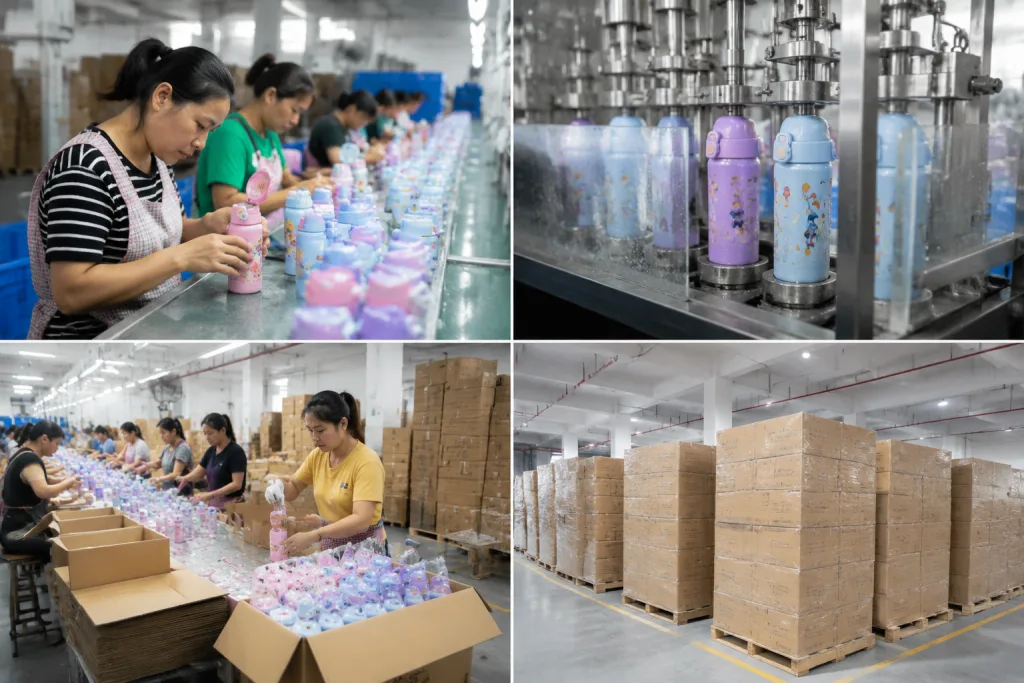
Key Takeaways
- Standard custom kids bottle MOQ is usually 3,000-5,000 units, while stock-color programs can start at 1,000 units
- Typical FOB China pricing runs about USD 1.20-2.80 for Tritan or PP kids bottles and USD 2.80-5.50 for 18/8 stainless insulated models
- Production lead time is commonly 25-40 days after sample approval, with new molds adding 20-35 days
- Testing, decoration, and packaging changes can add 5%-22% to unit cost on a bulk school water bottle order
If you buy for schools or import children’s drinkware, the hard part is not finding a bottle. It is getting the right bottle at the right landed cost, with testing paperwork that will survive a retailer, district, or customs review. A kids bottle in bulk order can look cheap on the first quote, then land 18% higher after mold cost, 100% leak test, print setup, carton revision, and freight out of Zhejiang. We’ve seen this go sideways after a buyer approved artwork, then flagged the master carton size because the shelf pack was 12 mm too tall.
You need the numbers early: MOQ, unit price, decoration cost, sample days, production days, and the delays that actually hit the line. This is the right comparison point, not sales promises. At BottleForge Industrial in Hangzhou, Zhejiang, we usually quote 3,000 to 5,000 units MOQ for standard custom kids water bottle programs, with monthly capacity above 400,000 units across core bottle lines. QC pulled the sample, the buyer checked the lid fit, and we ship faster when the PO is clean—one typo in the print color code can turn 12 days into 18 days.
What drives bottle cost first
The first quote on a bulk children water bottle usually comes down to four cost drivers: material, capacity, lid structure, and decoration. Everything else sits behind those. If you are buying a bulk kids bottle for schools, camps, museum stores, or kids retail, start with those four and lock them early. On our side, sales cannot give a clean price until the line confirms body weight in grams and neck size in mm.
Material moves the price more than most buyers expect, and this is where the math often gets missed. A single-wall PP or food-grade polyethylene bottle is usually the lowest-cost route, often around USD 0.70-1.30 FOB China for simple 350-500 ml bodies at 5,000 units. Tritan costs more, but it gives better clarity, better impact performance, and an easier premium story for a custom children water bottle; a 400-500 ml Tritan bottle typically lands in the USD 1.20-2.20 FOB range. Stainless steel steps up again. A single-wall 18/8 stainless kids bottle may run USD 1.80-3.20, while vacuum insulated 18/8 stainless often sits at USD 2.80-5.50 depending on finish and lid. Last month a buyer pushed for Tritan pricing on a 0.5 mm single-wall stainless body; that does not work.
Lid structure matters because a children water bottle customizable program usually adds parts, and parts add risk. A basic screw cap is the safer choice. A flip straw lid with silicone bite valve, carry loop, and lock button can add USD 0.35-0.90 per unit compared with a plain cap. More parts also mean more assembly labor and more leak-test rejects. We run 100% vacuum or air-pressure leak checks on some kids lid programs, and QC pulled the sample twice on one order because the spring pin was sitting off by 0.3 mm.
- Body size: 350 ml and 500 ml are usually cheaper than 650 ml because resin or steel usage is lower. On stainless items, even a small weight jump per body shows up fast at 5,000 pcs.
- Wall design: single-wall lowers cost; insulated doubles material and process time. You are paying for two shells, welding, vacuuming, and extra inspection on the line.
- Surface finish: standard injection color or spray color costs less than rubber paint, gradient spray, or special glitter coatings. Glitter looks good on screen, but we have seen adhesion testing fail after cross-hatch checks.
- Decoration: 1-color silkscreen is cheaper than wrap print, heat transfer, or laser plus pad print. If the logo registration is tight, the print shop will ask for a larger allowance, not a miracle.
If a children water bottle supplier gives you one price without asking about certification, age group, leak performance, drop resistance, and retail packaging, that is the wrong quote to trust. Good costing is slower. Across Zhejiang, the better factories usually take longer because they price the hidden parts upfront: test standard, inner tray, drop height, master carton spec, and even small PO mistakes. We have had buyers send a PO with 500 ml in the artwork note and 450 ml in the item description, and that kind of typo will throw the quote off before production even starts.
MOQ tiers that change your pricing
MOQ is not a factory slogan. It decides how setup cost gets spread across the order: pad printing plate, Pantone color mixing, carton MOQ, and the first-line machine adjustment. On kids bottle in bulk orders, the gap between 1,000 and 10,000 pcs is often larger than the gap between two suppliers quoting the same 500 ml body.
For standard bottle bodies on existing molds, a children water bottle factory will usually quote by 1,000, 3,000, 5,000, and 10,000 pcs. That is how we run the line. A normal structure looks like this:
- 1,000 units: possible for stock color + 1-color logo, but unit price may be 12%-25% higher than 5,000 units.
- 3,000 units: common entry point for custom logo kids bottle orders with basic packaging.
- 5,000 units: where many custom made kids bottle programs start to become cost-efficient.
- 10,000+ units: best for custom color matching, multi-SKU school programs, and lower per-unit packaging cost.
Take a 500 ml Tritan bulk school water bottle with flip straw lid and 1-color logo. You might see USD 1.95 at 1,000 pcs, USD 1.62 at 3,000, USD 1.48 at 5,000, and USD 1.39 at 10,000 FOB Ningbo or Shanghai. Same bottle. Same mold. The only change is that printing setup, carton buying, and resin loss on startup get spread across more units; on one run, QC pulled the first 80 bottles before the color stabilized.
New mold programs are different. If you need a children water bottle customized around a mascot-shaped lid, unique grip pattern, or district-exclusive body shape, expect mold MOQ from 5,000 to 10,000 units depending on process. Injection mold charges can range from USD 3,000 for a small cap component to USD 12,000 or more for a full bottle and lid system. Buyers push back on this all the time, but the math doesn't work if the tool cost is loaded into 2,000 pcs.
School buyers usually save money by customizing color, logo, and packaging on an existing mold instead of chasing a fully unique shape on the first order.
This is the right starting move, even if it sounds less exciting. Most children water bottle distributors in Europe and North America start with proven molds, then invest in exclusive tooling only after reorder data is real. We've seen this go sideways when a buyer approved a new lid tool first, then changed the straw diameter by 1.5 mm after the pilot sample.
Decoration, packaging, and compliance adders
A children water bottle wholesale quote climbs in small lines on the sheet. One line looks harmless. Six lines later, landed cost is off by USD 0.30-0.80 per unit, and that hurts on a 10,000 pcs PO. New buyers often stare at the bottle body price and miss the extras that decide whether the order still works for school supply or retail shelf programs. We’ve seen this go sideways after sample approval, especially when the PO only says “same as sample” and leaves out print position or pack-out details.
Decoration cost ranges
For a bulk kids water bottle, simple 1-color silkscreen printing may add only USD 0.05-0.12 per unit. Two-color print can move to USD 0.10-0.18. Heat transfer wrap or full graphic transfer commonly adds USD 0.18-0.45 depending on coverage and yield. Laser engraving on stainless can be USD 0.08-0.20. If you want a children water bottle promotional order with individual names or variable data, handling slows down fast and labor goes up because the line has to match data one by one. On our side, QC pulled the sample more than once for name alignment drifting 1.5 mm on curved bodies, and buyers will flag that right away.
Packaging cost ranges
A polybag and export carton is the baseline. A white box may add USD 0.10-0.18. Printed retail color boxes often add USD 0.22-0.55, depending on board grade and print coverage. If you need barcode labels, FNSKU labels for marketplace prep, insert cards, or master carton drop-test upgrades, add more. For custom school water bottle projects, district-level assortment by school color also raises picking risk unless the factory uses clear carton marking and final scan checks. This is the wrong question to ask: “How much is the box?” Ask how the bottles are sorted, scanned, and packed by color SKU, because one carton packed wrong can hold up a school delivery. We ship these with outer marks in 32 mm text for a reason.
Compliance and testing
Kids products are not the place to save USD 300 on testing. Depending on your market, you may need REACH, LFGB, CPSIA-related checks, California Proposition 65 screening, or ASTM-related mechanical and migration considerations tied to the age group and product design. Third-party lab testing for one bottle family can cost roughly USD 250-800 for basic chemical scopes and more if you include package claims, dishwasher validation, or bite-valve component review. The math doesn’t work if you skip it and then scrap 5,000 lids after a migration fail. We’ve had labs ask for extra silicone valve data on a 6 mm bite component, so build time into the plan, not just cost.
Ask your children water bottle vendor for what they already have. A professional children water bottle manufacturer in Zhejiang, China should be able to show material declarations, supplier traceability, and prior reports for similar structures. That does not replace your project-specific testing, but it cuts surprises and shortens the first document round from 18 days to 12 days in a normal case. Check the paperwork closely. Last year a buyer sent a PO with the lid resin code typed wrong, and we caught it before sampling because the supplier lot sheet did not match.
Lead times from sample to vessel
Lead time on a custom kids water bottle order gets misread all the time. Buyers hear one number from sales, but the actual calendar is broken into quotation, pre-production sample, approval, mass production, inspection, and vessel booking. Miss one approval slot and the season slips. For back-to-school programs, we have seen a 3-day artwork delay turn into a 14-day shipping miss because the line was already reserved for another PO.
For an existing mold project, a practical timeline looks like this:
- Quote and artwork review: 2-4 working days
- Pre-production sample: 5-10 working days
- Sample shipping: 3-7 days by courier
- Mass production: 25-40 days after sample approval and deposit
- Final inspection and booking: 3-7 days
- Ocean transit to Europe or North America: roughly 18-40 days depending on port pair and season
For a children water bottle custom mold program, add 20-35 days for tooling and first article adjustment. If the lid includes a straw, silicone mouthpiece, spring hinge, or safety lock, build in more time. The tooling shop might finish steel cutting in 18 days, but that does not mean the part is ready. We have had lids pass dimension check at 0.15 mm tolerance and still fail leak testing on the line, so debugging took another 7 days.
The biggest delays usually are not in molding. They sit in approvals. Pantone color confirmation can burn 3-5 days, and retail packaging artwork often burns another 7. QC pulled the sample once because the PO said “sky blue” while the AI file called out Pantone 2905 C. Small typo, big stop. If the purchase order changes after sample approval, your slot in the China factory schedule can move behind a customer already holding resin, carton stock, and machine time. This is the wrong question to ask: “What is your fastest lead time?” Ask what approvals are included in that number.
At BottleForge Industrial, standard lead time for a 5,000-unit custom logo kids bottle order on existing tooling is usually 30-35 days in normal season. In peak months from June to September, 35-45 days is more realistic. We run extra hours in summer, but the math does not work if every buyer wants the same ship window. If a children water bottle distributor promises 15-day production on a fully custom school program, ask what exactly is included and what is being skipped. We have seen this go sideways, especially when packaging, leak test, and booking are missing from the promise.
Quality control for school-use bottles
School district buyers and importers should ignore brochure copy and focus on repeatable QC. That is the right test. A bulk kids bottle gets dropped from a 760 mm desk, squeezed in the lunch line, chewed on the spout, then jammed into a backpack with books. The quality plan needs to match that abuse, or the math doesn't work.
Start with incoming material control. Each lot should be tied to a record for resin grade, stainless grade, silicone hardness, and color masterbatch, not a sales promise. For 18/8 stainless, ask for grade confirmation and whether weld areas are passivated and visually checked under a standard light box. On plastic bottles, ask how the children water bottle supplier controls odor, transparency consistency, and stress cracking. We have seen buyers flag a cap set because the blue masterbatch shifted one shade between lots, and QC pulled the sample before mass packing.
Then check the line. On a straw-lid custom children water bottle, the failure points are usually thread fit, straw length tolerance, valve assembly, leak test pressure or inversion test time, and print adhesion. On one PO, the buyer typed the wrong straw cut length by 2 mm, and the line had to stop for reconfirmation. Reasonable checkpoints include:
- Leak test: 100% inline inversion or air-pressure test for assembled lids
- Print adhesion: cross-hatch or tape test per lot
- Vacuum retention: for insulated bottles, sample check over 6-12 hours
- Drop check: practical drop verification on packed product and selected unpacked samples
Before shipment, importers often use AQL inspection. A common plan is AQL 2.5 for major defects and 4.0 for minor defects, though some school programs tighten that to match internal safety rules. If the bottle is for younger children, give more attention to visual safety risks such as loose decorative parts, sharp flashing, or accessible small components than to small print shade variation. We have seen this go sideways: QC found a tiny burr near the handle hinge, while the buyer was still arguing about logo centering.
Factory audits still matter. Ask whether the children water bottle factory has BSCI or equivalent social compliance records if your organization requires them. ISO-style process discipline helps, but certificate language should never replace actual test standards, inspection reports, and corrective action history. This is the wrong question to ask: “Do you have the certificate?” Ask what defect categories the factory tracked in the last 3 months, how many lid leaks were found per 10,000 pcs, and what action was closed on the line. Good children water bottle manufacturers in Zhejiang will show that data, not just the certificate on the wall.
How to lower landed cost safely
You can cut landed cost on a bulk kids water bottle order without pushing the factory into a mess. Cut complexity first. Do not cut the controls that stop claims. Buyers who force the last USD 0.03 out of unit price often pay it back in rework, delayed vessel loading, or replacement stock. We have seen this go sideways after a PO typo changed a lid insert spec and the line built 12,000 sets before QC caught it.
The safest savings usually come from specification choices:
- Use existing molds: save USD 3,000-12,000 in tooling and 20-35 days in development. On our side, that also avoids first-trial mold corrections after T1 sampling.
- Limit custom colors: one body color and one lid color are easier than four mixed components. The buyer flagged this before on a 4-part lid because shade drift showed up between ABS and PP.
- Choose 1-color print: saves USD 0.05-0.25 per unit over complex wrap decoration. A single-pass pad print is easier to hold than multi-station wrap registration.
- Standardize carton packs: simpler inner pack counts reduce labor and carton waste. A 24-pack master carton runs faster on the line than mixed 6/8/10 inner pack requests.
- Consolidate SKUs: two strong variants usually cost less than six weak ones. MOQ math matters here, and the math does not work when 6 SKUs each need their own cap, straw, and carton mark.
Freight planning matters too. If your children water bottle distributors need delivery to multiple warehouses, compare one full-container shipment against split LCL deliveries before you approve the routing. A 40HQ usually gives better freight per bottle than 3 smaller departures, especially for lightweight PP and Tritan bottles that cube out before they weigh out. We ship these by CBM, not by feeling, and loading pattern on a 58 x 38 x 42 cm carton changes the result fast.
If you sell through marketplace channels, price prep work at the start. FNSKU labels, suffocation warning bags, carton label rules, and appointment compliance add labor that buyers often miss on the first quote. Small line items become expensive warehouse claims. Last month QC pulled the sample because the outer carton label was printed 8 mm too low for a scanner window requirement, and that kind of mistake burns time.
One practical point: do not ask a children water bottle vendor to match the cheapest quote if the low offer quietly removed testing, downgraded straw silicone, or changed wall thickness. This is the wrong question to ask. A bottle body that drops from 2.2 mm to 1.8 mm can save resin, then create squeeze deformation and cap-fit instability at assembly. We have also seen softer silicone straws fail pull-force checks after aging. Better buying is not the lowest FOB price from China. It is the lowest problem-adjusted landed cost.
Get a clear kids bottle bulk quote
Send your target quantity, capacity, material, logo method, and delivery date. We will reply with MOQ, FOB price range, sample timing, and production lead time.
Frequently asked questions
What is a normal MOQ for kids bottle in bulk orders?
For existing molds, a normal MOQ is 3,000-5,000 units per design for a custom kids water bottle order. Some stock-color programs can start at 1,000 units if you only need a 1-color logo and standard export cartons. If you want custom body color, custom lid color, printed retail box, and multiple artwork versions, factories usually push MOQ higher to keep setup efficient. For a fully new mold, expect 5,000-10,000 units plus tooling charges. If you are a school district buyer with several campuses, combining colors under one structure often helps you reach factory-friendly volume without overbuying one SKU.
How much does a bulk school water bottle usually cost?
A simple PP or PE school bottle can be around USD 0.70-1.30 FOB China at 5,000 units. A Tritan bulk school water bottle with straw lid usually runs about USD 1.20-2.20. A single-wall stainless custom school water bottle may be USD 1.80-3.20, while insulated 18/8 stainless can be USD 2.80-5.50. Decoration, packaging, and testing can add another 5%-22% depending on your spec. For example, a 500 ml Tritan bottle with 1-color logo and white box may move from USD 1.48 to about USD 1.72 before freight. The right price target depends on your channel: school fundraising, retail, promotion, or institutional use.
How long does a custom kids bottle order take from China?
If you use an existing mold, plan on 5-10 working days for a pre-production sample and about 25-40 days for mass production after approval and deposit. Add 3-7 days for final inspection and booking. New molds usually add 20-35 days before production even starts. Ocean shipping from China to Europe or North America can add roughly 18-40 days depending on route and season. For back-to-school programs, you should work backward at least 90-120 days from delivery date. The most common delays are artwork approval, color confirmation, and packaging changes, not the bottle body itself.
What tests and documents should I ask a children water bottle manufacturer for?
Ask for material declarations, prior test reports on similar products, and factory QC records first. Then confirm the project-specific compliance scope based on your market. Common requests include REACH or LFGB-related compliance for Europe, CPSIA-related material review for the US kids market, California Proposition 65 screening, and general food-contact migration checks. If the bottle has a straw or bite valve, ask about silicone and small-parts risk. On quality control, request leak-test method, AQL level, and packaging specifications. A serious children water bottle factory should also provide carton dimensions, net and gross weight, and HS code data before booking.
Should I choose plastic or stainless for a children water bottle customized program?
Plastic is usually better when cost, weight, and school-bag practicality matter most. Tritan gives you better clarity and impact resistance than standard PP, and it usually keeps the FOB price under USD 2.20 at mid-volume. Stainless is better if you need stronger premium positioning, higher perceived value, or insulation for all-day use. The tradeoff is price and shipping weight. A stainless insulated bottle may cost 60%-150% more than a plastic version and can increase freight per unit. For most district-wide bulk kids bottle programs, lightweight plastic wins. For branded retail and gift programs, stainless often gives better margin potential.