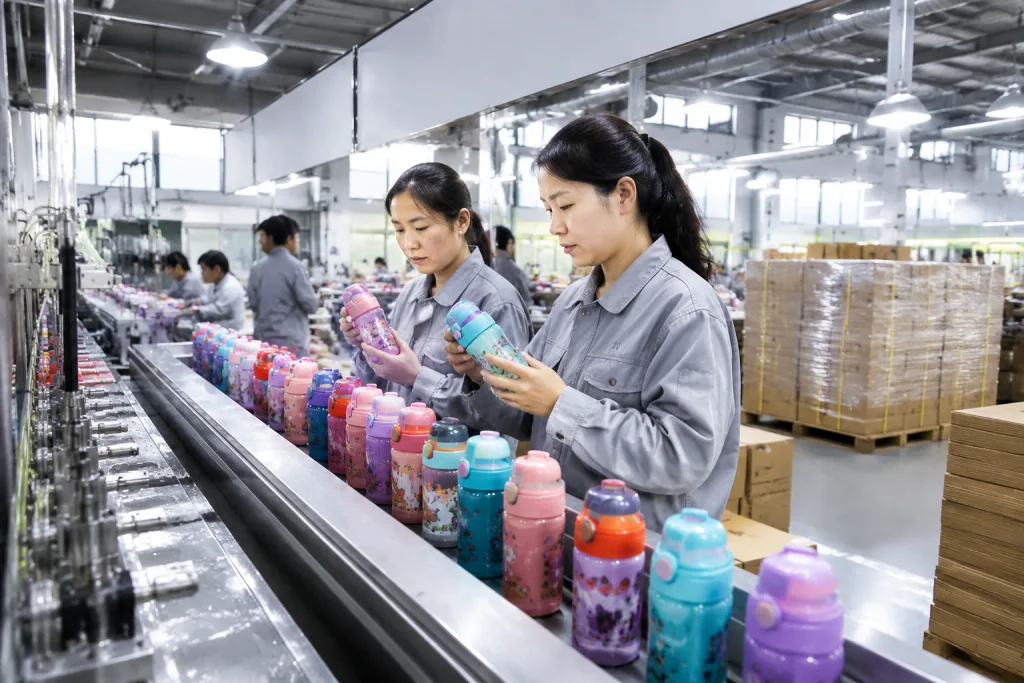
Key Takeaways
- Start with 4 decisions: material, lid design, compliance scope, and delivery plan before you compare FOB prices
- For school programs, practical MOQ is often 3,000-5,000 pcs per color, while custom mold changes usually start above 10,000 pcs
- A realistic lead time from Zhejiang, China is 7-12 days for samples and 35-45 days for bulk after approval
- Use written AQL 2.5/4.0 standards, migration testing, and drop-test criteria before you place a children water bottle bulk order
If you buy for schools or import children’s drinkware at scale, finding a kids bottle distributor is not the hard part. Keeping trouble off your desk 6 weeks later is. We see the same failures on the line: lid torque out by 0.3 N·m, packaging delayed because the PO artwork file had the wrong barcode, test reports that match the sample but not the mass-run item, or a quoted price that shifts after sampling once the buyer adds a silicone boot. A cheap bulk kids water bottle is easy to quote. A repeatable program is harder.
You usually have to balance four decisions at once: material, closure design, compliance paperwork, and delivery model. In Zhejiang, China, 200-plus factories can make a children water bottle customized with your logo. Far fewer hold the same Pantone shade across 3 production lots, pass AQL inspection, and ship on a 35-45 day lead time with stable carton specs like 24 pcs per master, under 18 kg. This is the wrong question to ask: not "who is cheapest?" but "who can run the same bottle again in 90 days without QC pulling the sample for color drift or thread fit?" That is where your supplier choice matters.
Decide the bottle program first
Before you ask a children water bottle manufacturer for a quote, decide what program you are buying. We see school district buyers and importers combine 3 different jobs into one RFQ all the time: a low-cost promotional bottle, a daily-use school bottle, and a retail-ready custom kids bottle. They do not share the same cost build or line setup. On our side, the tooling list changes fast—sometimes from a basic 1-color screen fixture to a full wrap-print sample and retail pack drop test.
Start with four decisions.
- Use case: classroom issue, cafeteria resale, club fundraising, retail, or event giveaway.
- Life cycle: one semester, one school year, or multi-year repeat SKU.
- Decoration level: one-color silkscreen, wrap print, heat transfer, laser mark on stainless, or private label packaging.
- Risk tolerance: lowest first cost or lowest complaint rate.
If you need a bulk school water bottle for daily student use, put leak resistance, easy cleaning, and replacement consistency ahead of the lowest unit price. The math doesn't work any other way. A 0.20 USD saving disappears fast if 3% of caps leak. QC pulled the sample on one school order last season because the straw seal failed after 300 open-close cycles, and the buyer flagged it right away. For a children water bottle promotional run used once at a summer event, cost and speed usually matter more than long-term durability.
For most import programs, split the range into good, better, best. This is the wrong question to ask if you want one bottle to cover every channel. We ship cleaner quotes when the buyer sets the target by channel first, then by price. A buyer once sent us a PO with "retial pack" typed on it, but the packed target was still a polybag promo bottle—those jobs go sideways fast.
- Good: 450-500 ml single-wall Tritan or food-grade PP, one-color print, polybag, FOB China around 1.45-2.20 USD at 5,000 pcs.
- Better: 500 ml Tritan with flip straw, carry loop, color carton, FOB 2.30-3.40 USD.
- Best: 350-500 ml 18/8 stainless vacuum bottle, 0.4 mm inner and 0.5 mm outer wall, powder coat, FOB 3.80-6.80 USD.
Once the project is framed correctly, a kids bottle distributor or children water bottle supplier can quote apples to apples. Without that, you end up comparing offers built on different resin grades, cap structures, and packing assumptions. We've seen this go sideways. One factory quotes 5,000 pcs with a standard PE bag, another builds in a color box at 24 ECT, and the line cost is no longer comparable.
Pick material with complaint risk in mind
Material choice sets your price, shipping weight, drop performance, and compliance bill. Most buyers start from color and shape, then get hit later by the real problem: returns, odor claims, leaking lids, or parents saying the bottle feels cheap. We’ve seen a PO approved on appearance alone, then QC pulled the sample and found the body wall was 0.15 mm thinner than the approved unit.
Plastic options for school volume
For high-volume bulk children water bottle orders, Tritan, PP, and PE are the standard picks on the line. Tritan gives cleaner clarity, better odor resistance after 3 to 5 wash cycles, and a stronger shelf impression. PP saves cost and works well for lids and some bottle bodies, especially squeeze styles. PE is lighter and cheaper, but buyers flag it more often for hand feel because it does not read as premium in a 500 ml school bottle.
- Tritan: clear look, stronger premium feel, usually 0.9-1.2 mm wall thickness for kids bottles.
- PP: practical and durable at lower cost, often used in squeeze styles and cap systems.
- Silicone: usually only for spouts, seals, or sleeves; ask for food-contact grade documentation.
If your priority is children water bottle wholesale for schools, Tritan is usually the safer middle ground. Yes, it costs more than standard PP. The math still works if it cuts complaint rate from 3% to 1% on a 10,000-piece run. This is the right question to ask, not just ex-factory price.
Stainless for higher-value programs
For retail or premium district merchandise, 18/8 stainless steel makes sense. The common spec is SUS304 inside and outside, though some lids still use PP plus silicone seals. If you need thermal performance, vacuum stainless sells well, but it adds cost, weight, and more leak-risk points at the stopper, straw seat, and base weld. We ship samples with a 1.2 m drop test for this reason, because we’ve seen this go sideways when lid tolerances drift by 0.3 mm.
You do not buy material once. You buy the complaint profile that comes with it.
A children water bottle factory in Zhejiang may offer identical-looking bottles in different resin grades or steel specs. Ask for the exact material declaration on the quotation, not just “food grade.” We had one buyer send a PO with “silicon ring” typed on it, and that small miss tells you nobody checked the seal spec line by line. If a children water bottle distributor cannot confirm body material, lid material, straw material, and seal material one by one, treat that as a warning sign.
For school tenders, the best result usually comes from keeping the range tight. One 500 ml Tritan platform and one 350 ml stainless platform can cover most custom school water bottle needs without creating inventory chaos. Two platforms. That’s enough for most programs, and MOQ planning stays cleaner at 3,000 to 5,000 pcs per style.
Lid design is where failures start
Most complaints don’t come from the bottle body. They come from the cap. If you source from children water bottle manufacturers in China, spend more time on closure structure than on Pantone matching for the body, because this is where we see leaks, cracked hinges, bite-valve returns, and lids that parents say are hard to wash. On the line, QC pulled the sample more than once for a silicone seal sitting 0.3 mm proud of the groove.
For kids products, the common closure types are screw lids with carry handles, flip-top straw lids, push-button lids, and squeeze spouts. Each one has a cost and complaint profile. This is the wrong place to shop by photo alone.
- Screw lid: lowest cost, simple structure, fewer parts to fail. In most programs, this gives the lowest complaint rate and the cleanest assembly flow.
- Flip straw lid: sells well in school and retail channels, but it carries more parts and more leak risk if the mold tolerance is loose. We’ve seen this go sideways when the straw seat shifts by 0.2 mm.
- Push-button lid: convenient for kids, but the tooling cost is higher and QC gets heavier because the spring, latch, and pin all need repeat checks.
- Squeeze bottle cap: works for sports use, keeps the price down, but the shelf look is less premium. Some buyers flagged it as “too basic” after sampling.
If you are a children water bottle distributor serving school districts, ask direct questions before you approve the lid:
- How many opening cycles is the hinge designed for: 3,000, 5,000, or more?
- Is the straw removable without tearing the silicone connector?
- Can a child clean the lid cavity properly?
- Does the assembled lid pass upside-down leak test for 30 minutes?
- What is the drop-test standard: full bottle dropped from 80 cm or 100 cm?
For a bulk kids bottle order, paying 0.08-0.18 USD more for a cap that has already been mass produced for 100,000 units is usually the safer call than approving a new cap design with no field history. The math doesn’t work if you save 0.10 USD and then eat returns on 2,000 pieces. We had one PO with a lid code typo that mixed two hinge versions, and that single mistake delayed approval by 6 days.
At BottleForge Industrial, our advice is simple: if your order is below 10,000 pcs, don’t change the lid structure unless it fixes a real use problem. Keep the mold standard. Then customize color, print, and packaging. That route gives better yield on the line, fewer schedule slips, and a steadier children water bottle custom program from China.
Verify compliance before you approve artwork
Buyers often push compliance to the last step because artwork looks urgent. That is the wrong order. If you import into Europe or North America, check documents before mass production starts, not after 2,000 cartons are taped and stacked by the loading bay.
For kids drinkware, the file set usually covers food-contact declarations, REACH screening where applicable, and market-specific testing on finished goods. For the US, buyers also ask for ASTM-related checks based on age grading, packaging claims, or accessory design. We have seen a flip straw trigger extra review because the buyer flagged the pinch gap at 4 mm. For the EU, ask for migration reports and confirmation on restricted substances for coatings, inks, and plastics. If the bottle is sold to children, label clarity matters as much as material compliance. A warning line in 6 pt type will get kicked back.
Ask your children water bottle supplier for:
- Bill of materials: body, lid, straw, seal, paint, print ink, and packaging. We want the full list, down to the silicone shore grade and master carton spec.
- Existing test reports: recent reports tied to comparable structure and material. If the report is 18 months old and the lid resin changed, QC pulled the sample for retest.
- Factory certifications: ISO 9001 is common; BSCI is often requested by larger buyers. Some retailers ask for both before they release the PO.
- Inspection plan: incoming material checks, in-line leak tests, and final AQL standard. On our line, we run 100% vacuum leak checks on the first batch start.
For final inspection, a realistic standard is AQL 2.5 for major defects and 4.0 for minor defects. Define defects in writing. Do not leave this loose. Major defects usually include leaking, wrong logo color, missing parts, sharp edges above tolerance, or failed function. Minor defects can include light specks, slight print position deviation such as 1.5 mm, or carton scuffing within tolerance. We have seen this go sideways because one PO said “blue logo” and the approved file was Pantone 2995 C.
If you need children water bottle customized with school branding, make sure inks and decoration process are part of the compliance review. A safe bottle body with an unverified print process is still a risk. In Zhejiang, China, a lot of factories outsource printing or packaging. That is normal. What matters is visibility and control. Ask whether decoration is in-house or subcontracted, who owns the test record, and whether the same QA standard applies. We ship plenty of outsourced print jobs, but the math does not work if the print vendor never signed the color and adhesion standard.
The right sequence is simple: approve construction, confirm compliance path, test pre-production sample, then lock artwork. We run it in that order for a reason. It saves rework, scrap, and 12 days you do not have.
Price the order beyond FOB
Comparing a children water bottle vendor or children water bottle wholesale offer on FOB alone is the wrong question to ask. Buyers for schools and importers need landed program cost per usable bottle, because a quote that looks cheaper on paper can lose money fast once we pack it, test it, and ship it.
Start with these variables:
- MOQ: common MOQ for standard custom logo kids bottle orders is 3,000 pcs per model, sometimes 1,000 pcs per color if stock parts are used.
- Tooling: new mold or lid modification can run from 1,500 to 8,000 USD depending on complexity.
- Packaging: polybag, egg-crate divider, white box, color box, PDQ display, or master-carton drop test upgrades.
- Testing: pre-production or finished goods testing can add several hundred to several thousand USD.
- Freight cube: a bulky 500 ml bottle with straw lid may cost more to ship than a heavier but tighter-packed design.
Here is where quotes separate. A children water bottle custom price at 1.78 USD FOB can end up weaker than a 1.92 USD offer if the cheaper bottle packs 24 pcs per carton instead of 30, ships in larger cartons, and has a straw lid that QC pulled twice for leak issues at the 1.2 m drop test. On a 20,000-piece order, a 5% gain in carton efficiency can wipe out a visible unit-price gap. We have seen buyers focus on 0.14 USD and miss the freight math.
Ask every children water bottle distributor or factory for the same quote structure:
- FOB Ningbo or Shanghai
- MOQ by color and logo
- Sample charge and refund rule
- Production lead time after deposit and artwork approval
- Master carton size, gross weight, and pcs per carton
- Spare parts policy for lids and straws
Zhejiang factories usually ship through Ningbo, and for our Hangzhou line that often means 2 days less trucking coordination than routing the same order another way. Small detail, real effect. A clean quote should also state whether the logo is silkscreen, heat transfer, or UV print; one buyer flagged a PO last season because “silk print” was typed where the approved file called for UV. If you buy children water bottle customizable items for multiple school districts, standardize the bottle body, lid color set, carton count, and test standard first. Fewer moving parts after PO. Fewer surprises when we ship.
Choose a supplier built for repeat orders
The first PO shows they can make a sample. The second and third POs show whether they can run the same kids bottle again without cap fit drift, color shift, or carton mistakes. That is what protects school-season deadlines and replenishment orders.
Ask for operating numbers, not sales talk. A solid children water bottle factory should answer monthly capacity, the slow station on the line, and how they schedule peak season before August shipping. A workable benchmark is 300,000-500,000 units per month across mixed drinkware lines, with standard kids bottle lead time around 35-45 days after approval. If your program is 8,000 pcs now but may grow to 50,000 pcs across districts, this is not a future problem. We have seen buyers ask only about unit price, then get stuck when one silicone straw mold becomes the bottleneck.
Ask how they control changes on repeat POs:
- Color consistency: do they keep signed Pantone chips and golden samples, and does QC pull the retained sample before bulk packing starts?
- Replacement parts: can they sell spare caps at 2%-3% of order qty, or will they push back because the cap injection run does not meet MOQ?
- Packaging updates: can they revise FNSKU, barcode, or warning labels without restarting the whole approval process, and who checks the outer carton file before print?
- Quality records: do they keep leak test logs and final inspection reports by PO number, so if the buyer flagged 12 leaking pieces last shipment they can trace the batch fast?
If you are a children water bottle distributor in North America or Europe, communication discipline matters more than fast replies. You need records. A Zhejiang supplier that sends a revised spec sheet every time the lid gasket changes by 0.3 mm is worth more than one that replies in 10 minutes and leaves the details vague.
For most buyers, the best long-term partner is not the lowest quote or the factory with the biggest catalog. It is the supplier that runs the same custom children water bottle month after month, tells you straight when the matte coating will fail scratch testing, and puts that warning in writing. That honesty saves more money than aggressive first-order pricing. The cheapest first PO often goes sideways.
Need a reliable kids bottle distributor manufacturing in China?
Send your target size, lid style, MOQ, and compliance market. We will suggest the right bottle platform, quote clearly, and flag risks before sampling.
Frequently asked questions
What is a realistic MOQ for a custom kids water bottle order?
For a standard custom kids water bottle using an existing mold, a realistic MOQ is usually 3,000-5,000 pcs per model, with 1,000 pcs per color sometimes possible if stock lids and body colors are available. For stainless models or complex flip-lid designs, 3,000 pcs is common. If you want a custom made kids bottle with structural mold changes, most factories in China will want 10,000 pcs or more, plus tooling charges from about 1,500 to 8,000 USD. For school district programs, you can often control MOQ by using one body shape and changing only print, carton label, or insert card.
Which material is best for a bulk school water bottle program?
For most school programs, 450-500 ml Tritan is the safest balance of cost, appearance, and complaint control. It is clearer than PP, feels more premium, and generally performs well for repeated use. Typical wall thickness is around 0.9-1.2 mm. If your budget is tight and the program is mainly promotional, PP can work well, especially for squeeze or simple screw-cap designs. Stainless steel is better for higher-value resale or branded spirit wear, but FOB cost is usually 3.80-6.80 USD instead of 1.45-3.40 USD for plastic. The key is matching the material to expected service life and cleaning habits.
How do I reduce leak complaints on children water bottles?
Keep the closure simple and define your test standard before production. The lowest-risk option is usually a screw lid with a well-designed silicone seal. Flip straw lids are popular but should be validated with an upside-down leak test of at least 30 minutes and a drop test from 80-100 cm with a filled bottle. Ask for hinge cycle expectations such as 3,000 or 5,000 openings. Also request 2%-3% spare lids or straws on large orders. On children water bottle bulk shipments, spending an extra 0.08-0.18 USD on a proven lid normally costs less than handling returns from a weak cap design.
What compliance documents should I request from a children water bottle supplier?
Request a bill of materials listing body, lid, straw, seal, decoration, and packaging. Then ask for recent food-contact test reports relevant to the same structure and materials. For Europe, buyers often ask about REACH-related screening and migration suitability for finished goods. For North America, finished-product testing expectations vary by product design, age grading, and customer requirements. You should also ask for factory certifications such as ISO 9001 and, if social compliance matters to your organization, BSCI. Finally, require a written final inspection standard, typically AQL 2.5 for major defects and 4.0 for minor defects.
What lead time should I expect from a children water bottle factory in China?
For an existing model with standard customization, expect 7-12 days for pre-production samples and about 35-45 days for mass production after sample approval and deposit. If you need new packaging, third-party testing, or peak-season booking before back-to-school, add 7-15 days of buffer. New tooling can add 20-35 days depending on the lid complexity. From Zhejiang, China, export routing through Ningbo is common and usually efficient, but vessel space and final destination still affect total transit time. If your school deadline is fixed, work backward from delivery date and lock artwork earlier than you think necessary.