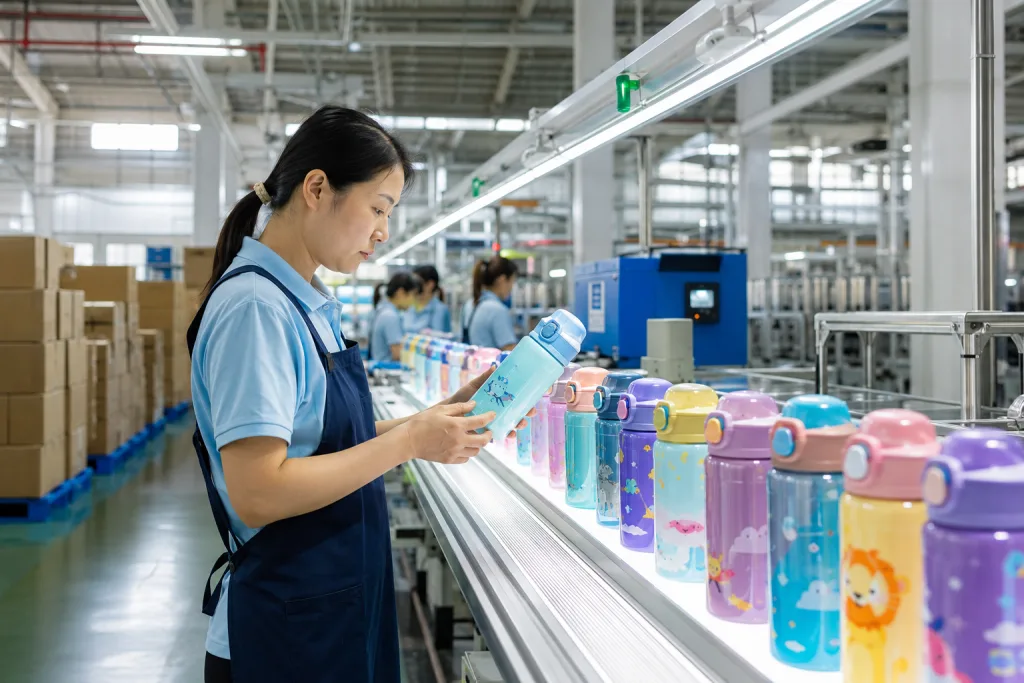
Key Takeaways
- For a first kids bottle customized order, 3,000-5,000 pcs per color is a realistic MOQ, with 25-35 days mass production after sample approval
- PP, Tritan, and 18/8 stainless steel are the usual material choices; ask for REACH, LFGB or FDA contact compliance based on your market
- Use AQL 2.5 for major defects and run 100% leak testing before packing, especially for straw lids and push-button lids
- A school program often lands at USD 1.65-3.80 FOB China per unit depending on material, decoration, and packaging
You are not buying a generic bottle if the end user is a child. A kids bottle customized program has to survive daily drops, school bag abuse, dishwasher pushback from parents, logo sign-off, and compliance checks from cautious buyers. We have seen this go sideways: leaking lids after a 1.2 m drop test, odor complaints on first opening, print adhesion failing after 50 dishwasher cycles, and inner boxes that miss the master carton plan by 8 mm.
The practical way to buy from China is to treat the order like a controlled project. Start with the child age group, lock the bottle structure, confirm materials and testing, then control decoration and inspection before balance payment. This is how experienced buyers in Zhejiang keep 20,000-unit reorders smooth. We run the line to spec, not by guesswork. A factory in China can make the bottle you want, but only if you write the PO like someone expecting 20,000 units to land exactly as promised—down to the straw length, lid torque, and a carton mark that QC pulled against the approved file.
Start with the actual use case
A school district buyer sends a clean brief: 12,000 bottles for students aged 6 to 10, four school colors, one district logo, delivery before August. An importer sends almost the same PO, then adds retail box size, barcode placement, and drop-test limits. On paper, it looks easy. On the line, this is where trouble starts. We ask blunt questions first: does it need to fit a lunch bag side pocket, is one-hand opening required, can a 7-year-old pull apart the straw set for washing, and is the bottle for cold water only? That last one matters. We’ve seen a buyer assume warm drinks were fine, then QC pulled the sample and found the silicone vent was set up for cold-fill use only.
This is where 8 out of 10 bulk kids bottle projects drift. Buyers ask for a custom kids water bottle but skip the daily-use details. For schools, 350ml to 500ml is the normal range, and 400ml to 450ml usually wins after sample review. Below 350ml, kids refill too often. Above 500ml, the carry weight gets rough for younger grades once the bottle is full; a filled unit can jump past 0.55 kg depending on wall thickness. We usually target a body diameter of 65mm to 72mm so smaller hands can grip it, and we check that on the fixture before sign-off. Price is not the first question here. The wrong question is “what’s your cheapest bottle?”
For a bulk school water bottle program, decide early whether replacement lids are part of the plan. If the district wants the bottles to last one academic year, buying 3% spare lids is usually cheaper than replacing full units later. The math works. On repeat school orders in Zhejiang, we often see buyers add spare components only after the first season, usually right after the buyer flagged broken handles, missing bite valves, or hinge cracks from playground drops. We ship spare lids in a separate export carton so schools do not open master cases just to fix 20 units.
- Best for lower grades: 400ml straw bottle with soft carry handle and a lid push force light enough for small hands
- Best for older students: 500ml chug lid or flip spout, depending on whether the school wants faster drinking or better dust cover protection
- Typical first order: 12,000 to 20,000 pcs across 4 colors, often packed by color ratio on the PO
- Safer timeline: artwork lock by May, shipment by July for August delivery, because one label typo or carton mark revision can cost 5 to 7 days
If you are a children water bottle distributor or a school procurement manager, the first job is not price comparison. It is to remove ambiguity from the use case. Get the real use condition nailed down, then quote the bottle.
Choose materials before chasing price
Once the use case is clear, material choice gets simpler. On a kids bottle customized order, buyers usually stack up single-wall stainless, Tritan, and full-PP construction. Same bottle category, different job. We check all three on the line with a wall-thickness gauge before quoting, because this is the wrong question to ask first: “Which one is cheapest?”
Tritan is a regular pick for children water bottle custom programs because it is clear, impact-resistant, and light in carton weight. For school projects, that matters. A 450ml Tritan bottle with a PP lid and silicone seal may land around USD 1.65 to 2.20 FOB China at 5,000 pcs, depending on print and packaging. Freight math is usually better too; one buyer cut carton weight by 1.8 kg per master carton versus steel and the shipment cost moved fast. PP can be cheaper, often around USD 1.20 to 1.80 FOB, but the surface marks up faster, and buyers have flagged scratch lines after drop tests. 18/8 stainless steel single-wall versions are tougher and feel heavier in hand, often USD 2.20 to 3.20 FOB. Double-wall vacuum bottles for kids can exceed USD 3.50 to 4.80 FOB and are not always necessary for school distribution. We have seen this go sideways when the brief says “daily school use” but the team buys vacuum by habit.
For Europe, ask your children water bottle manufacturer for REACH-related declarations and, where relevant, LFGB food-contact support. For North America, buyers usually ask for FDA food-contact compliance and ASTM-related checks if the product falls into child-use sensitivity. The exact standard depends on product design and sales channel, so do not accept a vague line like “test passed.” Ask what was tested, on which material, and by which lab. QC pulled the sample once on a mixed-material lid set, and the report covered only the bottle body, not the spout. That gap matters.
Material details buyers should lock
- Body material: Tritan, PP, or 18/8 stainless steel
- Lid material: usually PP for impact resistance; we often run drop checks at 1.0 m with the assembled lid
- Seal material: food-grade silicone, Shore A hardness typically 50-70
- Wall thickness: Tritan body often 0.8-1.2mm; stainless single wall often 0.4-0.5mm
- Temperature claim: cold only, or cold plus warm under a specified limit written on the PO, not left as “general use”
Good children water bottle suppliers in China will spell out the trade-offs in plain numbers. If a quote is low because Tritan dropped from 1.0mm to 0.8mm, or the silicone grade is left open, you are not comparing the same bottle anymore. The buyer sees one SKU; we see two builds.
Build the specification like procurement
At this stage, issue a short but tight product spec sheet. This is where a custom children water bottle stops being a nice-looking sample and becomes something the line can run. The sheet should call out dimensions, weight tolerance, color standard, logo size, packaging method, test requirements, and carton limits. We usually ask for neck diameter to the nearest 0.5mm and carton gross weight in kg, because this is where buyers get loose and production gets burned.
For example, a 420ml custom kids bottle for school distribution can be written like this: Tritan body, 70mm diameter, 185mm height, unit weight 132g plus or minus 5g, PP flip lid, silicone seal, integrated carry loop, Pantone 2935C blue body, one-color white silk screen logo 45mm wide, individual polybag, 24 pcs per export carton, drop test 80cm, 100% leak test, and no BPA-added materials. That is clear enough for purchasing, tooling, printing, and packing to follow without guessing. QC pulled a sample last month where the PO said “blue” but missed the Pantone, and the buyer flagged the lid shade on arrival.
Decoration needs practical choices, not just pretty mockups. Silk screen is the low-cost option for 1-2 colors and usually adds about USD 0.05 to 0.12 per color per position. Heat transfer or wrap printing gives larger graphics, but we have seen this go sideways on tapered bodies because edge lift shows up after the 80cm drop test. Laser marking fits coated stainless steel; for most school programs, the math doesn't work. For a custom logo kids bottle, keep artwork away from mold parting lines, grip ribs, and volume markings. On our line, we normally ask for at least 3mm clearance from the parting line so the print does not break.
A bottle sample that looks good on a sales desk can still fail in production if the artwork crosses texture changes or if the lid color target is not defined by Pantone.
Experienced children water bottle vendors ask for packaging details early because a retail box change can shift master carton quantity from 24 pcs to 18 pcs and push freight up fast. If you sell through retail or e-commerce, add barcode position, FNSKU if needed, suffocation warning language, and carton mark format before sampling. This is not admin work; it affects carton size, outer box drop performance, and booking space. In Zhejiang, factories that run 300,000 to 500,000 units per month depend on accurate specs to keep lead times under control, and the buyer pushback is usually the same: they want to fix packaging after sampling. Better to lock it earlier and ship in 12 days instead of 18 days.
Sampling is where problems should appear
Do not rush sampling because the school deadline is tight. This is where problems should show up, not after deposit and carton print. For a first pre-production sample on a children water bottle customizable project, we want five clear answers: does it leak after a 30-minute inversion test, can a child open it without help, does the logo stay clean after handling, does the color match the approved chip, and does the packed bottle fit the shipping plan and carton count. On our line, QC pulled samples that passed leak test but failed cap torque because the push button needed too much force for small hands. That is the kind of issue sampling is for.
For a normal project from China, expect 5 to 7 days for stock-shape logo samples and 10 to 15 days for full custom color or mold-adjusted samples. Tooling changes add more time. If you need a new lid mold for a custom made kids bottle, that can mean 25 to 40 days before final sample approval. Buyers forget this, then ask for mass production in 20 days. The math does not work. We have seen a PO marked "ship before 8/15" while the new hinge mold steel was not even cut yet.
Here is the practical sample review routine good children water bottle manufacturers run before approval:
- Fill and invert for 30 minutes, then side-lay for another 30 minutes
- Open and close the lid 200 cycles to check hinge fatigue
- Wash once and recheck print adhesion with cross-hatch tape test if relevant
- Measure net weight and dimensions against approved tolerances
- Ask two or three adults to simulate child use with wet hands
If you are a children water bottle wholesale buyer, do not approve only the "best sample." Ask the factory to attach the exact Pantone chip, decoration file, and packaging dummy to the purchase order. Those are the inspection standard. One factory-floor miss we still see is a mailer box that fits Sample A but gets tight by 3 mm after adding a silicone boot. If the factory says minor color difference is normal, ask them to define "minor" in writing. Usually that means visual acceptance against the approved sample under consistent light, often D65 light box checking, not a vague verbal promise.
A careful sample stage saves more money than hard price cutting. Most claims on bulk children water bottle orders start because the approved reference was loose, incomplete, or never attached to the PO. We have seen this go sideways from one missing color chip.
Production control and inspection points
After you place the order, the key question is not “did production start?” The real question is whether the line is under control. A solid children water bottle factory should lock raw material lot traceability, run in-line leak tests, check print adhesion, and finish with final AQL inspection. If all you get is 6 photos of sealed cartons, you are flying blind. We have seen this go sideways after a PO typo changed a lid color code and nobody caught it until packing.
For a 12,000-piece bulk kids water bottle order, the sequence should be clear: raw material confirmation, color chip approval, first-off production sample, in-line inspection at 20% completion, and final random inspection when 100% packed. Use AQL 2.5 for major defects and 4.0 for minor defects unless your internal standard is tighter. Major defects usually mean leaking lids, sharp edges, broken handles, missing components, wrong logo, or failed carton barcode. Minor defects are things like a small print speck, slight shade variation within the approved limit, or scratch marks not visible at 500 mm. QC pulled the sample at first-off, checked logo position with a ruler, and signed against the approved swatch. That step saves claims later.
Leak testing should be 100% for children’s bottles, not sample-only. This is the wrong question to ask: “Did you test a few pieces?” Ask how the factory tested all units. Straw bottles need more attention because the seal path is longer and the leak risk sits across more contact points. Ask whether the factory runs air pressure, water inversion, or both. On printed bottles, ask for an adhesion check such as 3M tape pull after curing. On stainless bottles, check weld cleanliness and whether the mouth rim shows any burr risk under glove wipe inspection. We run this on the line because one rough rim can kill the whole shipment claim.
- Common critical defects: accessible small parts, cracked hinge, cut hazard, odor contamination
- Common major defects: leaking, wrong assembly, missing straw, wrong color, crooked print
- Common minor defects: light scuffing, small dot contamination, slight carton mark shift
If your buyer team uses a third-party inspector in China, send the approved sample, PO, carton marks, and defect list before inspection day. Good children water bottle distributors already do this. It cuts out the usual warehouse-gate argument after 100% packing is done and the buyer flagged a logo angle issue that should have been settled 7 days earlier.
Freight, compliance, and reorder planning
The last stage is where first-time importers give margin away. They chase unit price and miss packaging density, pallet height, and HS code review. We’ve seen this go sideways. One bulk kids bottle program looked cheap until the buyer approved a gift box that added 18mm on each side, and freight ate more margin than the logo print ever could. For school distribution, simple packs usually work better: polybag or recycled paper sleeve, then tight export cartons. For retail, color boxes may be required, but size them off an actual carton drop test, not a mockup on screen.
As a rough example, 12,000 Tritan school bottles packed 24 pcs per carton might use about 500 cartons, depending on structure and inserts. If each carton measures around 46 x 31 x 40cm, the shipment volume becomes meaningful fast. The line sees this early once the cartons are stacked on a 1.1m pallet and the cube starts climbing. Sea freight from China to North America or Europe is usually the default for this kind of order. Air only makes sense for urgent partial shipments, sample top-ups, or replacement lids after QC pulled the sample and found a seal issue.
Ask your children water bottle vendors for these final documents before balance payment: commercial invoice, packing list, test reports or declarations promised in the PO, carton mark confirmation, and pre-shipment inspection report. Check the PO wording too. We still get simple mistakes like “FNSKU lebel” or a missing item code, and those small errors slow booking. If the goods go to Amazon or another fulfillment channel, add outer carton label rules, FNSKU labeling, and pallet instructions. If the goods go to schools, make sure the master cartons stay manageable; 15kg to 18kg is the usual ceiling before the receiver flags it.
For reorder planning, keep the successful bottle body and change artwork or color only where needed. This is the right question to ask. A new mold for a small styling change often does not pay back at 3,000 or 5,000 pcs MOQ, while a color change on the same body is routine on the line. That lowers risk and helps your children water bottle distributor or importer maintain continuity. A stable program from Zhejiang or elsewhere in China usually gets better on the second order: fewer comments, faster approval, and sometimes 5% to 8% cost improvement through packaging optimization or combined color runs.
Smart buyers do not end the project at shipment. They log defect data, return rate, and user feedback, then tighten the next PO with actual numbers, photos, and AQL notes from inspection. One factory-floor detail matters here: if QC found 7 leaking straws in a 200 pcs pull test, write that limit into the next order instead of calling it a general quality issue. That is how a one-time children water bottle promotional order becomes a repeatable sourcing program.
Specify your kids bottle project with fewer surprises
Send your target age, capacity, material, logo file, and quantity. We will review MOQ, testing, packaging, and lead time for your China order.
Frequently asked questions
What is a realistic MOQ for kids bottle customized orders?
For standard bottle shapes with custom colors and logo, a realistic MOQ is usually 3,000 to 5,000 pcs per model, sometimes split across 2 to 4 colors. If you choose a stock color and simple one-color print, some China factories can go lower, around 1,000 pcs per color. Fully custom parts, such as a new lid or body mold, push MOQ much higher because tooling and setup costs must be absorbed. For school district orders, 5,000 to 12,000 pcs is a comfortable range for pricing and production efficiency. Always ask whether the MOQ applies per color, per logo version, or total order quantity, because that changes your landed cost more than buyers expect.
Which material is best for a custom kids water bottle?
It depends on how the bottle will be used. Tritan is a common choice for school-age children because it is lightweight, impact resistant, and visually clean. PP is cheaper and practical for high-volume promotions, but it can feel less premium. Single-wall 18/8 stainless steel is stronger and often preferred by importers targeting a longer service life. For younger users, weight matters: a 450ml Tritan bottle may weigh around 130g to 160g, while stainless can be 180g to 260g before filling. If your market is Europe, request food-contact documentation relevant to REACH or LFGB support. For North America, ask for FDA-related compliance backing from the supplier.
How long does production take for bulk school water bottle orders?
For an existing mold with custom color and logo, sample lead time is usually 5 to 10 days, and mass production is commonly 25 to 35 days after sample approval and deposit. If packaging is complex or there are four or more colorways, add a few more days. New mold development can add 25 to 40 days before you even start mass production. During peak season, especially before back-to-school shipping windows, lead times in Zhejiang and other China manufacturing areas can stretch quickly. If you need August delivery, lock artwork and sample approval by May or early June. Waiting until July often forces expensive air freight or rushed inspection decisions.
What QC checks matter most on children water bottle bulk orders?
Start with 100% leak testing. If the lid leaks, everything else is irrelevant. Then check opening and closing function, handle strength, print adhesion, odor, and assembly consistency. For random final inspection, many buyers use AQL 2.5 for major defects and 4.0 for minor defects. Major defects include leakage, sharp edges, missing seals, wrong logo, cracked lids, or broken straw parts. For school and importer programs, also confirm carton quantity, carton marks, and barcode accuracy because warehouse mistakes create downstream costs fast. A pre-shipment inspection in China is cheap compared with replacing 1,000 faulty bottles after arrival. Ask your factory to keep approved samples on the line during production.
How much should I budget for a children water bottle customized order?
A practical FOB China budget for standard school-use bottles is about USD 1.20 to 1.80 for PP, USD 1.65 to 2.20 for Tritan, and USD 2.20 to 3.20 for single-wall stainless steel at around 5,000 pcs. Decoration, retail packaging, and extra testing can add another USD 0.10 to 0.80 per unit. A color box often adds more than buyers expect, especially when freight volume increases. For a 12,000-piece school order, it is smarter to compare total landed cost than just unit price. Ask the supplier to quote FOB and carton details together so you can calculate sea freight, duty, and local delivery before approving the order.