Key Takeaways
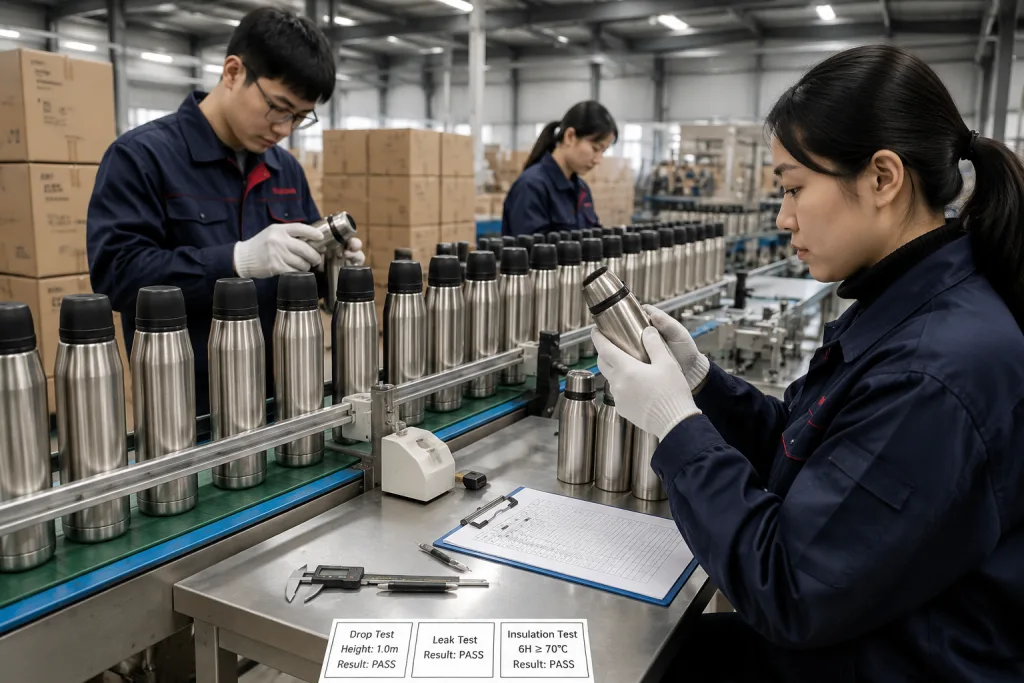
- For a 500 ml double-wall 18/8 bottle, 0.4 mm inner and 0.5 mm outer wall thickness is a practical baseline for retail-grade durability
- Typical MOQ is 1,000 pcs per color per size, with 35-45 days lead time after sample approval and deposit in Zhejiang, China
- AQL 2.5 for major defects and 4.0 for minor defects is a common inspection plan for custom thermos export orders
- FOB price swings of USD 0.25-0.80 per unit usually come from steel grade, lid tooling, coating process, and packaging rather than pure factory margin
You do not usually lose a thermos order because the sample looked bad. You lose it because one spec line was vague, the lid leaked on the line at 3,000 pcs, or the factory quietly changed steel thickness after approval from 0.5 mm to 0.4 mm. If you buy from insulated water bottle vendors for an outdoor retail line or a promotional campaign, the hard part is not finding a supplier. China has thousands. The hard part is reading the spec sheet like a production document, not a sales flyer. This is the wrong question to ask: “Who has the best price?” Ask who will hold the same build on repeat POs.
At BottleForge Industrial in Hangzhou, Zhejiang, we build stainless vacuum bottles for buyers who need repeatable results, not just a low quote. A 500 ml custom thermos at USD 3.20 FOB Ningbo can turn into an expensive claim if lid torque, powder coat adhesion, or carton drop standard is left open; QC pulled the sample last month on a cap fit issue at 1.8 N·m. You need to know which spec lines actually move margin, returns, and delivery, because we have seen one typo on a PO change a 304 stainless inner from brushed to polished and hold shipment for 12 days.
Start with steel and structure
On a quotation sheet, the first lines need to show body material, vacuum structure, capacity tolerance, and wall thickness. If those lines are missing, you are not comparing the same bottle. For a serious bulk thermos program, ask for 304 stainless steel, also written as 18/8, on both inner and outer walls unless you have a clear cost target for changing the outer wall. In Europe and North America, buyers still read 18/8 faster than the full grade name. We see this on POs every week, sometimes with the grade typed wrong as “308,” and that is where claims start. For food-contact compliance, ask for test reports tied to the exact SKU, not a broad factory statement. This is the right place to be picky.
A common retail-ready build for a 500 ml custom thermos is 0.4 mm inner wall plus 0.5 mm outer wall. Some thermos manufacturers quote 0.35 mm/0.4 mm to cut cost. That usually trims FOB by USD 0.12-0.18 per piece, but the math does not work if dent complaints show up after arrival. We have seen thinner bodies fail the simple drop-and-roll check on the line, and thread stability gets worse after repeat cap cycling. Outdoor retailers catch this faster than promo buyers because store customers pick up, squeeze, and twist the bottle before buying.
Vacuum construction matters just as much. Good factory thermos production should state double-wall vacuum insulation with a copper-plated inner wall or the equivalent thermal build if the hot-hold claim is aggressive. Ask for the actual test condition: 95 degrees C fill, ambient 20 degrees C. A “12 hours hot” claim is too loose. You need start and end temperatures, such as 95 degrees C down to 58 degrees C after 12 hours, and 4 degrees C up to 10 degrees C after 12 hours. QC pulled one sample last month that looked fine on weight but missed the hot test by 6 degrees because the vacuum pull was unstable.
- Best for outdoor retail: 304/304 stainless, 0.4/0.5 mm, powder coat body
- Best for price-led promotional thermos: 304 inner, 201 or 304 outer only if compliance and corrosion expectations are clear
- Capacity tolerance: keep within plus or minus 3%
If a thermos supplier cannot lock these basic lines early, do not spend time on logo printing or carton marks yet. We have seen projects go sideways over a 0.05 mm wall gap while the buyer was still discussing Pantone colors.
Insulation numbers that affect returns
Thermal performance is where 7 out of 10 insulated water bottle vendors get slippery. They print “keeps hot and cold for 12-24 hours” because it covers them. That is the wrong question to ask. Ask for the test method. On stainless vacuum bottles, heat retention comes down to vacuum level, inner wall polish, stopper structure, fill volume, and headspace. On our line, a 750 ml narrow-mouth bottle usually beats a 750 ml wide-mouth version under the same test because less heat escapes at the opening and lid seat.
For a manufacturer thermos quote, ask for the following exact data points:
- Fill temperature and room temperature
- Elapsed time: 6h, 12h, and 24h
- Result temperature at each time point
- Whether the bottle was preheated or prechilled
- Whether the test used the final production lid
For outdoor retail, practical performance on a 500-750 ml bottle matters more than a big claim on the carton. For commuter use, 12-hour hot and 24-hour cold are usually enough. We have seen buyers push for 36-hour hot retention, then reject the sample because the lid got bulky and the drinking diameter dropped by 4 mm. For hiking or winter field use, check the lid and mouth structure before you obsess over the body. A weak gasket turns a strong vacuum bottle into a weak thermos custom product fast.
Ask your supplier thermos partner for leak testing standards. We recommend 100% air-pressure or inverted water leak checks at assembly, plus batch verification after aging. QC pulled the sample after 48 hours on the rack more than once and found slow seepage at the thread start, not the vacuum body. For screw lids, set the torque range. Too loose leaks. Too tight brings returns and cracked caps. A simple torque spec such as 8-12 kgf-cm for a PP cap with silicone gasket gives your QC team something real to inspect.
Buyers often stare at heat-retention numbers and miss condensation, cap fit, and one-hand use. Returns usually come from the lid, not the vacuum chamber.
That is why a cheap thermos vendor can look good on paper and still fail after the first container ships.
Lids, seals, and drinking format
The lid is not decoration. It is the highest-risk component in a customizable thermos project because it pulls together tooling tolerance, user use, leak control, and food-contact compliance in one assembly. On our line, the lid is the part QC pulls first after the first 50 pcs. Outdoor retailers usually stay with screw caps, chug lids, or cup-cap structures since they hold up better and are easier to wash. Promotional brands often ask for flip tops or push-button lids because the sample looks more “featured” in a sales meeting. That choice has a cost. A basic screw lid may run below 0.5% assembly-related issues in production. A push-button mechanism can push that above 1.5% if the molding supplier drifts on pin fit or spring seat tolerance by even 0.2 mm.
When comparing thermos suppliers, ask what resin is used in the lid. PP is standard. Tritan is used when a clear part matters. Silicone needs to be food-grade and odor-controlled; if the gasket smells after the 70°C hot-water soak, the buyer will flag it fast. For Europe, REACH and LFGB come up in almost every serious quote. For North America, buyers may also request California Proposition 65 screening depending on the channel. If you sell to kids or school-related programs, ASTM-related accessory safety expectations may also appear, even for drinkware. This is not paperwork for the file cabinet. We have seen one PO held because the cap color masterbatch was changed and the lab asked for a fresh declaration.
There are four practical lid questions you should put in your RFQ for a customized thermos:
- How many components are in the lid assembly?
- Is the gasket removable for cleaning?
- What is the leak test standard and sample size?
- Can replacement lids be ordered separately, and what is the MOQ?
Replacement parts matter more than new buyers expect. If your distributor thermos business supports seasonal retail, being able to buy 500 spare lids instead of 5,000 full bottles can save a launch. We ship spare lids for repeat programs every quarter, and the usual MOQ is 500 to 1,000 pcs by color, not 5,000. In Zhejiang, China, some factories refuse low-volume spare-part support because their molding partners give machine time to complete bottle orders first. Ask this before mass production, not after the first complaint batch. The wrong question is “Can you do spare parts?” The right one is “What MOQ, what lead time, and do you keep the old color chip?”
For cup-cap vacuum flasks, check the handle weld or joint strength, cup threading, and stopper pour rate. We test pour rate with a 45° tilt and watch for dribble on the first 200 ml. A flask that dribbles when pouring generates complaints even if it passes thermal testing. We have seen this go sideways when the stopper thread feels smooth by hand but binds after powder coating buildup on the neck.
Surface finish and logo method
Most buyers fixate on logo size and miss the coating under it. That is the wrong question to ask first. The body finish decides shelf look, scratch resistance, and which decoration methods will hold up on your thermos customized order. Standard options are spray paint, powder coating, brushed steel, rubber paint, electroplating, and special effects like crackle or gradient. On our line, outdoor buyers usually pick powder coating because it gives better grip and hides carton rub marks better than gloss spray paint; last month a U.S. camping buyer flagged 3 mm scratches on a shiny sample after a drop test.
A typical powder coat thickness is around 60-80 microns. Too thin, and edge coverage fails fast. Too thick, and thread areas or bottle base transitions start to look wavy under side light. Ask your thermos factory if they mask the thread zones before coating; we use high-temp silicone plugs on some SKUs for that reason. If they do not, cap fit can drift lot to lot, and QC pulled one batch this spring because torque feel changed after coating buildup on the neck.
For branding, the common choices are silk screen, heat transfer, laser engraving, and digital printing. Each has a different cost and wear result:
- Silk screen: lowest cost for 1-color logos, good for promotional thermos runs from 1,000 pcs; works best on flatter bottle panels, not deep curves
- Laser engraving: premium look, excellent abrasion resistance, usually USD 0.08-0.20 more than simple screen print; on powder-coated bodies, the beam setting needs to stay tight or the edge burns dirty
- Heat transfer: suitable for wrap graphics, but check dishwasher and abrasion limits; we have seen seam alignment go sideways on tapered bodies
- Digital printing: flexible for multicolor short-run visuals, but not every bottle geometry prints well; one buyer sent artwork for a full wrap on a bottle with a heavy shoulder radius, and the math did not work
If you are sourcing thermos promotional products, ask for adhesion and abrasion testing. Do not just ask for a nice photo. A practical standard is cross-hatch adhesion plus tape pull, and 50-100 rub cycles for printed areas depending on the finish. QC usually runs the cross-hatch cutter on a hidden area first, then checks edge lift after tape pull. For retail packaging, barcode readability is part of decoration quality too. If your order goes to Amazon FBA, FNSKU label placement and scannability need to be written into the pack-out SOP; we once saw a PO typo put labels across the bottle curve, and the scanner miss rate jumped on the packing table.
A good manufacturer thermos partner will say straight out when a logo method looks cheap on a certain finish. We have talked buyers out of glossy silver screen print on brushed steel more than once. That honesty saves rework, and it is worth more than a low setup charge.
Packaging, carton math, and freight
Packaging is where margin disappears fast. A thermos bulk quote can look sharp on the bottle price, then get hit by color boxes, dividers, instruction sheets, barcode labels, and stronger export cartons. We see this every week on the line. For promo orders, plain white box packing is still common because the math works. For outdoor retail, buyers usually ask for a printed color box or belly band, and the buyer flagged this more than once: shelf presence matters if the store will not open the carton.
Ask every suppliers thermos candidate for unit weight, product size, box size, master carton size, pieces per carton, and gross weight. Ask for the numbers in mm and kg, not screenshots with half the fields missing. Then run the container math. A 500 ml vacuum bottle packed 24 pcs per carton may fit roughly 10,000-12,000 pcs in a 20GP depending on carton dimensions and cap style. Change to a wider sports lid, and the load count drops fast because carton cube goes up even if bottle weight barely moves. Freight per piece follows that carton cube, not your hopes. This is the wrong question to ask: “What is your best FOB price?” Ask landed cost per piece.
Write the carton standard into the PO. We usually advise 5-ply export cartons and a drop test level based on the sales channel. QC pulled the sample last month and found one outer carton crushing at the handle side after a 76 cm drop, which is exactly why this detail should not stay verbal. If the product goes to club retail or e-commerce, outer carton strength matters more than for palletized distributor shipments. For Amazon or DTC programs, specify suffocation warning if polybags are used, carton labeling format, and pallet pattern if the final leg requires it.
Do not skip these packaging lines
- Inner pack quantity
- Barcode type: UPC, EAN, or FNSKU
- Instruction sheet language set
- Carton drop requirement
- Pallet or floor-load shipment
In Zhejiang, China, a bottle factory may produce 600,000 units/month but still outsource color boxes. That is normal. We ship this way often. What matters is who signs off final packaging QC and who pays if the barcode is wrong. We have seen a PO typo swap EAN for FNSKU, and 3,000 labels had to be reworked by hand. For our own programs, mass production MOQ is usually 1,000 pcs per color, and lead time runs 35-45 days after artwork approval and deposit. If custom packaging includes a new dieline or foam insert, add 5-7 days. That extra week is cheap compared with a carton failure claim.
Compliance, audits, and inspection control
If you buy from manufacturers thermos in China, treat compliance as part of the product spec from day 1. Not later. Ask for food-contact test reports for the exact bill of materials: body, lid, silicone gasket, straw, and decoration ink or powder. We’ve seen buyers approve a 304 stainless body, then get stuck because the lid pigment had no backup file. For Europe, REACH and sometimes LFGB are standard asks. For North America, FDA food-contact declarations and Proposition 65 screening often show up before the PO is released. If your customer needs social compliance, check BSCI audit status or equivalent before deposit; this is not the part to “sort out later.”
Inspection planning carries the same weight as certification. Put the QC plan in writing: incoming steel check, in-process vacuum test, coating adhesion, leak test, and final random inspection. On our line, QC pulled the sample after the vacuum hold test and measured base flatness with a 0.5 mm feeler gauge because unstable bottles get rejected fast. AQL is still the working language. A common plan for a thermos distributor order is AQL 2.5 for major defects and 4.0 for minor defects, though some retail chains go tighter. Define major defects in plain words: leakage, wrong logo, sharp edge, missing gasket, failed barcode, unstable base, or a body dent beyond tolerance. If you leave that vague, the math doesn’t work.
For first orders with a new thermos manufacturer, use three checkpoints to cut risk:
- Pre-production sample approval: lock color, finish, logo size, and packaging; we usually sign off against a master sample and Pantone note before the line starts
- During production inspection: verify dimensions, coating, and lid assembly before 20-30% output is complete; if thread fit is off by 0.3 mm, fix it here, not after 5,000 pcs
- Pre-shipment inspection: confirm AQL, carton marks, count, and function; the buyer flagged a PO once because one carton line missed a color code suffix
If you are buying distributors thermos volume for multiple SKUs, ask whether the factory uses lot traceability by date code or carton mark. Ask for the actual format. A stamp like 240318-A on the inner carton is enough if the records are clean. This matters when one lid sub-supplier changes material or one mold cavity starts flashing. We’ve seen this go sideways on mixed-SKU orders above 12,000 pcs. A reliable thermos distributors program is built on traceable batches, not attractive pricing alone.
Good factories in China do not push back on specific QC language. Usually, the factories that resist are planning to improvise after the deposit hits. That is the wrong supplier to test.
MOQ, tooling, and quote realism
The last spec line buyers push on is the commercial one: MOQ, tooling cost, sample lead time, and how long the price stands. For a standard-shape custom thermos on existing molds, 1,000 pcs per color per size is normal in Zhejiang. We run that level every week. Some thermos vendors quote 500 pcs, but usually they are slotting your order into another production run or cutting decoration options to one color and one print position. We have seen this go sideways. The buyer wants a trial order, then the line waits 6 days for color matching because the shared run changed.
New lid tooling changes the math fast. A new cap mold usually runs USD 3,000 to USD 12,000, depending on structure and cavity count, and the mold shop will ask about thread depth and hinge life before they cut steel. A new body shape with a different base profile or shoulder line adds more cost. If your program is under 5,000 pcs, this is the wrong question to ask unless the silhouette is the brand story itself. In our factory, buyers often get 80% of the target look by keeping an existing bottle body and spending on the finish, tighter logo placement within 1.5 mm, and better packaging.
Price realism starts with knowing what moves the number. For a 500 ml 304 stainless vacuum bottle with powder coat and 1-color print, FOB Ningbo might land around USD 2.80-4.20 depending on quantity, lid type, and packaging. If a thermos supplier comes in USD 0.60 under the market cluster, ask why and ask for the weight in grams. Common reasons are thinner steel, no copper lining, weaker coating, lower carton spec, or scrap rates on paper that do not match the line. QC pulled the sample on one low-price project and found the outer wall thickness was down by 0.08 mm. None of that helps after shipment.
Request your quote in a format that forces clarity:
- FOB port and currency
- MOQ by SKU and color
- Sample charge and refund policy
- Mass production lead time
- Payment term, usually 30% deposit and 70% before shipment or against copy documents
A credible thermos factory should also say if the price covers spare parts, test costs, and export paperwork. We ship quotes both ways, and the difference shows up later. One PO we received even said “spare part included” while the approved quote did not, and that argument burned two days. If the quote hides those details, the math does not work and the order is not cheaper.
Send your bottle spec sheet for a real factory review
We will check steel grade, lid risk, packaging math, MOQ, and FOB pricing so you can compare insulated water bottle vendors with fewer surprises.
Frequently asked questions
What MOQ should I expect from insulated water bottle vendors for custom stainless thermos orders?
For existing bottle shapes, a realistic MOQ is 1,000 pcs per color per size. Some insulated water bottle vendors in China will offer 500 pcs, but usually with fewer color choices or shared production scheduling. If you need a custom logo only, 1,000 pcs is standard. If you want a new lid, unique body tooling, or fully customized thermos packaging, effective MOQ often rises to 3,000-5,000 pcs to spread tooling and setup cost. Sample lead time is normally 7-12 days for logo samples and 15-25 days for modified structures. In Zhejiang, mass production lead time for a standard 500 ml bottle is usually 35-45 days after deposit and final artwork approval.
Which stainless steel grade is best for outdoor retail thermos programs?
For outdoor retail, 304 stainless steel, also called 18/8, is the safest baseline for both inner and outer walls. It balances corrosion resistance, consumer recognition, and export compliance expectations in Europe and North America. A typical retail-grade build is 0.4 mm inner wall and 0.5 mm outer wall. Some manufacturer thermos quotes use 201 stainless on the outer wall to save around USD 0.08-0.15 per piece, but that can hurt long-term appearance in humid or salty conditions. If you sell premium hiking or worksite bottles, stay with 304/304 unless your customer clearly approves an alternative. Always ask for food-contact test documents and confirm that the tested material matches the actual production BOM.
How do I compare prices from thermos suppliers without getting fooled by a low quote?
Put every quote into the same template and force the suppliers thermos candidates to fill the same lines: steel grade, wall thickness, vacuum structure, lid material, coating type, logo method, unit weight, carton spec, MOQ, and FOB port. On a 500 ml powder-coated bottle, price differences of USD 0.25-0.80 usually come from material thickness, lid complexity, packaging, and finish quality, not from miracle factory efficiency. Ask whether the quote includes leak testing, logo setup, barcode labels, and spare gaskets. If one thermos supplier is much cheaper, check if they used 0.35/0.4 mm steel, omitted copper lining, downgraded cartons, or excluded custom box cost. Low opening prices often become expensive after claims or delays.
What quality standards should I write into a PO for a custom thermos order?
Write measurable standards, not vague words like premium or export grade. Use AQL 2.5 for major defects and 4.0 for minor defects unless your retail customer specifies something stricter. Major defects should include leakage, failed logo, unstable base, missing gasket, wrong color, sharp edge, and barcode problems. Add leak-test requirements, thermal test conditions, coating adhesion method, and acceptable dent or scratch limits. For packaging, specify carton size tolerance, gross weight limit, and drop test requirement if you sell through e-commerce. If your thermos factory is in China, ask for lot traceability by date code or carton stamp. That makes corrective action much easier if one lid batch or gasket batch fails after shipment.
Is it worth developing a fully customized thermos instead of using an existing mold?
Usually only if your annual volume justifies it. For many outdoor retailers and promotional thermos buyers, an existing mold with custom color, coating, logo, and packaging gives the best return. A new lid mold alone can cost USD 3,000-12,000, and a new body shape adds more tooling cost and development time. Unless your forecast is above 5,000 pcs per SKU, you may recover that investment slowly. Existing molds also reduce risk because the vacuum process, cap fit, and carton loading are already proven. If your brand needs a unique silhouette, ask the thermos manufacturer whether a semi-custom approach is possible, such as a modified cap top, special texture, or exclusive color finish rather than a fully new bottle structure.