Key Takeaways
- For a 500ml double-wall 18/8 stainless bottle, practical MOQ is usually 1,000 units and FOB China pricing often lands around USD 3.20-5.80 depending on lid, coating, and print
- A reliable custom thermos program needs 25-35 days production, 5-7 days for pre-production samples, and at least AQL 2.5 final inspection before balance payment
- Ask for real compliance scope: REACH, LFGB or FDA contact safety, and coating adhesion testing; do not accept a generic 'food grade' claim
- Heavy use outdoor bottles typically perform best with 0.4-0.5mm inner wall, copper-coated vacuum insulation, and leak testing at 100% on the assembly line
Buying for an outdoor retail line or a promo campaign looks easy until the first sample lands on your desk. Then the buyer starts asking the right questions. Why does one bottle hold heat 12 hours and another 24? Why did the logo scratch after 20 rubs in the tape test? Why did landed cost jump once the gift box, drop test, and FDA paperwork were added? Catalog photos do not answer that. The gap between insulated water bottle suppliers usually sits on the line: process control, steel grade, vacuum yield, and whether the factory gives you a straight answer when QC pulled the sample and found a 0.3 mm dent at the base.
From Zhejiang, China, you can buy a solid custom thermos at a workable cost, but you need to screen the factory like a buyer. Not a browser. At BottleForge Industrial in Hangzhou, Zhejiang, typical MOQ starts at 1,000 units per color, capacity is 450,000 units per month, and normal production lead time is 25 to 35 days after sample approval. We run those numbers first because the math does not work if a factory quotes low, then slips to 42 days or misses color match on the second batch. Those figures tell you more than sales copy, and we have seen this go sideways over a one-line PO typo on carton pack-out.
What makes a supplier worth shortlisting
Start with two filters: who actually makes the bottle, and who can ship it cleanly. A lot of companies in China call themselves a thermos manufacturer or thermos supplier, but 6 out of 10 first-contact vendors we see are trading offices or mixed trading-factory setups. A trader is not a bad choice by itself. The wrong question is “factory or trader?” Ask who owns the mold, who signs the AQL report, and who locks the vessel loading date. On the line, this usually shows up fast once you ask about neck forming dies or vacuum hold records.
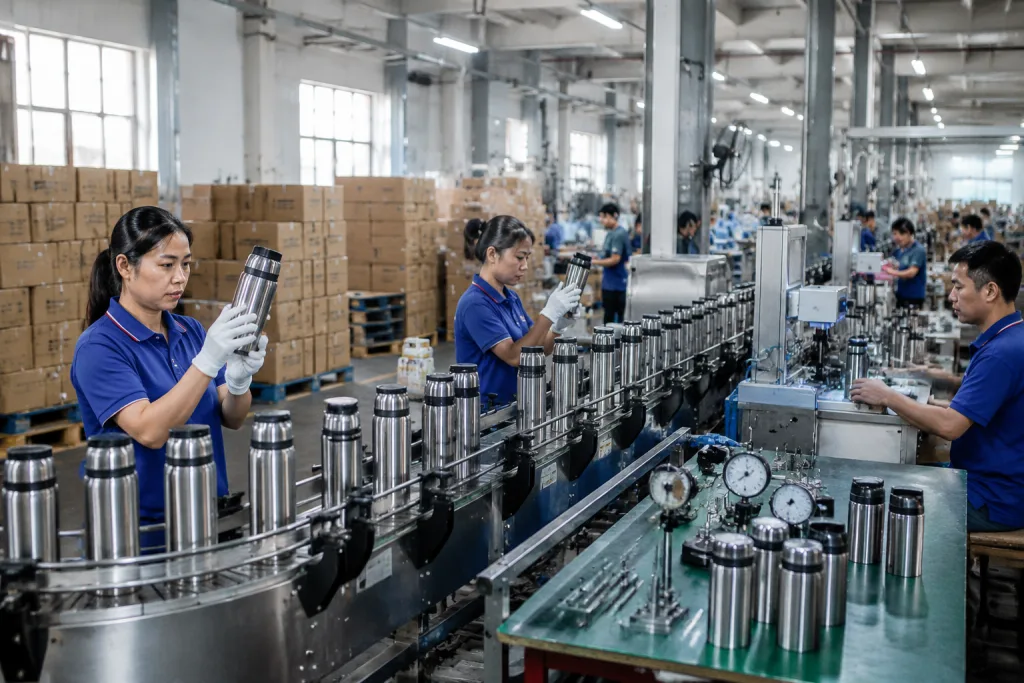
For outdoor retailers, product fit starts with abuse resistance. You need a factory thermos program that runs powder coating with stable film thickness, anti-slip base options, reinforced carry loops, and repeatable vacuum insulation performance batch after batch. We usually check coating at 60-80 μm with a thickness gauge, not by eye. For promotional thermos orders, decoration control and carton planning often matter just as much as thermal retention, because one logo shift by 2 mm or a weak master carton can turn into a claim. So your checklist should split retail questions from campaign questions.
- Factory status: Ask if the supplier has in-house forming, welding, vacuuming, polishing, coating, and print, or if key steps are outsourced. If welding goes outside, ask which shop does it and who handles rework when QC pulled the sample for pinholes.
- Monthly output: A serious thermos factory should give you a range, not a soft answer. If your forecast is 20,000 units per month, a plant running 300,000 to 500,000 units monthly is safer than a workshop built around small spot orders. We have seen buyers push for a cheaper small shop, then wait 18 days for replenishment instead of 12.
- Audit and systems: BSCI, ISO-style process records, AQL inspection standards, and batch traceability are basic signals of export readiness. Ask to see lot coding from liner to finished carton, not just a certificate PDF sitting in sales email.
- Communication speed: If a supplier thermos quotation takes 6 days and still misses steel grade, carton spec, and test scope, expect bigger problems later. One missed line on a PO sounds small until the buyer flagged it because “304 stainless” was never written into the final sheet.
Good manufacturers thermos programs answer practical questions fast: steel composition, lid material, gasket grade, drop risk points, and replacement part availability. They will usually tell you if the loop passed a 15 kg hang test or if the stopper uses food-contact silicone at once. Weak suppliers thermos programs push color charts and low headline pricing. We have seen this go sideways. If you are buying from Zhejiang or broader China for the first time, do not mistake fast replies for operational control. A sales reply in 20 minutes means nothing if the factory cannot show vacuum test records or carton burst data.
Questions on steel, insulation, and lid design
The biggest performance gap in a custom thermos sits inside the wall, not in the paint or powder coat. For premium insulated bottles, ask for 18/8 stainless on the inner wall. You will also see offers marked 304 inside and 201 outside. We run that spec for price-driven promo orders, usually 3,000 pcs and up. For outdoor retail, 304 inside and outside is the cleaner choice for corrosion resistance, dent balance, and shelf value. This is the wrong place to save $0.20.
What specification should you ask for?
- Inner wall: 18/8 stainless, typically 0.4mm
- Outer wall: 18/8 or 201 stainless, typically 0.45-0.5mm
- Insulation: double-wall vacuum, ideally with copper coating for better heat reflection
- Mouth finish: smooth rolled edge, no sharp weld feel
- Lid seal: food-contact silicone gasket, preferably replaceable
If you are sourcing bulk thermos for hiking, gyms, or commuter retail, ask for retention data tied to a test method. A usable claim looks like 12 hours hot from 95°C to above 50°C, and 24 hours cold with ice retention under defined ambient conditions. Put the room temp on the report. Put the fill volume on it too. We have seen suppliers quote "24 hours hot" with no start temp, no ambient, and no bottle fill ratio. QC pulled the sample once and found the test was run at 70% fill, which makes the math look better than real use. That is not data. It is sales copy.
Lid design needs its own line on the RFQ. A bottle body can pass drop test and vacuum check, then the lid still causes leaks, odor claims, and returns. Ask if the lid is PP, Tritan, or stainless wrapped. Ask if the handle was load-tested to 10 kg or 15 kg. Ask whether the thread start is consistent; on the line, a bad thread lead shows up fast in torque checks. For a customizable thermos with straw lid, spout lid, and screw cap options, confirm that all lids fit the same neck finish, such as a 44mm mouth. The buyer flagged this on one PO after the cap sample fit but the straw lid did not. Shared tooling lowers MOQ and makes spare-part planning easier for a thermos distributor or thermos vendor serving more than 2 channels.
Do not approve a customized thermos from appearance photos alone. Ask for a leak test video, a weight spec, and a cutaway or process explanation of the vacuum structure.
MOQ, pricing, and where costs move
Buyers often ask price first and lock the structure later. That is the wrong question to ask. For insulated water bottle suppliers, FOB price moves on more than most new teams expect: capacity, steel grade, lid build, coating, decoration, unit pack, and test scope. On our line, a 500ml manufacturer thermos with powder coat and one-color silk screen usually sits at USD 3.20 to 4.10 FOB Ningbo. Add a stainless lid, copper coating, laser engraving, color box, and a drop-tested e-commerce carton, and the same bottle moves to USD 4.60 to 5.80. Last month a buyer flagged a quote gap of USD 0.48, and it came from the carton spec alone.
MOQ shifts with the process, not just the bottle shape. A simple thermos custom order may start at 1,000 units per color per model. A fully thermos customized project with a new lid mold can require 3,000 to 5,000 units plus tooling charges from USD 1,500 to 6,000 depending on mold complexity. We have seen this go sideways when a customer hears a low MOQ on a custom lid and assumes new tooling is included. Usually it means the factory is changing artwork on an existing body and lid, then calling it custom. On the factory floor, even a 0.2 mm gasket change can force a new fit check.
Use this cost checklist before you compare quotes
- FOB or EXW basis
- Steel grade: 304/304 or 304/201
- Powder coat, spray paint, or bare steel
- Decoration: silk screen, heat transfer, laser, 360-degree digital print
- Packaging: polybag, white box, gift box, PDQ, master carton drop standard
- Testing: food contact, coating adhesion, dishwasher claim validation if any
- Spare lids or extra gaskets
For promotional brands, a promotional thermos order can look cheap until inner trays, barcodes, and destination labels get added. We ship a lot of these, and the quiet cost is usually packaging labor, not the bottle. For outdoor retailers, margin disappears fast if you skip a wear-resistant coating and then absorb return claims for scratching after 2 weeks on shelf. Ask every thermos supplier to split pricing into body, lid, decoration, and packaging. QC pulled a sample on one PO where the barcode label size was printed as 35 mm x 53 mm instead of 53 mm x 35 mm, and that small typo changed the outer box layout. Breaking the quote this way makes thermos suppliers and manufacturers thermos sources easier to compare across China, and it shows where negotiation is real versus cosmetic.
Samples, testing, and compliance checkpoints
A sample is not only for color approval. It is your first audit on the line. For a factory thermos program, a normal pre-production sample takes 5 to 7 days with existing molds and standard finishes. New tooling or a rubber-feel coating usually stretches that to 10 to 15 days. We often check lid fit with a 0.2 mm gap gauge and confirm thread feel by hand, because that is where early problems show up. If a supplier ships a sample in 3 days but cannot hold the same build in mass production, the test has no value. We have seen this go sideways.
For Europe and North America, ask for compliance papers that match the market and the claim on the bottle. If the thermos manufacturer says the bottle is food safe, ask for the exact test scope, not a one-page summary. That means REACH SVHC screening, LFGB or FDA-related food contact migration testing based on the selling market, plus material declarations for silicone and plastic parts. On our side, QC pulled the sample once because the PO said “food grade lid,” but the supplier note did not list the silicone grade. Small typo, big delay. If you sell children’s SKUs, ASTM-related review may matter depending on the handle, straw, small-part risk, and age grading. This is the right checkpoint to press.
QC should not stop at paperwork. Your checklist should include:
- Incoming material check: verify steel, plastic resin, silicone, and coating materials; we usually match mill certs to the 304 stainless lot before the line starts
- Inline leak testing: ideally 100% for vacuum and assembly leakage; on better lines, each bottle goes through an air-pressure leak tester, not a random hand dip
- Vacuum retention spot checks: by batch, with recorded data; a 12-hour and 24-hour reading tells more than a salesman promise
- Coating adhesion: cross-hatch or tape test after curing; if the buyer flagged peeling near the base ring before, run the test there first
- Salt spray or abrasion review: if you promise outdoor durability; the math does not work if the finish fails after one retail season
- Final inspection: AQL 2.5 for majors, with carton and barcode check included; we also recheck scan readability before sealing master cartons
Thermos distributors and distributors thermos buyers often need Amazon or retail compliance details as well. If you ship to FBA, confirm carton dimensions, FNSKU labeling position, suffocation warning language if needed, and master carton weight under your warehouse limit. We ship plenty of cartons at 18 kg or less because buyers push back once a warehouse starts charging handling penalties. A disciplined thermos vendor in Zhejiang should have this ready without turning each order into a special case.
Decoration choices buyers usually underestimate
On stainless bottles, decoration is where good projects start bleeding into claims. The print method has to match the sales channel and the bottle finish, not just the artwork on the AI file. Outdoor retail buyers usually ask for laser engraving or silk screen on powder coat because the line can pass a tape test and survive shelf handling. Promo programs push for bright PMS matching or a 360-degree wrap, but we have seen those jobs go sideways fast once abrasion testing starts and QC pulled the sample after 50 rubs.
Here is the practical view from the factory floor. Silk screen is the low-cost choice and looks clean on simple 1-color logos, but weak ink or short oven cure will scratch; on our line, curing temperature drift of 8°C is enough to show up in adhesion results. Laser engraving holds up well and looks premium, but it burns through the coating, so the color effect is limited and the engraved edge on thin powder can look less crisp than buyers expect. Heat transfer and digital wrap give stronger shelf impact, though process control has to be tighter, and rejection rates climb if seam alignment runs off by 1.5 mm on a tapered body. This is the wrong question to ask: “Which decoration looks best?” Ask which one still looks acceptable after shipping, carton friction, and store handling.
Ask these decoration questions before PO
- What is the maximum print area in millimeters?
- Can the supplier match PMS or only close visual matching?
- Is logo setup included, and how many print positions are quoted?
- What abrasion or adhesion test is standard?
- Will the artwork registration shift on tapered bodies?
For a thermos customizable program, ask to see decoration on the exact body finish you will buy. A white sample bottle and a black production bottle do not print the same, and laser on smooth paint will not read like laser on a rough powder coat; we checked this last month on two SKUs with the same logo and got different edge definition. Promo buyers also ask for mixed logo versions by end client. Confirm whether MOQ sits at 500 pcs per design, per color, or per total order, because the buyer flagged this more than once after seeing the PI. Some supplier quotes look cheap until each logo version triggers a new screen charge, new label mark, and carton segregation fee. The math doesn't work if you find that out after approval.
If you are building a custom logo line from China for repeated seasonal launches, pick one or two decoration methods and hold that standard. We run smoother that way. Approvals are cleaner, rework drops, and branded output stays consistent across repeat orders instead of changing every season because one buyer wanted UV print and another sent a PO with the logo code typed wrong.
Retail, promo, and distributor order checklist
Insulated bottle programs fail in different places, so they should not be bought the same way. Outdoor retail buyers watch return rate, shelf appearance, and heat retention because one leaking cap can trigger a whole-store complaint. We see this on the line. Corporate gifting teams push hardest on ship date, logo finish, and landed cost; last month a buyer flagged a silver print that shifted 0.8mm off center on a navy flask. Distributors handling mixed customer orders usually care more about packaging flexibility and clean repeat replenishment than fancy first-run options.
Use this final checklist when you compare insulated water bottle suppliers:
- For outdoor retail: 304 inner wall minimum, stable powder coat, carry-handle load check, leak test records, and replacement lid policy.
- For promotional thermos: exact in-hand date, logo approval timeline, split shipment option, and gift box cost per unit.
- For thermos distributor or thermos distributors: blank stock availability, low-complexity repeat orders, barcode flexibility, and spare parts support.
- For all buyers: Incoterm, payment terms, carton spec, inspection standard, compliance files, and claim handling process.
A capable thermos factory in Zhejiang, China should state its limits clearly. That matters. If you ask for 8,000 units in 18 days with custom lid molding, retail gift boxes, and multi-color wrap print, the math doesn't work. A new lid mold alone can eat 12 days vs 18 days total requested, and that is before sample sign-off. If you need 3,000 thermos bulk units on an existing 500ml model with one-color logo and standard export cartons, 25 to 30 days is realistic. We ship orders like that every month.
This is the real test when you shortlist manufacturers thermos partners: can they turn your spec into a repeatable production plan. Big promises mean nothing. We want to see MOQ, lead time, AQL, compliance scope, and cost drivers written on the PI, not buried in chat history with a PO typo on carton marks. QC pulled the sample, signed off the seal test, and matched the packing spec. At that point you are not buying a sample. You are buying a supply chain.
Get a clear stainless thermos quote fast
Send your target capacity, logo method, packaging plan, and delivery date. We will reply with practical MOQ, FOB pricing, and lead time options.
Frequently asked questions
What MOQ should I expect from insulated water bottle suppliers for a custom stainless thermos?
For an existing bottle body and lid, most insulated water bottle suppliers in China will quote MOQ at 1,000 units per color per size. If you want mixed colors with the same logo, some can work from 500 units per color if the total order still reaches 1,000 to 3,000 units. A truly customized thermos with a new lid, base, or body shape usually starts at 3,000 to 5,000 units plus tooling. Tooling can range from about USD 1,500 for a simpler lid insert to more than USD 6,000 for a full new cap set. Always ask whether MOQ is based on total units, per SKU, per decoration, or per carton assortment, because that changes your actual buying plan.
How do I compare prices from thermos manufacturers fairly?
Put every supplier on the same spec sheet. A fair comparison needs capacity, steel grade, wall thickness, lid material, coating, print method, packaging, and Incoterm. A 500ml bottle quoted at USD 3.40 FOB may actually be more expensive than a USD 3.85 quote if the cheaper one uses 201 outer steel, no copper coating, a lighter lid, and plain bulk packing. Ask for body weight in grams, carton dimensions, and unit pack details. Also separate one-time charges from unit cost: mold fee, print setup, color box artwork, and testing. If one thermos manufacturer quotes 25 days and another 40 days, lead time also has a cost, especially for promotional deadlines or seasonal outdoor retail launches.
What tests matter most for outdoor retail stainless thermos products?
For outdoor retail, start with food-contact compliance and real use durability. Ask for REACH-related screening for Europe, and food-contact testing relevant to your market for stainless, plastic, and silicone components. Then focus on performance: leak testing, vacuum retention, coating adhesion, and handling durability. A good factory will run 100% leak checks on assembled bottles and spot-check thermal retention by batch. For coated bottles, ask about tape or cross-hatch adhesion testing after curing. If you claim rugged use, review abrasion or salt spray data as well. Many buyers also request a simple drop assessment for packaged goods. Final inspection should be done to AQL 2.5, with barcode, carton marking, and finish quality checked before shipment.
How long does a custom thermos order usually take from sample to shipment?
Using an existing mold, a pre-production sample usually takes 5 to 7 days after artwork and color references are confirmed. If you need a new lid mold, special powder effect, or gift box with custom insert, sampling can extend to 10 to 15 days. Mass production for a standard custom thermos order is commonly 25 to 35 days after sample approval and deposit receipt. Peak season can add another 7 to 10 days, especially before summer outdoor promotions and year-end gifting. Plan extra time for compliance testing if required, often 5 to 12 business days depending on test scope. If your order ships to Amazon FBA, leave time for FNSKU labeling, carton compliance checks, and booking space with your forwarder.
Should I buy from a factory directly or through a thermos vendor or trading company?
Direct factory buying usually gives better technical control, clearer pricing, and faster feedback on mold, finish, and QC issues. That is often the best route if you buy 3,000 units or more per SKU and can manage the detail. A trading company or thermos vendor can still be useful if you need mixed product categories, lower operational load, or help consolidating shipments from several factories in China. The key is transparency. Ask who owns the production schedule, who handles final inspection, and whether the compliance documents come from the actual factory or only from a sales office. If the vendor cannot identify the production plant in Zhejiang or elsewhere in China, your risk goes up quickly.