Key Takeaways
- 304 stainless is the default for body and liner; 316 usually adds USD 0.35-0.90 per bottle at 500ml
- A realistic MOQ for a custom thermos is 1,000 pcs per color, with samples in 5-7 days and mass production in 25-35 days
- Heat retention claims should be tied to a test method: 95°C fill, 20°C ambient, then check temperature after 6, 12, and 24 hours
- AQL 2.5 for major defects and 4.0 for minor defects is a practical QC baseline for thermos bulk orders
You usually do not lose money on a stainless bottle because the render looked off on a screen. You lose it on the spec line nobody challenged: steel grade, vacuum rate, lid leak test, logo method, carton drop standard, or whether the supplier thermos quote is FOB Ningbo or ex-works Zhejiang. We have seen this go sideways after a PP sample passed, then QC pulled the sample from the line and found the lid torque sitting 0.3 N·m below target. For outdoor retailers and promotional brands, a custom thermos works only when the sample, production lot, and delivered cartons match the same written standard.
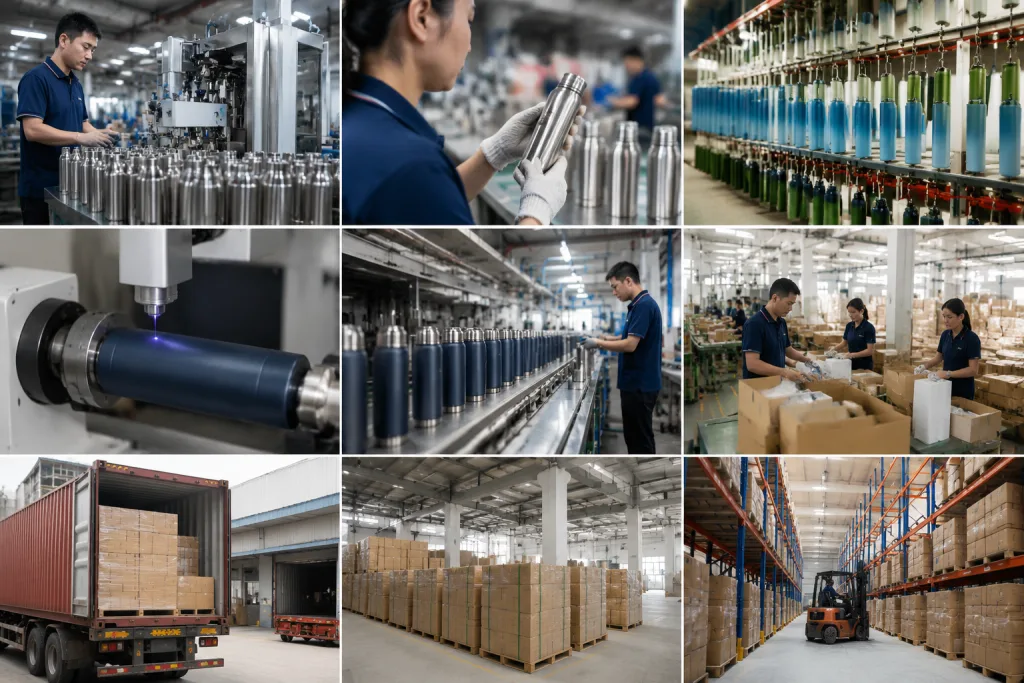
If you are screening an insulated water bottle supplier in China, the fastest comparison is not brochure copy. Read the spec sheet like a buyer. Ask what each line does to cost, lead time, compliance, and returns. That is the right question; glossy factory photos are not. BottleForge Industrial in Hangzhou, Zhejiang builds around 400,000 units per month, with MOQ from 1,000 pieces per SKU and normal lead times of 25 to 35 days. On our floor, the buyer usually flags two points first: whether the logo is laser or silk print, and whether the carton spec is 5-layer or 7-layer, because that changes claim risk fast.
Start with steel grade
The first line on a factory thermos spec sheet should state the exact material for the outer body, inner liner, lid contact parts, and any filter or straw. For most stainless drinkware, the practical baseline is SUS304 for both outer and inner walls. That is what we run on most export orders above 3,000 pcs. It balances cost and food-contact safety if the polishing and welding are controlled on the line, and buyers in Europe and North America accept it without debate. For bulk thermos orders used for coffee, tea, or plain water, 304 usually does the job.
Buyers get burned by vague wording like “food grade stainless steel.” That wording is useless. Ask your insulated water bottle supplier to write 18/8 or SUS304 clearly on the quote and on the drawing, down to the liner note. If the bottle is meant for outdoor retail, marine use, or higher-acid drinks, SUS316 on the inner liner can make sense. It gives better corrosion resistance, but the math does not work for every project. On a 500ml customized thermos, moving the liner from 304 to 316 often adds USD 0.35 to 0.90 depending on weight and market steel prices. Last quarter, one buyer flagged a rust claim that turned out to be a PO typo: outer 304, liner blank.
Questions worth asking
- Are both inner and outer walls 304, or only the liner?
- What is the wall thickness: 0.4mm, 0.45mm, or 0.5mm?
- Are lid contact parts PP, Tritan, silicone, or stainless?
- Can the supplier provide REACH and LFGB or FDA test reports by component?
For promotional thermos projects, some buyers cut cost too far and accept mixed-grade construction without noticing. We have seen this go sideways on repeat POs. It may pass for a short campaign, but if you want stable reorders, keep the material spec consistent and check the drawing against the sample approval. QC pulled the sample on one 10,000-piece order and found the outer wall at 0.38mm against a 0.4mm callout. A thermos manufacturer in Zhejiang should state steel source, thickness tolerance, and food-contact declarations on the spot. If they cannot, treat it as a warning sign, not a paperwork delay.
Vacuum performance is not a slogan
Every thermos supplier says their bottle keeps drinks hot and cold. That means nothing until the test setup is fixed. Ask the spec sheet to show the vacuum structure, copper coating if used, and the retention result tied to one method. For a 500ml thermos custom order, a workable baseline is hot water filled at 95°C, room temp at 20°C, cap fully closed, then record the remaining temperature at 6, 12, and 24 hours. On our line, QC writes the start-fill temp and sample ID on the tank sheet before the hold test starts.
A decent manufacturer thermos for retail can often show around 70°C after 6 hours and 50-55°C after 12 hours. Better shapes with a tighter vacuum gap and a copper-coated liner can do more, but this is the wrong question to ask if the bottle diameters and lid structures are different. Cold retention needs its own method: ice ratio, starting liquid temperature, and how often the lid is opened. We have seen buyers compare one sample opened 6 times against another left sealed for 12 hours, then claim one vendor is stronger. That math does not work. Last month QC pulled the sample and found the buyer's own test sheet had a PO typo: 550ml written instead of 500ml.
A bottle that tests well in the lab but fails after transport usually points to a process problem: unstable vacuum sealing, a weak neck weld, or poor carton protection.
For outdoor retailers, ask about the vacuum pass rate. On stable production, serious thermos manufacturers should discuss a target above 98%. Ask one more thing: do they inspect 100% of units or only run random sampling? Most supplier thermos factories use a pressure-based or temperature-based check on every unit, then confirm retention by batch. We run a leak check after vacuum sealing, and if the neck bead is off by 0.2 mm, the reject pile starts growing fast.
If you sell to distributors thermos channels, keep the retention claim on the packaging conservative. Print “up to 12 hours hot” and let the product beat the claim in customer use. Printing “24 hours hot” looks good on a mockup, then returns hit. The buyer flagged this on one of our past projects after chain-store shoppers tested the bottle during winter delivery. This line on the spec sheet affects product quality, review score, replacement cost, and your standing with retail buyers.
Weight, wall thickness, and durability
Buyers usually look at shape and finish first. Then the buyer flags it: the sample feels heavier than the production bottle. Weight is not a small detail. It tells you how much steel went into the body, how the bottle feels in hand, what you will pay in freight, and how easily the sidewall will dent when cartons get squeezed on the pallet. A 500ml stainless vacuum bottle often lands somewhere between 260g and 380g, depending on body diameter, wall thickness, and the lid set. On our line, QC pulled the sample more than once because a low quote was hiding thinner steel than the drawing implied.
For a customizable thermos sold through outdoor retail, 0.4mm/0.4mm outer and inner wall thickness is common. That is the baseline. For tougher models, especially tall narrow bottles that pick up shoulder dents after a drop test, some thermos factory programs move to 0.45mm outer or add a reinforced shoulder design. We check that area with a ball micrometer, not by guesswork. It adds cost, but the reduction in freight damage and store-handling dents is usually easy to see. For promotional thermos use, thinner construction can still work if the target price is fixed and the buyer accepts the trade-off. If they want premium feel at promo pricing, the math doesn't work.
Tell the thermos manufacturers exactly which abuse matters most:
- Drop resistance from 80cm in retail handling
- Sidewall dent resistance in master cartons
- Base stability on uneven outdoor surfaces
- Lid thread durability after 3,000 open-close cycles
Also ask for net weight tolerance. Put it on the signed drawing. A reliable thermos manufacturer may hold production within ±5g to ±10g per unit on standard models. Weigh 10 pcs per lot with a calibrated digital scale and compare them with the approved pre-production sample. That matters when goods arrive in North America and your team wants a fast check before release. In Zhejiang and across China, factories that control tube sourcing, forming, and vacuum welding well are usually comfortable tying weight to the final signed drawing. If a factory avoids that point, we've seen this go sideways.
If you buy thermos bulk for e-commerce, balance durability against parcel cost. An extra 40g on 20,000 units is 800kg of additional outbound freight. That number gets expensive fast. We ship both heavy-wall and standard-wall programs, and in plenty of cases a better carton spec, like a 5-layer master carton with tighter partitions, cuts claims better than a heavier bottle body.
Lid system decides return rate
Most complaints on a custom thermos are not about the steel body. They start at the lid. We see the same failure points on the line: leakage, odor, broken handle, weak hinge, thread mismatch. On one 25,000-piece run, QC pulled the sample and found the cap thread was off by 0.3mm against the master. The body was fine. The spec sheet should give the lid more space. Start with the construction: screw cap, flip lid, push-button, straw lid, or loop cap. Then list each material that touches the drink path, usually PP, Tritan, silicone, and 304 stainless.
For distributor thermos business, the safest default is a simple screw lid with one silicone gasket. Less to go wrong. Fewer parts cut defect risk and make QC faster; our team can check a screw lid in seconds with a go/no-go thread gauge, while a push-button lid needs spring force, pin fit, and lock action checked one by one. Push-button lids sell well at retail, yes, but they bring more assembly variation. If you are sourcing a customized thermos for a promotional campaign with a hard delivery date, simpler is safer. We have seen this go sideways in the last 7 days before shipment.
Minimum checks to require
- 100% leak test after final assembly
- Hot water inversion test for 30 minutes
- Thread smoothness check against approved sample
- Handle pull test if the lid has a strap or loop
- Odor check after sealing for 24 hours
A serious insulated water bottle supplier should write the leak standard in plain words. No dripping after inversion. No seepage at the spout. No pressure release under normal use. This is the wrong question to leave vague. If your market includes children or active outdoor use, ask for a drop-and-leak combined check. Fill the bottle, drop it from 60 to 80cm, then retest the seal. We usually run this on a steel plate with a rubber mat, because bare concrete and lab flooring give different results.
China factories do not differ on sample making. Most can make one lid work. The real gap is batch consistency over 10,000 or 50,000 units. Ask the suppliers thermos team if they mold in-house or buy caps from partner molders, and ask who controls incoming cap inspection. We check thread fit, hinge action, and gasket hardness lot by lot; last month the buyer flagged a smell issue, and the cause was a silicone batch packed too soon after curing. Also ask whether spare gaskets can be packed at 1% to 2% of order quantity. The math works. That small line item saves after-sales trouble and cuts arguments over missing parts.
Decoration, branding, and color control
A thermos built for brand programs usually sells in two steps: first the look, then the performance. Decoration specs hit both. The shell finish might be powder coating, spray paint, brushed stainless, electroplating, or a texture like wrinkle or rubber-touch. For logos, the common methods are silkscreen, heat transfer, laser engraving, and UV print. Each one shifts unit cost, wear resistance, and production timing. On our line, QC often checks logo position with a 0.5 mm scale before mass run.
Powder coating is still the workhorse finish for outdoor retail. It adds grip. It also hides light clamp marks from handling better than bare stainless. On a 500ml bottle, it may add roughly USD 0.20 to 0.45 depending on texture and color. Standard Pantone-matched colors are manageable, but exact brand matching needs an approved color chip and a written tolerance, not just a phone photo. Bright white, pastel, and neon are where buyers get pushback from us, because we have seen this go sideways between batches even with the same powder lot. Ask the factory about batch variation risk and rework policy before you release the PO.
Logo choice should follow the channel:
- Laser engraving: durable, premium look, usually best for stainless or powder-coated premium lines; on matte black, the contrast is clean and the reject rate stays low once focus is locked
- Silkscreen: lower cost, good for simple 1-2 color logos, but abrasion resistance depends on ink system; we normally ask for artwork line width above 0.15 mm
- Heat transfer: better for multi-color artwork and wrap graphics; good option when the buyer wants photo-style designs without opening a new mold
- UV print: useful for detailed designs but verify adhesion on curved surfaces; QC pulled samples before where edges lifted after curing
For thermos promotional orders, ask for adhesion and abrasion tests. A practical benchmark is tape test after curing and a simple rub test, such as 50 manual rubs with a dry cloth on the logo area. If the bottle will be sold online, also confirm barcode placement, including FNSKU or carton labels for Amazon prep. This sounds basic, but the buyer flagged one shipment from another supplier because the FNSKU crossed the bottom curve and would not scan. A manufacturer thermos partner in Zhejiang that exports regularly should already know retail barcode zones, suffocation warnings for polybags, and carton mark consistency.
Do not approve decoration from a retouched photo alone. Ask for a physical pre-production sample showing final logo size, position tolerance, and finish texture. This is the right question to ask. On repeat orders, reference that sample by date and code in the PO; we have even seen a single PO typo on logo orientation create rework. That keeps the thermos custom program stable even if the factory changes line scheduling or paint batches.
Compliance, QC, and shipment terms
The last third of the spec sheet is where experienced buyers slow down and read line by line. A bottle can look great on screen and still get stuck at customs, fail retailer onboarding, or land with a claim. For Europe, buyers often ask for REACH, and some programs also require LFGB. For North America, FDA food-contact paperwork is standard, and children’s items can pull in CPSIA or ASTM depending on the lid design and age grading. If the custom thermos has powder coating, a silk-print decal, or a silicone straw, the test scope needs to cover those exact parts. We have seen labs miss a straw because it was not listed on the application form, and then the buyer flagged it after shipment booking.
Factory system certificates help, but they do not replace product testing. If a thermos supplier shows BSCI or ISO 9001, read that as process support only. Ask who pays for the third-party lab test, whether the report is tied to one model, and whether a material change means retesting. This is the right question to ask. On our side, we usually keep core migration and heavy metal test records on file for the main SKUs, and QC pulled the sample again any time we changed a lid supplier or moved from one Pantone coating batch to another.
For inspection, a practical baseline is AQL 2.5 major / 4.0 minor. Put the defect list in writing. Major defects usually include leaks, vacuum failure, sharp edges over 0.3 mm burr, wrong logo, wrong color, or an unstable base. Minor defects are different: a small paint speck, carton print offset, or a seam mark still inside the approved sample limit. If you are new to China sourcing, write the inspection timing into the PO: pre-production sample approval, in-line checks at the line, and final random inspection before balance payment. We have seen this go sideways when a PO said “final inspection” but never stated who signs off the golden sample.
Then you get to the commercial terms. For a lot of orders we ship from Zhejiang, buyers use FOB Ningbo or FOB Shanghai. Check whether the price covers inner box, master carton, palletization, barcode labels, and export documents, because the math does not work if each item gets added back later. A standard lead time for a thermos bulk order is 25 to 35 days after deposit and artwork approval. MOQ is commonly 1,000 pcs per model per color, though stock-color programs may go lower. If you have a launch date, break the lead time down by step: steel sourcing, painting, logo curing for 24 hours, and packing. A supplier who can give you that split, instead of one vague date, is usually the safer insulated water bottle supplier.
Send your thermos spec sheet for a factory review
Share target capacity, steel grade, lid type, logo method, MOQ, and market. We will flag risk points and quote a practical Zhejiang production plan.
Frequently asked questions
What MOQ should I expect from an insulated water bottle supplier for a custom stainless thermos?
For a fully custom thermos, a realistic MOQ is usually 1,000 pieces per model per color, with logo decoration included. If you want multiple colors, many factories in China will still ask 1,000 per color because powder coating and setup are separate. For stock molds with simple silkscreen, some suppliers can do 500 pieces, but your unit cost may rise by USD 0.20-0.50. If you need custom packaging, expect a carton or gift box MOQ as well, often 1,000 to 3,000 units depending on print complexity. Ask whether the MOQ is tied to the bottle body, lid color, logo process, or packaging. Those are different cost drivers, and buyers often confuse them.
How do I compare quotes from different thermos suppliers without getting misled by a low price?
Put every quote into the same spec table. Compare steel grade, wall thickness, net weight, lid material, coating type, logo method, packaging, and trade term. A quote that is USD 0.60 lower may be using 201 steel on outer parts, thinner walls, or lower-grade paint. Also check whether the price is EXW, FOB Ningbo, or FOB Shanghai. Lead time matters too: 25 days and 40 days are not equivalent if you have a retail launch. Ask each thermos supplier to state sample cost, mold charges if any, AQL standard, and whether third-party inspection support is included. If two suppliers look similar, the one with clearer written tolerances is usually the lower-risk option.
Which logo method is best for outdoor retail and promotional thermos orders?
For outdoor retail, laser engraving and durable powder-coated finishes are usually the safest combination. Laser is hard-wearing, looks premium, and avoids many ink adhesion problems. For promotional thermos campaigns where budget matters, 1-color silkscreen is common because it is fast and cost-effective, often adding only a few cents per unit on larger runs. Heat transfer works better for multi-color artwork or wrap designs but needs careful adhesion testing. Ask for a physical sample with the final finish because a logo that looks sharp on bare stainless can behave differently on textured powder coating. Also confirm logo position tolerance, typically within 1.5-2.0mm, so repeat orders stay consistent.
What quality checks should I require before paying the balance on a thermos bulk order?
At minimum, require approved pre-production samples, in-line production checks, and a final random inspection under AQL 2.5 major and 4.0 minor. Your checklist should include 100% leak testing, vacuum performance sampling, logo accuracy, color consistency, thread fit, and carton drop condition. For lids with handles or buttons, add pull tests and cycle tests. If the bottle is going to Amazon or another e-commerce channel, inspect barcode accuracy, carton dimensions, and shipping marks too. Many buyers also ask for 1-2% spare accessories such as gaskets. Do not release the final payment based only on factory photos. A third-party inspection in Zhejiang or nearby export hubs is inexpensive compared with a container of returns.
How long does production take for a customized thermos from China?
If you use an existing mold, sample lead time is often 5-7 days for a simple logo sample and 7-12 days for a finish-and-packaging pre-production sample. Mass production for 1,000 to 10,000 units usually takes 25-35 days after deposit, artwork approval, and sample signoff. Larger orders, special colors, or complicated gift boxes can push that to 40 days or more. Around Chinese holiday periods, add buffer. The useful question is not just total days, but where the time goes: steel tube sourcing, body forming, vacuuming, painting, curing, assembly, and packing. A reliable thermos manufacturer should break that down for you instead of giving one vague promise.