Key Takeaways
- For most custom thermos programs, the real decision starts with channel fit: retail usually needs 1,000-3,000 units per SKU, while promotional thermos orders can work at 500-1,000 units
- A practical FOB China target for a 500ml double-wall 18/8 bottle is often USD 3.20-5.80 depending on lid type, coating, and decoration
- Normal production lead time for customized thermos orders is 25-40 days after sample approval, with 7-12 days for pre-production samples
- Use AQL 2.5 for major defects, request REACH or LFGB based on market, and confirm vacuum retention test standards before placing bulk thermos orders
You can buy a stainless bottle from almost anywhere in China. Easy part. The hard part is picking an insulated water bottle distributor or factory thermos partner that matches your sales channel, margin target, and tolerance for quality claims. Outdoor retail buyers ask us about drop dents, leak rates, and replenishment lead time—12 days on repeat orders versus 18 days is a real difference. Promo buyers push on logo cost, carton count, and MOQ 500 vs 3,000. Same bottle shape on the screen, different job on the line.
In Zhejiang, you will see 20 suppliers showing the same catalog photos and giving different answers once you ask about steel grade, vacuum pass rate, REACH testing, or spare lids. QC pulled one sample last month with a 0.3 mm rim mismatch, and the buyer flagged it before mass production; this is where weak suppliers get exposed fast. A sound decision starts with four points: target use, required compliance, decoration method, and reorder plan. Ask those first. This is the wrong question to skip, because we have seen sourcing go sideways over a PO typo, the wrong silk-screen setup, or a lid that could not be matched on the second order.
Start with the four decisions
If you are an outdoor retailer or a promotional buyer, decide four things before you collect quotes. That step saves time on the line and cuts the usual back-and-forth we see after a buyer sends a 2-line inquiry.
- Decision 1: channel — define where the bottle sells: retail shelf with barcode and hangtag, event giveaway with tight unit cost, corporate gifting with presentation box, or e-commerce replenishment where carton drop-test matters.
- Decision 2: product architecture — lock the build: bottle body size, lid style, coating, packaging, decoration, and details like neck diameter in mm or whether the lid uses a silicone seal we already stock.
- Decision 3: compliance and quality risk — state the market, the test reports, and the inspection level you expect; QC pulled one sample last month where the logo position was off by 1.8mm, and that kind of issue matters more in retail than in giveaways.
- Decision 4: supply model — say if this is a one-off buy, a seasonal launch, or a rolling reorder, because MOQ, safety stock, and carton marking all change with the plan.
These four choices drive the commercial math: MOQ, tooling cost, lead time, defect exposure, landed margin. A thermos inquiry from a distributor that only says “need 20oz bottle with logo” gets generic pricing from 12 suppliers. That is the wrong question to ask. A useful RFQ reads more like this: 530ml stainless double-wall bottle, 304 inside and outside, powder coat, laser logo, individual color box, REACH, 3,000 units across 3 colors, FOB Ningbo. Now the thermos manufacturer or thermos supplier can quote the actual job instead of guessing, and we do not have to chase basic points like whether the PO typo says 5,300 or 530ml.
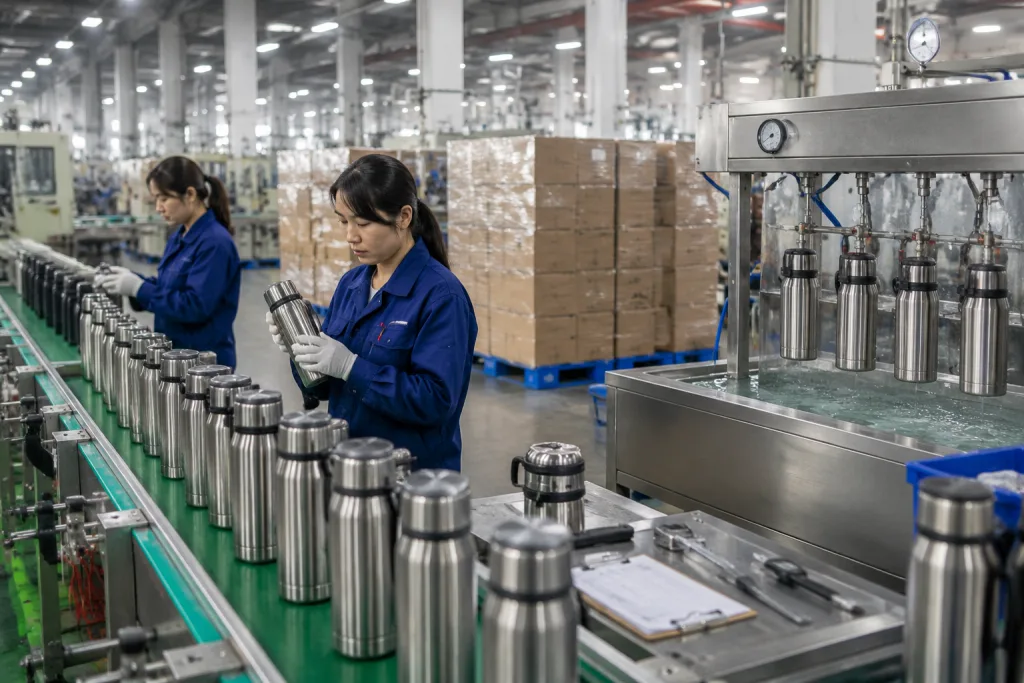
In Zhejiang, China, most serious manufacturer thermos programs support multiple bottle shapes, but factory strengths split fast once you get into decoration, lid engineering, or compliance paperwork. We have seen this go sideways. One vendor may show a clean catalog but outsource vacuuming and coating to 2 other workshops; another runs tube forming, seam welding, vacuuming, powder coating, and assembly in-house, with a helium leak tester beside the vacuum station. Ask where the critical process happens. Ask who owns the tooling. Ask who signs the test reports.
You are not buying a bottle. You are buying a repeatable process with acceptable risk at a workable cost.
At BottleForge Industrial in Hangzhou, Zhejiang, a typical MOQ starts at 1,000 units per model and our lead time is usually 30-35 days for standard custom-logo production after sample sign-off. Capacity matters. A factory running 300,000-500,000 units per month can absorb repeat orders far better than a small workshop that looks cheap on the first PO, then slips from 32 days to 41 days when 2 larger orders hit the line. We ship enough repeat programs to know the pattern: first-order price gets attention, reorder stability keeps the account.
Match the thermos to the channel
The quickest way to burn budget is speccing a retail bottle for a promo job with a hard target price. The return problem starts when buyers go the other way. We’ve seen this go sideways: a PO said “gift campaign,” but the sample approved was a retail-grade 750ml with heavy packout, and the landed cost missed target by USD 1.12.
Outdoor retail priorities
Retail buyers look at heat retention, coating wear, leak rate, and shelf presence. For this channel, a 0.4mm outer wall and 0.4mm inner wall in 18/8 stainless steel is common for a 500-750ml bottle. On our line, QC pulled the sample after the cross-hatch adhesion test, and powder coating with a 60-80 micron film thickness holds up better than simple spray paint. A screw lid with silicone seal usually gives fewer leak claims than a complex flip lid unless the lid supplier already has a proven record.
Packaging matters too. Full gift boxes look good on shelf, but the math doesn't work if carton volume jumps 18% and freight climbs with it. For outdoor programs, a kraft box with a barcode label often protects margin better, and it still runs clean on a standard 5-layer master carton.
Promotional brand priorities
Promotional buyers focus on logo area, setup cost, color options, and lead time. Different job, different spec. A 500ml or 600ml bottle with standard powder coat and one-color silkscreen is often enough. We ship plenty of these in 25-30 days from artwork sign-off. You do not need the top-end lid or a premium retail pack if the bottle is going out at a campaign booth and not onto a specialty store shelf.
This is why thermos bulk and bulk thermos buying should match campaign length and budget, not just unit price. A custom-logo run of 1,000 units may be right for a regional event. A national promotion may justify 5,000-10,000 units and cut FOB cost by USD 0.20-0.60 per unit, depending on model. One buyer flagged this as a small saving, but across 8,000 pcs, the number is not small.
The same check applies whether you talk with thermos distributors, a thermos factory, or suppliers thermos teams in China. Ask which channels they actually serve day to day. If 80% of their business is low-cost giveaway bottles, they are usually the wrong fit for specialty outdoor retail. If they only run premium retail programs, expect slower sampling and higher cost for distributor thermos campaigns. We had one inquiry where the PO typo listed “retial pack,” and that small miss told us the buyer was mixing two channel specs in one order.
Read the cost structure clearly
Buyers comparing a custom thermos quote usually stare at the unit price first and miss the cost stack under it. That is where claims start later. We have seen a PO marked “same as last order” while the carton spec changed from 5-ply to 3-ply, and the buyer only caught it after the drop test.
For a standard 500ml double-wall stainless bottle made in China, FOB pricing often falls into these broad ranges:
- Standard shape, plastic screw lid, powder coat, one-color silkscreen: USD 3.20-4.10 at 3,000 units
- Sports lid or carry-handle lid, powder coat, laser logo: USD 3.80-4.90 at 3,000 units
- Premium shape, matte finish, two decorations, custom box: USD 4.80-5.80 at 3,000 units
If your price lands well below that band, ask what was stripped out. This is the right question. On the line, the usual cuts are 0.35 mm outer steel instead of 0.4 mm, lower-cycle powder, a lighter export carton, fewer in-process checks, or vague compliance paperwork. Some suppliers quote 201 stainless outside instead of 304 to pull cost down. That can work on some projects, but the buyer should sign off on it up front, not find it in a random sample after mass production.
Ask every thermos manufacturer to break out the following items:
- Unit price by quantity break: 1,000 / 3,000 / 5,000 / 10,000
- Decoration charge by method and color count
- Sample charge and refund policy
- Custom packaging cost
- Master carton size, gross weight, and loading quantity
- Tooling if a fully customizable thermos body or lid is requested
For outdoor retailers, freight efficiency matters almost as much as factory price. The math does not work if a bottle is USD 0.12 cheaper but loads 15% fewer units per container. We ship both ways, and a 68 x 45 x 27 cm carton that nests cleanly often beats a cheaper bottle with wasted air space. Good manufacturer thermos and supplier thermos partners talk about CBM, pallet pattern, and carton drop performance early. Not after production.
This matters more if you import from Zhejiang or other China ports under FOB terms and book freight yourself. QC pulled one shipment here because gross weight hit 21.8 kg per carton, and the forwarder flagged it before loading.
Know which specs actually matter
Most custom thermos RFQs come in bloated with 20 copied line items that do not change the job. The better filter is simple: which specs affect thermal performance, dent risk, leakage, or claim rate? We see buyers paste nice catalog wording into a PO, then the line still has to decide the real control points.
- Steel grade: 18/8 stainless, usually SUS304, is standard for food-contact inner walls. For premium corrosive-use environments, some buyers specify 316 inside. We usually verify inner tube material with handheld XRF on incoming lots.
- Wall thickness: 0.4mm/0.4mm is common. Going thinner saves cost but can dent more easily. Buyers ask for lower price, then flag body dents after a 76cm drop test. We have seen that go sideways fast.
- Vacuum retention: define a test, for example after 12 hours with hot water, not vague wording like “good insulation.” This is the wrong question to ask if the RFQ only says “keep warm longer.” Put the water fill temperature and ambient test condition on paper.
- Lid system: the lid is often the failure point, not the body. QC pulled the sample more than once because a gasket groove was off by 0.3mm while the bottle body was fine.
- Coating: powder coat usually outperforms basic spray finishes in abrasion resistance. On the line, a cross-hatch adhesion cutter tells the truth faster than any sales sheet.
- Base construction: anti-slip silicone base or reinforced base can help on premium retail items. For shelf-heavy retail programs, we also get pushback about wobble, so base flatness matters.
For a customizable thermos used in outdoor stores, ask for a realistic test package: leak test, vacuum test, coating adhesion, salt spray if relevant for decoration hardware, and drop test with packed units. We usually run leak check at the line before packing, then repeat carton drop on finished units because body performance alone is not enough. For promotional thermos jobs, the spec sheet can stay lean, but leak integrity and food-contact compliance still have to be locked.
Do not confuse polished wording with factory control. A solid thermos factory should tell you if vacuuming is done in-house, what the vacuum yield rate is, and how lid incoming inspection works. Good factories in China commonly target vacuum qualification above 98.5% before final assembly. If a supplier cannot explain how QC separates bad vacuum pieces before painting, ask harder questions.
If you are buying thermos customized for Amazon or big-box retail, barcode placement, FNSKU label rules, and carton markings matter too. Not glamorous. Still expensive if missed. We have shipped orders where the buyer flagged a carton mark typo on the PO suffix, and the relabel bill hurt more than a small material upgrade would have.
Avoid over-customizing unless your volume supports it. A thermos customizable program with unique lid tooling, custom boot, special insert, and gift box can work well at 5,000-10,000 units. At 1,000 units, standard-platform customization is usually the safer commercial choice. The math does not work if you spread tooling and packaging setup over a small run.
Check compliance before you check color
A smart buyer checks compliance before talking about Pantone. We tell distributors this early because a color chip does not save a shipment at customs. If you sell into Europe or North America, your custom thermos program needs valid paperwork and a factory that runs to that standard on the line, not just in a PDF.
For Europe, buyers usually ask for REACH compliance and often LFGB for food-contact items. For North America, we see FDA-related material declarations first, then CPSIA or ASTM checks if the bottle is for a kids program. That last point matters. A kids SKU is not the same as a standard adult distributor item, and we have seen buyers flag a 0.3 mm paint gap near the lid seam that would pass on a general promo bottle.
The practical questions to ask a thermos supplier or thermos distributors partner are simple, and this is the right place to push hard before you place a 3,000 pcs MOQ:
- Which test reports are current, and for which exact models?
- Are reports from raw materials only, or finished product?
- Can the factory support BSCI, ISO 9001, or social audit requests?
- What is the inspection standard: AQL 2.5 / 4.0 or something looser?
- How are major defects defined?
For most stainless drinkware shipments, AQL 2.5 for major defects and 4.0 for minor defects is a reasonable starting point. QC pulled the sample set before packing and checked dent, scratch, logo position, and base wobble on a flat steel table. Define cosmetic tolerance before mass production, especially on matte powder coat, because a small rub mark that looks minor in the workshop turns into a claim on arrival.
Ask who owns corrective action when problems show up. Some thermos manufacturers thermos teams reply the same day with a CAPA, root-cause notes, and a replacement schedule. Others go soft once the container is on water. We have seen this go sideways over one PO typo and one unapproved lid change.
China has strong factories, and Zhejiang alone has more than a few that can do the job. The better supplier thermos relationships are built on document control, signed golden samples, and approval gates before cutting mass packaging. This is the wrong question to skip. If a factory cannot show those basics, do not expect discipline to appear once your order hits the welding station.
Choose a supply model you can repeat
The best first order is not the cheapest. It is the order you can place again without chaos on the line. Your insulated water bottle distributor or factory partner needs to match your reorder pattern, not just the launch PO, because a clean 2,000-piece repeat with the same lid torque and carton mark matters more than a flashy opening quote.
If you sell outdoor retail, seasonality drives the plan. You might launch 3,000 units in spring, then need another 2,000 fast if sell-through is strong. Ask if the factory keeps coating color standards, lid stock, and packaging files for reruns, and ask how they verify them—at our side, QC pulls the sealed approval sample and checks color against the standard under the light box before the line starts. Reorders are where 2 suppliers that look similar on day one start to separate. We have seen this go sideways when a buyer assumed the old box file was still active and the PO carried a small print typo.
If you buy for promotions, speed usually beats perfect continuity. Ask the thermos vendor about blank stock, standard decoration windows, and which models they keep semi-finished in 304 stainless. On repeat logo jobs, a supplier holding semi-finished stock in China can cut lead time from 35 days to 15-20 days on selected models. That is a real gap. The wrong question to ask is only “what is your lowest unit price,” because the math does not work if the event date is fixed and the shipment misses by 12 days.
Also decide who you want to work with:
- Factory direct: you get clearer process visibility and a better shot at stable pricing, but you will handle more daily details, from pantone confirmation to carton drop test feedback.
- Trading or distributor model: sourcing is easier across multiple categories, but defect follow-up is slower if the buyer flagged leakage and nobody owns the root cause at the gasket station.
Neither option is automatically better. A good thermos distributor works well if you need mixed product lines and one commercial contact. A strong thermos factory fits better if stainless drinkware is core to your business and you want direct engineering feedback from the sample bench, not a relayed answer 2 days later.
Ask one last question: what happens if I need the same bottle again in 90 days? The answer tells you more than most presentations. Serious thermos manufacturers and thermos suppliers will talk clearly about retained samples, BOM version control, packaging archives, and reorder MOQ, and they should be able to tell you where that data sits, whether in the ERP or in a signed sample room log. What you want from Zhejiang, China or any supply base is not a one-off shipment. You want a controlled repeat program we can ship again without re-learning the job.
Get a workable stainless thermos sourcing plan
Send your target capacity, logo method, market, and quantity. We will quote the right bottle platform, MOQ, lead time, and compliance path clearly.
Frequently asked questions
What MOQ should I expect from an insulated water bottle distributor or factory?
For a standard stainless double-wall bottle, a realistic MOQ is usually 1,000 units per model and color if you want stable FOB pricing. Some supplier thermos programs can do 500 units for existing blank stock with simple one-color logo printing, but your unit cost will rise and color choices narrow. If you need mixed sizes, such as 500ml and 750ml, many China factories will treat those as separate MOQs because lids, cartons, and production setups differ. For a fully custom lid or body, expect 3,000-5,000 units minimum plus tooling. If a quote promises very low MOQ with fully customized thermos specs, check carefully whether production is actually in-house or being brokered through multiple manufacturers thermos sources.
How much should a custom stainless thermos cost in bulk?
For a 500ml insulated stainless bottle in thermos bulk quantities, a normal FOB China price is around USD 3.20-4.10 for a basic model at 3,000 units. Add a more complex lid, carry handle, premium powder coat, gift box, or multi-position decoration and the price often moves to USD 4.30-5.80. Laser engraving is usually cheaper long term than multi-color print, but it depends on logo size and placement. Air freight can destroy margin, so most outdoor retailers and promotional brands should calculate landed cost using ocean freight, carton count, and duty before approving a factory thermos offer. Ask for quantity breaks at 1,000, 3,000, 5,000, and 10,000 units so you can see the real pricing curve.
What tests and certifications matter for Europe and North America?
For Europe, start with REACH compliance and ask whether the report is for the finished customized thermos or only for component materials. Some buyers also request LFGB for food-contact reassurance, especially on retail programs. For North America, ask for food-contact declarations and any market-specific documentation your retailer requires. If the item is intended for children, ASTM or CPSIA-related requirements may come into play depending on the product design and accessories. On the factory side, ISO 9001 and BSCI are useful indicators of process control and audit readiness, though they do not replace product testing. For shipment inspection, many buyers use AQL 2.5 for major defects and 4.0 for minor defects on stainless drinkware orders.
How long does production take for custom thermos orders?
For standard thermos custom projects using an existing mold, pre-production samples usually take 7-12 days after artwork and Pantone confirmation. Mass production normally takes 25-40 days after sample approval and deposit receipt. If your bottle uses a new lid, special packaging insert, or complicated customized thermos decoration, add another 7-15 days. Repeat orders can be faster if the thermos manufacturer keeps semi-finished stock or standard blanks; in those cases, 15-25 days is possible. Timing in Zhejiang and broader China also depends on peak season, especially before summer retail and before major holiday shutdowns. If your delivery window is tight, ask for a day-by-day production plan instead of accepting a vague lead time promise.
Should I buy factory direct or through a thermos distributor?
Buy factory direct if stainless drinkware is a core category for you and you need better visibility into steel grade, vacuum process, lid sourcing, and corrective action. This is usually the better route for outdoor retailers placing repeat orders of 1,000-10,000 units per SKU. Use a thermos distributor or thermos vendor if you need mixed product categories, simplified communication, or lower administrative load across many promotional items. The trade-off is less process transparency and sometimes slower root-cause handling when quality issues appear. The right answer depends on your team. If you can manage technical RFQs and inspections, direct factory sourcing in China often gives better control. If not, a capable distributor thermos partner can still work well if roles and accountability are clear.