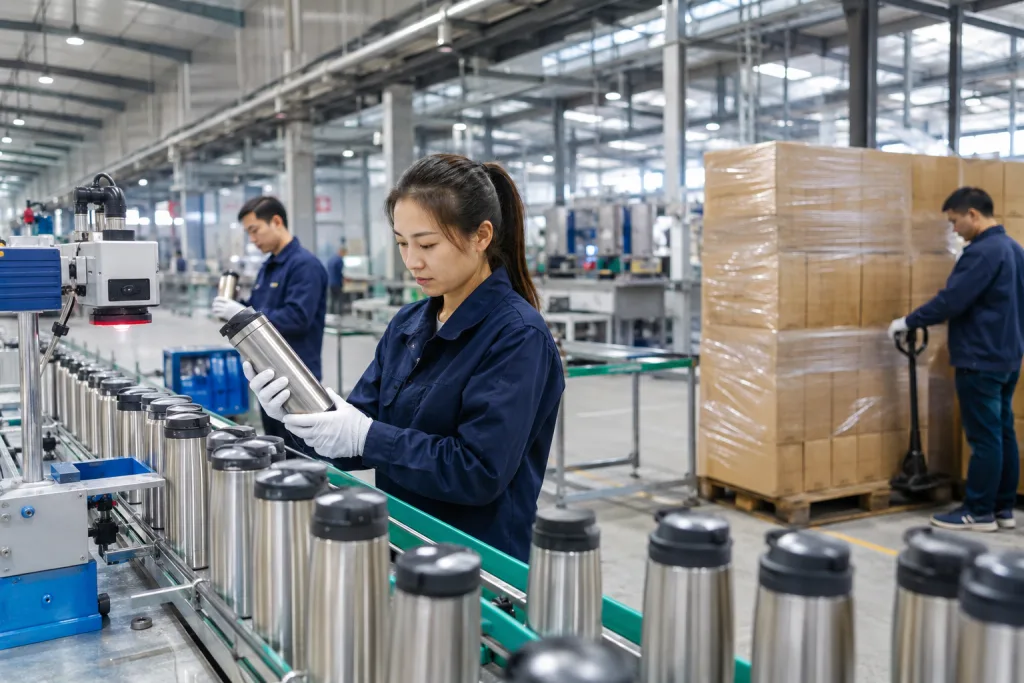
Key Takeaways
- For a standard 500-750 ml stainless custom thermos, MOQ is usually 1,000-3,000 pcs per color, with sample time around 7-10 days and mass production 30-45 days
- Most retail-grade vacuum bottles use 18/8 stainless steel, 0.4-0.5 mm inner wall, 0.45-0.6 mm outer wall, and vacuum leak testing at 100%
- Decoration cost changes quickly: one-color silkscreen may add USD 0.08-0.18, laser engraving USD 0.12-0.30, powder coating USD 0.35-0.80 per unit
- A practical incoming inspection target is AQL 2.5 for major defects and AQL 4.0 for minor defects, with carton drop checks and seal performance verification before shipment
You are not buying a stock bottle. You are buying a product that needs to survive sea freight, hold your target margin, pass compliance in Europe or North America, and still look clean on shelf or in a promo pack. We’ve seen custom stainless projects go sideways at this stage. The sample on the bench looks good, then mass production lands 12 days late, cost runs 8% over plan, or QC pulled the sample and found scratches around the lid seat after the drop test.
If you are sourcing an insulated water bottle customizable for outdoor retail or promotional use, ask for hard answers: steel grade, decoration method, MOQ, test items, carton spec, and a real lead time from Zhejiang, China. On our line, one wrong number on a PO—even a logo size typed as 28 mm instead of 26 mm—can delay sample approval by 3 days. A factory thermos program is manageable once the numbers are fixed. The wrong question to ask is whether the bottle looks good. Ask whether the math works before you place the PO.
What should you lock first?
Lock the use case first, not the logo. We hear decoration requests on the first call all the time, then the spec sheet changes after the buyer sees the weight and lid structure on the sample table. Camping, gym retail, gifting, and a distributor thermos program do not use the same bottle build. This is the wrong question to skip. The structure drives cost, complaint rate, and how the bottle feels in hand.
A buyer brief should include at least these points:
- Capacity: 350 ml, 500 ml, 750 ml, or 1,000 ml
- Body style: straight wall, cola shape, wide mouth, handled lid
- Steel grade: 18/8 for body, often PP or Tritan for lid components, food-grade silicone seal
- Thermal target: 12 hours hot, 24 hours cold is common; premium projects ask for 12 hours above 55°C from a 95°C fill
- Sales channel: retail shelf, ecommerce, event giveaway, or thermos bulk distribution
- Target price: FOB Ningbo or FOB Shanghai price range in USD
In Zhejiang, China, a manufacturer thermos quote can vary by more than 30% even when the bottle looks close in photos. On our line, a 500 ml customizable thermos with spray paint, a one-color screen print, and standard 5-layer export carton usually lands at USD 2.20-3.20 FOB at 3,000 pcs. Move up to powder coating, carry loop lid, copper-plated inner wall, and an individual color box, and the same format shifts to USD 3.80-5.80 FOB. We ship both types. The math changes fast once you add parts and packing.
If a supplier thermos quote comes in far below the pack, check what got cut. QC pulled the sample before and found 0.4 mm outer wall instead of the heavier feel the buyer expected, plus weak carton board and no spare seals. Common shortcuts are thinner steel, lower-grade powder coating, lighter carton strength, or no spare seals. We have seen this go sideways. Dent rate goes up, heat retention drops, and returns follow. For outdoor retail, the bottle needs to feel solid the second a customer picks it up, before they even look at the logo.
How do you judge the bottle build?
A custom thermos project usually fails on build quality before it fails on artwork. The safe starting spec is double-wall vacuum stainless steel with 18/8 food-contact stainless on both inner and outer body. Some suppliers quote 201 on the outer wall to hit a target price. We ship that for promo orders at 5,000 pcs MOQ if the buyer accepts the trade-off, but for outdoor retail this is the wrong place to save money. Stay with 304 inside and outside, or lock the exact steel grade on the PO and confirm the corrosion standard before the line runs.
Checklist for physical construction
- Inner wall thickness: 0.4-0.5 mm is common
- Outer wall thickness: 0.45-0.6 mm is common
- Mouth welding: smooth weld, no sharp edge, no visible burn marks
- Vacuum process: 100% vacuum inspection and heat-retention spot testing per batch
- Lid fit: thread engagement should be smooth within 1.5-2 turns, no cross-threading
- Base stability: bottle should sit flat with no rocking on a plate
For a daily-use thermos, ask the factory how it runs leak testing on finished goods. “We check parts before assembly” is not enough; we have seen this go sideways after the silicone ring shifts by 0.3 mm during capping. A serious China factory runs air-pressure or inverted leak tests on assembled bottles, not random checks on loose lids and bodies. Ask one more direct question: is vacuum checked piece by piece or by batch? A plant running 600,000 units per month across drinkware lines can still miss basics if the process control is weak. Volume sounds good. It proves nothing by itself.
If you are new to thermos customized sourcing, ask for the net weight tolerance on the approved sample. QC pulled the sample once on a repeat order and found a 17 g drop versus approval; the buyer flagged it, and the outer wall had been reduced without updating the PO. A 15-20 g drop in production weight often means steel thickness changed somewhere.
Outdoor buyers should check coating adhesion and grip, not just color. Powder coating usually holds up better than plain spray finish in scratch tests; on our line, a cross-hatch tape test will show the gap fast. If your brand is building a premium thermos custom line, the math works on this upgrade because the bottle gets handled every day, packed into cup holders, and knocked against metal racks. Surface quality matters more than first-time buyers expect.
Which customization methods actually work?
Not every decoration works on every stainless body. Buyers ask us for a customizable thermos with a Pantone body, metallic logo, dishwasher-safe print, and low MOQ, often at 1,000 pcs. The math doesn’t work. In most cases you get three, not four. We usually check the bottle surface first on the line—painted, powder-coated, or bare 304 stainless—because that decides what will stick and what will fail after 200 rubs or a dishwasher cycle.
For promo orders, we run silkscreen, heat transfer, laser engraving, and powder coating with logo print most often. Retail programs add digital printing, embossed lid marks, or full wrap graphics on the color box. QC pulled a sample last month where the wrap art was fine, but the lid logo sat 2 mm off-center, and the buyer flagged it right away.
- Silkscreen: best for simple 1-2 color logos; cost-effective from 1,000 pcs; roughly USD 0.08-0.18 each depending on print size. Good choice for straight-wall bottles. On tapered shapes, we check screen contact pressure before mass run.
- Laser engraving: clean and durable; ideal for premium outdoor positioning; usually USD 0.12-0.30 each. We use it a lot on powder-coated bottles where the contrast comes out sharp and the logo won’t peel.
- Heat transfer: works for multicolor artwork. Check seam alignment, film stretch, and abrasion resistance. We’ve seen this go sideways when artwork crosses the bottle curve and the seam lands under the handle side.
- Powder coating: adds grip and shelf appeal; usually USD 0.35-0.80 each depending on finish and bottle size. Texture matters here: fine sand feels different from matte smooth, and it changes how the top print lays down.
For thermos promotional programs with short timelines, keep the artwork simple. A one-color logo on a standard mold can save 10-15 days versus a fully customized thermos body or custom lid tooling. We ship faster when we stay with 500 ml or 750 ml standard bodies and existing molds from a thermos manufacturer in Zhejiang. That keeps tooling risk down and holds MOQ closer to 1,000 pcs. The wrong question to ask is “Can you make it custom?” Better ask, “What can you ship in 12 days instead of 18?”
For retail brands, ask for an adhesion test standard and a color reference process. If your suppliers thermos team says “same as sample” without a Delta E tolerance or approved Pantone reference, expect inconsistency. Factories in China are uneven on this. A disciplined thermos supplier keeps the signed sample, artwork file, and coating reference card in one order file, usually with the PO copy and revision mark. We’ve even seen repeat-order trouble start from one typo on a PO—“navy” vs “Navy 2965 C.” Basic control prevents those arguments.
What MOQ and pricing are realistic?
This is the section where first-time buyers lose weeks. A custom thermos is not a stock pen. MOQ moves with body style, powder-coat line setup, packaging method, and decoration process. For a standard vacuum bottle from China, 1,000 pcs per item is normal for one simple color. Once you ask for 3 custom paint colors, a gift box, and separate logo versions, 3,000 pcs is still common because we run extra line changeovers and carton setup.
Typical ranges you can use for budgeting:
- 500 ml standard stainless bottle: USD 2.20-3.20 FOB China at 3,000 pcs
- 750 ml powder-coated bottle: USD 3.10-4.50 FOB at 2,000-3,000 pcs
- 1,000 ml handled outdoor bottle: USD 4.20-6.20 FOB at 1,000-2,000 pcs
- Custom color box: usually adds USD 0.18-0.45
- Egg-crate or molded insert packaging: can add USD 0.12-0.35
Tooling is a separate cost, and buyers ask the wrong question here. The real question is whether you are changing artwork or changing plastic and steel. If you only need a thermos custom logo on an existing mold, there is often no tooling charge; maybe just a screen or laser setup. If you want a new lid, base, or body profile, tooling can run from USD 800 for a simple component adjustment to USD 5,000+ for a completely new bottle set. We have seen buyers call a lid tweak “minor,” then QC pulled the sample and found the thread pitch was off by 0.3 mm, which meant new tooling after all. Good manufacturers thermos teams in Zhejiang should tell you that up front.
Lead time is usually 7-10 days for pre-production samples, 12-20 days for approval revisions, and 30-45 days for bulk after deposit and artwork confirmation. Before Q4, some thermos manufacturers in China move closer to 50-60 days because the line is packed with holiday programs. If a thermos vendor promises 18-day delivery on a fully decorated order in peak season, check what day they start counting. We have seen 18 days counted from sample sign-off, not from deposit. That math doesn't work if you still need packaging approval.
For distributor thermos and distributors thermos programs, splitting the order usually works better: one standard body in the higher-volume run, then multiple logo versions by carton or by pallet. We ship plenty of programs that way at 1,000 pcs per logo while holding the main bottle run at 3,000 pcs. The bottle cost stays under control, and the buyer flagged fewer inventory headaches on the last mixed-pallet PO.
What compliance questions matter most?
If you sell in Europe or North America, compliance is built into the unit cost. It is not admin work. For an insulated water bottle customizable, the test package changes with the bill of materials and sales market, so this is the first question to ask, not the last. At minimum, check REACH, LFGB or FDA food-contact suitability, plus any plastic-part testing tied to lids, straws, or carry handles. On our side, QC usually starts by matching the BOM line by line against the sample bottle, including the silicone ring hardness and the lid resin code.
A practical buyer checklist includes:
- Material declaration: stainless grade, PP/Tritan/AS resin, silicone, paint system
- Food-contact testing: based on destination market requirements
- REACH: especially relevant for EU distribution
- ASTM/CPSIA: if the item is marketed to children, even indirectly
- BSCI or social audit: often required by retail accounts
- ISO quality process: useful signal, but not a replacement for product testing
Do not assume a supplier thermos file from last year covers your current SKU. We have seen this go sideways. A new lid colorant, a different powder coat, or a straw switch from PE to silicone can change the test scope. Ask one blunt question: do the reports match the exact BOM for this PO? Buyers flag this after problems start, usually too late. In one case, the PO had a matte-black lid, but the report on file covered the old clear AS lid from a prior run.
Write inspection terms into the PO. For stainless drinkware, many buyers use AQL 2.5 major / 4.0 minor. Spell out the defect list: logo misprint, coating chip, dent, base wobble, leakage, odor, dirty interior, barcode error. We run leak checks with an air-pressure fixture on the line, and QC pulled the sample twice last month for base wobble over 1.5 mm. If you ship ecommerce units, carton marks and barcode scans sit close to bottle quality in importance. For Amazon or other marketplace orders, confirm FNSKU placement, suffocation warning where required, and master carton limits before mass production.
The best thermos factory relationships are not built on a polished sales deck. They come from the supplier pushing back when the spec is risky. If a factory will not say no to a thin wall, untested coating, or rushed 3,000-piece color change, the math does not work. That pushback saves money later.
How should you pack and ship?
Packaging gets ignored until cartons land with corner crush, labels lifting at the seam, or the pallet size misses the warehouse rack by 20 mm. For a thermos bulk order, packing is not a back-office detail. It changes freight, claim rate, and how smoothly the line runs at loading.
For standard export packing, a 500 ml bottle may use 1 pc per polybag, then 24 or 36 pcs per master carton, depending on bottle diameter and box style. A common master carton target is under 15 kg gross for easier handling. We usually check carton drop first and cube second, because the buyer always notices dents before they notice a cleaner freight sheet. Ask for carton size early. We have seen freight jump 12% on large-diameter bottles just because the outer box crossed a volumetric break.
Checklist before approving packaging
- Individual pack: polybag, white box, color box, or PDQ display
- Insert protection: cardboard grid, pulp tray, or EPE foam
- Drop standard: basic carton drop test from 60-80 cm
- Barcode plan: UPC, EAN, FNSKU, carton marks, PO number
- Pallet spec: EU pallet or US pallet requirement
If you buy from Zhejiang, China on FOB terms, also confirm which port the thermos manufacturer uses most often. Ningbo is common and practical for many factories in this region. Ask this before cargo ready. Not later. We ship from Ningbo on plenty of orders from Hangzhou and Jinhua, and the booking window can get tight fast in peak weeks. QC pulled the sample once and found the PO number printed with two digits reversed on the carton mark. That small typo held up the warehouse release and added relabeling cost.
For promotional thermos campaigns, ship date usually matters more than saving USD 0.05 on a box. For outdoor retail, shelf presentation matters more. That should decide the packaging budget. This is the wrong question to ask: "Which box looks best in the sample room?" The better question is how the product sells. A cheap-looking box can pull down a good bottle, but a solid factory thermos packed in an overbuilt gift box can kill your target margin. We have seen this go sideways when the buyer flagged a gift box that added 180 g per unit and pushed the master carton over the freight limit.
When is a supplier ready for repeat orders?
The first PO only proves the factory got through round one. The better question is this: can they ship the same bottle three orders in a row, with the same lid fit, same coating, and the same 0.3 mm logo position tolerance? Repeatability beats a perfect golden sample on one lucky run.
Check a manufacturer thermos partner on five dull habits. This is where repeat orders are won or lost:
- Quotation discipline: same spec, same unit basis, same packing method; we have seen a buyer flag a quote that quietly changed from egg-crate to individual white box
- Sample control: signed approval sample stored, dated, and pulled by QC before mass production starts
- Production reporting: updates from the line at decoration, assembly, and packing, not one photo dump at the end
- Corrective action: direct response if leak rate climbs or silk-print defects show up, with a cap torque check and root-cause note
- Document control: test reports, inspection standards, carton data, and shipping marks matching the PO, down to a typo in the item code if the buyer sent one
A reliable thermos distributor or thermos vendor relationship is built on predictable execution. If your thermos distributors network needs 4 seasonal reorders per year, a factory that holds lead time at 35-40 days and keeps finishing stable across the second and third run is worth more than a cheaper opening price. We have seen this go sideways: the first shipment looked fine, then the second missed vessel cut-off by 6 days because packing materials were not booked.
Ask for capacity in plain numbers. Monthly output. Welding line count. Usual sample lead time. If a suppliers thermos team cannot tell you whether they run 2 lines or 6, or whether a pre-production sample takes 7 days or 15, you are still at brochure level. This is the wrong question to dodge. In China, strong factory thermos partners usually answer fast because they track this data every month.
For outdoor retailers and promotional brands, the best path is often simple: choose one proven 500 ml or 750 ml bottle, standardize the lid, lock the carton, and change only color and artwork. We ship programs like this with MOQ split by color, and the math works. That is how you make an insulated water bottle customizable program scalable without turning every PO into a fresh development job.
Get a practical quote for your custom thermos project
Send your target capacity, decoration, packaging, and quantity. We will review feasibility, MOQ, FOB pricing, and lead time for stainless thermos production in Zhejiang, China.
Frequently asked questions
What is a normal MOQ for a customized stainless thermos order?
For a standard bottle on an existing mold, 1,000 pcs is a practical starting MOQ in China, especially for one body color and one logo treatment. If you need powder coating in several Pantone shades, custom gift boxes, or mixed lids, MOQ often moves to 2,000-3,000 pcs per SKU. Completely new tooling can push the opening order higher. For promotional programs, some factories accept 500 pcs for stock colors with simple laser marking, but the unit price usually rises by 10-20%. If your target is a repeat retail line, it is usually better to place 1,000-3,000 pcs and negotiate packaging or decoration costs instead of forcing an artificially low MOQ.
How long does custom thermos production usually take?
A realistic schedule is 7-10 days for pre-production samples, another 3-7 days if artwork or color needs revision, and 30-45 days for mass production after deposit and final approval. In peak season, especially before Q4 shipping from Zhejiang or other China manufacturing hubs, 45-60 days is more honest for decorated vacuum bottles. Custom molds or lids add development time, often 20-35 days before sample approval. If you also need third-party testing, add roughly 5-10 working days depending on the test scope. Good buyers build a buffer instead of planning to the shortest promise on the quote sheet.
Which logo method is best for outdoor retail bottles?
For outdoor retail, laser engraving and powder-coated bodies with a simple print are usually the safest choices. Laser marks are durable, clean, and premium-looking, typically adding around USD 0.12-0.30 per piece. Silkscreen is cheaper at about USD 0.08-0.18, but it can scratch faster if the bottle sees heavy use. Heat transfer works for multi-color art, but you should check abrasion resistance closely. If the bottle is meant for event giveaways rather than long shelf life, silkscreen is fine. If your brand wants a stronger perceived value and lower complaint risk, a powder-coated stainless bottle with laser logo is usually the better commercial decision.
What quality checks should I require before shipment?
At minimum, require 100% leak testing, visual inspection during packing, and batch heat-retention checks. For finished-goods inspection, many buyers use AQL 2.5 for major defects and 4.0 for minor defects. Your defect list should include dents, coating chips, crooked logos, dirty interiors, sharp edges, base wobble, cross-threading, odor, and barcode errors. Also confirm carton drop checks from 60-80 cm and carton weight control, especially if the goods ship through distributor channels. If the order is for ecommerce, add barcode placement and assortment checks. The best result comes when these points are written into the PO and not left as verbal assumptions.
Should I choose FOB or another shipping term for thermos bulk orders?
For many experienced importers, FOB Ningbo or FOB Shanghai is the cleanest option when buying thermos bulk from Zhejiang, China. It lets you control freight with your own forwarder while the factory handles export customs and delivery to port. If you are new and want simpler budgeting, DDP can work, but you lose some visibility and usually pay a premium. EXW is rarely ideal unless your logistics setup in China is strong. Whatever term you choose, confirm whether pricing includes inner box, export carton, palletization, barcode labels, and port-related local charges. A low bottle price means little if the shipping term hides avoidable cost later.