Key Takeaways
- Standard 20 oz to 40 oz tumbler MOQ is usually 1,000 pieces per color, while true custom molds often start at 3,000-5,000 pieces
- FOB China pricing for 304 stainless insulated tumblers commonly ranges from USD 2.80 to 6.80 depending on size, coating, lid type, and decoration
- Repeat orders can ship in 20-30 days, but new custom drinkware programs with samples and packaging approvals often take 35-55 days
- Decoration, packaging, and leakage control can move landed cost by 8%-20%, more than many buyers expect at quote stage
You usually do not lose money on insulated tumblers on the cup body itself. You lose it in the items nobody priced at RFQ stage: logo method, lid leakage rate, carton count, and whether the “factory” is a trading desk with no line of its own. We’ve seen this go sideways over a 3 mm logo shift or a PO typo on carton quantity. If you are comparing insulated tumbler suppliers, vague quality claims are the wrong question to ask. Ask for cost drivers, MOQ breakpoints, and a production calendar that matches actual capacity.
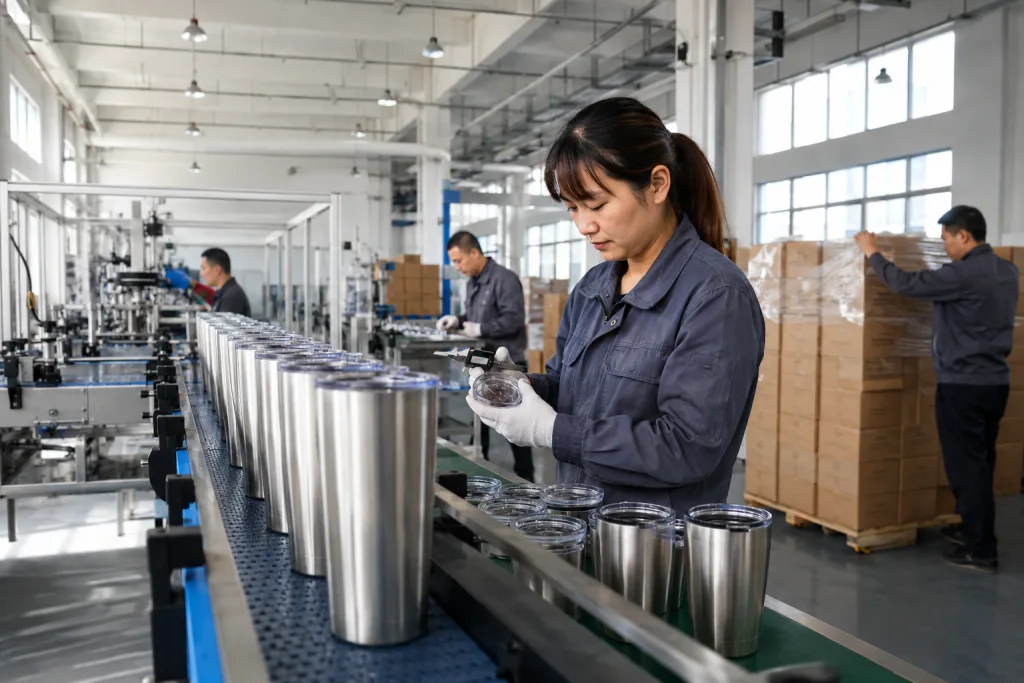
At BottleForge Industrial in Hangzhou, Zhejiang, we make custom drinkware for importers, brand owners, and distributor drinkware accounts shipping into Europe and North America. Our plant runs roughly 450,000 units per month, with standard MOQ from 1,000 pieces per SKU and typical bulk lead times of 25 to 40 days. We run vacuum testing on the line, and QC pulled the sample last month because a lid leaked after a 1-meter drop test. Those numbers tell you more than polished catalog photos.
What actually sets the unit price
If you ask five insulated tumbler suppliers for a quote and send only a photo, you will get five prices that don’t match up. That’s normal. The unit price moves on material grade, body size, vacuum build, lid structure, surface finish, decoration, packaging, and MOQ. On our side, the first thing sales asks the line is simple: body diameter, height, and whether the lid is press-fit or threaded.
For common 18/8 or SUS304 inner and outer stainless steel, a straight-wall 20 oz tumbler is usually the lowest-cost format because the tube size is standard and scrap loss stays low. FOB China price at 1,000 pieces may land around USD 2.80 to 3.80 with powder coating and a simple clear push lid. Move to a 30 oz or 40 oz body, add a handle, use a screw lid with straw, or specify a two-tone powder coat, and you can move quickly into USD 4.20 to 6.80. If you ask for copper-plated vacuum insulation, recycled stainless claims with document support, or retail-grade gift box packaging, expect another 5% to 15%. We’ve seen buyers push for a 40 oz handled mug at 20 oz pricing. The math doesn’t work.
Wall thickness matters too. Many buyers read “double wall vacuum” and stop there. This is the wrong question to ask. A tumbler using 0.4 mm outer wall and 0.3 mm inner wall can quote lower than one built with 0.5/0.4 mm, but dent resistance and thread stability are different. On the floor, QC pulled the sample and measured the rim after welding; the thinner body shifted more during thread forming. Lid resin also changes cost. AS lids are cheaper. Tritan holds up better. Polypropylene components usually survive repeated assembly better than brittle low-cost blends.
Ask every supplier to break out these lines:
- Body and lid unit price
- Decoration cost by method and color count
- Packaging cost per unit
- Tooling or screen charge
- Export carton spec and gross weight
- FOB port and validity period
A canteen factory or canteen manufacturer quoting a custom canteen, custom growler, or customized drinkware line should be able to send this fast, often in the first quote sheet. If the reply stays vague, you’re probably not talking to the production side. We ship these sheets with carton size and GW/NW every week, and sometimes the buyer flagged a price gap that came down to a typo on the PO: push lid quoted, screw lid requested.
MOQ tiers that change your math
MOQ is not a hurdle. It changes the cost math. Most insulated tumbler suppliers in China quote three working bands: 1,000 pieces, 3,000 pieces, and 5,000 pieces. At 1,000 pieces, the line runs less efficiently, carton overage sits on the floor, and powder coating loss is higher on a short run. We see this every week. By 3,000 pieces, the setup cost spreads better and raw material buying improves. By 5,000 pieces, the unit price often stops dropping much unless you also cut colorways or keep one box spec. This is the wrong question to ask if you only look at unit price.
A practical example for a 30 oz vacuum tumbler with one-color logo, powder coating, and standard white box:
- 1,000 pcs: around USD 4.60 FOB Ningbo
- 3,000 pcs: around USD 4.15 FOB Ningbo
- 5,000 pcs: around USD 3.95 FOB Ningbo
That does not mean every project should chase the lowest unit cost. If you are a canteen distributor, canteen vendors network, or a distributor growler program testing a private label, 1,000 to 1,500 pieces is often the safer start even with a higher piece price. We have buyers push for the extra USD 0.20 to 0.35 saving, then sit on 2,000 unsold units for 4 months. The math doesn't work. Slow inventory costs more than the FOB gap.
For canteen customizable and customizable growler projects, MOQ moves again if you change mold details such as handle geometry, lid threading, or bottom shape. A canteen customized body mold often starts around 3,000 to 5,000 pieces, with tooling from USD 1,500 to 6,000 depending on complexity. On the factory side, even a 0.8 mm thread change can trigger new sampling and fit checks with the lid gauge. Minor changes such as a custom silicone stopper color or a debossed bottom logo may avoid new mold cost.
Separate “stock model with custom decoration” from “new model development.” Buyers mix these two all the time, then ask why lead time went from 18 days to 32 days.
In Zhejiang, canteen suppliers and canteen manufacturers often advertise low MOQ, but that usually means stock colors and no retail packaging revision. We ship plenty of these jobs. Once the buyer flagged a simple white box update, and the PO even had a typo on the lid code, MOQ changed because the box print run and insert match-up changed. Ask for MOQ by SKU, color, lid, and box style, not one headline number.
Decoration and packaging add up fast
On custom drinkware, decoration is where quote sheets start hiding cost. A one-color silk screen logo may add only USD 0.08 to 0.18 per unit on simple curved surfaces, but that price usually assumes one print position, one setup, and clean artwork. Laser engraving is often USD 0.12 to 0.30 depending on size and position. Full-wrap heat transfer, UV print, or multi-position graphics can add USD 0.35 to 0.90. On our line, a wrapped tumbler also runs slower because the jig has to hold registration tighter, sometimes within 1.5 mm. If you are sourcing canteen promotional items for campaigns, artwork cost often lands at 10% or more of the ex-factory price on lower-priced bottles. Buyers miss this all the time.
Packaging is the second quiet cost driver. Bulk-packed tumblers with egg-crate dividers are efficient. We ship a lot of those. Individual white boxes are standard for many North American and European accounts. Custom color boxes, mailer-tested e-commerce cartons, belly bands, insert cards, and barcode labels all add cost and lead time. We have seen a PO held up for 3 days because the buyer flagged a barcode typo on the side panel. Typical ranges:
- Plain white box: USD 0.12 to 0.28
- Custom color box: USD 0.28 to 0.65
- FNSKU or barcode label application: USD 0.02 to 0.05
- Instruction sheet or insert: USD 0.03 to 0.10
If you sell through retail or Amazon, ask early about carton drop resistance, master carton dimensions, and pallet efficiency. Ask before sampling is approved, not after. A cheap customized canteen packed in an oversized gift box can wreck your freight math; we have seen CBM jump from 0.048 to 0.072 on the same bottle just from box size. For a premium customizable drinkware or custom growler launch, better packaging may improve sell-through enough to justify the cost. Still, this is the wrong question to ask if your first target is margin and repeat replenishment.
Common decoration methods by project type:
- Corporate logo runs: silk screen or laser
- Outdoor brands: powder coat plus laser reveal
- Retail private label: UV print or heat transfer
- Kids and lifestyle lines: wrap print with stronger color control
A serious canteen supplier should also confirm REACH-compliant inks or coatings when required for the EU. If the supplier cannot explain coating cure tests, abrasion checks, or color tolerance, keep looking. QC pulled a sample last month where the coating passed color match but failed the cross-hatch adhesion test after cure, and that kind of miss will come back as a claim. We have seen this go sideways.
Lead time from idea to vessel booking
Delays usually start before the line runs. We lose time in artwork approval, sample markups, and carton files that are still being revised after the PO is placed. For standard insulated tumblers on existing molds, the usual timing from approved artwork to shipment is 25 to 40 days. Repeat orders on the same spec often move in 20 to 30 days if 304 stainless coil is already in stock and the body color stays with standard black, white, or navy.
For a first order, use a calendar that matches factory reality. This is the right question to ask.
- Quotation and technical confirmation: 2 to 4 days
- Pre-production sample: 5 to 10 days
- Logo and packaging approval cycle: 3 to 7 days
- Mass production: 20 to 35 days
- Final inspection and booking: 3 to 5 days
That puts most programs at 35 to 55 days before the goods leave China. In peak season from August to November, add 7 to 15 days. Custom color boxes slow things down fast, and mixed container loading adds another coordination step. We have seen one PO held 6 days because the barcode file was still in draft and the buyer flagged a 2 mm logo shift on the mailer.
Buyers get burned when they assume every item in a mixed drinkware order moves at the same speed. It does not. A stock tumbler may be ready in 25 days, while a canteen custom bottle with bamboo parts or a customized growler with a pressure-tested cap can need 40 days or more. QC pulled the sample on one growler project because the cap torque was off, and that alone cost 4 days. If you are buying from one canteen factory and one tumbler line in the same Zhejiang supply base, sync approvals early so the slowest SKU does not hold the vessel booking.
What shortens lead time
- Choosing existing molds with standard lids that we already run on the line
- Using one body color for 70% or more of volume, which cuts paint changeovers
- Approving artwork in vector format on day one, not a low-res screenshot from WhatsApp
- Accepting standard export cartons instead of custom PDQ display packs with a small MOQ
What usually extends it
- Frequent logo size changes after sampling; we have had buyers revise the print width from 45 mm to 52 mm after approval
- Low-volume custom packaging, where the carton supplier will not start below MOQ
- Leakproof lid redesigns, because the math does not work if the first seal test fails
- Holiday production gaps in China, especially when booking falls near factory shutdown dates
Quality checks that protect margin
Price and lead time do not save you if 4% of the shipment leaks or lands dented. Margin is gone fast. You need a real quality plan on paper and on the line, not a sales promise. For insulated tumblers, we usually lock six control points: vacuum retention, lid fit, coating adhesion, logo position, dimensions, and carton drop performance. On our floor, QC pulled the sample and checked logo offset with a 0.5 mm tolerance card before mass print. AQL 2.5 for major defects and 4.0 for minor defects is a common final inspection level for B2B orders, though some brand owners go tighter on appearance.
Ask the supplier for internal test standards with actual numbers. “Good insulation” is the wrong question to ask. Better: water from 95 degrees C to above 55 degrees C after 6 hours, or cold retention with ice after 12 hours depending on the format. For powder coating, cross-hatch adhesion and rub testing should be routine; we run a 3M tape pull after the cutter grid, not just a fingernail check. For lids, ask for the leak test method and pass rate. A reliable factory should tell you straight if they do 100% vacuum inspection, 100% air-pressure leak test on assembled bodies, or sample-based checks only. We have seen buyers assume 100% testing, then flag 600 pcs later because the PO never stated it.
If you import into Europe, ask for REACH and LFGB-related material declarations where applicable. For North America, projects may also call for California Proposition 65 review and ASTM-related packaging or component checks depending on product category, especially for kids lines. We ship retail programs where the buyer flagged ink migration risk on a straw part, so this paperwork needs to match the actual BOM, not an old sample file. Social compliance such as BSCI matters to many retail accounts, while ISO 9001 process control is useful but not a guarantee of product quality by itself. The math does not work if the audit file is clean but incoming silicone hardness is off by 5 Shore A.
For a canteen vendor, canteen distributors program, or distributor canteen order that includes several SKUs, define carton marks and barcode logic early. This goes sideways more than people expect. A small labeling mistake can trigger chargebacks after arrival, and we have seen a single PO typo swap 12 oz and 20 oz outer marks on 850 cartons. The best canteen factory teams in China treat quality, packing, and shipping marks as one process, because they know warehouse errors cost as much as cosmetic defects. Before we ship, the line lead usually checks carton mark, barcode scan, and pallet tag against the packing list in one pass.
Choosing between factory and trading offer
Not every non-factory supplier is a bad choice. Some trading companies are solid, especially if you need a mixed custom drinkware shipment: tumbler plus customized canteen, sports bottle, and customizable growler on one PO. That setup saves sourcing time. Still, you need to know what margin you are paying and who owns the problem when QC pulled the sample and found a lid leak at 0.03 MPa.
A direct canteen manufacturer or canteen factory usually gives you tighter control on engineering details, sample timing, and corrective action. You can ask about weld seam consistency, vacuum hold time, coating line capacity, and the in-line inspection rate on the line. At BottleForge in Hangzhou, Zhejiang, for example, we can normally issue pre-production samples in 7 days and push repeat bulk orders in about 25 days because the process is under one roof. We run wall-thickness checks with an ultrasonic gauge and log body weight by gram before powder coating. That kind of answer is hard to fake, and this is the right question to ask.
A trader still makes sense if your program needs mixed categories from 3 or 4 specialized plants. The downside is slower communication and weaker root-cause work when there is a defect. We have seen this go sideways: the lid supplier blames the tumbler plant, the tumbler plant blames the packaging line, and you lose 7 days while cartons sit with a PO typo on the mark artwork.
Ask these direct questions before placing the PO:
- Are you the actual producer of the stainless body?
- Which processes are in-house, and which are subcontracted?
- What is your monthly capacity for this exact model?
- Can you support third-party inspection before balance payment?
- What was your last average lead time for this SKU?
If the answers are vague, the quote is less reliable than it looks. Good insulated tumbler suppliers speak plainly about bottlenecks, MOQ, and reject rates, like whether the line ran 2.1% rework last month on this lid fit. If a supplier dances around those numbers, the math doesn't work.
Get a real tumbler quote, not a vague catalog price
Send your size, lid type, logo method, target MOQ, and delivery window. We will map cost drivers and a workable China production schedule.
Frequently asked questions
What is a realistic MOQ for custom insulated tumblers?
For stock molds with your logo, 1,000 pieces per size is a common starting MOQ in China. Some factories will accept 500 pieces, but usually only on standard colors and with limited decoration options. If you want a true customized drinkware program with a new lid, handle, or body mold, expect 3,000 to 5,000 pieces minimum plus tooling. Packaging can also have its own MOQ. A custom color box may require 1,000 to 2,000 pieces, while a standard white box does not. Always ask for MOQ by SKU, color, and lid combination. A quote that says only “MOQ 500” is usually leaving out an important restriction.
How much should I budget per unit from insulated tumbler suppliers?
A practical FOB China range for 20 oz to 40 oz stainless vacuum tumblers is USD 2.80 to 6.80. At the low end, you are looking at a basic stock model, 304 stainless, simple powder coat, clear push lid, and plain packaging at 1,000 to 3,000 pieces. At the higher end, add a handle, screw lid, straw set, dual-finish coating, gift box, or multi-color print. Decoration often adds USD 0.08 to 0.90, and packaging can add another USD 0.12 to 0.65. If you need retail compliance documents, third-party inspection, or special carton tests, put another 1% to 3% into the total sourcing budget.
How long does a first order usually take?
For a first order using an existing mold, plan on 35 to 55 days from technical confirmation to cargo ready. That usually includes 5 to 10 days for samples, 3 to 7 days for logo and packaging approval, 20 to 35 days for production, and a few more days for inspection and vessel booking. Repeat orders can be much faster, often 20 to 30 days, if the same decoration and packaging are reused. Peak season in China, especially from late summer into Q4, can add 7 to 15 days. If your order includes a custom canteen, custom growler, or mixed drinkware set, the slowest SKU usually sets the shipping date.
What tests and standards should I ask for on insulated tumblers?
Start with practical factory tests: 100% vacuum inspection if possible, lid leak checks, coating adhesion, logo abrasion, and packaging drop checks. Ask the supplier to state the pass criteria in writing, not just say “tested OK.” For Europe, many buyers ask for REACH-related material compliance and, depending on components, LFGB support. For North America, California Proposition 65 review may be needed, and some retail accounts ask for additional documentation tied to packaging or product category. On quality control, AQL 2.5 major and 4.0 minor is common for final inspection. If your account is demanding, book a third-party inspection before the balance payment.
Is it better to buy from a factory or from a trading company?
If you are buying one or two insulated tumbler styles in volume, a direct factory usually gives better cost transparency and faster technical answers. You can confirm capacity, wall thickness, and lead time more accurately. If you are building a mixed line with tumbler, customizable canteen, and distributor growler items from different processes, a strong trading company can simplify coordination. The key is to ask who makes the stainless body, what is subcontracted, and who owns quality responsibility. A weak trader can add 3 to 7 days to communication and make corrective action difficult. A strong one can save you time if your assortment is broad.