Key Takeaways
- A useful supplier shortlist is usually 5 to 8 factories, not 30, with MOQ from 1,000 to 3,000 units per colorway
- For a 30 oz stainless tumbler, normal sampling is 7 to 12 days and bulk lead time is 25 to 40 days after deposit and artwork approval
- Common FOB China pricing for a powder-coated 30 oz tumbler is about USD 3.20 to USD 5.80 depending on steel, lid, packaging, and print method
- Set QC rules before deposit: AQL 2.5 for major defects, 4.0 for minor defects, plus 100% leak testing on lids
You do not need a giant insulated tumbler supplier list. You need 5 to 8 factories that can quote your exact spec, match your packaging rules, and ship on time without turning Rev B into another fight. Most sourcing errors start in the first RFQ: the supplier quotes 201 instead of 304 stainless, nobody defines the lid leak test, the logo fails after 200 dishwasher cycles, or sales says yes before the toolroom checks the mold and thread gauge.
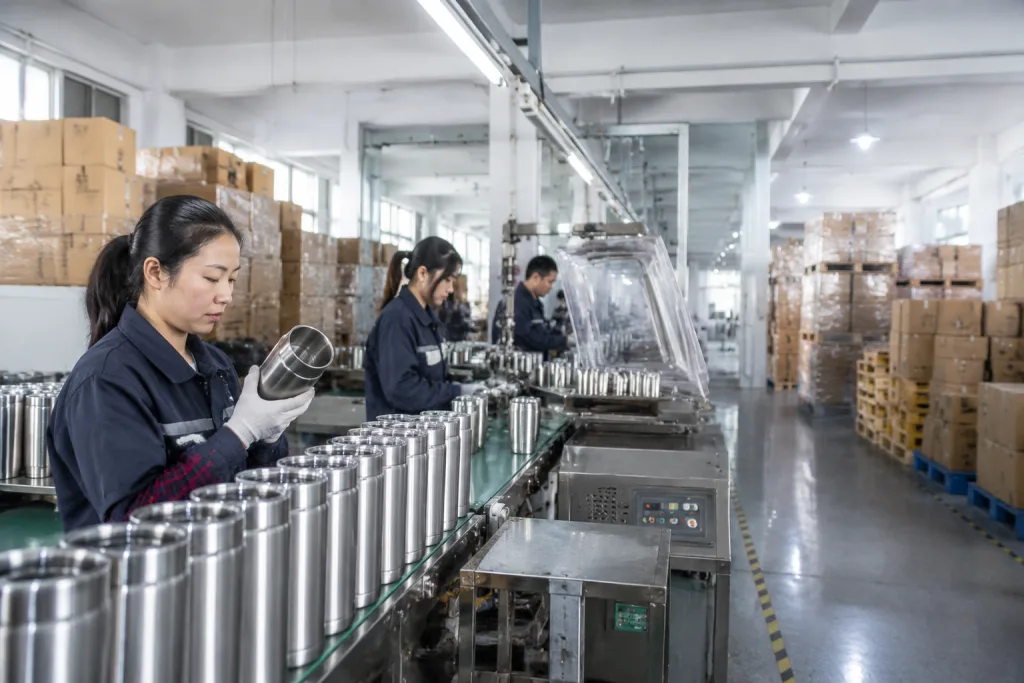
Here is a realistic B2B order flow, written the way a procurement manager runs it. You are buying a 30 oz insulated tumbler for a retail launch, with a follow-on custom canteen and customizable growler program if the first PO lands clean. We use typical export conditions from Zhejiang, China, where a 3,000 pcs MOQ and a carton drop test are normal checks on the line. This is the wrong question to ask: “Who is the cheapest supplier?” Better question: who can hold the spec, pass QC, and still ship in 18 days instead of 26 when the buyer flagged a packaging typo on the PO.
Start with the order, not the catalog
Say you are a North American brand owner booking a first run of 8,000 insulated tumblers for Q4. Your sales team wants headroom to add custom drinkware, a custom canteen, or a customizable growler if the first PO lands well. Start by asking 10 factories for “best price tumbler,” and the math does not work. You will get 10 numbers built on different assumptions: steel grade, lid style, powder coat thickness, logo method, carton drop standard, and whether straws or paper inserts are packed in. We see this all the time, even down to a PO typo on lid color that flips clear to smoke.
Freeze a working spec sheet first. That is the right question to ask. For example:
- Body: 30 oz double-wall vacuum tumbler, 304 inner and 304 outer, 0.4 mm inner wall, 0.5 mm outer wall
- Lid: AS or Tritan slide lid, clear, BPA-free, with silicone seal
- Finish: matte powder coating, Pantone matched, 60 to 80 micron coating thickness
- Branding: 1-color silk screen on two sides, 35 mm tall logo area
- Packaging: white box, barcode sticker, master carton under 15 kg
- Compliance: REACH-ready materials for Europe, FDA/LFGB-contact-safe components, drop test and leak test requirements
Once that sheet is fixed, your insulated tumbler supplier list gets shorter and a lot cleaner. You can line up a canteen manufacturer, a canteen supplier, and a general distributor drinkware source against the same build. In Zhejiang, factories that know OEM work usually ask for artwork files, target market, test standard, and packaging details before they lock price. That is a good sign. On our side, QC pulled the sample and checked logo height with a caliper before final approval. A factory that sends a one-line quote in 20 minutes usually has not checked the points that decide claims later.
BottleForge Industrial, for example, plans around OEM orders instead of stock-only selling, with capacity around 600,000 units per month across tumblers, bottles, and related lines in Zhejiang. Big output alone means nothing. Process discipline is what saves the order. We run into buyer pushback here on lead time, but the real question is whether the supplier can take a repeat PO of 12,000 units after your first 8,000 ships without changing finish, pack-out, or leak-test standard mid-line.
Build a shortlist buyers can defend
For this order, keep 5 to 8 names on the shortlist. More than 8 slows the team down. Fewer than 5 is thin coverage if one factory fails sampling, misses paperwork, or QC pulls the sample for a weld issue at the cup shoulder. The shortlist should lean toward real manufacturing sites in China. Use a trader only if they solve a clear problem, such as combining 3 SKUs into one shipment or managing a messy packaging handoff.
Here is a practical buyer screen:
- Product fit: ask what percent of output is tumblers, sports bottles, and vacuum items. If vacuum drinkware is under 30% of the business, they are probably still learning on your order. We have seen buyers push ahead anyway, then the line misses vacuum retention on the first batch.
- MOQ fit: check if MOQ is realistic. For many OEM tumbler programs, 1,000 units per color is workable; custom lids, special molds, or retail gift boxes can push MOQ to 3,000 or 5,000. Ask for the MOQ by body, lid, and print method, not one blended number. This is the wrong question to ask if you only say, "What is your MOQ?"
- Process fit: confirm in-house spinning, vacuuming, powder coating, laser, silk screen, and leak testing. If everything is outsourced, your schedule risk rises. Ask what they run on the line: auto spray booths, vacuum furnaces, laser markers, and 100% air-pressure leak test stations.
- Audit fit: ask for BSCI, ISO 9001, Sedex if needed, and recent test reports. Not every buyer needs every audit, but you need to know what is real. We have seen factory profiles with an audit logo on page 2 and an expired date in 8 pt text on the last page.
- Communication fit: can they answer whether a logo should be silk screen, heat transfer, or laser based on finish and quantity? A capable sales engineer will tell you, for example, that laser reads clean on powder coat, while silk screen may chip on a curved area if the artwork sits too close to the radius.
This is where related categories matter. A strong canteen factory or canteen manufacturer often handles tumblers well because the vacuum stainless process overlaps: tube cutting, neck forming, seam welding, copper coating, and vacuum hold testing. We run into the same buyer pushback here every season: "A canteen supplier is not a tumbler supplier." Sometimes true. Sometimes not. The better check is whether they build 304 stainless vacuum bodies every day and hold consistent dimensions, such as lid fit within about 0.3 mm. The same supplier may also support canteen custom, canteen customizable, or customized canteen programs later. If you are a canteen distributor or one of several canteen distributors serving outdoor or corporate channels, that overlap cuts supplier count and saves approval time.
Ask each candidate for three things in one email: a formal quotation, a factory profile, and recent bulk production photos. Put a deadline on it, such as 48 hours. Good canteen vendors and canteen suppliers usually send line photos that show something real: pallet stacks, carton markings, or a date board next to 20 oz bodies at final pack. Weak suppliers hide behind generic PDFs, or they reply with a PO summary that still carries a typo in the customer name. By the end of this step, your supplier list should shrink to three serious options. If it does not, the screen was too soft.
Quote apples to apples or pay later
Send the RFQ pack to the three finalists. This is where buyers leak margin. One supplier quotes FOB Ningbo at USD 3.45, another quotes FOB Shanghai at USD 4.10, and a third throws EXW at USD 3.25 to look cheap. We see this every month. Until you line up carton spec, decoration, and who pays the truck from factory to port, those numbers are not comparable. Last week one PO even had “FOB Ningbo” typed on page 1 and “EXW” on page 3.
For our 8,000-piece scenario in China, a real comparison sheet should include:
- Unit price by quantity break: 1,000 / 3,000 / 5,000 / 10,000
- Tooling fee if any: new lid mold, base die, or custom handle part
- Sample charge and sample lead time
- Packing cost: inner box, mailer box, PDQ, barcode, instruction sheet
- Decoration cost by method: silk screen, laser engraving, heat transfer, UV print
- Trade term: EXW, FOB Ningbo, FOB Shanghai, or DDP if offered
- Payment term: 30% deposit, 70% before shipment is still standard
Use one sheet. Same spec. Same assumptions. On the line, we usually add net weight, gross weight, carton size, and CBM because freight math changes fast at 8,000 pcs. For a standard 30 oz tumbler, FOB China pricing often lands at USD 3.20 to USD 5.80 depending on coating, lid material, handle, and packing detail. Add USD 0.08 to USD 0.25 for a basic logo. Full-wrap or 2-color work climbs fast, and the math does not work if one factory priced a 1-pass silk screen while another priced UV print with a jig change. If you later move into a customized growler or custom growler, the steel weight, cap structure, and slower cycle time usually push pricing above tumbler levels. A 304 stainless body at 0.5 mm and one at 0.4 mm do not cost the same.
Watch the hidden cost points
The cheapest quote usually leaves out the item that turns into a claim later. This is the wrong question to ask: “Who is lowest?” Ask what is missing. QC pulled one sample last month where the silicone ring was too loose by about 0.6 mm, and the cup leaked only after the third heat cycle.
- silicone ring hardness and fit tolerance
- powder coat adhesion standard
- master carton strength for Amazon or club-store handling
- individual polybag or no polybag
- straw brush, extra gasket, or insert card
You are not buying a sample photo. You are buying a repeatable process with a landed cost you can defend to finance.
If your business also serves as a distributor canteen or distributor growler channel partner, standardize the RFQ template now. We ship plenty of repeat orders where tumbler, canteen, and growler programs share one format, one barcode rule, and one carton drop-test standard. It saves time later, and we have seen the opposite go sideways during replenishment.
Sampling exposes the real supplier
Once you shortlist a factory, sampling starts. This stage tells you more than any brochure or sales deck. A serious supplier in Zhejiang or elsewhere in China should deliver pre-production samples in 7 to 12 days for standard bodies; custom boxes, new molds, or a fresh lid tool usually push it to 15 to 20 days. If they miss the sample date twice without a clear technical reason, treat it as a bulk lead-time warning. We’ve seen this go sideways on the line after mass production starts.
For this walkthrough, you request three samples:
- one unbranded construction sample for thermal and leak evaluation
- one color sample with Pantone-matched powder coat
- one full packaging sample with barcode and shipping marks
Check the basics first. Weigh the tumbler on a 0.1 g bench scale. Measure height, base diameter, and mouth diameter with a digital caliper, not a ruler. Test whether it fits your cup-holder claim if that matters; we’ve had buyers flag a base at 76.8 mm because their retail card promised under 76 mm. Fill with hot water and check outer wall heat transfer after 10 minutes. Put it upside down for 30 minutes. Open and close the lid 20 times. Rub the print with alcohol if that matches your internal standard. If you sell to Europe, ask what components contact liquid and whether the supplier has supporting declarations for REACH and LFGB pathways.
This is also the time to ask broader category questions. Can the same factory produce a customizable canteen with the same finish and color tolerance? Can they quote a customized drinkware family that carries one visual language across tumblers, bottles, and growlers, with one powder line and shared carton spec? A capable canteen vendor or canteen factory should tell you where tooling is shared, where it is not, and what that does to MOQ. This is the right question to ask before you combine SKUs on one PO.
Do not approve samples on looks alone. Ask for a sample approval sheet with sign-off items for dimensions, finish, logo position, packaging, and function. Add real checkpoints like logo offset within 1.5 mm and barcode scan pass on the outer box. If the order later drifts, that sheet is your reference. Good factories in China welcome this because it cuts arguments during production; QC pulled the sample, the buyer signed it, and everyone works from the same standard.
Lock production controls before deposit
After sample approval, a lot of buyers pay the 30% deposit and go quiet. That is where orders slip. Before the line starts, lock a short quality agreement. Two pages is enough in most tumbler programs. We usually attach marked photos, a PO number, and one signed spec sheet instead of hiding behind “best quality” language that means nothing on the factory floor.
For our tumbler order, the pre-production control list should include:
- Incoming material: confirm 304 stainless, lid resin type, silicone color, and carton board grade
- In-process checks: vacuum retention check, thread fit, powder coat appearance, logo position tolerance within plus or minus 2 mm
- Functional checks: 100% leak test on assembled lids, random vacuum test each lot, carton drop test on packed goods
- Final inspection: AQL 2.5 major, 4.0 minor, level II unless your retailer requires tighter rules
- Traceability: carton marks, production date code, line or shift code if available
If you ship to Amazon FBA or big retail, add labeling and carton rules before mass production. Not after. We have seen one FNSKU placement error at 18 mm off-center hold up 12,000 units for relabeling, and the math does not work in the buyer’s favor. Suffocation warning wording and carton dimension caps need to sit on the approved packing file now. Define major defects the same way. Failed leak test, sharp edge, missing logo, wrong barcode, or a visible dent are majors. Light print offset, a small speck under coating, or minor carton scuffing can sit under minor defects, but QC pulled the sample and agreed that threshold with the buyer first.
For buyers running 6 or 12 SKUs, including a canteen promotional line or a customized canteen for events, this discipline scales cleanly. It also gives you a fair way to compare different canteen manufacturers and canteen suppliers. This is the right comparison. Gut feel is not. One supplier says “no problem,” another sends a control sheet with seal ring hardness, logo jig position, and carton burst grade; we know which one will ship with fewer surprises.
In Zhejiang, factories used to organized OEM export work usually accept these controls because they already run internal QC points on the line. We run incoming checks, first-piece signoff, and packed-carton audit as standard on most export orders. If a supplier pushes back on basic AQL or refuses third-party inspection, move them down your list. We have seen this go sideways after deposit, especially when the factory will not print a shift code or the buyer flagged a PO typo too late.
Production day issues and how buyers react
Real orders do not run clean from deposit to shipment. On day 12, the line might flag two problems at once: the matte navy powder coat shifts off Pantone under 3000K warm light, and one lid batch shows 3% seepage after an overnight hold test. This is the moment the supplier shows what kind of factory it is.
A practical response is simple. Don’t panic. Don’t just accept “we are checking.” Ask for:
- photos and video under neutral light, preferably 5000K
- the actual defect rate by batch size
- corrective action plan with timing
- whether rework affects delivery date
For color deviation, the first check is whether it stays inside the approved sample tolerance. If your carton print, insert card, and web images depend on exact brand color, stop mass finishing before the next 8,000 pieces run. Buyers push back here for good reason, and we’ve seen this go sideways when a factory keeps coating first and debating later. For lid seepage, 3% is too high for a decent tumbler program. QC pulled the sample, isolated the lot, and the team should check silicone ring dimension, lid injection consistency, and assembly pressure on the press. A capable factory can usually fix this in 2 to 4 days, not 10, without blowing the full schedule.
What a good factory says
We stopped the affected lid lot at 6,200 pieces, checked gasket dimensions against the approved sample, and started 100% reinspection. Revised completion date is plus 3 days, no unit price change.
That answer is useful. “No problem, friend” is not. This is the wrong question to ask: “Will there be any issue?” The right question is, “What batch, what defect rate, what containment?” Whether you are buying tumblers, a custom canteen, or a customizable drinkware program, you need defect data and clear containment steps. This is why 2 out of 3 buyers we ship to in Europe and North America keep one backup supplier on the insulated tumbler supplier list even after the PO is placed.
Good canteen distributors, canteen vendors, and private-label buyers learn the same lesson after a few production cycles. Speed matters. Controlled speed matters more.
Shipment approval decides repeat business
When bulk is finished, do not release the balance on pretty photos alone. We have seen this go sideways. For an 8,000-unit order, book a one-day final random inspection through your China office, a third-party team, or your own sourcing staff. On the line, QC pulled the sample by carton number, not by whatever looked cleanest on top, and that detail matters.
Your shipment release checklist should cover:
- quantity count by color and carton, with carton totals matched to the packing list
- workmanship against approved sample, including paint edge, weld area, and scratch standard
- logo accuracy and durability rub test, because buyers flag 1 mm logo shift fast
- leak and lid fit spot checks, usually with upside-down hold and thread match check
- barcode scan readability on outer carton and unit pack
- carton markings, pallet layout, and loading condition before container door close
If the order passes AQL and function checks, approve shipment and collect the full export file: commercial invoice, packing list, bill of lading draft, test records if agreed, and any certificate copies your customer requires. A standard OEM tumbler order in China usually runs 25 to 40 days from deposit to cargo-ready. From August to November, the line gets tight and vessel space gets tight too. We ship plenty in that window, but booking 7 to 10 days earlier is the safer move.
After arrival, review the project like an operator. Not a spectator. Was the landed cost still acceptable after rework, inspection, and freight? Did the supplier reply in 24 hours when a leak claim showed up? Could the same factory also support a canteen customized range, a customized growler, or broader customizable drinkware needs for your next season? This is the right question to ask. If the answer is yes, the factory moves from trial supplier to approved vendor.
That is how a sharp buyer builds a real supplier list: one controlled order at a time, with clear specs, realistic MOQ, and hard QC gates. We have seen 12 factories on a shortlist drop to 3 after first shipments. That is fine. The list gets shorter, and your buying gets better.
Send your tumbler spec and get a usable quote
Share your target quantity, artwork, packaging, and delivery window. We will review MOQ, lead time, and QC points before you place the order.
Frequently asked questions
How many factories should be on an insulated tumbler supplier list?
For a serious sourcing round, keep 5 to 8 suppliers on the longlist and narrow to 3 for sampling. That is enough to compare pricing, MOQ, lead time, and communication without wasting weeks on low-quality quotes. For a standard OEM tumbler, you want factories that can handle 1,000 to 3,000 units per color, provide samples in 7 to 12 days, and confirm FOB pricing clearly. If you also buy custom canteen, customized drinkware, or customizable growler items, include 1 or 2 suppliers with broader stainless capacity. Once one factory proves itself on bulk production, most buyers keep 1 approved supplier and 1 backup in China rather than constantly re-sourcing every PO.
What is a normal MOQ for custom insulated tumblers?
For standard body shapes with basic logo printing, MOQ is often 500 to 1,000 units per color, but 1,000 is the more practical number for stable pricing. If you want a custom lid, special color match, gift box, or new mold, MOQ usually rises to 3,000 to 5,000 units. Some China factories quote lower MOQ, but the unit cost may jump by USD 0.40 to USD 1.20, which is not always worth it. For connected categories such as custom canteen or customized growler products, MOQ is usually higher because bodies are heavier and slower to produce. Always ask whether MOQ applies per color, per print design, or per shipment.
What should I check in tumbler samples before approving bulk production?
Check more than appearance. Measure dimensions, weigh the unit, test lid fit, fill volume, leak performance, and coating consistency. For branding, confirm logo size, placement, and rub resistance. For packaging, verify barcode placement, carton weight, and insert accuracy. If you sell into Europe or North America, ask the supplier to identify food-contact materials and share available REACH, LFGB, or FDA-related documentation. A good sample approval process covers at least 10 to 15 checkpoints and ends with a signed reference sample or approval sheet. Without that, factories in China may interpret details differently during mass production, especially on custom drinkware orders with several SKUs.
How do I compare supplier prices fairly?
Use one RFQ sheet and force every supplier to quote the same assumptions. Ask for unit price, tooling, sample fee, decoration charge, packaging cost, MOQ, lead time, and trade term such as FOB Ningbo. A tumbler quoted at USD 3.35 EXW can end up costing more than one quoted at USD 3.70 FOB if packaging, lid upgrades, and inland trucking were left out. Also compare wall thickness, steel grade, and test commitments. A 304/304 tumbler with 0.4 mm inner and 0.5 mm outer walls is not the same as a downgraded body quoted on thinner material. Do the same if you compare canteen manufacturers, canteen vendors, or growler suppliers.
When should I use a third-party inspection?
Use one on any first order, retailer program, or shipment that would hurt badly if rejected. For an 8,000-piece tumbler PO, a final random inspection in China is a small cost relative to a container of faulty stock. Set the standard first: AQL 2.5 major and 4.0 minor is common, plus functional checks like leak testing and barcode scans. You can also add during-production inspection if the order includes several colors or custom packaging. Once a factory has passed multiple orders consistently, some buyers reduce inspection frequency, but they rarely remove it completely for high-value custom drinkware or seasonal launch orders.