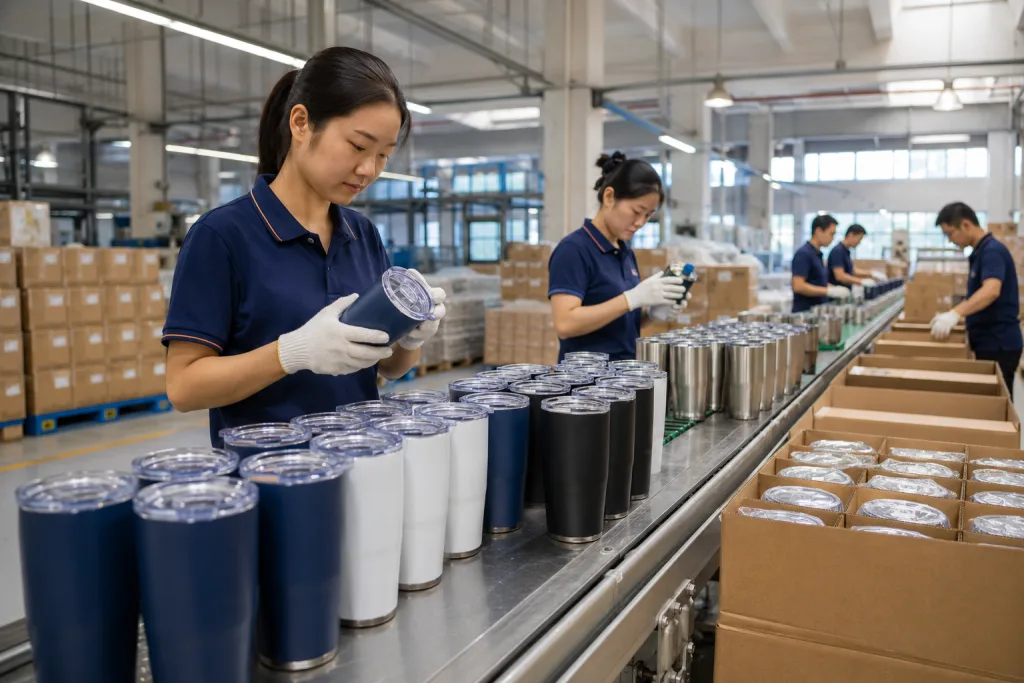
Key Takeaways
- A workable opening MOQ for insulated tumblers is usually 500-1,000 pcs per SKU, with custom color and print often starting at 1,000 pcs
- Standard production lead time from Zhejiang, China is typically 25-40 days after sample approval and deposit, not the 15-day promise you sometimes hear
- For reliable inbound quality, ask for AQL 2.5/4.0 inspections, 304 stainless steel confirmation, and vacuum retention data at 6, 12, and 24 hours
- A serious canteen factory or tumbler supplier should be able to explain FOB pricing, carton drop test standards, and decoration durability in under 10 minutes
You are not looking for a list of names. You are trying to avoid the wrong insulated tumbler supplier, the wrong MOQ, the wrong test standard, and the wrong delivery promise. A useful insulated tumbler supplier directory needs to do more than point you to China. It should help you screen canteen manufacturers, tumbler factories, and custom drinkware vendors with the same discipline you use in any other sourcing category. On our line, this usually starts with one plain check: is the drawing calling for 304 stainless, 0.4 mm outer wall, and a real MOQ, or is the quote just dressed up?
From Zhejiang, China, you can find hundreds of suppliers offering stainless tumblers, custom canteen programs, and customizable growler lines. On paper, 200 of them look the same. That is the problem. If you are a procurement manager, brand owner, or distributor drinkware buyer, you need a sharper filter: material grade, weld quality, leak rate, AQL, REACH, ASTM, carton specs, and realistic lead times. We have seen buyers flag a 45-day promise that turned into 58 days after lid tooling and drop-test rework. This is the wrong question to ask: “Who is cheapest?” Ask who can hold spec and still ship on time.
Start with the shortlist question
Search an insulated tumbler supplier directory with one question first: which factories stay on the shortlist, and which get cut in 5 minutes? New buyers in China often stare at catalog count. That is the wrong question to ask. A supplier showing 800 models is not automatically stronger than a Zhejiang plant running 600,000 units per month on a narrower SKU set, with a stable QC team and a wall of approved golden samples by the packing line.
Use a first-pass checklist. Fast. If a supplier cannot answer these points without circling back to sales, move on; we have seen that go sideways after the PI is signed.
- Main product focus: insulated tumbler, sports bottle, custom canteen, custom growler, or a mixed trading catalog with 4 factories behind it?
- Material clarity: 18/8 stainless steel, 304 inner and outer, or lower-cost mixed grades? Ask what the spectrometer report shows, not just what the artwork sheet says.
- MOQ reality: 500 pcs, 1,000 pcs, or 3,000 pcs per color? We ship projects where the printed MOQ and the real lid-color MOQ are 2 different numbers.
- Factory or trader: own workshop, outsourced production, or a hybrid model? Ask who runs the vacuum test and where the line actually seals the body.
- Compliance scope: REACH, LFGB, FDA-contact materials, ASTM where relevant for kids' items? QC should be able to pull the last report in 2 minutes.
- Lead time: sample in 7-10 days, bulk in 30-35 days, or vague promises? Ask for the cap assembly timing too, because that is where the math often breaks.
If you buy for retail, promotional, or distributor canteen channels, ask one more thing: can they support repeat orders with consistent powder coating and logo alignment? Sounds basic. It is not. The buyer flagged this on one repeat PO because the logo sat 3 mm higher than the approved sample. We also see first orders pass, then repeat orders drift by 8-10 Delta E points and the shelf presentation is off.
A dependable canteen manufacturer in China should tell you where the bottlenecks are. During peak season, lid injection and painting usually delay orders more than steel forming. On our side, the line can form bodies all day, but one painting queue adds 4 days fast. Straight answers beat polished brochures.
You do not need the cheapest name in the directory. You need the supplier that can repeat the same result on order one, three, and ten.
What should you ask first
Good sourcing starts with pointed questions. Skip the generic opener. If you ask, “Can you do customized drinkware?” 9 out of 10 suppliers will say yes before they even check the line. Ask how they make it, the MOQ, and the actual defect rate from the last run. We’ve seen buyers lose a week on this step because the PO sounded clear and the factory answer was not.
Core questions for the first call
- What is your MOQ for a 20 oz or 30 oz double-wall tumbler with one-color silk screen logo?
- What is the price difference between spray paint, powder coating, and bare steel?
- Do you produce in Zhejiang, China, or source from multiple partner workshops?
- What is your standard wall thickness, such as 0.4 mm inner and 0.5 mm outer?
- Can you provide vacuum insulation retention results for hot and cold performance?
- Which lids have passed leak testing at 90-degree inversion for 30 minutes?
For a standard 20 oz tumbler, you should expect indicative FOB China pricing around USD 3.20-5.80 depending on steel grade, finish, lid type, and order volume. A larger 30 oz unit can sit around USD 4.10-6.80 FOB. If a quote comes in at USD 2.10 with claimed 304 stainless and premium powder coat, check it hard. This is the wrong price, not the wrong question. Usually something got cut: wall thickness, lid resin, carton spec, or QC time. Last month QC pulled the sample and found the outer wall at 0.43 mm where the quote was built on 0.5 mm.
If your business also sells custom canteen, customizable canteen, or customizable growler products, ask whether molds, lids, and decoration lines are shared across categories. That detail matters on the floor. A factory already running canteen custom and customized growler programs usually matches threads, cap colors, and print positions faster because they already run the same jig and pad printing setup across SKUs. We’ve seen this go sideways when a supplier only knows one tumbler body and tries to “match later.”
For distributor growler and canteen promotional programs, ask about mixed packing. A workable offer is often 3-4 logo variations within 1,000 pcs total if the body color stays the same. Some factories will split 250 pcs per logo and still keep one master carton mark, others will not. The buyer flagged this on one PO after a single typo in the item code mixed two logo versions into the same carton. Mixed packing cuts inventory risk for North American and European distributors testing multiple customer accounts, but only if the line and warehouse both follow the same packing list.
How to verify factory capability
A supplier directory entry is marketing copy. Capability shows up on the shop floor. We verify it with current documents, workshop photos, sample quality, and the way the factory explains each step. QC pulled one sample last month with a 0.4 mm lid gap, and that told us more than 20 brochure photos.
Ask for a current factory profile with workshop area, headcount, production lines, and monthly capacity. A serious canteen factory or tumbler plant should give hard numbers: 500,000-800,000 units per month, 6 automatic polishing lines, 8 vacuuming machines, 2 laser marking stations, MOQ 3,000 pcs per color. If the answer is only “large capacity,” this is the wrong question to dodge, and you learned nothing.
Then check whether the line matches the product you want. We have seen buyers send a wide-mouth growler drawing to a plant that only runs slim tumblers, and the math doesn’t work.
- For insulated tumblers: check weld consistency at the cup seam, vacuum machine count, lid fit control, powder-coat line settings, and logo application method. Ask how they check fit—go/no-go gauge, torque test, or 1.2 m drop test.
- For canteen customizable projects: check neck forming accuracy, cap compatibility, loop or handle assembly, and narrow-mouth cleaning tests. On one PO, the buyer flagged a cap thread mismatch after pilot run because the neck tolerance drifted by 0.3 mm.
- For customized growler orders: check large body forming ability, sealing stability under pressure, and handle weld strength. We usually ask for a handle pull test record in kg, not just a verbal promise.
Request audit and system documents that matter in B2B: ISO 9001, BSCI or Sedex if your program needs social compliance, and product test reports aligned to your market. Europe may prioritize REACH and LFGB-related material safety. North America may focus more on FDA-contact declarations, CPSIA or ASTM relevance for kids' drinkware, and retailer-specific packaging rules. We ship to both regions, and missing one line on a declaration form can hold a booking for 3 days.
Do not ignore sample speed. A supplier that needs 18 days to produce a simple logo sample will likely struggle when you need carton mark updates, barcode changes, or urgent replacement lids. In our corner of Zhejiang, China, a normal custom sample window for drinkware is about 7-12 days. Bulk lead time is commonly 25-40 days after deposit and pre-production sample approval. On the line, a standard silk-print proof should not sit for 4 days waiting on screen exposure.
Also confirm whether the supplier owns export experience or only production. If you sell to Amazon FBA, a capable distributor tumbler partner should understand FNSKU labeling, carton weight limits near 15-18 kg, and palletization requests. We have seen this go sideways over one shipping mark typo on a master carton. If they cannot handle shipping marks correctly, you will spend your savings on rework.
The pricing checklist that matters
Price comparison works only if the quote structure matches line by line. We see buyers collect 5 quotes and call them comparable, then QC pulls the sample and the gap shows up fast: one factory priced 0.4 mm outer wall, another priced 0.5 mm, and the “cheap” canteen vendor looks 18% lower for a reason. This is the wrong question to ask. Do not ask who is cheapest first. Ask what is actually included.
Break every quote into the same checklist.
- Body specification: size, steel grade, wall thickness, base construction
- Finish: painting, powder coat, electroplating, or bare steel
- Lid: slider lid, screw lid, straw lid, material mix, gasket count
- Decoration: silk screen, heat transfer, laser engraving, digital print
- Packaging: polybag, white box, color box, master carton, dividers
- Trade term: EXW, FOB Ningbo, or FOB Shanghai
For example, a 30 oz customized drinkware tumbler quoted at USD 4.40 FOB Ningbo may include a standard AS lid, one-position silk screen logo, white box, and AQL final inspection. A quote at USD 3.95 might exclude inner box packaging, use a thinner outer wall, and allow a higher defect tolerance. We ship both types in this market. On paper the units look identical. In your warehouse they will not be. Last year a buyer flagged this after drop-test damage traced back to lighter inner packing.
If you buy canteen promotional products, custom growler items, or canteen customized gift sets, ask about tooling and setup charges as separate lines. A simple logo screen charge is often USD 40-80 per color per artwork, and we usually note mesh count and print size on the sheet. New lid colors, custom silicone parts, or body mold adjustments can run from a few hundred dollars to several thousand. We have seen POs where this got buried under unit price, then the repeat order looked “more expensive” because the setup charge disappeared from round one.
Also ask where scale starts to help. A lot of canteen distributors and canteen vendors place a first PO at 500 pcs, then push back on price after the quote lands. The math does not work at low volume. Going from 500 pcs to 1,000 pcs may only cut unit cost by USD 0.15-0.25. But jumping from 1,000 pcs to 3,000 pcs can lower coating and packaging overhead enough to save USD 0.35-0.60 per unit, depending on the model. On our line, carton MOQ and coating batch size are usually the two pressure points.
The practical lesson is simple: compare total landed logic, not just headline FOB price.
Quality control before you place orders
Most tumbler defects show up before shipment if the checkpoints are set early. QC should start before the cartons hit the sealing line, not after the tape gun is already on the bench.
Write a short control plan with the supplier and your third-party inspector. For standard bulk orders, AQL 2.5 for major defects and 4.0 for minor defects is common. Critical defects should remain at zero acceptance. Put that on the PO or in the quality appendix. We still see buyers skip this, then argue over a 2 mm logo shift after packing. That is the wrong question to ask at that stage.
Check these points on every insulated tumbler order
- Vacuum retention: hot and cold data at agreed checkpoints such as 6, 12, and 24 hours
- Leak resistance: full-fill inversion test for 30 minutes, plus shake test where relevant
- Coating adhesion: cross-hatch or tape test on painted surfaces
- Logo durability: rub test and dishwasher-position warning if hand wash only
- Dimensional control: height, mouth diameter, base diameter, lid fit tolerance
- Carton integrity: drop test, barcode readability, shipping mark accuracy
For custom canteen and customized canteen models, add strap, loop, or handle pull tests. We usually hang a 5 kg load on the strap point for a timed check, because the buyer flagged loose hardware on one order after only 200 units were packed. For customizable growler and distributor growler programs, watch cap sealing and handle attachment closely. Larger formats magnify small design weaknesses fast.
Request in-process photos from body forming, painting, logo application, and packing. On our line, QC pulled the sample after spraying once because the lid color was off by one Pantone step, and that saved a full rework. Serious canteen suppliers in China are used to this. We ship cleaner orders when the buyer asks for these checkpoints up front.
If you plan repeat business, keep a golden sample signed by both sides. That sample becomes the visual standard for powder coat texture, logo position, and accessory combination. We usually label it against the PO and seal it in a sample carton, because we have seen “same as last order” go sideways over a 3 mm logo raise or a handle color swap.
For buyers sourcing from Zhejiang, solid factories are not offended by QC discipline. They prefer clear standards because they cut claims, debit notes, and late-night price fights after shipment. The math does not work if a container lands with preventable issues.
When a supplier fits your channel
A good factory on paper can still miss your sales channel. We’ve seen a promo buyer place a 3,000 pc insulated tumbler order with a retail-focused plant, then get stuck on gift-box rules and color delta limits they never asked for. The reverse goes wrong too: a factory that runs smooth on fast logo swaps may frustrate a retail brand that needs stable shelf look across 4 seasons.
Match the supplier to your channel. This is the right question.
- Retail brands: need packaging that repeats lot to lot, low-odor coatings, tighter finish control, and shelf appearance that stays consistent; on our line, QC usually checks visible color variation at about 50 cm under standard light.
- Promotional buyers: need flexible MOQ, faster logo changes, and price points that still work after freight; a common ask we get is 500 pcs per color with 3 logo versions on one 20 oz body.
- Distributors: need wider SKU coverage, quicker replenishment, and clean master data for dozens of accounts; if carton size, GW/NW, and HS code fields are messy, the back office slows down fast.
- E-commerce sellers: need barcode accuracy, carton compliance, and lower parcel damage rates; the buyer flagged one case last year where an outer carton passed drop test but the insert gap was 6 mm too loose.
If you run custom drinkware programs with multiple sub-clients, ask whether the supplier can support mixed artwork on one body style in the same production window. If you sell custom canteen, customized growler, and insulated tumbler lines together, ask for component standardization early. Shared lids and shared straws cut dead stock. Shared color families help too. We’ve seen this go sideways when a buyer approved 3 lid molds that looked similar on screen but used different thread starts.
A practical sign of fit is how the supplier handles change control on normal weekdays, not on a polished sales call. Can they revise carton marks in 24 hours? Can they reissue PI and packing list versions without a typo on the PO number? Can they split one PO into 2 partial shipments and still keep label control by account? That is daily work for canteen distributors and canteen vendors shipping across Europe and North America, and the math doesn’t work if the factory treats each update like a special favor.
At BottleForge Industrial in Hangzhou, Zhejiang, this is usually the point where buyers realize they need an operator, not just a low quote. We run into this after the first sample review, often when QC pulled the sample and found the logo position shifted 2 mm from the approved artwork. The best canteen supplier is usually the one that makes your second order easier than the first, because specs, packaging, testing, and replenishment start to run without drama.
Need a supplier shortlist you can actually trust?
Send your target size, MOQ, market, and logo method. We will help you compare factory fit, pricing logic, and production risk from Zhejiang, China.
Frequently asked questions
What MOQ should I expect from an insulated tumbler supplier?
For a standard 20 oz or 30 oz stainless insulated tumbler, a realistic MOQ is usually 500-1,000 pcs per SKU. If you want a stock color with one-color logo, some China suppliers can start at 500 pcs. If you need a custom powder coat, custom lid color, or color box, 1,000-3,000 pcs is more typical. For related custom canteen or customized growler items, MOQ often rises because accessory parts and body sizes are less standardized. Always ask whether MOQ is per model, per color, or per logo. That detail changes your inventory plan more than buyers expect.
How do I tell whether a supplier is a factory or a trading company?
Ask for factory audit documents, workshop photos, production equipment lists, and a video showing forming, vacuuming, coating, and packing. A real canteen factory or tumbler manufacturer should describe machine count, monthly capacity, and sample lead time without hesitation. For example, they may say 600,000 units per month, 30-day bulk lead time, and 7-10 days for pre-production samples. Also check whether the business license scope matches manufacturing and exporting activity. A trader is not automatically bad, but you should know the structure because it affects price, technical control, and how quickly issues get solved when a PO is already in production.
What certifications or test reports matter most for B2B drinkware buyers?
The answer depends on your market and product category, but a solid baseline includes material safety documentation, factory quality systems, and social compliance if your customers require it. For Europe, buyers often ask for REACH-related declarations and sometimes LFGB-aligned testing. For North America, FDA-contact material declarations are common, while ASTM or CPSIA relevance applies more to kids' products. On the factory side, ISO 9001 is useful, and BSCI or Sedex can matter for retail supply chains. For insulated tumblers specifically, ask for vacuum retention, leak tests, coating adhesion, and migration-related reports tied to the exact material set, not just a generic old report.
What lead time is realistic for custom insulated tumblers from China?
If the model is already developed and you only need logo and color changes, expect around 7-12 days for samples and 25-40 days for mass production after deposit and approval. Peak season can push that to 45 days, especially if lid colors or gift boxes are custom. In Zhejiang and other main drinkware clusters in China, faster lead times are possible, but only when stock components are available and decoration is simple. Be careful with suppliers promising 15-day bulk production on fully customized drinkware. That usually means they are skipping queue transparency, outsourcing part of the job, or assuming details like packaging and inspection will be handled later.
What are the most common quality problems on tumbler and canteen orders?
The most common issues are not dramatic failures. They are repeat-order problems: inconsistent powder coat color, logo misalignment, loose lids, minor dents, scratched bases, and carton mark errors. On insulated tumblers, vacuum loss and leak issues matter more than buyers think, so require retention data and inversion testing. On custom canteen and customizable growler products, watch cap fit, handle strength, and accessory color matching. Set AQL 2.5/4.0, define major and minor defects clearly, and keep a signed golden sample. That one step prevents many disputes because both you and the supplier are judging the bulk goods against the same physical standard.