Key Takeaways
- A practical MOQ for insulated tumbler promotional orders is usually 1,000-3,000 pcs per color, with 7-10 day sampling and 35-45 day mass production in Zhejiang, China
- 304 stainless steel inner and outer walls fit most promotional use; 316 inner wall usually adds about USD 0.25-0.60 per unit
- Powder coating gives better scratch resistance, but decoration yield can drop 2-4% versus plain spray finish on dark colors
- Leak risk often comes from lid design, not vacuum body quality; ask for 24-hour upside-down and thermal retention test data before approval
You are not buying a tumbler. You are buying margin, complaint rate, decoration yield, and on-time delivery. We have seen 20 oz insulated tumbler promo projects go sideways for one simple reason: the approved sample looked clean, but the production setup never matched the sales channel. A 20 oz travel tumbler that works for a corporate gift in Germany may fall apart in North American retail, Amazon FBA prep, or a 10,000-piece canteen promotion run, where carton drop risk, barcode placement, and lid fit get checked harder than the logo.
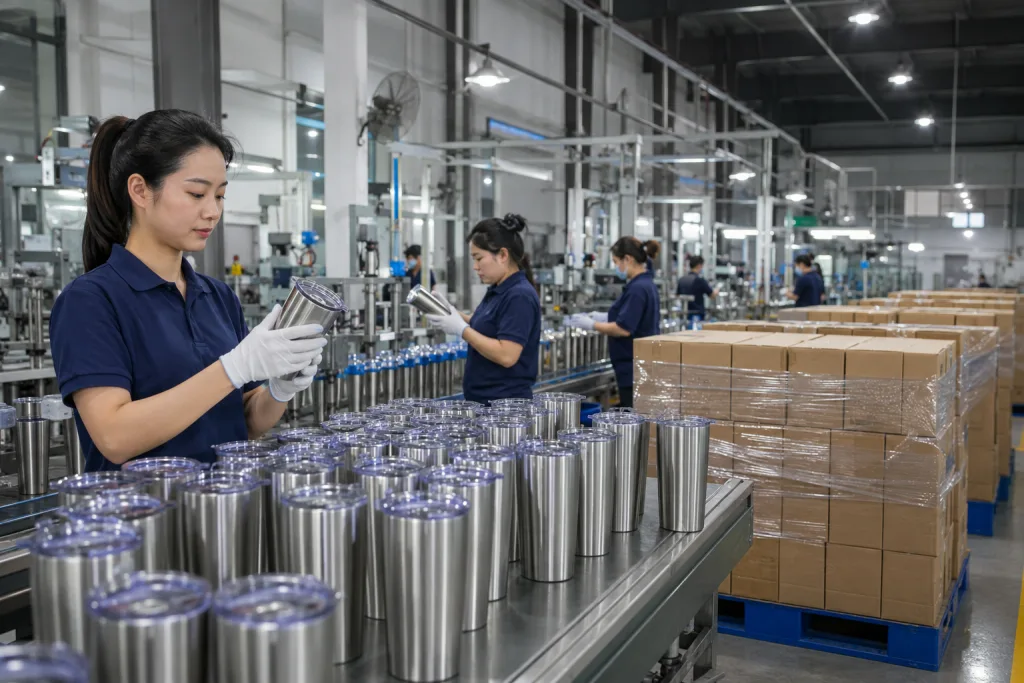
At our Zhejiang plant, we run into the same mistake every month. Buyers look at shape and logo area first; then the line starts and the real issues show up—lid leakage at a 45° tilt test, 24 pcs vs 36 pcs per carton, powder coat reject rate over 3%, or missing REACH paperwork on a PO with one model code typed wrong. If you are sourcing custom drinkware, custom canteen lines, or a customizable growler range, this is the wrong question to ask: “Which one looks best?” You need a straight spec-to-spec comparison, not brochure copy.
What Buyers Actually Compare
For B2B sourcing, the right comparison is not “which tumbler looks best.” Buyers compare which build fits the sales channel with the lowest total risk. A promotional insulated tumbler order for a distributor program is not built like a custom drinkware launch for retail shelves. We’ve seen buyers mix custom canteen, custom growler, and customized drinkware on one PO, then find the lid spec or carton size doesn’t line up. Match the spec to the use case first. That is the job.
Once sampling gets serious, most procurement teams narrow it this way. On our side, QC pulled the sample set after the second drop test, not after the hero photo looked nice.
- 20 oz straight tumbler: the safe volume for mass promotions. It packs cleanly, gives a bigger print window, and keeps tooling simple. On the line, this shape usually runs faster because the side wall is straight and the jig setup is easier.
- 30 oz handled travel tumbler: a better fit for lifestyle retail and premium gifting. Freight cost goes up, master cartons carry fewer pieces, and buyers flag lid leaks more often. We hear the same pushback: “Why is the complaint rate higher if the shelf price is higher?” Because the handle, lid, and straw set add failure points.
- 12-16 oz compact tumbler: a practical choice for office coffee programs and Europe-facing campaigns. Cupholder fit matters here, and so does smaller serving size. We often check the base diameter with a caliper before final sample approval because 2 mm can decide whether it works in a car console.
- Growler-style insulated bottle: stronger for outdoor bundles and beverage programs. Still, it behaves more like a customizable growler than a standard tumbler during carton testing and cap testing. The math doesn’t work if you price it like a straight tumbler but pack it in a taller insert with more headspace.
Quick spec table
- Body material: food-contact SS304 is standard; SS316 upgrade for tea, sports, and premium lines. We usually see SS316 requested on projects where the buyer already had 1 complaint batch on odor retention.
- Wall structure: double wall vacuum, 0.4/0.4 mm is common; 0.5 mm outer improves dent resistance. On factory floors, this shows up fast when a 12 kg carton gets bumped at the loading bay.
- Capacity tolerance: typically plus or minus 3%. We check fill volume during pre-shipment inspection, not just weight.
- MOQ: usually 1,000 pcs for existing molds, 3,000 pcs if mixed colors and custom packaging are involved. If the PO has 4 lid colors and 1,000 pcs total, this is the wrong question to ask.
- FOB Ningbo price: around USD 2.85-4.60 for a basic 20 oz vacuum tumbler, depending on lid, coating, and print method. A powder coat with silk print and a simple slider lid lands near the lower end; a tougher lid set with separate straw parts moves it up fast.
You do not need the heaviest spec. You need the spec that survives your channel with an acceptable landed cost and complaint rate.
If you work with a canteen distributor, distributor canteen importer, or canteen vendors managing 6 to 20 SKUs, standardization matters more on every reorder. The best canteen manufacturer or tumbler supplier is usually the one that keeps accessories, color matching, AQL control, and repeat production stable across 3 reorder cycles, not the one that wins one sample round. We’ve seen this go sideways over a PO typo on lid color code alone.
Straight Tumbler Versus Handled Tumbler
The clearest sourcing comparison here is straight body versus handled body. Buyers often treat the handled version as the “upgrade.” We don’t. It carries a different failure rate on the line, and that changes the buy decision.
- Straight tumbler advantages: lower FOB price, tighter carton loading, cleaner silkscreen setup on a flat body, fewer lid SKUs to manage, and fewer cosmetic rejects at final QC.
- Handled tumbler advantages: stronger shelf presence, better perceived value at retail, and easier daily carry for 30-40 oz formats where a full cup can add 0.9-1.2 kg in hand.
A straight 20 oz vacuum tumbler in China usually lands around USD 2.85-3.60 FOB for SS304 with a clear push lid and one-color silkscreen. A handled 30 oz travel tumbler with a rotating lid, straw set, and powder coat often moves to USD 4.80-6.90 FOB. The gap is not just steel weight. We see it in bigger body blanks, more lid parts, more carton cube, and more rework when QC pulled the sample and found handle alignment drifting 2-3 mm or powder coat marks near the weld point.
For promotional use, straight tumblers usually win when your main KPI is cost per impression. The math doesn't work if you pay handled-tumbler cost for a giveaway program with a tight CPA target. For loyalty campaigns, premium gift sets, and higher-AOV retail, handled models can earn the extra spend. Ask your canteen supplier or canteen factory one direct question: what is the complaint history by lid type over the last 12 months? Many canteen manufacturers and canteen suppliers can produce both shapes, but we’ve seen this go sideways when a factory runs body production well and still struggles with multi-part lid fit.
If your order mixes canteen custom programs with tumblers, a common move is to standardize coating colors across a custom canteen and tumbler family. It cuts color approval rounds and keeps your canteen customizable or canteen customized line consistent in one catalog. In Zhejiang factories with 600,000 units per month capacity, this usually saves 3-5 days in pre-production coordination when the Pantone and finish library is already qualified, especially if the line already has the same sandblasting reference panel and powder sample signed off.
Material, Gauge, and Thermal Reality
Thermal claims are where sourcing calls drift fast. Don’t let that happen. Ask four things: material grade, wall thickness, vacuum process, and test method. If a tumbler factory cannot answer those in 2 minutes, move on. We’ve seen buyers get a nice PDF and still miss the basic spec. On the line, QC usually checks wall thickness with a micrometer, not with sales language.
For most insulated tumbler promotional projects, the standard build is SS304 inner and outer with double-wall vacuum. Common body gauge is 0.4 mm inner and 0.4 mm outer. If the channel is club stores, campus bookstores, or rough distributor handling, 0.5 mm outer wall is a practical upgrade. It helps with dent resistance at the carton edge and around the base. Cost usually moves up by about USD 0.12-0.22 per unit, depending on size. Buyers sometimes push for 0.55 mm on low-price programs; the math doesn’t work unless you cut something else.
- SS304: the standard choice for custom drinkware, customized drinkware, and most canteen promotional projects. It is the grade we run on most 20 oz and 30 oz orders.
- SS316 inner wall: a better fit for acidic drinks, premium positioning, and some medical or outdoor channels. Expect a cost jump, and ask for the inner-wall spec on the PO because we have seen 316 typed in email and 304 printed on the order sheet.
- Copper coating in vacuum layer: it can improve heat retention, but ask if the factory applies it on bulk production or only on sampling units. This is the wrong question to skip. We have had buyers flag samples that held heat well, then bulk units came back weaker because the process was not matched.
A realistic test for a 20 oz tumbler is hot water filled to rated volume at around 95 degrees C, then measured after 6 and 12 hours. Good production-level performance is often 55-65 degrees C at 6 hours and 40-50 degrees C at 12 hours, depending on lid style and ambient conditions. That is the useful range to compare. Cold retention is easier, so do not get distracted by 24-hour ice claims alone. We ship plenty of lids with different leak paths, and a slide lid versus a screw lid can change the result more than buyers expect.
The same discipline applies if you are buying a customizable canteen, customized canteen, or customizable growler line. A customized growler with a wide mouth and metal cap may hold temperature differently from a narrow-mouth bottle. Ask for data by structure. One generic PDF for every SKU is not enough. A canteen manufacturer in China should separate results by body shape, mouth diameter, and lid system. In Zhejiang, factories sit close to lid suppliers, carton plants, and vacuum-processing shops, so unclear engineering data is usually a management issue, not a supply issue.
Decoration Choices Change Your Yield
Decoration is where unit price stops telling the full story. We have seen a “cheap” logo method turn into the expensive option after 3% rejects, rework on the line, and off-register prints that QC pulled at final inspection.
For insulated tumbler promotional orders, the common choices are silkscreen, heat transfer, laser engraving, digital print, and embossed or debossed packaging details instead of decorating the body itself. Each fits a different job. This is the wrong question to ask if you only compare add-on cost per piece; you need to compare shipped yield by method.
- Silkscreen: lowest cost for simple 1-2 color logos; typical add-on USD 0.08-0.22 per color per unit. Best on clean artwork with solid blocks and repeat positioning locked by fixture.
- Laser engraving: durable and clean on powder coat; usually USD 0.12-0.35 per unit. We run this with a rotary fixture, and the result stays stable if the powder coat thickness is controlled.
- Heat transfer: better for full-wrap graphics; often USD 0.25-0.60 per unit with higher setup control needs. The buyer usually wants photo graphics here, but a 1.5 mm shift at the seam gets flagged fast.
- Digital print: useful for short design complexity, but check dishwasher and abrasion expectations carefully. Good sample-room option, not always the right production option.
For promotional buyers, powder coat plus laser often gives the best balance of premium appearance and low complaint rate. The trade-off is color consistency and scratch sorting. On black, navy, or deep green powder coat, it is normal to see 2-4% more cosmetic sorting than on stainless or plain spray finishes. That matters when your AQL is 2.5/4.0 and your event deadline is fixed. We have seen this go sideways when the buyer approves a dark matte finish and then asks for zero visible hook marks under 600 lux inspection.
If you are also purchasing a canteen custom assortment, canteen customizable gift set, or a custom growler family, ask your canteen vendor whether the same decoration line handles all products. Shared process control usually means tighter logo position and fewer shade gaps across the set. If the tumbler is printed in-house and the growler is sent out, we often see lead time move to 12 days vs 18 days and more mismatch risk across a customized canteen and tumbler collection. One PO even came in with two spellings of the same color name, and that was enough to slow artwork signoff.
For North America retail and Amazon prep, barcode placement also matters. FNSKU labels, suffocation warnings, and master carton marks must be planned before print approval, not after production starts. This is basic, but first-time buyers still miss it. The buyer flagged cartons before because the barcode sat too close to a box edge radius, and scan reliability dropped. Check curvature, safe print area, and carton scan reliability before the line starts, not after 3,000 units are packed.
Use-Case Fit Beats Lowest FOB
The best spec starts with the selling channel and the actual use case. Lowest FOB alone is the wrong question to ask. A buyer thinking like a canteen distributor or a canteen distributors network manager usually buys better because they ask where failure costs more—leaks at a school canteen, dents at retail, or logo complaints at a corporate event. On our line, QC pulled a sample last month with a lid torque reading 0.4 N·m under target; that kind of miss is cheap at packing and expensive after delivery.
Corporate gifting and events
For this channel, we usually run a 20 oz straight tumbler, SS304, standard push lid, powder coat or satin spray, and laser logo. Keep packaging simple: white box, barcode label, master carton that still loads cleanly at 1,000-2,000 pcs. Target FOB USD 3.10-4.20 and MOQ 1,000-2,000 pcs. The logo area is generous, carton efficiency is solid, and the line runs faster on straight bodies than on shaped mugs. Buyers push for gift-box upgrades here, but the math often doesn’t work unless the event budget supports it.
Retail and lifestyle chains
Retail needs a shape that stands out on shelf, usually a 30 oz handled body or a premium 16 oz commuter shape. We often bump the outer gauge by 0.1 mm or upgrade the lid feel because shoppers judge the product in 3 seconds by hand feel and thread engagement. Plan ASTM and CPSIA checks if youth-oriented graphics are involved. We’ve seen this go sideways: one cheap lid saved a few cents, then returns ate the margin in one month.
Outdoor and beverage programs
If your line extends into custom canteen or custom growler items, keep cap thread systems and colors aligned across SKUs so replenishment stays clean. A customizable growler or distributor growler program needs tougher leak and drop checks than a desk tumbler; we ship these only after strap, handle, and weld area inspections are passed. On the factory floor, the weld bead around the handle base is one of the first spots QC checks after drop test review.
Distributor and importer bulk programs
For distributor canteen, distributor growler, or broad canteen promotional catalogs, trim the range hard. Two body sizes. Four stock colors. Two decoration methods. That is enough for most programs, and we’ve seen buyers regret trying to run 18 SKUs off the same forecast sheet after one PO typo mixed matte black with black pearl. Extra variation raises dead stock risk and slows replenishment on the next order.
A good canteen factory or canteen manufacturer in China should cut the matrix down, not keep adding variants. Practical factories know SKU discipline protects repeat orders. On our side, once the mold list, color chips, and print positions go past one control sheet, the chance of packing errors starts climbing.
Supplier Questions That Prevent Rework
Call them a canteen supplier, canteen factory, canteen manufacturer, or custom drinkware partner—the title is not the point. Ask for proof. We’ve seen buyers lose 12 days because a factory said “ok” on the call and sent no records after. Start with documents, sample photos, and one clear process sheet.
- Quality system: Do you inspect to AQL 2.5/4.0 or another agreed standard? Is there 100% vacuum test or sampling only?
- Compliance: Can you provide REACH, LFGB, FDA, Prop 65, and stainless steel composition reports by model?
- Social and process audits: Do you have BSCI, ISO 9001, or Sedex if my customer requires it?
- Lead time: What is sample lead time, bulk lead time, and delay risk during peak Q3 season?
- Packaging control: Can you do drop-tested mailer packs, color boxes, PDQ trays, or Amazon carton limits?
A serious Zhejiang supplier answers with files and numbers, not sales talk. A normal reply looks like this: 7-10 days for pre-production sample, 35-45 days for normal bulk, 45-60 days in peak season; MOQ 1,000 pcs for stock mold; monthly output 500,000-800,000 units depending on season and decoration complexity. QC pulled the sample, the vacuum tester passed, the carton drop test was done from 76 cm, and the report is ready to send. Those numbers mean something. “No problem” means nothing.
If you also manage canteen customized or canteen customizable lines, confirm whether the supplier controls cap molding, painting, and final assembly in-house or through nearby partners in China. This is where projects slip. On the line, a color delta over 1.0 or a lid leak at the silicone seat turns into a blame game fast, and the buyer flagged it on us more than once before we tightened supplier mapping. Vertical control affects schedule accuracy. It also decides who owns the mess when color mismatch or leakage shows up.
The best supplier is not the one who says yes fastest. It is the one who tells you where the project can fail before PO placement.
This matters more for canteen distributors and canteen vendors selling under private label. Your end customer will count every defect as yours. Not the factory’s. That is why “who fixes it if 3% leaks after filling” is a better question than “can you make this bottle?”
Send your spec sheet and target price
We will review body style, lid risk, compliance needs, MOQ, and FOB options for your insulated tumbler promotional project within one working day.
Frequently asked questions
What MOQ should I expect for insulated tumbler promotional orders?
For an existing mold, a realistic MOQ is 1,000 pcs per model, often with 250-500 pcs per color if the finish is standard. If you need a custom color box, multiple logo positions, or special powder coat, many China factories will push the practical MOQ to 2,000-3,000 pcs. New tooling for lids or body changes usually starts much higher. In Zhejiang, buyers combining a tumbler with a custom canteen or customized drinkware family can sometimes share packaging or coating runs to keep MOQs manageable. Ask whether the MOQ is based on body production, color coating, or packaging print, because those are not always the same limit.
How do I choose between 304 and 316 stainless steel?
For most promotional and distributor drinkware business, SS304 is enough. It is the standard choice for insulated tumblers, custom canteen products, and most customized drinkware because it balances corrosion resistance, availability, and cost. SS316 is worth considering when the product will be marketed as premium, used with acidic beverages, or sold into outdoor and medical-adjacent channels. The common cost increase is about USD 0.25-0.60 per unit depending on size and steel market conditions. Do not upgrade blindly. Ask for material certificates and the exact configuration, because some canteen manufacturers offer 316 inner wall only, which is usually the most cost-effective option.
What quality tests matter most before mass production?
Three tests catch most trouble early: vacuum retention, leakage, and coating adhesion. For vacuum, ask for hot water data at 6 and 12 hours, not just an ice claim. For leakage, require upside-down and side-lay tests for at least 24 hours using the final lid and straw configuration. For coating, cross-hatch adhesion and abrasion checks matter if you use powder coat or rubber finish. Also confirm AQL levels, usually 2.5 for major defects and 4.0 for minor defects, plus whether vacuum testing is 100% or sampling only. If your item is a customizable growler or custom canteen with a different cap system, ask for separate test results by model.
How long does production usually take from sample approval?
After artwork and pre-production sample approval, normal bulk lead time is about 35-45 days for standard insulated tumblers in China. Sampling usually takes 7-10 days if you use an existing mold and standard finish. If you add custom packaging, outsourced heat transfer, or peak-season booking, 45-60 days is safer. Buyers working with a canteen supplier in Zhejiang often gain a little schedule stability because lid parts, cartons, and decoration partners are clustered locally. Still, do not rely on verbal promises. Put milestone dates in the PO: sample approval, material arrival, first article, final inspection, and ex-factory date.
Is a tumbler or canteen better for promotional programs?
It depends on use case. A tumbler usually performs better for office, commuting, trade show gifts, and broad corporate programs because the logo area is larger and the perceived value is strong at a moderate FOB cost, often around USD 3-4.50. A custom canteen works better for sports, schools, outdoor, and hydration-focused campaigns where portability matters more than desk use. If you are a canteen distributor or run a mixed catalog, the strongest approach is often one tumbler plus one canteen customized style sharing the same coating colors and branding rules. That keeps your line consistent while covering two very different buyer needs.