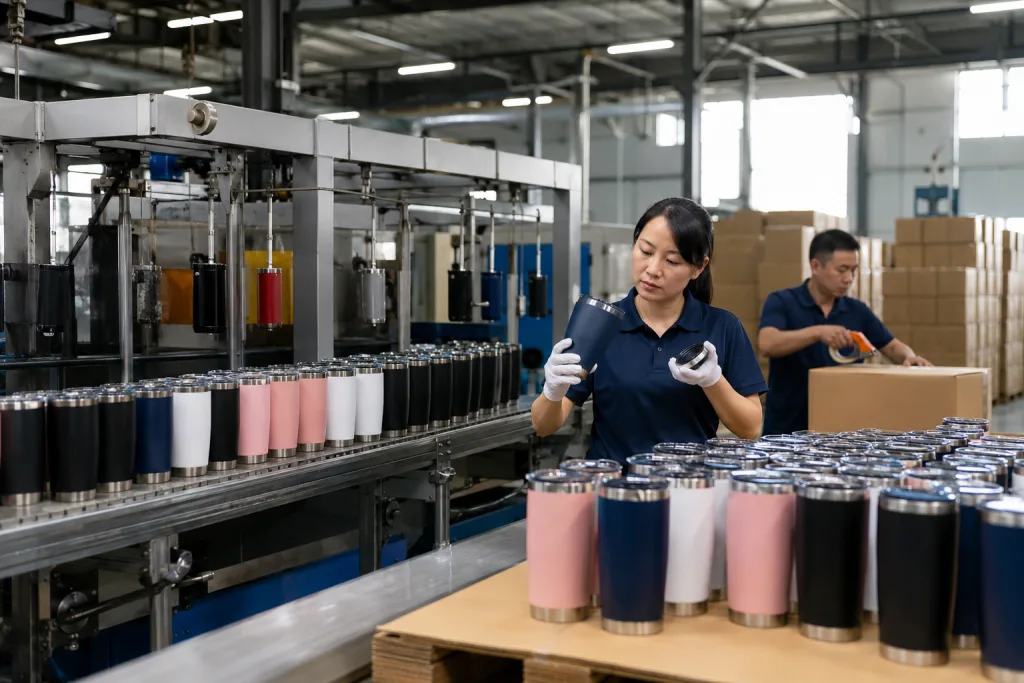
Key Takeaways
- Most insulated tumbler private label programs start at 1,000-3,000 pcs per color, with 30-45 day lead time from Zhejiang, China
- 18/8 stainless steel with 0.4-0.5 mm inner and outer walls is the practical baseline for retail-grade vacuum tumblers
- Powder coating usually adds USD 0.18-0.45 per unit, while laser marking often costs USD 0.05-0.12 less than multi-color screen print
- AQL 2.5 for major defects and 4.0 for minor defects is a sensible inspection level before final balance payment
You can buy an insulated tumbler from almost any canteen factory in China. Easy part. The harder job is locking a private label spec that hits your target price, survives a 1.2 m drop test, clears compliance in Europe or North America, and does not come back as a warranty claim 6 months later because the lid thread was off by 0.3 mm. We have seen this go sideways.
If you are sourcing custom drinkware for retail, gifting, subscription boxes, or a distributor drinkware program, you need a cleaner comparison method. A 20 oz tumbler with a handle, a 30 oz travel format, and a 12 oz slim design may look close on a quote sheet, especially when the buyer flagged only FOB price. The math does not work that way. Tooling cost, lid leak risk, decoration yield, carton efficiency, and margin profile change fast from one model to the next. QC pulled samples like this on the line last month. A head-to-head spec review shows the gap before you place MOQ 3,000 and find a typo on the PO or the wrong lid fit after production.
Start with the spec table
If you are buying insulated tumbler private label, skip the color cards and mockups at the start. Build a spec table first. That is the only clean way to compare one canteen supplier against another canteen factory or canteen vendor in Zhejiang or other parts of China. We run quotes this way on the line because one missing detail—like lid type or wall thickness in mm—throws the whole price comparison off. A practical head-to-head view is below.
- 12 oz slim tumbler: 304 SS double wall vacuum, 0.4/0.4 mm wall, push lid, net weight 240-280 g, MOQ 3,000 pcs, FOB USD 2.60-3.30. Best for gift sets and cafe merchandise. Freight stays lower.
- 20 oz straight tumbler: 304 SS double wall vacuum, 0.4/0.4 or 0.5/0.4 mm, slider lid, 280-340 g, MOQ 2,000 pcs, FOB USD 3.10-4.20. Best all-round option for customized drinkware retail and corporate orders. This is the size most buyers start with.
- 30 oz travel tumbler with handle: 304 SS double wall vacuum, 0.5/0.5 mm recommended, screw lid plus straw, 430-580 g, MOQ 1,000-2,000 pcs, FOB USD 4.80-6.80. Best for trend-driven retail and high ticket online sales. We have seen buyers push 0.4 mm here, and the math doesn't work.
- 40 oz handled tumbler: 304 SS, vacuum, 0.5/0.5 mm, 520-700 g, MOQ 1,000 pcs, FOB USD 5.60-8.20. Strong for promotional campaigns and lifestyle channels, but shipping volume matters. One carton dimension change by 8 mm can cut loading qty.
The cheapest offer is rarely the best one. A tumbler quoted at USD 0.35 lower can lose that saving fast through slower line speed, decoration rejects, or a weak lid gasket that triggers claims after shipment. QC pulled the sample on one order last season and found the gasket hardness was off, which explained the leakage complaint. BottleForge Industrial in Hangzhou, Zhejiang runs around 500,000 units per month across bottles, tumblers, and canteen custom projects, and the same lesson repeats: profit sits in the full landed result, not only the ex-factory unit price.
Which format fits your channel
The right tumbler starts with the channel, not the trend chart. Buyers ask for one hero SKU all the time. That is the wrong question to ask. We’ve seen a copied best-seller stall in 60 days because the user case was off, while a plain 20 oz sold through cleanly. On the line, QC pulled a sample last month where the base OD was 72.4 mm instead of the target cupholder range, and that one detail mattered more than the color.
Retail shelf and DTC
A 20 oz straight body is still the safest first SKU. We ship this format every week because the FOB math works, the print area is easy to use, and the silhouette reads fast on shelf. For DTC, it also packs without drama. If you are a canteen distributor, or one of several canteen distributors building a seasonal line, this size usually brings fewer returns because the lid fit and base geometry are steady. We run leak checks with a vacuum jig, and the straight-wall body gives the line fewer surprises than tapered shapes.
Corporate gifting and canteen promotional orders
For a canteen promotional brief, lighter units usually win on cost. A 12 oz or 16 oz tumbler cuts courier charges and drops into a gift box with less dead space; a 20 oz often forces a bigger insert and the math doesn’t work. Logo size matters more than adding 4 oz of capacity. Buyers push back on this, then approve the smaller size after seeing carton count. If the client wants a custom canteen look without paying for new tooling, slim tumblers and standard travel mugs are the practical compromise. Last season, the buyer flagged a PO typo on box size, and that 8 mm mismatch would have held the packout.
Outdoor and hydration crossover
When your buyer searches for canteen customizable options, they sometimes want a hybrid line instead: tumbler plus bottle, with a custom growler in the same visual family. In that case, pick a coating and lid finish that carry across customized canteen and customizable growler items from the same canteen manufacturer. Shared finishes cut SKU confusion, and they also make reorder matching easier because the line runs one powder recipe and one gloss target. We’ve seen this go sideways when a matte black tumbler gets paired with a semi-gloss bottle cap from a second vendor.
Use-case fit decides the spec. Cupholder diameter, one-hand lid use, gift-box size, or max beverage volume should be settled before artwork, not after.
If you supply Amazon FBA, larger handled tumblers can sell well, but dimensional weight and FNSKU relabel handling need to be priced on day one. A 40 oz with handle looks strong online, then lands in prep with extra label labor and oversize freight. For club stores or mass retail, the 20 oz and 30 oz range usually packs better and keeps carton drop performance under control. We test master cartons on the floor, and once gross weight creeps past about 14 kg, damage claims start showing up faster.
Materials, walls, and thermal truth
New buyers fixate on “keeps hot 12 hours, cold 24 hours.” That claim alone tells you little. Ask how the tumbler is built, what steel is used, and what QC pulled on the sample after the hot-water test.
- Material: 18/8 stainless steel, also called SUS304, is the standard for food-contact interior and exterior. Some low-cost factories quote 201 on the outside to save a few cents per unit. We’ve run those budget programs. They work for short-cycle promos, but for Europe and North America, 304/304 is the safer long-term spec, especially once the buyer flagged rust spots after salt-spray storage.
- Wall thickness: 0.4 mm inner and 0.4 mm outer is common for mainstream tumblers. For larger handled formats, 0.5 mm outer wall gives better rigidity and dent resistance on the line and in carton drop tests. If a canteen factory quotes an unusually low weight, check whether the wall has been thinned; we’ve seen 30 oz bodies come in 18-25 g light, and that usually shows up later as sidewall dents.
- Vacuum performance: Real vacuum retention comes from copper coating, steady vacuum level, weld quality, and lid design. This is the wrong question to ask if you only want an hours claim on a sell sheet. A good 20 oz tumbler should keep the outer wall stable in a hot-water fill test, and QC should not see a clear heat ring around the bottom weld under a simple IR thermometer check.
- Lids: Press-fit slider lids are cheap and fast to assemble, but they are not leakproof. Buyers still ask for “100% no leak” on this lid style, and the math doesn’t work. Screw lids with silicone seals improve leak resistance and are worth the added USD 0.25-0.60 if your channel includes commuting, backpacks, or kids tossing the bottle into a tote.
If you are comparing canteen suppliers in China, ask for test protocols, not just claims. We ship samples with the protocol sheet for a reason. For compliance, REACH, LFGB where needed, FDA food-contact declarations, and California Proposition 65 screening are normal document requests. For children’s formats, ASTM and CPSIA relevance goes up fast, especially on straw parts and small-component checks. For social compliance, plenty of buyers ask whether the canteen manufacturer or canteen vendors on the shortlist have BSCI or similar audit coverage, and yes, they will ask again before PO release if the audit expires within 3 months.
There is no universal best spec. There is only the spec that matches your target retail price, defect tolerance, and shipping route. A heavy 40 oz tumbler feels premium in hand, but freight is blunt; one extra 80-120 g per unit hits harder once you load 1,000 pcs per pallet. If your market needs a USD 14.99 shelf price, we’ve seen this go sideways fast, and the buyer usually comes back to a lighter customized canteen or a 20 oz tumbler line after the first landed-cost sheet.
Decoration methods compared honestly
Private label margin is usually built with decoration, not by redesigning the bottle body. The real question is simpler: what fits your MOQ, artwork file, and complaint risk. We’ve seen buyers spend 3 weeks debating lid shape, then the PO had the logo width typed wrong by 2 mm.
- Silkscreen print: Lowest setup burden for 1-color or 2-color logos. Typical add-on cost USD 0.08-0.20 per color per position. Best fit for simple marks and big runs where the line needs speed. We run this a lot for canteen promotional orders and distributor canteen programs. Weak point: scratch resistance is lower than laser or baked transfers. On press, screen tension and fixture position matter; QC pulled the sample last month because one logo drifted 1.5 mm on a 5,000-pc run.
- Laser engraving: Usually USD 0.10-0.25 depending on area. Cleaner for premium logos. No color registration issue. Fewer print rejects. Best on powder-coated surfaces where the stainless contrast is sharp. If the powder coat thickness is off, the burn tone changes, so we check that before mass production. Buyer pushback is common on large engraved areas because the math doesn’t work at low price targets.
- Heat transfer or water transfer: Good for full-wrap graphics and seasonal retail. Add roughly USD 0.25-0.60 per unit. Reject risk is higher because alignment and color consistency are harder over curved bodies. This is where projects go sideways fast. On 20 oz tumblers, seam position and body taper make full-wrap approval harder than most buyers expect, and QC usually watches the overlap line first.
- Powder coating: Not decoration by itself, but it changes the perceived value fast. Expect USD 0.18-0.45 depending on finish and color. Matte powder is forgiving. Metallic and rubber finishes need stricter process control. We check coating feel, color lot match, and cure condition on the line; under-cured rubber finish gets flagged almost immediately in carton rub tests.
If you are a canteen supplier or distributor growler buyer building a broad catalog, standardize decoration where possible. Same logo treatment across a customizable canteen, customized growler, and tumbler range looks tighter on the shelf and cuts approval rounds from 3 to 1 in some programs. Ask for Pantone tolerance, adhesion test standard, and whether the factory performs tape tests and dishwasher simulation for printed products. This is the right question to ask. We ship faster when those standards are fixed before sampling.
Do not over-spec the artwork. A low-margin campaign item does not need three decoration processes. For many B2B buyers, the right answer is powder coat plus laser. It is durable, easy to approve, and scales well from 1,000 pcs to 20,000 pcs. We’ve seen this combo hold up better in carton drop and handle packing than mixed print methods. If a canteen vendor promises photographic wrap quality on a low budget and short lead time, assume the reject rate or the finish stability will disappoint you. Short version: 12 days with powder coat plus laser is normal; 18 days with wrap graphics and rework is common.
MOQ, tooling, and cost traps
Most buyers ask about MOQ first. Fewer ask what drives it on the line. That is where projects slip, and we've seen this go sideways after a PO is already stamped.
For standard body shapes from a canteen manufacturer in Zhejiang, MOQ usually comes from coating color, lid color, and packaging setup, not steel forming. On our floor, the hydroforming set is already there; the extra cost starts when the buyer wants a Pantone body, a custom lid shot, or a 5 mm EPE fit tweak. A realistic private label starting point is:
- Existing mold, standard lid, stock carton: 1,000-2,000 pcs
- Custom color body plus private label box: 2,000-3,000 pcs
- New lid mold or custom handle part: tooling from USD 2,000-8,000, plus 45-60 days development
If you are talking to multiple canteen manufacturers or canteen suppliers, split the quote bucket by bucket: unit price, decoration details, packaging spec, mold cost, carton drop test compliance, spare lid policy. This is the wrong question to ask: “What is your best FOB price?” A unit quote without packaging specs is incomplete. We ship cases where a colorful mailer box adds USD 0.35-0.90, and an EPE insert or molded pulp adds another USD 0.12-0.40. QC pulled the sample on one order last month because the box corner crushed at the first drop, and the math didn't work without the insert.
For custom growler and customizable growler programs, tooling goes up faster because cap fitment and neck dimensions need tighter control. A 0.3 mm neck tolerance can decide whether the cap seals or leaks. For tumblers, the hidden trap is usually accessories: straws, handle parts, boot sleeves. Those parts often push lead time from 12 days to 18 days on sub-supply because they come from different canteen vendors in China, and the buyer flagged color mismatch more than once on silicone boots.
Lead time from deposit to shipment is usually 30-45 days for repeat orders, 35-55 days for new artwork and packaging, and longer in peak season before Q4. If your launch date is fixed, book the production slot before artwork is perfect. We run line allocation first, then lock print approvals during pre-production sampling. Last season, one PO even came in with the lid code typoed, and catching that before mass print saved 18 days.
Quality control before you scale
A tumbler can pass the sales sample and still fail on the line at volume. We see it often. Your QC plan has to cover the claims buyers get billed for in real orders: leaks after a 45° tilt test, dents from poor nest packing, color shift between batches, missing straws, and export cartons crushed at the bottom layer.
A practical inspection standard for insulated tumbler private label is AQL 2.5 major / 4.0 minor. For mainstream retail, this is usually the right line to hold; tighter on a first order and the math doesn't work. Your inspection checklist should include:
- Vacuum retention spot test on sampled units
- Lid fit and leak test at defined fill level and angle
- Coating adhesion and color comparison against approved swatch
- Laser or print position within agreed tolerance, often plus or minus 2 mm
- Weight check, barcode scan, carton mark verification
- Drop test or transit simulation for packaged goods
If you are a canteen distributor, canteen supplier, or distributor growler buyer managing multiple importers, insist on a golden sample signed against the production PO. Put the full pack on that sample: body finish, lid, straw if any, logo size, carton mark, inner tray or polybag. QC pulled a sample last month where the PO said “matte black” but the approved unit was fine sand powder coat; without the signed sample, that argument goes nowhere.
Factory paperwork matters. Ask if the site runs ISO-based process control, has BSCI or equivalent audit status if your program requires it, and can trace raw material by lot. For Europe, request REACH-related declarations early, before labels and manuals go to print. For North America, line up food-contact documents before final payment. This is normal in China. If a canteen factory team drags on basic lot traceability for 304 stainless, we've seen this go sideways.
The first order is where you learn the real defect pattern. Keep the first run manageable, maybe 1,000-3,000 pcs across one or two colors, so QC can isolate issues by shift and carton lot. Then scale. Once leak rate, coating adhesion, and pack-out are stable, you can ship wider canteen customized or customized drinkware assortments with less risk and fewer chargebacks.
Compare your tumbler spec before you commit
Send your target price, capacity, market, and artwork plan. We will recommend a workable private label tumbler spec with MOQ, lead time, and QC checkpoints.
Frequently asked questions
What MOQ should I expect for insulated tumbler private label?
For a standard tumbler body using an existing mold, expect 1,000-3,000 pcs per color or design. A simple 20 oz tumbler with one laser logo and brown master carton can often start at 1,000-2,000 pcs. If you add a custom retail box, mixed lid colors, or a new handle component, MOQ usually moves toward 2,000-3,000 pcs and lead time extends by 5-10 days. New tooling for a custom lid or body can cost USD 2,000-8,000 depending on complexity. In Zhejiang, China, many factories will sample faster than they can produce packaging, so always confirm whether MOQ is based on steel body production, coating color, or printed box quantity.
How do I compare quotes from different canteen suppliers fairly?
Use one fixed RFQ sheet and force each canteen supplier to fill the same fields: capacity, wall thickness, steel grade, lid type, unit weight, decoration method, packaging spec, MOQ, tooling, test documents, FOB port, and lead time. Ask whether the quote includes 304 inside and outside, or 304 inside with 201 outside. Clarify if powder coating, logo setup, and barcode labels are included. Require carton dimensions and gross weight so you can compare freight, not only FOB price. A tumbler that is USD 0.20 cheaper but 12% bulkier can lose its price advantage after ocean freight and warehouse handling. Also compare defect policy, spare parts support, and inspection standard such as AQL 2.5/4.0.
Which tumbler size is safest for a first private label order?
For most B2B buyers, the safest first SKU is a 20 oz straight insulated tumbler. It usually lands in the USD 3.10-4.20 FOB range from China depending on finish and lid, has broad logo area, and packs more efficiently than large handled formats. The lid system is also simpler, which means fewer leak claims. A 30 oz or 40 oz handled tumbler can sell very well, but it brings higher freight cost, more accessory risk, and greater carton volume. If you are testing a new market, start with 1,000-2,000 pcs of a proven 20 oz model in one or two powder-coat colors, then add larger formats after you confirm sell-through and customer feedback.
What compliance documents should I ask a canteen manufacturer for?
For Europe and North America, ask for food-contact declarations tied to the materials used, plus REACH-related declarations and LFGB if your market requests it. Many buyers also ask for California Proposition 65 screening for the US market. If the product is aimed at children, CPSIA and ASTM-related checks may apply depending on design and age claim. Social compliance requests often include BSCI or similar audit reports. You should also request stainless steel material statements, coating information, and test records for lid components. The key point is timing: ask for these documents before mass production, not after the cargo is ready. If a China factory needs 7-10 days to gather test files, that delay can easily push your vessel booking.
How long does production take for custom drinkware from China?
A realistic lead time for custom drinkware is 30-45 days after deposit and final sample approval for standard repeatable models. If you need new packaging, multiple colors, or accessory sourcing, plan 35-55 days. New tooling can add 45-60 days for development and validation before mass production even starts. During peak season, especially before Q4, line booking becomes the bottleneck, not printing. That is why experienced buyers reserve capacity early with a clear forecast. For shipments from Zhejiang, China, leave time for inspection, export carton rework if needed, and vessel booking. If your order is for Amazon FBA, add extra days for FNSKU labeling, pallet rules, and carton compliance checks.