Key Takeaways
- For most 20 oz to 40 oz tumblers, practical OEM MOQ is 1,000-3,000 pcs per SKU, while custom color plus private mold usually starts closer to 3,000-5,000 pcs
- A realistic bulk lead time from Zhejiang, China is 25-45 days after sample approval and deposit, not counting peak-season congestion
- 304 stainless inner and outer is standard for premium tumblers; heat retention claims should be verified with a 6-12 hour test protocol and AQL inspection
- Decoration cost can change landed price by USD 0.20-1.20 per unit depending on silkscreen, laser, powder coat, wrap, and retail packaging complexity
You are not buying a sample for your desk. You are buying a production system: steel grade, vacuum performance, decoration yield, carton drop resistance, and a factory that still ships on time when your forecast moves in week 5. This is where buyers get stuck with an insulated tumbler OEM manufacturer. The showroom cup looks clean, then 10,000 units land with weak color adhesion, mixed lids on the packing line, or outer cartons that fail Amazon FBA prep after a 76 cm drop test. We’ve seen this go sideways.
At BottleForge Industrial in Hangzhou, Zhejiang, China, we hear the same questions from buyers in Europe and North America. MOQ, compliance, tooling, and what actually moves cost. Last month, QC pulled the sample because the PO listed a black lid in one line and a smoke lid in the next; that small typo turns into a full rework if nobody catches it before mass production. Whether you also source custom canteen, custom growler, or broader custom drinkware lines, the right evaluation method is practical, measurable, and tied to the line. This is the wrong purchase to judge by sample appearance alone.
What are you really buying?
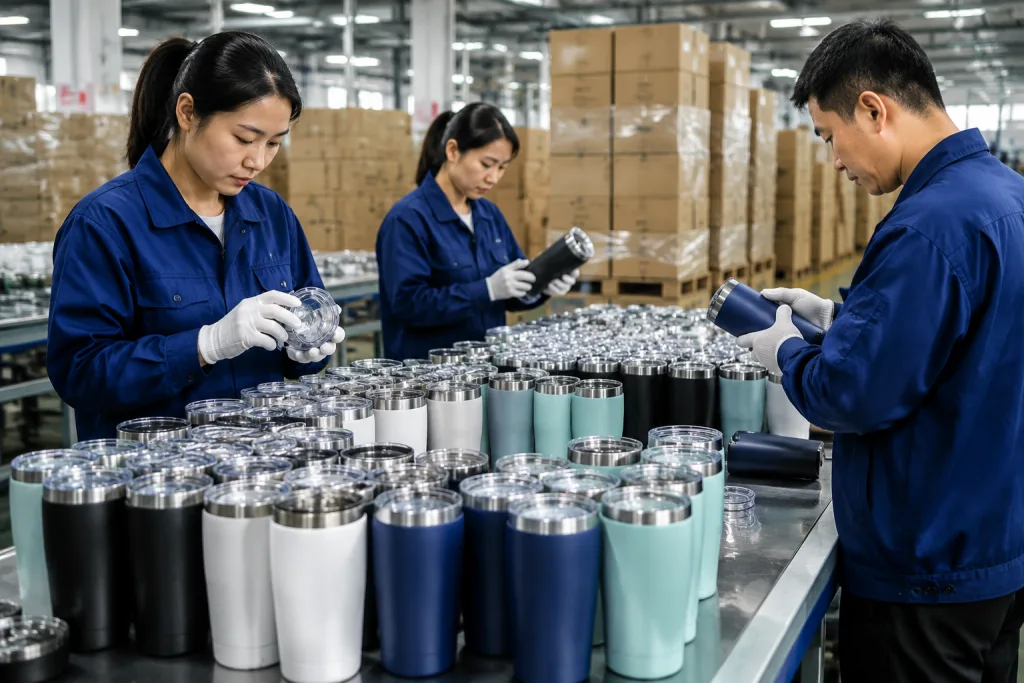
Ask an insulated tumbler OEM manufacturer for a quote, and you are buying more than a cup. You are buying process control on the line. One tumbler program usually runs through tube cutting, neck shaping, seam welding, vacuuming, leak test, coating, logo printing, lid assembly, packing, and final inspection. QC pulled the sample after the vacuum station more than once because one weak weld blew the heat-retention result. One loose step, and your claim rate climbs.
For B2B buyers, “best price” is the wrong first question. Ask which parts of the SKU are standard and which need new tooling, handwork, or carry higher scrap risk. A standard 30 oz travel tumbler with 304 stainless steel, double-wall vacuum, powder coat, and one-color silkscreen is routine for most factories. We run that kind of item every week. A canteen customized with a new shoulder curve, soft-touch coating, dual-function lid, and gift box puts pressure on mold cost, assembly time, and packing yield. We have seen buyers send a PO with the lid code typed wrong by one digit, and the whole approval loop lost 3 days.
- Body material: 18/8 stainless steel, commonly called 304, is the usual export grade.
- Wall structure: double-wall vacuum for hot/cold retention; single-wall should only be selected for budget promotional use.
- Typical thickness: around 0.4-0.5 mm inner wall and 0.45-0.6 mm outer wall depending on model.
- Leak risk points: lid threads, silicone gasket fit, straw opening, and weld consistency.
If you also source customizable drinkware beyond tumblers, the same rule still applies. A customizable canteen, customized growler, or custom growler needs a clear split between stock parts and true OEM parts. A serious canteen factory or canteen manufacturer should state it plainly: stock modification, semi-custom project, or full custom mold. That call drives MOQ, development time, and defect risk. The math does not work if a buyer expects stock-item speed on a full custom body. We ship stock-modified orders in one cycle; a new mold project can add 12 days vs 18 days depending on sample approval and whether QC finds fit issues on the first lid-gasket test.
How do you screen a factory fast?
You do not need 40 questions on day one. You need six answers. They tell you fast whether the supplier can run your program or just quote it. In Zhejiang, we still see trading companies using workshop photos and calling themselves factories. Some do a decent job, but ask early who owns the line, who packs the goods, and who issues the inspection report before you wire a deposit. We usually ask for one shop-floor photo with the hydrotest station or powder coating conveyor in frame. That clears up a lot in 10 minutes.
Use this short screening checklist
- Capacity: ask for a real monthly range. A capable plant should state something like 300,000-500,000 units/month for insulated drinkware, not “unlimited.” If they run 3 body-forming lines and 2 packing lines, they should be able to say so.
- MOQ by finish: stock color, custom Pantone powder coat, laser engraving, printed wrap, and gift box should each have separate MOQs. This is where buyers get burned. A 1,000 pcs tumbler MOQ does not mean 1,000 pcs for a custom wrap box with a 5-color print.
- Audit and systems: BSCI, ISO 9001, or similar quality system records matter more than polished brochures. Ask to see the latest report date, not just the logo on page one. We have seen expired certificates attached to a fresh quotation.
- Compliance experience: ask about REACH, LFGB, FDA-contact materials, and ASTM testing if kids' use is involved. If they cannot tell you which lid parts touch liquid or which silicone grade they run, the answer is not ready.
- Inspection method: they should know AQL 2.5/4.0 and how they handle incoming, in-line, and final inspections. Ask what QC pulled on the last order: coating adhesion, vacuum retention, leak test, or carton drop. If they answer with “we inspect before shipment,” that is the wrong question answered.
- Export execution: ask whether they support FOB, EXW, carton barcodes, FNSKU labeling, pallet specs, and drop-test packaging. One buyer flagged a 2 mm barcode quiet-zone issue after arrival, so now we check carton artwork against the PO before mass print.
At BottleForge Industrial, our practical MOQ for many tumbler styles starts at 1,000 pcs per color with standard lids, and bulk lead time is usually 30-40 days after deposit and approved pre-production sample. That is the level of answer you want from any canteen supplier or canteen vendors you screen. Not “fast delivery.” Not “best price.” Give me numbers, lid options, and whether the line is free this month.
A supplier who cannot separate sample capability from mass production capability is a risk, even if the sample looks excellent.
This matters if you are building a wider range for a canteen distributor, distributor drinkware account, or distributor growler channel. We have seen this go sideways. A factory can be strong on tumblers and weak on custom canteen or customizable growler packaging, especially where molded inserts, mailer strength, or 6-drop carton testing are involved. Screen by process, not by catalog size.
MOQ, tooling, and price pressure
Most price fights in drinkware start with a scope mismatch. The buyer says “custom tumbler” and means logo on an existing body; the factory reads it as new shape, new lid, new carton, plus straws or a boot. Those are different products on the line. We’ve seen POs with “same as sample” typed in, then the buyer flagged a custom insert and Pantone box after sampling. MOQ and unit price mean nothing until the scope is locked.
For insulated tumbler programs, these ranges are common:
- Existing mold + stock finish + simple logo: 500-1,000 pcs may be possible, but 1,000 pcs is more realistic for stable production.
- Existing mold + custom Pantone powder coat + custom box: usually 1,000-3,000 pcs per SKU.
- New mold or major lid change: often 3,000-5,000 pcs minimum plus tooling cost.
- Private label e-commerce prep: MOQ may be low, but packaging labor increases unit cost.
Typical FOB pricing from China can vary widely. As a trade reference, a standard 20 oz or 30 oz vacuum tumbler in 304 stainless with powder coat and simple one-position print may land in the USD 3.20-6.80 FOB range depending on size, lid style, coating, and order quantity. The spread is big for a reason. A narrow-body 20 oz with a stock slider lid runs differently from a 30 oz with a handle lid, and QC pulled samples before over a 0.3 mm print shift that added rework cost. Premium handles, electroplating, full-wrap print, or gift-ready inserts can add USD 0.40-1.50.
Ask your canteen supplier or canteen vendors for a cost breakout. This is the right question. You do not need every internal number, but you do need to know what changed the quote and by how much. If the price moved USD 0.38, say where it came from. On our side, we usually split it by body, lid, decoration, packaging, and freight-loading impact.
- new lid mold amortization
- powder coat color matching surcharge
- laser vs silkscreen decoration delta
- individual polybag or kraft wrap
- master carton count change from 24 pcs to 12 pcs
This applies across custom drinkware lines too. A customized canteen, custom growler, or canteen promotional program may look simple on paper, then the math doesn’t work because of accessory packs, low carton efficiency, or decoration scrap above 3%. We ship plenty of “easy” programs that turned expensive after a boot, hangtag, and cleaning brush were added. Good canteen manufacturers say this early, not after deposit.
Samples, drawings, and approval traps
A clean sample process saves lead time. We've seen a loose sample flow turn into an 18-day argument after shipment: our side said bulk matched the signed sample, the buyer flagged that the sample was hand-finished and never reflected the line. Approve more than looks. That is the point.
For a serious OEM program, use three sample stages when needed:
- Reference sample: confirms size, hand feel, and rough structure. On our bench, this is often a quick check with calipers and a basic lid fit test, not a final cosmetic standard.
- Pre-production sample: confirms final color, logo file, lid, and retail packaging. QC pulled the sample here to verify Pantone callout, print position in mm, and carton drop notes before bulk starts.
- Golden sample: retained by both sides as the shipment standard. Seal it, date it, and mark the PO number; we once saw a single digit typo on a PO send the wrong lid version into approval.
Your approval file should include exact capacity tolerance, weight tolerance, finish code, logo position, barcode format, carton marks, and test requirements. List each accessory by material and color if the tumbler is sold with a straw, brush, or boot. TPU boot in black is not the same as silicone boot in Pantone 426C. For canteen custom projects, a customizable canteen with interchangeable lids, or a customized growler for a seasonal launch, this paperwork matters more because the SKU count jumps fast and the line gets crowded. Buyers often ask for a "good sample." This is the wrong question to ask.
Do not skip these details
- Pantone reference: note whether finish is matte, gloss, metallic, or soft-touch. We also mark the approved panel because metallic paint on a curved body can shift under warehouse light.
- Logo method: silkscreen, heat transfer, laser engraving, UV print, or emboss. Each process has different edge sharpness, abrasion risk, and setup cost; the math doesn't work if you pick UV for a 500 pc MOQ without checking unit price.
- Tolerance: for example, capacity plus or minus 3%, weight plus or minus 5 g to 12 g depending on size. We weigh first articles on a digital scale and check fill volume with a graduated cylinder.
- Lid standard: leak-resistant, splash-resistant, or fully leakproof are not the same. We ship all three, and buyers mix them up on POs every season.
A reliable canteen factory in Zhejiang, China should tell you which sample is handmade and which one is made with production tooling. Hand-built samples can look perfect because a technician can spend 25 minutes reworking a seam, polishing a print edge, or tuning lid torque by hand. Bulk production does not run that way. On the line, cycle time and fixture limits decide the result. If your supplier cannot explain that gap, expect trouble when scaling from 100 samples to 20,000 units. We've seen this go sideways after mass production starts, usually with paint touch-up, logo alignment drifting 1.5 mm, or a lid that passed a desk test but failed carton vibration.
Which tests should you require?
Most buyers write “quality check” on the PO like it covers everything. It doesn’t. For insulated tumblers and other customizable drinkware, you need a test matrix matched to your sales channel and market. Europe and North America usually ask for different documents, and promo orders often accept cosmetic limits that premium retail will reject. We’ve had buyers flag a 0.3 mm paint dot on a matte body for retail, while the same issue passed on a 10,000-piece giveaway run.
Start with functional tests:
- Vacuum retention: define the method. Example: fill with 95 degrees C water, test ambient 20-25 degrees C, measure after 6 or 12 hours. Ask for the actual record, not a sales claim. We run spot checks with a digital thermometer and batch sheet at the line.
- Leak test: upside-down and side placement for a defined period, usually 30 minutes to 2 hours depending on lid claim. This is where buyers get burned. A flip lid that passes 30 minutes may fail at 2 hours in side placement.
- Coating adhesion: cross-hatch or tape adhesion checks after curing. QC pulled the sample last month and found weak adhesion on a powder coat lot that was under-cured by 8 minutes.
- Dishwasher statement: only claim dishwasher safe if materials and decoration actually pass repeat-cycle testing. If the logo is screen printed, this is the wrong claim to make unless you have cycle data.
- Salt spray or corrosion: useful for special finishes and metal accessories. We usually add this for electroplated trims, handle screws, and coastal-market programs.
Then ask about compliance and inspection:
- AQL: AQL 2.5 for major defects and 4.0 for minor defects is common. Put it in writing. If the buyer flagged dents above 1.0 mm before, define that standard again on the new order.
- Food contact: REACH, LFGB, FDA-related material declarations depending on market. For 304 stainless and silicone parts, ask for the current file, not last year’s scan with a blurred stamp.
- Social and system audits: BSCI and ISO 9001 help verify process maturity. They don’t replace product testing, and we’ve seen buyers mix those up.
- Packaging: carton drop test, barcode scan readability, pallet stability. One failed barcode can hold a whole shipment, and we’ve had a master carton reworked over a single PO typo in the item code.
This matters for every category extension: custom canteen, custom growler, canteen promotional packs, or customized drinkware sets. If you are a canteen distributor or work with canteen distributors in multiple countries, the risk goes up fast because one defect hits 3 channels at once. We ship retail and promo orders on the same week, but the acceptance standard is not the same.
If a factory offers a low price but cannot show actual test records, your “savings” are usually delayed claims cost.
For children’s bottles or models marketed to schools, add migration and mechanical safety checks relevant to ASTM or equivalent standards. Check bite resistance, small-part risk, and strap pull force if the design includes a carry loop. A canteen manufacturer with export experience should already know what your importer or lab will request, and if they don’t, the math doesn’t work.
Lead time, shipping, and forecast reality
Lead time is where sourcing plans break. We hear buyers ask for “factory lead time,” then miss the queue ahead of them, lid sourcing, gift box approval, and vessel space. The real clock starts after artwork is signed off, the sample is approved, the deposit is in, and compliance files are cleared. On our side, QC pulled a job last month that sat 4 days because the PO said “navy” but the Pantone code was missing.
For standard insulated tumbler OEM orders from Zhejiang, China, a realistic planning model is:
- Sample revision: 5-12 days
- Pre-production approval: 3-7 days depending on your response speed
- Bulk production: 25-45 days
- Final inspection and booking: 3-7 days
- Sea transit: often 25-40 days to Europe or North America, route dependent
That is the clean version. On the line, peak season can add 7-15 days fast, especially on custom lids, gift boxes, or mixed-container loading. We have seen one 40HQ plan slip because a handle mold needed another polish pass at 0.2 mm mismatch, while the tumbler body was already packed. If you also buy from canteen suppliers for a broader catalog, do not lump every SKU into one schedule. A custom canteen with bamboo parts, a customized growler with swing-top hardware, and a tumbler with an injection-molded handle each get stuck in different places. This is the wrong question to ask: “What is your lead time?” Ask which part of the order will choke first.
Forecast questions worth asking now
- Can the supplier reserve steel and lid components against a rolling 90-day forecast?
- What is the reorder lead time if artwork and carton stay unchanged?
- Can mixed colors ship under one PO without splitting cartons incorrectly?
- Does the factory support FOB Ningbo or Shanghai, and can it coordinate with your forwarder?
If you sell through Amazon FBA, lock down FNSKU labeling, carton dimension limits, pallet labels, and prep compliance before the PO is opened. We ship orders that pass factory inspection but still get held because the outer carton is 8 mm over an FBA limit or the pallet label format is wrong. If you supply a distributor canteen program or distributor growler chain, ask how backorders are handled before the first release. The best canteen suppliers are not the ones quoting the shortest lead time. They are the ones whose 35-day promise still holds after the sample room hands the order to production.
What should be in your PO?
A purchase order should kill disputes before the first carton is sealed. We still get one-line POs with item name, qty, and price, then the buyer flags a lid mismatch after production starts. That is the wrong question to ask. For insulated tumblers, customized drinkware, or mixed custom canteen projects, the PO needs the full build spec.
Your PO and attachment pack should include:
- SKU details: size, capacity, material grade, finish, lid type, accessories, and key dimensions if fit matters; on our line, a 0.5 mm lid tolerance can decide whether the straw cap sits flat.
- Artwork file version: approved logo file name, color code, placement drawing; we have seen POs with the right logo but the wrong suffix in the file name, and the print room caught it only at sample stage.
- Packaging spec: inner pack, master carton count, carton dimensions, barcode type, carton mark layout; if you want 24 pcs per master instead of 20, write it down because the carton drop-test result changes.
- Quality clause: AQL standard, leak-test requirement, appearance standard, approval sample reference; QC pulled the sample more than once because the PO said “no scratches” but the approved sample had a brushed finish line at the weld.
- Commercial terms: FOB or EXW, deposit percentage, balance timing, claim window; if the claim window is missing, small defects turn into big email chains 45 days later.
- Delivery terms: ex-factory date, inspection date, booking responsibility; if booking is on buyer side, say who sends the SI and by what date.
For a lot of orders, 30% deposit and 70% balance before shipment is still standard. On annual programs above 100,000 pcs, some buyers ask for better terms after 3 stable shipments, and that is fair if forecasts are clean and payments land on time. If not, the math doesn't work. We have seen this go sideways when the PO says one ship date and the booking email says another.
Also, think range strategy, not one SKU. If your tumbler line may later expand into customizable canteen, customized canteen, custom growler, or canteen promotional gift sets, choose suppliers that can hold finish consistency across categories. We run spectrophotometer checks for color and go/no-go gauges for lid fit because shelf presentation gets messy fast when one matte navy turns 2 shades off. A factory that can produce 400,000 units per month matters, but the factory you keep is the one that ships repeat orders with stable color, lid fit, and packaging details.
Send your tumbler spec for a practical factory review
Share your target size, finish, MOQ, market, and packaging plan. We will review feasibility, lead time, and likely cost drivers before you commit.
Frequently asked questions
What MOQ should I expect from an insulated tumbler OEM manufacturer?
For existing tumbler molds, you should expect a workable MOQ of 1,000 pcs per color or logo version in most factories. Some suppliers will offer 500 pcs, but that often means limited finish choices or a higher unit price. If you need a custom Pantone powder coat, custom packaging, or special lid parts, 1,000-3,000 pcs per SKU is more realistic. Full new mold projects usually start at 3,000-5,000 pcs plus tooling. If you are combining tumblers with custom canteen or customized growler items, ask whether MOQs apply per item, per color, or per order value. That detail changes your buying plan more than the headline MOQ.
How can I tell if a supplier is a real factory or only a trading company?
Ask for production capacity, main process photos, audit reports, and a video of current lines running. A genuine factory should answer with specifics such as 300,000 units per month, 30-40 day lead time, and clear limits by process. Ask who controls welding, vacuuming, powder coating, and final assembly. If every answer is vague, you are likely dealing with a middleman. That is not always bad, but you should know it upfront. Also ask who signs quality claims and whether inspection records are kept in-house. For a canteen manufacturer or canteen factory, process ownership matters more than showroom size. In Zhejiang, China, capable exporters usually handle documentation, inspection, and FOB shipment terms directly.
Which material and insulation specs are standard for premium tumblers?
For premium export tumblers, 18/8 stainless steel, also called SUS304, is the normal choice for both inner and outer walls. Inner wall thickness is often around 0.4 mm, with outer wall around 0.45-0.6 mm depending on size and shape. Double-wall vacuum insulation is standard. Copper plating inside the vacuum area may be offered for improved heat retention, but ask for actual test data instead of marketing claims. A good supplier should state the test method, such as 95 degrees C water at 20-25 degrees C ambient with readings at 6 and 12 hours. If you also source customizable drinkware like canteen customized or customized canteen products, use the same discipline: request exact grade, thickness, and test protocol.
What quality checks should I include before shipment?
At minimum, set an AQL standard and define functional tests. Many B2B buyers use AQL 2.5 for major defects and 4.0 for minor defects. Include leak testing, vacuum performance, logo adhesion, appearance inspection under defined lighting, barcode scan checks, and carton drop checks. If lids have straws or moving parts, inspect fit and assembly consistency. For EU and North American markets, request applicable food-contact documents such as REACH or LFGB-related files, depending on your channel. If you sell through a canteen distributor network or Amazon FBA, packaging errors can be as costly as product defects, so carton marks, FNSKU labels, and pallet labels should be inspected too.
How long does bulk production usually take from China?
For a standard insulated tumbler order with approved artwork and confirmed packaging, bulk production usually takes 25-45 days from deposit. Add 5-12 days for sample revisions if your project is still being finalized. Final inspection and booking often need another 3-7 days. Then add ocean transit, commonly 25-40 days depending on the destination and season. Complex orders with custom lids, gift boxes, or mixed accessories may add 7-15 production days. If your order includes custom growler, customizable canteen, or multiple customized drinkware items, ask for a line-by-line critical path instead of one overall date. That is the only realistic way to manage launches and distributor commitments.