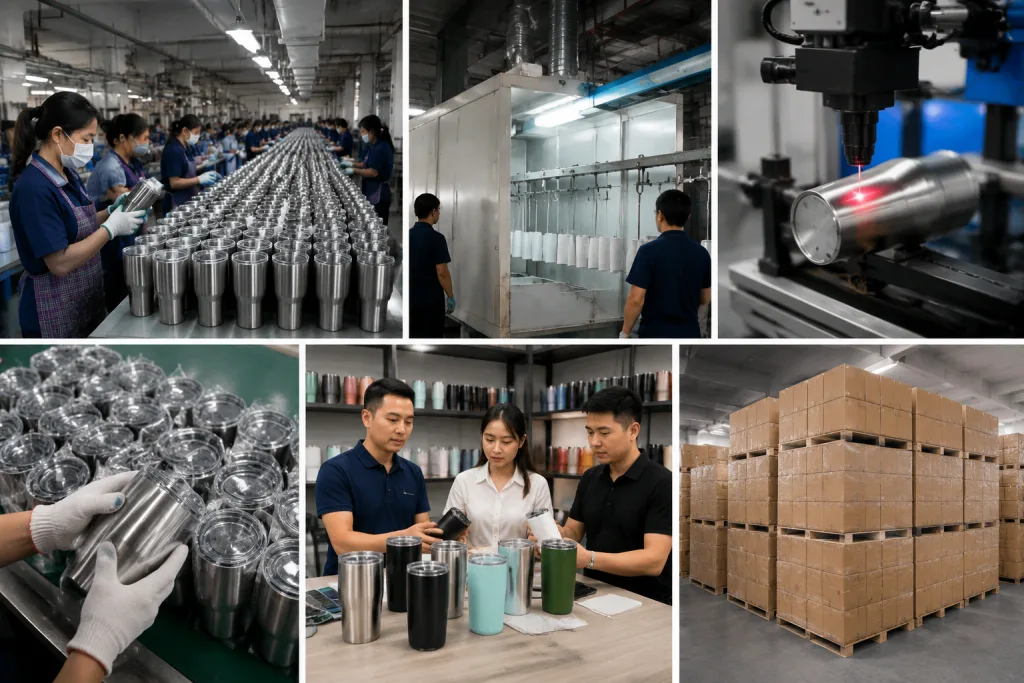
Key Takeaways
- For a standard 20 oz double-wall stainless tumbler, realistic MOQ is 1,000-3,000 pcs per color, with 25-35 day production after sample approval.
- 304 inner and 201 outer can cut unit cost by about USD 0.18-0.35 versus full 304, but it changes corrosion margin and premium positioning.
- AQL 2.5/4.0, coating adhesion, 24-hour salt spray, and leak tests should be written into the PO, not discussed loosely by email.
- If you need custom drinkware for retail, keep carton drop, lid torque, barcode placement, and FNSKU workflow in scope from day 1.
You can quote a 20 oz tumbler from 10 factories in China and still not know who to buy from. The unit price looks fine until QC asks for 304 stainless, vacuum yield, powder coating adhesion, or the actual replacement rate from the line. We see this all the time. One supplier says sampling is fast, then lead time turns into 45 days after deposit because the lid is outsourced to a separate canteen factory and nobody locked that source on the PO. If you buy for retail, promo, or a canteen distributor network, those misses become chargebacks, delayed launches, and complaint cases.
The right way to compare an insulated tumbler manufacturer is simple: same end use, same spec sheet, same checkpoints at inspection. This is the wrong question to ask if you start with price only. In Zhejiang, where a big share of China drinkware output runs, the gap between factories is usually plain on the floor. It shows up in steel batch consistency, decoration control, MOQ flexibility like 1,000 pcs versus 3,000 pcs, and whether the sales team answers technical questions straight before you place the PO. We’ve seen this go sideways over a 0.3 mm lid fit issue and one typo in the artwork approval.
Start with the comparison table
If you are choosing an insulated tumbler manufacturer, skip the catalog cover and the lowest FOB line on page one. Start with a fixed comparison table. Make every supplier answer the same points in the same format, or the quotes are not comparable. We’ve seen this go sideways fast: one supplier quotes on photos, another quotes after checking wall thickness on the line with a micrometer. Those are not the same supplier type.
- Body material: SS304/304, 304/201, or 18/8 wording only.
- Capacity and weight: 20 oz, 30 oz, 40 oz; actual fill volume tolerance within plus or minus 3%.
- Wall structure: double-wall vacuum, copper plating yes or no, typical outer wall thickness 0.4-0.5 mm, inner 0.3-0.4 mm.
- Lid system: slider, screw, straw, spill-resistant, gasket material.
- Decoration: silkscreen, laser, heat transfer, powder coat, dishwasher claim yes or no.
- MOQ: body color MOQ, logo MOQ, packaging MOQ.
- Lead time: sample 7-10 days, bulk 25-35 days, peak season 40-50 days.
- Compliance: REACH, LFGB, FDA, CA Prop 65 testing support.
- Inspection: AQL level, leak test rate, vacuum retention standard.
At BottleForge Industrial in Hangzhou, Zhejiang, a normal custom tumbler line runs 400,000 units per month across tumblers, bottles, and growlers. That sounds big. It means nothing if your SKU does not fit the line setup. A simple canteen custom logo job may run with a 1,000 pc MOQ. A customized growler with a new lid mold, color insert, and gift box can move to 3,000-5,000 pcs. Last month a buyer flagged a 1,000 pc target on a boxed growler set, and the math didn’t work after tooling, insert packing, and drop-test risk. The right comparison is capability against your actual build, not generic factory claims from China.
Material choices change cost and returns
Most buyers start with tumbler shape. That is the wrong question to ask. Material comes first because it drives unit cost, taste neutrality, corrosion resistance, and return rate. On insulated drinkware, we usually run SS304 inner with SS201 or SS304 outer. A full 304 body is easier to sell as premium customized drinkware, especially for retail programs and outdoor use where the bottle stays in service for 12 months or more. A 304 inner plus 201 outer body is common in canteen promotional programs where price pressure is hard and the user is not filling it with lemon water every day. On the line, QC checks the bottom weld and thread area first, because that is where trouble starts.
Typical cost difference on a 20 oz tumbler can be USD 0.18-0.35 per unit between 304/201 and 304/304, depending on steel market swings in Zhejiang and lid complexity. At 10,000 pcs, that is USD 1,800-3,500. The math is simple. It is also cheap compared with returns if rust shows up around an unpassivated thread area after 30 to 60 days in use. We have seen buyers push back on the upgrade, then come back after QC pulled the sample and found orange spots near the mouth after salt-spray exposure. That claim costs more than the steel.
What you should ask directly
- Is the inner wall certified food-contact grade SS304?
- What is the actual wall thickness by drawing: 0.35/0.45 mm or 0.4/0.5 mm?
- Is the weld polished smooth at the bottom seam?
- Do you use copper-plated vacuum insulation on this SKU?
- What is the heat retention test method: 95°C fill, measured after 6 and 12 hours?
If you also source a custom canteen, custom growler, or customizable canteen line from the same supplier, insist on the same material naming format across all quotations. We have seen 3 terms on 1 PO: 18/8, 304, and food-grade stainless, with no drawing attached. That goes sideways fast. A serious canteen factory or insulated tumbler manufacturer will give you the drawing, wall thickness, and steel callout, not a sales slogan. If the buyer flagged one SKU for 0.4/0.5 mm, every quote in that program should match the same format.
Cheap steel is rarely what hurts you. Unclear steel spec is what hurts you, because you cannot control claims or replacement policy later.
Use-case fit beats catalog breadth
A supplier with 300 shapes is not a better fit by default. The right question is whether their line matches your sales channel. A tumbler for retail shelves, a canteen customized for a museum store, and a custom growler for brewery merchandise can come from one canteen supplier, but the process controls are not the same. On our floor, the same 20 oz body might run through one-color silkscreen on Line 3 for promo orders, then move to barcode labeling and insert packing for retail. Different work. Different risk points.
- Corporate gifting: focus on stable logo placement, low MOQ, fast proofing, and carton efficiency. We usually steer buyers to a 20 oz powder-coated tumbler with one-color silkscreen because the rejection rate stays lower at a 500 pcs MOQ, and logo position is easier to hold with a fixed jig.
- Retail and e-commerce: prioritize leak testing, barcode workflow, carton drop tests, and color consistency across repeat POs. You may need FNSKU labels, insert cards, and master carton weight below 15 kg. QC pulled the sample last month because an outer carton came in at 15.4 kg, which is enough to trigger problems at Amazon intake.
- Outdoor and hydration: larger handles, straw lids, boot accessories, and stronger powder coat matter more than a few cents of unit cost. Buyers push back on price here, but the math doesn’t work if the handle cracks after a 1.2 m drop test or the boot slips on a 40 oz body.
- Brewery and beverage: a customized growler or customizable growler needs thread accuracy, pressure limits clearly stated, and packing that protects decoration in transit. We check thread fit with a go/no-go gauge, and we’ve seen this go sideways when a cap supplier shifts tolerance by 0.3 mm.
- Distributor programs: if you are a distributor drinkware buyer or distributor growler buyer, SKU continuity matters. You need the same mold available 12 months later. Ask for the mold code on the PI, because we still see POs with a lid color noted and no body mold reference.
This is where 7 out of 10 canteen distributors and canteen vendors read the factory wrong. They ask a canteen manufacturer to handle retail-grade packaging and Amazon prep on a line built for canteen promotional volume. Then the shipment slips from 12 days to 18 days, cartons get relabeled, and claims show up later. Across Zhejiang, some factories are strong at metal forming and average at fulfillment detail. Others are the reverse because they outsource the vessel and only control decoration and packing. This is the wrong question to ask: not “Are you a manufacturer?” Ask which steps they run in-house, which steps they outsource, and who owns final inspection before we ship.
Decoration methods side by side
Decoration is where a sample wins the meeting and the bulk order gets rejected. Your insulated tumbler manufacturer should spell out what survives daily use, what only looks good on day one, and where the process stops. We’ve seen this go sideways on a 0.5 mm logo shift that looked minor on the sample table and obvious on 5,000 pcs. There is no single best method for every custom drinkware project. That is the wrong question to ask.
- Silkscreen: lowest setup cost and best for 1-2 solid colors. Usually makes sense from 1,000 pcs. Good for canteen customizable logo programs. On the line, mesh count and ink viscosity decide the edge sharpness more than the artwork PDF does. Not a good pick for heavy abrasion.
- Laser engraving: clean and permanent on powder coat or brushed steel. Slightly higher unit cost, usually USD 0.08-0.20 more than simple print, depending on area. We run fiber laser marking for this, and the buyer usually likes the crisp look once QC pulled the sample from black powder coat stock.
- Heat transfer: full-color graphics around the body. Strong shelf effect for canteen promotional work and retail collections. Registration and color tolerance need approval standards, especially on wraps where 1 mm misalignment at the seam gets flagged fast.
- Powder coating: not just color. It changes grip and scratch resistance. Ask for coating thickness and adhesion testing; if the factory cannot give you a micron range, ask again.
- 3D wrap or digital print: works for low-volume SKU variety and short MOQ programs. Confirm dishwasher claims carefully. We’ve had buyers ask for 500-cycle dishwasher performance on digital print, and the math doesn’t work without clear limits in writing.
Good factories in Zhejiang run cross-hatch adhesion tests, color checks under consistent light, and rub tests before mass production. A D65 light box on the QC table is better than checking color by the warehouse door. Ask for Pantone reference, logo position tolerance in millimeters, and an approved golden sample signed before bulk. If you are sourcing a customized canteen, customizable drinkware set, or custom growler collection, make sure the factory can match decoration across different body shapes. About 7 out of 10 suppliers print a straight tumbler well, then lose consistency on a tapered bottle shoulder or near the neck radius.
Ask what happens at re-order. Can the same powder supplier and print mesh be used six months later? We ship repeat programs where the buyer flagged a shade change because the original powder lot was gone and the PO had only “matte navy” with no Pantone code. That matters more to a canteen distributor or distributor canteen buyer than to a one-off campaign buyer.
Quality control you can write into PO
Quality control is not “we check everything.” It is a short list of measurable points written into the PO and tied to pass/fail. For insulated tumblers and other customized drinkware, lock the inspection standard before deposit, not after the line starts. We’ve seen this go sideways when a buyer approved a sample, then added a 0.3 mm logo position tolerance after mass production.
Minimum QC points worth writing down
- AQL standard: commonly AQL 2.5 major / 4.0 minor for finished goods.
- Leak test: 100% for screw lid styles; random sample for slider lids unless otherwise agreed.
- Vacuum test: sample-based vacuum retention and spot checks for pinhole failure.
- Coating adhesion: cross-hatch tape test, no obvious peeling.
- Drop test: packaged product from 76 cm for retail cartons; define acceptable dent rate.
- Odor check: silicone gasket and straw components should be neutral after cleaning.
- Metal contamination and burrs: no sharp rim, no welding residue.
If your buyer team works with canteen suppliers, canteen vendor groups, or multiple canteen factories in China, use one inspection template across all projects. Same form. Same defect photos. Same judgment standard. That gives you clean data on repeat issues such as lid leak on lot 3, powder coat scratch above the weld seam, or carton crush at 18 kg stack load. BSCI and ISO 9001 tell you something about management discipline, but this is the wrong question to ask if you want to know whether the goods match your spec. Product conformity still needs REACH, LFGB, FDA, ASTM, or CA Prop 65 support based on market and product type.
For Europe, ask how the supplier handles REACH SVHC updates and whether they review the BOM again when a gasket supplier changes. For North America, ask who pays for testing if you switch lid resin or decoration ink after sample approval. QC pulled the sample on one order last year because the PO said “black lid,” while the resin grade had changed with no note. A reliable canteen manufacturer answers this fast and names the document trail. A weak canteen supplier says the old report is “still okay” and cannot confirm the exact BOM match.
Lead time, MOQ, and shipping reality
Most sourcing delays are not about bad intent. They start with bad timing on the PO. A practical insulated tumbler manufacturer will break lead time into sample, approval, production, and shipping, and we ask buyers to confirm each window one by one. On the factory floor, the line does not wait for artwork fixes; last month a buyer flagged a logo stroke that was off by 0.3 mm, and that alone pushed approval back 4 days.
For a standard custom tumbler with existing mold, expect:
- Pre-production sample: 7-10 days after artwork and color confirmation.
- Bulk production: 25-35 days after deposit and sample approval.
- Peak season buffer: add 7-15 days from August to November.
- MOQ: 1,000 pcs per model is common; true custom color plus custom box often starts at 3,000 pcs.
- Sea transit: around 25-35 days to Europe, 18-30 days to North America depending on port and service.
If you need a canteen custom assortment, custom canteen and tumbler mix pack, or a customized growler with accessories, ask which parts are made in-house and which come from partner canteen vendors. This is the right question. We’ve seen this go sideways on lids, straws, silicone boots, and gift boxes, especially when one outside vendor misses a print file cutoff by a day. A canteen distributor or distributor drinkware buyer should also ask about stock components. QC pulled the sample on one mixed set order and the only issue was a non-stock lid color; switching to an existing lid color saved 12 days and USD 0.06 per unit.
Trade term matters too. FOB Ningbo or Shanghai is still the cleanest choice for many B2B buyers in Zhejiang sourcing. If a supplier offers DDP on the first quote without asking about carton specs, pallet rules, or destination labeling, be careful. We ship this every week, and the math doesn’t work if they have not checked carton size, loading plan, and whether the outer mark needs a PO typo fixed before booking. That usually means sales is moving faster than operations. You need both sides aligned.
Questions that expose the right factory
Compare canteen manufacturers, canteen distributors, and a direct insulated tumbler manufacturer by asking about process control, not sales talk. Day one does not need a 3-hour audit. You need 6 questions that are hard to fake, and the answers should match what we see on the line: leak tester records, vacuum data, and lid fit checks with a 0.5 mm gauge.
- What percentage of your output is stainless insulated drinkware versus plastic items?
- What is your monthly capacity on this exact category?
- Can you share a current control plan for leak test, vacuum test, and decoration inspection?
- Which components are outsourced, and who controls incoming quality?
- What was your average on-time shipment rate in the last 90 days?
- How do you handle claims: credit note, remake, or spare quantity in next PO?
A good answer sounds plain. It sounds like someone from production wrote it. Example: “This 30 oz line runs 120,000 pcs per month, MOQ 1,000 pcs per color, current lead time 30 days, 100% leak check for screw lids, AQL 2.5/4.0 before loading.” That helps. QC pulled the sample, the records are there, and the numbers tie back to actual output. A weak answer is broad: “No problem, all can do.” We have seen this go sideways after mass production starts.
If you buy from China often, you know the pattern. The best canteen factory is not the one with the biggest showroom. It is usually the one that holds a spec, repeats a Pantone across 2 batches, and tells you on Tuesday, not day 28, that your requested packaging or canteen customized finish will delay shipment 12 days vs 18 days. This is the right question to ask. We ship programs more safely when the factory flags a barcode typo on the PO, catches a logo position drift at decoration inspection, and pushes back before the math breaks on delivery. That keeps a custom drinkware program profitable whether you sell as a canteen distributor, a distributor growler specialist, or a retail brand owner.
Compare your tumbler specs with a factory engineer
Send your target capacity, steel grade, logo method, MOQ, and destination market. We will review feasibility, lead time, and likely cost drivers clearly.
Frequently asked questions
What MOQ should I expect from an insulated tumbler manufacturer?
For an existing 20 oz or 30 oz model, a realistic MOQ is 1,000 pcs per item, often split by 250-500 pcs per color if the factory already stocks the lid and powder. If you need a custom color box, insert card, or a new handle or lid mold, MOQ usually moves to 3,000-5,000 pcs. For laser engraving on stock color bodies, some China factories in Zhejiang can accept 500 pcs, but unit cost rises fast. Always separate body MOQ, logo MOQ, and packaging MOQ in the quotation. That avoids a common problem where the tumbler meets MOQ but the gift box does not.
Is 304 inside and 201 outside acceptable for custom drinkware?
Yes, for many B2B projects it is acceptable, provided the inner wall is confirmed SS304 and the use case is normal beverage consumption rather than long-term acidic storage. A 304 inner plus 201 outer body can save around USD 0.18-0.35 per unit on a standard tumbler, which matters on promotional volume. For premium retail, outdoor, or repeat-use programs, full 304 body is easier to sell and defend if customers ask material questions. Ask your canteen supplier for a drawing, steel declaration, and corrosion-related test support. Marketing terms alone are not enough.
How long does production usually take for customized drinkware orders?
For standard models, plan 7-10 days for a pre-production sample and 25-35 days for bulk after approval and deposit. During peak season, especially from late summer into Q4, add 7-15 days. If your project includes full-color transfer, custom molds, or mixed items like a custom canteen plus customizable growler set, timing can stretch to 40-50 days. Sea freight from China is separate: roughly 18-30 days to North America and 25-35 days to Europe depending on service and congestion. Ask the factory to break timing into sampling, production, and ex-factory date instead of giving one vague lead time.
Which tests matter most before I ship a tumbler order?
At minimum, ask for leak testing, vacuum performance verification, coating adhesion, and a visual inspection to AQL 2.5 major / 4.0 minor. For retail packaging, include carton drop testing from around 76 cm and barcode scan checks if you sell through Amazon or chain stores. If the product is for Europe, request current REACH and LFGB support where relevant. For North America, FDA food-contact support and CA Prop 65 review are common. If the lid, straw, or gasket material changes, old reports may no longer match the BOM, so confirm testing against the actual shipped configuration.
How do I tell if I am talking to a real canteen factory or only a trading company?
Ask operational questions tied to one SKU. A real factory or a tightly managed manufacturer will usually state monthly capacity, standard MOQ, current lead time, and what parts are outsourced. For example, they may say they run 120,000 tumblers per month on that line, need 1,000 pcs MOQ, and source only the silicone gasket externally. Ask for workshop photos, process checkpoints, and whether they can support AQL inspection before loading. A trader may still be useful, but if they cannot explain lid sourcing, leak-test method, or decoration tolerance in millimeters, you should price in more risk and slower communication.