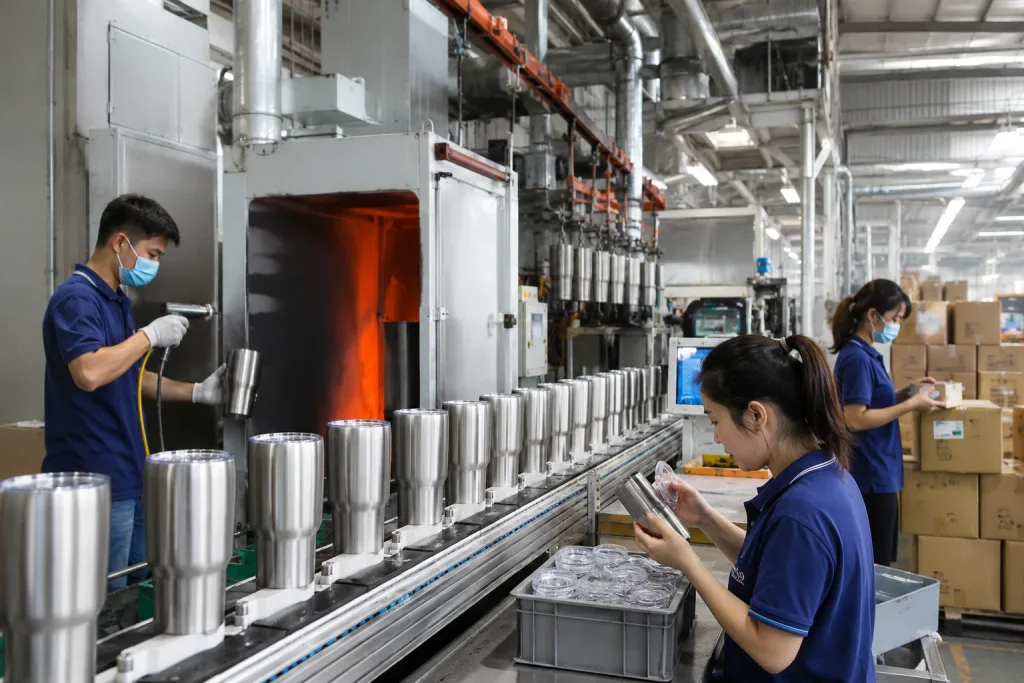
Key Takeaways
- A workable custom MOQ for insulated tumbler in bulk is often 1,000-3,000 pcs per SKU, with 25-35 day production after sample approval.
- FOB pricing for a 20 oz or 30 oz 18/8 stainless steel tumbler typically moves by USD 0.20-0.60 based on lid type, coating, and print method.
- Use AQL 2.5/4.0 final inspection plus 1.2 m carton drop testing and 6-8 hour heat retention checks before balance payment.
- If you are sourcing from Zhejiang, China, lock the spec sheet first: steel grade, wall structure, lid material, logo method, carton pack, and compliance standard.
You are not buying a tumbler. You are buying 40 or 50 production decisions that either hold your margin or eat it one defect at a time. A 30 oz insulated tumbler that looks clean under showroom lights can still fail a 76 cm carton drop, leak at the lid thread after torque test, or reach the warehouse with logo scratches from ocean transit. We have seen QC pull a sample that passed vacuum hold but failed after 800 km of truck vibration. So color is not the first question. Spec control, compliance, and packaging detail come first.
For procurement managers and brand owners sourcing from Zhejiang, China, the hard part is usually not finding a factory. The hard part is getting the same unit you approved, at the agreed cost, inside the agreed 35- to 45-day lead time. This is the wrong question to ask: “What is your best price?” The buyer should ask what steel grade, what lid resin, what carton spec, and what AQL the line will run. Below is a practical walkthrough of one insulated tumbler bulk order from RFQ to final inspection, including the buyer questions that matter if you also ship bulk drinkware, run a canteen wholesale program, or manage growler bulk orders.
The order starts with a margin target
Say you are a North American brand owner planning a fall promotion: 5,000 pieces of a 30 oz insulated tumbler in bulk, one body color, one logo, packed for retail-ready e-commerce replenishment. Your target landed cost has to leave margin for the distributor and still keep retail under USD 24.99. Sounds straightforward. Then the factory sales engineer comes back asking carton drop-test spec, logo size in mm, and whether the lid gasket is packed assembled or loose.
The right starting brief is not “quote your best price.” This is the wrong question to ask. Send a controlled RFQ with numbers:
- Capacity: 30 oz, tolerance within about 3%
- Material: 18/8 stainless steel inner and outer, BPA-free lid
- Construction: double-wall vacuum, copper lining optional
- Finish: powder coating, Pantone-matched if needed
- Logo: 1-color silk screen or laser engraving
- Packaging: egg-crate master carton or individual white box
- Compliance: REACH for EU, FDA/LFGB contact safety where applicable
- Target Incoterm: FOB Ningbo or Shanghai
Once you send that level of detail, quotes from China line up cleanly. Without it, Factory A prices a 201 stainless outer wall, Factory B prices 304 inside and outside, and Factory C leaves out the lid without saying much. We have seen buyers think they saved USD 0.45 per piece, then QC pulled the sample and found the wall spec was off by 0.2 mm or the straw lid was never included. That math does not work.
At BottleForge Industrial in Hangzhou, Zhejiang, buyers usually narrow a workable MOQ to 1,000 pieces per color for standard molds, and 3,000 pieces or more if they want multiple logo positions or custom packaging. We run into the same issue on mixed programs. A PO might say “matte black all items,” but one line means tumbler powder coat and another means a gloss canteen cap, and the buyer flagged it only after sample approval. If you buy wholesale drinkware programs that include a bulk canteen, wholesale growler, and best wholesale drink bottle assortment, the RFQ needs to separate each SKU clearly or the costing gets muddy fast.
Lock the tumbler spec before sampling
The costliest mistake we see is approving a sample that has no chance of matching the line. A polished hand sample can look clean on the table and still fail in production on lid fit, powder coat thickness, weld polish, or logo abrasion after 50 rubs. Lock the bill of materials before you pay for a pre-production sample. This is the right question to ask first. On our floor, QC pulled one sample last month with a lid gap of 0.8 mm, and the buyer had already signed off the shape.
What the buyer in this scenario confirms
- Body steel: SUS304 interior and exterior, commonly called 18/8
- Wall thickness: 0.4 mm inner, 0.5 mm outer for a stable 30 oz body
- Lid: AS or Tritan slider lid with food-contact silicone gasket
- Base: non-slip pad optional, but check carton nesting effect
- Coating: powder coat, 60-80 micron range
- Logo area: max width and height in mm, not “front center” only
Ask one more thing that new buyers skip: was this sample made on the same tooling, same spray line, and same assembly setup as mass production? If not, treat it as a shape sample only. Do not treat it as final approval. We’ve seen this go sideways when a hand-built sample looked tight, then the mass-run lid from the injection mold sat 1.2 mm higher.
For a 5,000-piece order, sample timing from Zhejiang, China is often 7-10 days for a logo sample using an existing mold. If you add a custom Pantone powder coat and revise the packaging mockup, 12-15 days is more realistic. Sample charges can range from USD 50 to USD 150 per piece depending on printing and freight. We usually tell buyers to check the PO twice, because one typo in logo size or carton mark can waste 7 days fast.
This is also where adjacent categories need a straight answer. If your line may expand into canteen bulk, growler wholesale, or alcohol flask bulk, ask whether the supplier makes them in-house or passes them to a sister factory. A tumbler line and a growler line are not the same job; neck forming, leak test standards, and cap fit control change. We run vacuum tumblers and bottles on separate setups, and the math doesn't work if a trader quotes all categories like they come off one machine. One buyer flagged this after finding the growler sample used different weld finishing than the tumbler order.
You are not approving “a nice sample.” You are approving a production standard that QC can inspect against later.
Price breaks depend on hidden variables
The factory comes back with a range, not one clean number. For a standard 30 oz insulated tumbler in bulk, one-color print, standard slider lid, and export carton packing, a typical FOB China quote might land around USD 3.60-4.80 depending on steel market movement, coating choice, and order quantity. On our line, a 304 stainless body that is 0.4 mm instead of 0.35 mm moves cost fast. Add a retail box, and you may add USD 0.22-0.45. Upgrade to laser engraving from basic screen print, and add roughly USD 0.08-0.20 depending on artwork size and position.
The buyer in this scenario compares three options:
- 1,000 pcs: higher setup burden, maybe USD 4.60 FOB
- 3,000 pcs: better material and packing leverage, maybe USD 4.05 FOB
- 5,000 pcs: target commercial level, maybe USD 3.85 FOB
These are not fixed market numbers. They show where the line starts to make sense. We run factories that lose time on small lots because cup forming, vacuum check, and carton marking still need the same setup whether the PO says 1,000 pcs or 5,000 pcs. A factory running 600,000 units per month absorbs that cost differently than a 40,000-piece workshop. This is the wrong question to ask if the buyer only wants “best price” without locking lid style, print method, and pack-out.
Ask what makes the price move. The honest answer from sales or production usually sounds like this, because QC pulled the sample and the cost issue is plain:
- stainless steel grade and weight, such as 18 g more body weight per cup
- lid complexity and seal design, especially leak-resistant lids with extra silicone parts
- powder coat vs spray paint, since the oven cycle and reject rate are different
- number of SKUs per order, for example 5 colors split across 3,000 pcs
- individual box or PDQ display pack, with different carton drop-test risk
- inspection level and compliance testing needs, such as AQL 2.5 or added lab cost
The same logic applies if you also source beer tumbler bulk, wholesale canteen, beer growler wholesale bulk, or wholesale growler assortments. The shape may look close on screen, but the math changes once the neck tooling, cap type, and inner packaging change. We have seen a buyer flag a growler quote after finding the cap torque spec was missing from the PO. A beer tumbler wholesale bulk order for bar promotions can live with simpler gift box standards than a direct-to-consumer best wholesale drink bottle launch.
If a quote looks too low, ask for the unit weight in grams, steel grade declaration, and carton specification. Ask for the master carton size too, like 54 x 54 x 32 cm, because freight math matters. We have seen this go sideways when a supplier shaved 25 g off the body and switched foam protection to thinner inserts. Cheap drinkware bulk quotes are often cheap for a reason.
Compliance and packaging decide real risk
By this point, 7 out of 10 buyers are still watching only color approval and ex-factory date. Too late. Real order risk usually sits in compliance paperwork and packaging execution, and we’ve seen this go sideways after the line was already booking cartons.
For Europe, check REACH alignment and a usable food-contact declaration tied to the actual SKU, sometimes backed by third-party migration tests if the retail program asks for it. For the US and Canada, buyers usually ask for FDA-related material declarations, CPSIA relevance on youth-oriented items, and California Proposition 65 review where it applies. If the tumbler is sold to children, ASTM-related points can show up in the lid, straw, and even the retail box copy. This is the wrong question to ask: not “do you have a report,” but “does the report match this PO?” We had one PO where the buyer flagged a lid note because the silicone gasket spec changed from clear to black.
Do not assume “passed test before” covers your exact order. Verify whether the report matches:
- the same material set
- the same decoration method
- the same lid and gasket materials
- the same production site in China
Packaging needs the same discipline. In this scenario, the buyer sells through distribution and a small Amazon replenishment channel. So we run outer cartons to handle parcel drops without wasting cube, because the math doesn't work if you ship air. On the floor, QC pulled the sample carton and checked wall thickness with a caliper before carton approval.
- Master carton: 5-layer corrugated, burst strength confirmed
- Drop test: 1.2 m on edges, corners, and faces
- Carton weight: ideally under about 15 kg for safer handling
- Marks: item code, color, quantity, gross/net weight, made in China
If your channel includes FBA, add FNSKU label placement and carton label standards before production starts. We ship to buyers who send the carton map before mass production, and that saves rework. Re-labeling after arrival kills margin fast.
This matters across neighboring categories too. A canteen wholesale order often needs a different divider because shoulder dents show up first in transit. A bulk growler or beer growler in bulk order usually needs stronger packaging because the taller neck geometry shifts load in drop testing. An alcohol flask in bulk order is a smaller pack-out, but mirror finish scratches get flagged fast, sometimes from one loose PE bag opening by 3 mm. Packaging is not a back-office detail. It is product performance during shipping.
During production, inspect the boring details
The buyer pays a deposit, usually 30%, and the line starts. For 5,000 custom tumblers, standard lead time is often 25-35 days after sample approval. In Zhejiang peak season, from August to November, we’ve seen coating capacity push that to 40 days when the spray line is booked and the oven schedule is full.
This is the stage where good procurement teams ask for mid-line control, not only a final inspection. That is the right move. A workable plan usually includes checks at incoming material, first article, in-line QC, and pre-shipment.
- Raw material check: verify steel grade paperwork and confirm incoming lid resin against the PO; we’ve had buyers flag a cap material swap before, and they were right to do it
- First article confirmation: check coating color against the approved chip, logo position in mm, and lid thread fit on the master sample
- In-line QC: run vacuum performance spot checks, cosmetic review under line light, and carton count accuracy; QC pulled the sample once because the count was short by 24 pcs on a 5,000 order
- Pre-shipment inspection: AQL 2.5 for major defects, 4.0 for minor defects
Typical major defects on an insulated tumbler order are leakage, poor vacuum that cuts heat retention, wrong logo, dented rim, and unstable base. Minor defects are smaller issues: paint pinpoints under 1 mm, light scratches outside the approved limit, or print position drift that stays in a non-critical area. We’ve seen this go sideways when “minor” was never defined on paper.
Define test methods in plain language. Short sentences. No guessing on the factory floor. For example:
- Fill with 95°C water, close lid, measure temperature after 6 hours
- Check vacuum dot or condensation behavior where applicable
- Test 10 pieces for leakage after inversion for 30 seconds
- Verify logo adhesion with tape test after full curing
If the order also includes drinkware wholesale line extensions such as canteen bulk, beer tumbler in bulk, or growler bulk, do not let the inspector sample them as one blended category. Each SKU needs its own count and defect review. This is the wrong question to ask: “They are similar products, so can we inspect them together?” No. A 32 oz growler, a beer tumbler, and a canteen do not fail the same way, and the carton count does not save you when one SKU comes back with claims.
Factories with BSCI or ISO-oriented systems still ship bad lots if the checklist is vague. We ship against the spec, not against nice paperwork. Standards help, but a clear limit sample, a written test method, and a disciplined QC plan are what protect the order.
Shipment, claims, and the next PO
Final inspection passed, but the job is not finished. On a 5,000-piece 30 oz tumbler order, shipment protection and post-order data matter just as much as the AQL result because this item eats container cube fast. We usually ask for master carton size in mm and gross weight in kg before balance payment; if the carton is 485 × 485 × 330 mm, the LCL vs FCL math gets clear fast. Buyers often ask freight first. Wrong sequence. Lock packing data first, then book space.
Before balance payment, confirm:
- final inspected quantity vs ordered quantity
- spare lids or overrun policy, often 1-2%
- shipping marks and pallet rules if required
- photo record of packed cartons and loading condition
When goods arrive, run your own receiving audit. Open 6 cartons from different pallet positions, not just the top layer, and check the back row where transit dents usually show first. Count shortages, inspect rim dents with a caliper if needed, and compare finish, logo position, and lid fit against your golden sample. QC pulled the sample for one buyer last month, and the issue was not the tumbler body at all; the PO had the wrong carton mark on 12 cartons. If there is a problem, file it within 48 hours with photos, lot references, and carton marks. Vague claims go nowhere.
A simple habit works well: score the order after delivery.
- Price accuracy: were there surprise add-ons?
- Lead time accuracy: was ship date within 3-5 days of promise?
- Defect rate: was it under your agreed threshold?
- Communication: did the factory solve issues fast?
That scorecard shows whether the supplier can take on broader programs. One tumbler PO is not enough proof. We have seen this go sideways when a buyer tried to jump from 30 oz tumblers into wholesale growlers and flasks without checking new tooling, lid compatibility, and carton drop test results. The line that runs a clean insulated tumbler order does not automatically run every bulk drinkware category well.
The second PO is usually easier if the first one was controlled properly. Your approved spec sheet, QC checklist, and packaging standard become working files the team can reuse, and the buyer flagged issues from PO1 should already be closed on the line before mass production starts again. That is how buyers in Europe and North America turn one insulated tumbler in bulk order from China into a repeatable sourcing model, not a one-off gamble.
Send your tumbler spec for a real quote
Share quantity, size, logo method, and target market. We will review MOQ, FOB pricing, compliance points, and lead time from Zhejiang, China.
Frequently asked questions
What MOQ should I expect for insulated tumbler in bulk with custom logo?
For standard molds, a realistic MOQ is usually 1,000 pieces per color or design, though some factories in China will quote 500 pieces at a higher FOB price. If you need Pantone-specific powder coating, custom retail boxes, or multiple logo positions, the efficient MOQ often moves to 2,000-3,000 pieces. For a mixed drinkware bulk order that includes a wholesale canteen or beer tumbler bulk program, some suppliers will combine quantities across similar bodies, but you should confirm whether tooling, lids, and cartons are truly shared. If the MOQ sounds unusually low, check whether the quote is based on leftover stock components rather than a repeatable production setup.
How much does a 30 oz insulated tumbler typically cost FOB China?
A practical FOB range for a standard 30 oz double-wall vacuum tumbler is about USD 3.60-4.80 per piece for 3,000-5,000 units, depending on steel weight, lid quality, coating, and print method. At 1,000 units, the price may rise by USD 0.40-0.80 because setup costs are spread over fewer pieces. Individual white boxes often add USD 0.22-0.45, while laser engraving can add USD 0.08-0.20 compared with basic silkscreen. If you are comparing against canteen wholesale, growler wholesale, or alcohol flask wholesale bulk offers, do not compare by piece price alone. Compare unit weight, material grade, packaging spec, and testing scope.
What quality checks matter most before I pay the balance?
The most useful control is a pre-shipment inspection using AQL 2.5 for major defects and 4.0 for minor defects, plus a few defined performance tests. For insulated tumblers, focus on leakage, vacuum retention, rim deformation, base wobble, logo adhesion, and coating scratches. A common heat test is 95°C water measured after 6 hours, and a simple leak test is inversion for 30 seconds on a sample group. You should also inspect carton quality, barcode placement, and quantity accuracy. If the order includes beer growler bulk, alcohol flask in bulk, or beer tumbler wholesale bulk SKUs, inspect each SKU separately. Blended sampling hides defects.
How long does production usually take for a bulk tumbler order?
For a repeat item with approved artwork, production is commonly 25-35 days after deposit and sample approval. A pre-production sample may take 7-10 days if the mold already exists. If you need new packaging, multiple body colors, or peak-season scheduling in Zhejiang, China, total lead time can stretch to 40-50 days. Ocean transit then depends on destination, but many buyers plan the full cycle at 60-90 days from PO to arrival. If your program also includes canteen bulk, wholesale growler, or best wholesale drink bottle assortments, ask whether production is split across multiple lines, because that often adds coordination days.
Can one factory handle tumblers, canteens, growlers, and flasks together?
Sometimes yes, but you should verify what is genuinely made in-house. A supplier may be strong in insulated tumbler in bulk production but outsource a bulk growler, alcohol flask bulk, or canteen wholesale item to partner factories. That is not automatically a problem, but it changes your control plan. Ask which SKUs share the same factory, what the monthly capacity is, and whether the same QC team covers every category. For example, a supplier may run 600,000 units per month on tumbler and bottle lines, yet rely on a separate workshop for wholesale growler or alcohol flask wholesale orders. If you need consistent finish, packaging, and compliance control, mapping the true supply chain early saves trouble later.