Key Takeaways
- A reliable insulated tumbler factory should quote MOQ clearly, often 1,000-3,000 pcs per SKU, with sample lead time around 7-12 days and bulk lead time around 25-40 days
- For 18/8 stainless vacuum tumblers, a common export FOB China target is roughly USD 2.80-6.50 depending on size, coating, lid type, and decoration
- Ask for AQL 2.5 final inspection, vacuum heat retention data, coating adhesion tests, and REACH or LFGB support before placing a deposit
- If you need canteen customized, customized growler, or distributor drinkware programs, align carton specs, barcode labeling, and replenishment planning before mass production
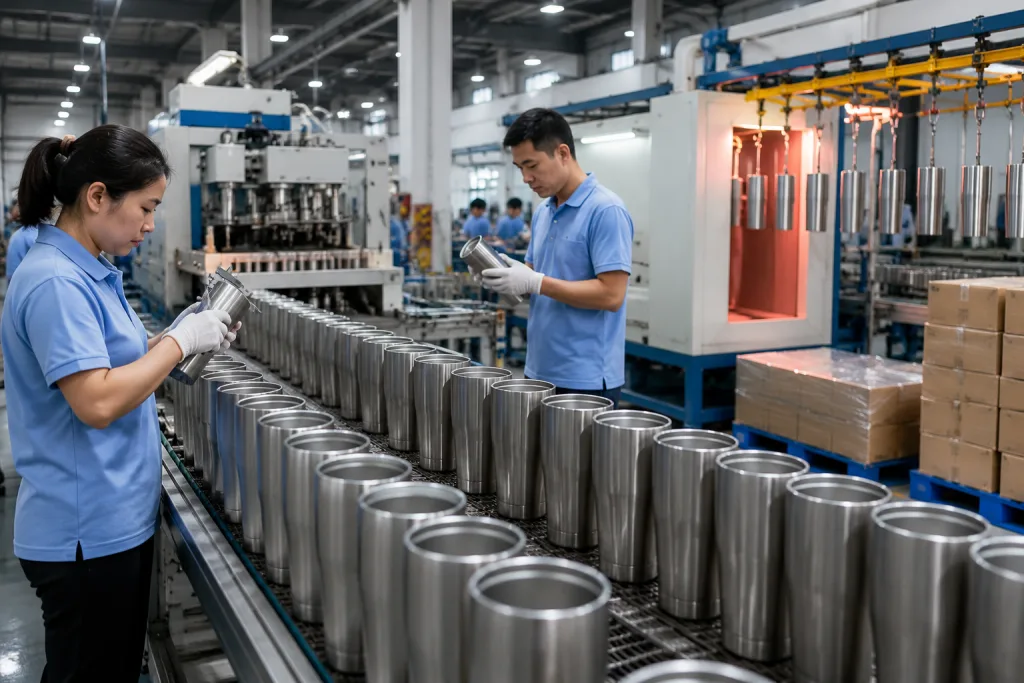
You are not buying a tumbler. You are buying a repeatable production result: correct steel grade, stable vacuum performance, decoration that survives washing, packaging that arrives intact, and a lead time your sales team can trust. On the line, that means 304 stainless where the PO says 304 stainless, vacuum hold checked batch by batch, and artwork registration kept within 0.5 mm. Choosing an insulated tumbler factory is less about catalog photos and more about process control. Buyers in Europe and North America usually catch problems late: color drift between approved sample and bulk, lids that leak at a 45-degree tilt test, cartons failing drop tests, or a compliance file missing one page when customs asks for it. We have seen this go sideways.
At BottleForge Industrial in Hangzhou, Zhejiang, we see the same pattern with new B2B buyers sourcing from China. The good projects start with a short checklist, hard numbers, and direct questions. Last month QC pulled the sample because the PO had a lid color typo, and that single line would have cost 12 days if nobody stopped the run. If you also source custom canteen, customized drinkware, or a custom growler line, the logic is the same: verify capability before you negotiate price. Price first is the wrong question to ask.
What should you verify first
Check the basics first. Before you discuss colors or packaging mockups, confirm whether the supplier can run your order on the line. A real insulated tumbler factory should answer five points fast and in plain language: monthly capacity, MOQ, standard lead time, steel grade, and decoration limits. We ask for carton size too, down to the cm, because if sales keeps sending lifestyle photos but cannot confirm wall structure or whether the master carton is 58 x 39 x 27 cm, that is not a factory answer.
For vacuum insulated tumblers, the standard build is double-wall 18/8 stainless steel, often listed as SUS304 inside and outside for mainstream retail lines. Some budget projects use 201 stainless on the outer wall, but a lot of buyers in Europe and North America reject it for corrosion consistency. Typical body thickness is 0.4-0.5 mm inner wall and 0.4 mm outer wall; bigger customized growler formats often move up after caliper checks on drop-risk areas near the shoulder. A workable MOQ for custom drinkware is often 1,000 pcs per color per size. Uncommon lid tools or special coatings can push MOQ to 3,000 pcs. Buyers ask for lower MOQ every week, but on new tooling the math doesn't work.
- Capacity: ask for confirmed output, such as 300,000 units/month across tumblers, bottles, and canteens.
- Lead time: 7-12 days for pre-production samples, 25-35 days for repeat bulk orders, 35-45 days for first orders with new artwork.
- Incoterms: FOB Ningbo or Shanghai is still the cleanest comparison point for China sourcing.
- Compliance: ask what they can support for REACH, LFGB, FDA-contact materials, and BSCI or SEDEX audit status.
If you also buy canteen custom or customizable drinkware, ask whether the same line handles bottles, tumblers, and custom growler formats, or whether part of the order is subcontracted. This matters. Subcontracting is not the problem by itself; the problem is losing control of timing and inspection. We have seen POs delayed 6 days because the powder coat vendor missed a Pantone match, and the buyer flagged it only after QC pulled the sample. In Zhejiang, plenty of suppliers trade more than they manufacture. Ask which process is in-house: tube forming, vacuuming, powder coating, silk screen, laser engraving, assembly, or packing. This is the first question, not the last.
How do you judge price properly
Price means nothing until the spec is locked. We still see buyers compare two 30 oz tumbler quotes and miss what changed: one factory included copper plating in the vacuum layer, dishwasher-grade powder coating, and an AS lid; the other quoted a basic build. QC pulled samples like this last month, and the wall thickness gap was 0.12 mm. The cheap quote looked good on paper. It turned into claims later.
For reference, a straightforward 20 oz insulated tumbler with 18/8 stainless body, powder coating, one-color silk screen, and standard slide lid may land around USD 2.80-3.90 FOB China at 3,000 pcs. A 30 oz version is often USD 3.60-5.20. Once you add full-wrap printing or laser engraving, the price moves. Special color matching adds setup time on the line, and one buyer flagged a lid gray that was 1.5 Delta E off their approved chip. Handle tooling and premium Tritan lid components also push cost up. A customized canteen with straw lid may price below a handled tumbler. A customized growler with larger capacity and heavier steel often costs more per piece but less per ounce. That per-ounce comparison sounds smart, but this is the wrong question to ask if your shelf price is set by unit.
Cost items buyers forget
- New mold or lid-tool cost: often USD 2,000-8,000 depending on complexity.
- Pantone color matching and coating changes between SKUs.
- Individual box upgrades, EPE inserts, and master carton strength.
- Barcode application, FNSKU labeling, and pallet configuration for Amazon or retail DC delivery.
- Third-party inspection and lab test fees.
Use a hard quoting checklist. We run side-by-side quote sheets with the same fields for every canteen supplier or canteen vendor: capacity, steel grade, finish, logo method, lid type, unit pack, carton quantity, carton size, gross weight, MOQ, sample fee, and lead time. Put all quotes on FOB basis and compare from there. One PO we received even had “30ox” typed instead of “30oz,” and that small typo flowed into carton marks and delayed approval by 2 days. For a distributor canteen or distributor drinkware program, ask for replenishment pricing on repeat orders too. First-order cost is rarely the real cost after 3 shipments.
A low quote that hides thin coating, unstable lids, or weak cartons is usually more expensive than a higher quote with controlled scrap and fewer claims.
Which factory questions reveal risk
The fastest way to size up an insulated tumbler factory is to ask shop-floor questions that kill brochure talk. A solid plant in Zhejiang should answer with numbers, line photos, or the actual check sheet we run at final QC. Weak suppliers drift into promises. If they cannot tell you the leak-test pressure or show a weld inspection record, we've seen this go sideways.
Use questions like these:
- What is your vacuum rate pass standard, and how do you test it on the line?
- Do you perform 100% air-pressure or leak checks on assembled lids?
- What AQL level do you use for final inspection? Many buyers use AQL 2.5 major / 4.0 minor.
- How do you control color difference for powder coating across multiple production dates?
- Can you provide coating adhesion and salt spray results for painted surfaces?
- Which parts are food-contact, and what supporting declarations or test reports can you share?
For custom drinkware projects with retailer exposure, ask about traceability early. Can the factory print date codes on cartons or laser-mark them on the bottom cup? Can they split raw material lots for 3 capacities in one PO? This matters. If your product line includes customizable canteen or customizable growler items in several capacities, complaints usually track back to one lid lot or one coating batch, not the full 10,000-piece order. Buyers ask about price first, but this is the wrong question to ask if the product will sit on retail shelves.
Another strong signal is how the factory handles defects during sampling. If they say a lid wobbles 1.5 mm but "it is normal," pay attention; QC pulled the sample for a reason. Small sample issues become claim issues at 10,000 units, and the math doesn't work once rework starts. The same applies to canteen promotional orders, where a 12-day ship target instead of 18 days puts pressure on the line and standards slip fast. Ask for a pre-production sample signed against a specification sheet with dimensions, weight tolerance, logo position, color reference, and packaging details. We usually add carton mark, drop-test standard, and even a typo check on the PO. That signed sample is the production target, not a sales photo.
Compliance, testing, and documentation checklist
Buyers often treat compliance like paperwork to chase after production. That's backwards. Check what the factory can actually support before deposit, especially for Europe and North America. On our side, this talk starts before sampling is approved, not after the line is booked. For an insulated tumbler factory, the minimum checklist is food-contact materials, coating heavy metals, packaging rules, and the social audit your sales channel asks for. If a buyer sends a PO with only "food safe" typed on it, that's not enough. We've seen this go sideways.
If you sell into the EU, REACH is a standard check for chemical substances. A lot of buyers also ask for LFGB-related food-contact support, depending on the product and the end customer. For the US, buyers usually want FDA-related material declarations. If the item is for children, ASTM or CPSIA-related review can come in fast once the buyer flagged the age grade on the artwork file. That happens more on kids bottle lines than on standard tumblers, but this is the wrong question to ask late, after the mold sample is signed. We run into that on lids with bite valves and soft silicone parts around 2.0 mm thick.
- Factory audit: BSCI or SEDEX is commonly requested by retailers and importers. If your channel is mass retail, ask for the latest report date, not just the logo on a slide.
- Quality system: ISO 9001 is a useful signal, but it does not replace inspection. QC pulled the sample last month from a 3,000 pcs run and found logo shift at 1.5 mm.
- Material file: stainless steel grade declarations, plastic resin information, silicone details, and coating data. We ship these as one file set, or the buyer loses time chasing 4 suppliers.
- Packaging: carton spec, drop test standard, pallet pattern, and shipping marks. One buyer pushback we get all the time: "Why is the master carton too tall for our shelf slot?"
- Inspection: pre-production check, in-line checks, and final random inspection with AQL criteria. AQL 2.5 means nothing if the checkpoint list is thin.
For canteen manufacturer or canteen manufacturers offering mixed-material products, identify every component. Lids often contain PP, AS, Tritan, silicone gaskets, and sometimes metal pivots. The body alone is not the product. A compliance file that only mentions the bottle body is incomplete. The same applies to custom growler and customized drinkware sets packed with straws, brushes, or gift boxes. On the factory floor, this usually gets missed on small parts under 5 g because the packing team treats them as accessories, not as contact components.
If your customer is a canteen distributor or one of several canteen distributors supplying schools, outdoor stores, or loyalty programs, document retention matters. Ask how long the factory keeps production records. Ask if they can reproduce the exact decoration and coating formula for a reorder six months later. Twelve days vs 18 days often comes down to this file control, not line speed. We keep signed color chips, coating batch records, and sample retention by PO; if the buyer changes one Pantone digit by typo on the reorder, the math doesn't work unless someone catches it before production.
Packaging and logistics usually decide margins
Packaging is not cosmetic. It hits claim rate, warehouse labor, container loading, and landed margin. We ask buyers to lock unit pack and master carton options early, because a small box change on bulky drinkware can move freight cost by 5-12%. On the line, we usually check master carton size with a tape measure and weigh a packed sample on a digital floor scale before final quote release.
Take a 30 oz tumbler with handle. It may load 24 pcs per master carton. A slim custom canteen shape may load 25 or 30 pcs, depending on box geometry and headspace. If the unit box is oversized for shelf effect, you can lose 180-420 pcs in one 40HQ container. The math doesn't work if you save USD 0.05 on the lid and give it back in ocean freight. Last season, one buyer flagged a gift box that was 8 mm taller than needed, and the load plan dropped right away.
Packaging checkpoints
- Confirm carton burst strength or edge crush standard for export stacking. We usually see this fail after top-load testing, not at first glance.
- Request carton dimensions and gross weight before approval. QC pulled the sample, measured all six sides, then caught a PO typo on carton weight once.
- Specify whether polybag, tissue, desiccant, and instruction sheet are included. If not listed, the packing line will not guess.
- Define barcode type: UPC, EAN, FNSKU, or retailer-specific labels. One wrong label format can stop inbound at the warehouse.
- State pallet requirement if shipping to a North American distributor warehouse. Standard pallet pattern and max height matter more than people expect.
For distributor growler or distributor drinkware projects, ask the factory if they can apply outer-carton assortment labels and pallet labels by PO. Small item, big cost. It cuts relabeling work at destination. If you ship DDP programs or direct-to-fulfillment channels, this is where weaker suppliers get exposed. We’ve seen this go sideways on mixed-SKU packing: barcode accuracy was fine, but pallet labels did not match the PO split, and the buyer held the delivery.
Zhejiang factories that export every week usually know how to raise carton density without crushing the presentation box. Ask for container load estimates: pieces per 20GP, 40GP, and 40HQ. Also ask what carton size they tested on the sample run. This is the wrong question to ask if you only compare unit price. The better comparison is shipped piece cost, and a polished supplier will answer it fast.
How to run a first order safely
Your first PO should teach you something without blowing up the launch. Smallest order is not always the safest order; this is the wrong question to ask. The safer move is tight control on SKU count, decoration, and QC hold points. On a new insulated tumbler factory run, keep it narrow: one or two body colors, one lid style, one packaging format. We’ve seen this go sideways when a buyer puts 6 colors, gift sets, and 3 logo methods into one PO, then asks the line to hold a ±1 mm logo position on all versions.
A sensible first order for custom drinkware is often 2,000-5,000 pcs across one or two SKUs. That is enough volume to show whether the line is stable, and still small enough to correct if QC pulled the sample and found drift on print placement after 800 pcs. Confirm these milestones in writing:
- Approved drawing and specification sheet
- Pre-production sample sign-off
- In-line photo approval for color and logo position
- Third-party final inspection at AQL 2.5
- Balance payment only after inspection pass and shipment documents
Payment terms for a first order from China are commonly 30% deposit and 70% balance before shipment. Some factories will talk about OA after a few clean shipments, but process control comes first. If you are a canteen distributor building a private-label line, leave room for sample correction; we often need 2 sample rounds when Pantone matching shifts after oven curing. The difference between a 28-day and 38-day lead time is often a cleaner launch, not poor performance. We ship faster every week, but the math doesn't work if the first PO goes out with avoidable defects.
For projects covering custom canteen, customized canteen, and customizable drinkware in one program, ask one blunt question: do the lids, gaskets, and straws share tooling? If yes, your spare-part plan gets simpler fast. If no, reorder friction starts early, and after-sales gets messy when the buyer flagged a replacement lid issue 4 months later and the gasket was 0.5 mm off. The buyers who scale fastest do not grind the first order for the last $0.03. They lock the spec, packaging, and QC method, then repeat orders run clean.
Get a workable tumbler quote, not a brochure
Send your target size, lid style, logo method, MOQ, and delivery window. We will reply with practical factory feedback, FOB pricing, and production options.
Frequently asked questions
What MOQ should I expect from an insulated tumbler factory?
For a standard vacuum tumbler with an existing mold, expect MOQ around 1,000 pcs per size per color, sometimes 500 pcs if the factory is filling a production gap. If you need a special lid, handle, or gift box, MOQ often moves to 2,000-3,000 pcs. New tooling can require 3,000-5,000 pcs to make the numbers work. For mixed custom drinkware programs, some China factories in Zhejiang will combine one container with several SKUs, but each SKU still needs a practical minimum. Ask whether MOQ is based on body color, logo artwork, or total order quantity. Those are not the same thing.
How long does custom tumbler production usually take?
A realistic first-order timeline is 7-12 days for a decorated sample, then 25-40 days for bulk production after sample approval and deposit. If your project includes new molds, add 20-35 days for tool development and testing. Peak season, typically from August to November for holiday and promotional demand, can stretch production by 7-15 extra days. Shipping from China then adds transit time: roughly 25-35 days by sea to the US West Coast, 30-45 days to Europe depending on routing. If you need canteen promotional timing, build in inspection time instead of trying to save 3 days and risking a late correction.
Which tests matter most for insulated tumblers?
For most B2B buyers, the practical core is vacuum retention, leak testing, coating adhesion, drop resistance of packaging, and food-contact support for relevant markets. Ask the factory how they verify vacuum performance and what retention result they target, for example hot water temperature loss after 6 or 12 hours under defined conditions. Lids should be checked for leakage, especially on straw and flip-top designs. For decoration, request cross-hatch adhesion or comparable coating checks and dishwasher guidance if you market repeated wash use. If your retailer requires it, add a third-party lab test before shipment. Testing costs are usually small compared with one rejected container.
Should I buy from a factory or a trading company?
Either can work, but you need to know which one you are dealing with. A factory gives you more direct control on lead time, engineering changes, and defect analysis. A trading company can be useful if you buy mixed categories such as custom canteen, custom growler, and glass bottle in one shipment. The problem starts when a supplier presents itself as a factory but cannot explain in-house processes. Ask what is made on site: vacuuming, powder coating, decoration, assembly, and packing. Ask for a production video or live factory call. If monthly capacity is 300,000 units but they cannot show line planning or warehouse control, keep asking.
How can I reduce risk on my first custom drinkware order?
Reduce variables before you reduce price. Start with one proven body shape, one or two colors, and one logo method. Get a signed specification sheet with dimensions, steel grade, coating, lid type, logo position, carton details, and barcode requirements. Use a pre-production sample, then book a final inspection at AQL 2.5 before balance payment. If you sell through Amazon or major distributors, confirm FNSKU, carton marks, and pallet rules before production starts. A first order of 2,000-5,000 pcs is often enough to evaluate a canteen manufacturer without overexposure. The goal is a stable reorder, not a heroic first PO.