Key Takeaways
- For most custom insulated tumblers, practical MOQ starts at 1,000-3,000 units per SKU, with sample lead time around 7-10 days and mass production 25-40 days
- 304 stainless steel inner and outer walls are common; 201 outer can reduce cost by about 3-6% but usually weakens your premium positioning
- AQL 2.5/4.0 final inspection and 24-hour vacuum tests cut avoidable claim rates more effectively than relying on pre-production samples alone
- FOB Ningbo or Shanghai pricing for a 20 oz powder-coated tumbler typically ranges from USD 2.80-4.90 depending on lid, finish, and print method
If you buy for resale, the hard part is not finding an insulated tumbler. The hard part is getting one that ships on time, passes compliance, prints cleanly, and still leaves margin after freight, testing, and replacement claims. We have seen this go sideways. The quote looks good on day one, then QC pulled the sample and found a leaking lid, a scratched powder coat, or a canteen customized color that missed the Pantone target by enough for the buyer to flag it.
At factory level in Zhejiang, these details decide the order. A 0.1 mm change in wall thickness, a different slider lid tool, or a rushed logo bake on the line can change vacuum retention and push up returns. This is the wrong question to ask: "Who is cheapest?" Ask who can hold the spec. If you are buying custom drinkware, custom canteen items, or a customized growler line from China, you need a supplier checklist built around actual production, not catalog promises.
What should you confirm first?
Confirm the commercial basics first. Before artwork, before Pantone debates. If you’re comparing insulated tumbler distributors’ suppliers in Zhejiang, send one first email and ask for five points: material spec, MOQ, tooling status, lead time, and export market experience. We’ve seen buyers lose 6 days on color mockups, then find out the factory had no matching lid mold. If a canteen factory cannot answer those five items clearly, this is the wrong question to delay—move on.
For tumblers, ask for a real spec sheet, not a sales flyer. It should show capacity, net weight, product size, stainless grade, insulation type, and finish, with actual dimensions like body diameter in mm and carton data. A serious canteen manufacturer or canteen supplier will state whether the body is 18/8 stainless steel, whether the lid is AS, SAN, Tritan, or PP, and whether the seal is food-grade silicone. QC pulled a sample last month where the PO said “clear lid,” but the resin grade was missing; that always turns into trouble later. If they only write “stainless steel” or “BPA free,” that does not pass for Europe or North America.
- MOQ: Standard shape with one-color logo often starts at 1,000 units. Custom color plus retail box may push MOQ to 2,000-3,000 units. Buyers push back on this all the time, but the math doesn’t work if the line has to split powder coating for 600 pcs.
- Lead time: Existing mold usually 25-35 days after deposit and artwork approval. New lid or new body tooling can add 20-35 days. Ask whether they run laser marking, painting, and assembly in-house or send one step out.
- Sampling: Stock sample in 2-3 days, pre-production sample in 7-10 days, full custom sample in 12-20 days. If the sample needs a new logo plate or a new straw cap, ask that up front.
- Factory scale: Ask monthly output. A stable Zhejiang plant should comfortably state a number such as 300,000-500,000 units/month. Then ask how many vacuum machines they run; if they dodge that, the output claim is soft.
If you also buy custom canteen, custom growler, or customizable growler products, confirm whether the supplier is a real canteen manufacturer or a canteen vendor buying across 3 or 4 workshops. Traders are not automatically bad. We ship through traders on some programs. Still, they add one more layer, and we’ve seen this go sideways when the buyer flagged a lid fit issue and nobody owned the fix. For repeat programs, direct production control usually matters more than a slightly lower opening quote.
How do you judge product quality?
Quality is not a slogan. It is a checklist. Good distributors break the tumbler into parts: body, vacuum, lid, coating, print, packing. Each one fails differently, and each failure hits margin in a different place. On our line, QC pulled the sample once because the logo print was fine but the carton drop test failed at 76 cm. That still counts as a quality problem.
Body and insulation
Most premium programs use double-wall vacuum stainless steel with 304 inner and 304 outer. Some canteen manufacturers offer 201 outer to cut cost. The saving is real, usually 3-6%, but this is the wrong question to ask if you sell into Europe or North America. Buyers there usually reject the downgrade once they see the spec sheet. Ask for wall thickness and ask how the factory measures it; we use an ultrasonic thickness gauge and spot-check at the rim and sidewall. Common ranges are 0.4-0.5 mm inner and 0.4-0.5 mm outer. Lighter bodies dent faster in transit, especially on orders packed 24 pcs per master carton.
Ask what vacuum standard the factory runs. A normal internal check is a 24-hour heat retention comparison or a vacuum leak test by immersion or instrument. For a 20 oz tumbler, if hot water starts near 95°C, many factories target over 45-50°C after 6 hours, depending on lid design. Do not accept “keeps hot 12 hours” on its own. Ask for the method, the starting temperature, and whether the sample was tested with the lid on. We have seen this go sideways when a buyer approved a lab sample, then the production batch used a different lid vent.
Lids and seals
Lid complaints drive a big share of after-sales cases. Confirm whether the lid is splash-resistant or leak-resistant. They are different. Slider lids cut spills but are rarely fully leakproof. Threaded lids with silicone gaskets perform better for travel use. If you are also sourcing canteen custom or customizable canteen styles, ask for cycle tests on flip straws, carry loops, and threaded caps. A common buyer pushback is “the sample didn’t leak upside down,” but one desk test means nothing if the gasket hardness is off by 5 Shore A in mass production.
You should approve based on a production-standard sample, not a hand-built showroom sample. The latter hides too many problems.
Insist on final inspection to AQL 2.5 for major defects and 4.0 for minor defects, plus drop checks on master cartons. Any export-ready canteen supplier in China should know that language. We ship with that standard every week. If the factory answers vaguely or avoids the defect classification sheet, the math doesn't work.
Which decoration method fits your channel?
Decoration changes shelf look and unit cost. Distributors buying insulated tumblers often follow the sales team's preference instead of the actual channel. That's the wrong question to ask. We have seen a clean-looking spec sheet fall apart once the line starts and the buyer flagged the logo position on a 2 mm taper.
For promotional programs, silkscreen is still the low-cost pick. On a 20 oz tumbler, a one-color silkscreen logo may add roughly USD 0.08-0.18 depending on size and quantity. It fits canteen promotions, event merchandise, and larger distributor canteen orders where every cent gets reviewed. The tradeoff is simple: lower abrasion resistance than engraving if the print zone gets rubbed all day in cup holders, dish racks, or vending setups. On our line, we usually check screen alignment with a steel jig before mass print.
Laser engraving is a cleaner fit for premium retail and corporate gifting. It typically adds around USD 0.15-0.35 and gives a durable mark on powder-coated bodies by revealing the stainless layer underneath. For programs with low tolerance for logo wear, this is usually the safe choice. QC pulled the sample last month on a black powder coat because the laser window looked too wide, and the buyer noticed the exposed stainless edge right away.
Heat transfer and 360-degree wraps give you more graphic range, but approval needs to be tighter. Curved bodies distort registration. Matte coatings make color drift obvious. If you are buying canteen customizable or customized growler products with wrap graphics, ask for an actual wrapped sample, not only flat artwork proof. We have seen this go sideways when a full wrap looked fine on paper, then the seam landed 6 mm off-center on the formed body.
- Silkscreen: Best for simple logos and high-volume orders where cost matters. A 5,000 pcs run is common.
- Laser: Best for premium appearance with stronger wear resistance on powder-coated bodies.
- Digital or transfer: Best for multicolor artwork, but check adhesion and scratch resistance with a tape test or rub test.
- Embossed or special finish: Good shelf impact, but MOQ is often higher and setup takes longer. We usually quote this after mold review.
Ask how the factory controls Pantone matching. A capable canteen factory should tell you the coating line tolerance and whether they can provide sprayed chips or first-off samples. If your brand book is strict, write acceptable variance into the PO. We have even seen a PO typo on color code approval trigger a full recheck. “Close enough” starts arguments later.
What pricing questions actually matter?
You already ask for FOB price. Fine. The question that matters is what is packed into that number. We’ve seen two quotes with a USD 0.25 gap and they were not the same tumbler at all: one used thinner 304 stainless, a lighter lid at 68 g, and a plain PE bag instead of an individual box. For insulated tumbler distributors, the cost drivers usually sit in steel grade, lid build, coating, packing, and scrap allowance. This is the wrong question to ask if you stop at price only.
A realistic FOB China range for a standard 20 oz vacuum tumbler is often USD 2.80-4.90. At USD 2.80, expect a basic straight body, standard press-in lid, plain white box, and light decoration or none. At USD 4.90, you may have 304/304 construction, premium powder coating with a 60-80 μm film check, a threaded leak-resistant lid, color retail packaging, and tighter finish control because QC pulled the sample and flagged dust points before packing. A 30 oz tumbler or handle tumbler goes up fast; the extra steel weight alone changes the math.
Ask each canteen vendor or canteen distributor candidate to split the quote line by line. We run quotes this way on the factory floor because vague totals cause arguments later, especially when the buyer flagged it after PO release because one carton spec was missing by 5 mm.
- Body and lid cost
- Decoration cost by method and colors
- Individual box and export carton cost
- Tooling or setup fee, if any
- Sample charge and refund policy
- Testing cost for REACH, LFGB, FDA, California Proposition 65, or ASTM as relevant
If you buy custom growler or customizable drinkware for Amazon or DTC channels, add labeling costs early. FNSKU sticker application, suffocation warning insertion, and barcode placement review look small at USD 0.02-0.06 each. On 20,000 units, that turns into USD 400-1,200 before freight. We’ve seen this go sideways when the PO had the barcode side wrong and the line had to rework 6,000 boxes by hand.
Payment terms need a hard look too. Common practice in China is 30% deposit and 70% balance before shipment. After two or three shipments with stable forecasts and clean payment history, some canteen suppliers will discuss better terms; we ship that way with a few old accounts. If a factory asks for 100% upfront on a standard item, treat it as a warning sign unless there is tooling, a special Pantone powder order with MOQ 300 kg, or imported raw material booked against your order. On standard tumblers, the math doesn’t work.
What factory controls reduce risk?
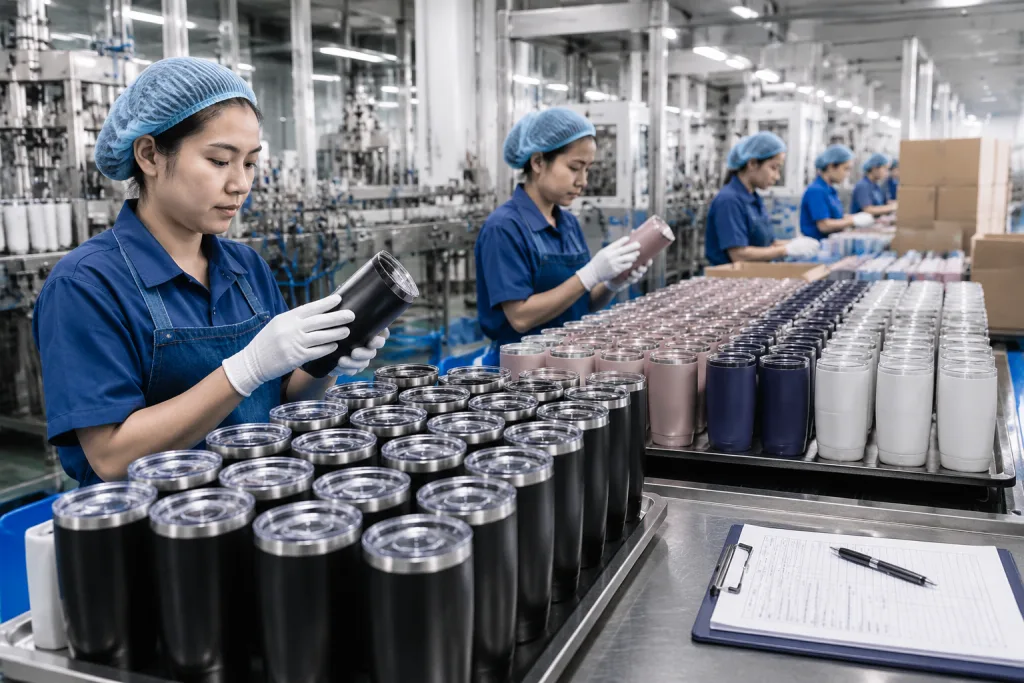
Most sourcing failures start the same way: the buyer skips process control and waits for final inspection to catch the whole lot. That gets expensive fast. A stable canteen manufacturer should walk you through control points from incoming steel to final packing, not just send a clean photo of finished cartons. On our line, QC pulled the sample at cup forming, not only at packing.
For stainless drinkware, ask about incoming material verification, weld inspection, vacuum testing, coating adhesion, and assembly checks. These are separate stations, and they should stay separate. A solid Zhejiang factory will have records for each step, even if it is a basic sheet clipped beside the line. We usually check logo offset with a 1 mm tolerance gauge, and buyers do flag this. If the answer sounds general, the risk is on your side.
Your minimum control checklist
- Incoming materials: steel grade confirmation, lid resin check, silicone hardness or food-contact declaration
- In-process controls: weld seam visual inspection, vacuum leak testing, coating thickness and adhesion checks
- Decoration control: logo position jig, bake temperature record, first-piece approval
- Final inspection: AQL sampling, carton drop test, barcode scan, assortment count
- Social and system compliance: BSCI, ISO 9001, Sedex or equivalent where required by your customers
If you supply major retail accounts, ask for a pre-shipment report with photos and actual counts. Not estimated counts. Actual counts. We have seen POs with one digit wrong on the assortment ratio, and that kind of typo can hold a shipment for days. For Europe, confirm REACH where applicable and migration safety for food-contact components. For North America, depending on the item and age grading, ASTM or CPSIA questions may come up, especially if kids bottles are packed with tumblers.
A serious canteen supplier or canteen manufacturers group should speak plainly about defect rates. Zero defects is the wrong question to ask. What matters is where defects are caught and how fast the line reacts. On one 20,000-piece run, our inspection found weak powder adhesion on the first bake test, so we stopped coating before mass loss built up. If a factory claims “100% perfect,” we have seen that go sideways.
When is custom development worth it?
Not every program needs a new mold. We see stocked tumbler bodies dressed up with a custom finish beat a full custom build all the time, and the math works better. On the line, a color swap and logo plate change move fast; a new body tool does not. Split cosmetic customization from structural customization first. This is the right question.
Cosmetic customization covers body color, powder coat texture, logo method, retail box, hangtag, and assortments. This is the fastest route for customized drinkware, and it usually stays within MOQ of 1,000-2,000 units per color or design. We run this work with existing jigs and screen fixtures, so sample approval is cleaner and lead time is shorter. For many canteen customized and customizable canteen projects, that is enough differentiation without opening tooling risk.
Structural customization means a new body silhouette, proprietary lid, integrated handle, unique base diameter, or special cap for a custom canteen or customized growler line. Go this route if you have protected distribution, forecast volume above 20,000-50,000 units, and margin that pays back the mold cost. A lid tool with slider action is not the same as a simple cap insert; we have seen quotes jump 30% after DFM review once the sealing geometry gets more complex. Tooling for a lid or cap system can range from a few thousand dollars upward, depending on complexity.
Ask your canteen factory to show exactly where new tooling creates market value. If the only change is a 3 mm taper on the sidewall, skip it. We have seen this go sideways. If a new lid fixes a leak complaint, gets the base into a 74 mm cup holder, or improves stack efficiency in cartons by 8-12%, then the buyer flagged a real problem and the tool has a job to do.
For distributor growler or custom growler programs, check the filling method and actual use case before you approve drawings. A 64 oz insulated growler with a swing top looks strong in a presentation, but we ship more dent claims on that format than on screw-cap designs because the head shape wastes carton space and takes hits in transit. One buyer pushed for a wide shoulder profile, then backed off after the drop-test sample came back with base deformation. Practicality wins in wholesale.
The rule is simple: use existing molds for speed and margin. Pay for new tooling only when it changes function, compliance, or sell-through.
Order checklist before you send deposit
Before you release payment, turn every assumption into a written line on the PO. This is where orders go sideways. The buyer thinks the logo sits 35 mm from the base, the factory runs 28 mm, and nobody catches it until QC pulled the sample from the line.
Your PO package should spell out the SKU list, capacities, Pantone references, approved artwork, decoration size and position, packaging spec, carton marks, barcode instruction, test requirements, inspection standard, ship window, and penalty or remedy language for major deviation. We have seen one typo on a PO change 30 oz to 20 oz, so this is not paperwork for its own sake. If you buy from China every season, this discipline saves more money than pushing for another USD 0.05 off the quote, because the math does not work once you reprint cartons or scrap lids.
- Specification lock: capacity, dimensions, steel grade, wall thickness, lid material, gasket color, plus the tolerance if 0.3 mm matters on the lid fit
- Artwork lock: vector file, size, position drawing, approved proof date, and the exact print area the buyer flagged on the mockup
- Packaging lock: box board grade, insert material, carton quantity, carton size, and gross weight limits such as 18 kg max per carton
- Compliance lock: REACH, FDA, LFGB, Prop 65, BSCI, or account-specific test plan, including who pays if a lab sample fails
- Logistics lock: FOB port, pallet rule, FNSKU, shipping mark, split shipment terms, and whether the warehouse rejects overhang on 1100 x 1100 mm pallets
If your supplier is a canteen vendor rather than a direct canteen manufacturer, ask who controls production and who signs off on quality. Ask for names. This is the right question, and we have seen traders get stuck when a lid leak issue showed up at final inspection and nobody would own the rework. Good canteen distributors and canteen suppliers answer this fast.
BottleForge Industrial in Hangzhou, Zhejiang handles projects this way because it cuts disputes later. With capacity around 400,000 units per month and typical lead times of 30-35 days on standard insulated tumblers, the daily work is plain stuff: seal-ring checks, carton drop test records, first-article approval sheets. We ship cleaner orders this way. That is how custom drinkware programs stay profitable and repeatable.
Get a practical quote for your tumbler program
Send your target size, quantity, decoration, and ship date. We will reply with workable MOQ, FOB pricing, sample timing, and the factory controls behind it.
Frequently asked questions
What MOQ should insulated tumbler distributors expect for private label orders?
For a standard existing tumbler mold, 1,000 units per SKU is a realistic opening MOQ in China. If you need one body color, one logo, and a plain box, some factories can work at that level. Once you add custom retail packaging, multiple colorways, or a non-standard lid, the practical MOQ often moves to 2,000-3,000 units per SKU. For fully new tooling, volume expectations should usually be 20,000 units or more to justify mold cost and setup. If you are buying a wider canteen custom range, ask whether MOQ is per color, per logo, or per shipment total. Those details affect your inventory risk more than the headline MOQ itself.
How long does a custom insulated tumbler order usually take from China?
For an existing body and lid with normal customization, plan roughly 7-10 days for a pre-production sample and 25-35 days for mass production after sample approval and deposit. During peak season, especially before Q4, production can move closer to 40 days. New tooling for a tumbler lid or custom canteen cap may add another 20-35 days depending on mold complexity and testing. Add transit time separately: ocean freight to the US or Europe commonly takes 25-45 days port to port, plus inland handling. If your distributor drinkware program has a strict launch date, build in at least 10% time buffer for carton approval, lab testing, or rework.
What compliance documents should a buyer ask for on custom drinkware?
At minimum, ask for food-contact material declarations for steel, plastic, and silicone parts, plus test reports relevant to your market. For Europe, REACH and sometimes LFGB-related expectations come up frequently. For North America, FDA food-contact positioning is common, and California Proposition 65 may matter depending on your channel. If kids use is involved, ASTM or CPSIA questions can appear. On the factory side, BSCI, Sedex, or ISO 9001 may be required by larger accounts. Also ask whether reports are from the exact product family or only a similar sample. A report dated three years ago on another lid style is weak support if you are buying a customized growler or tumbler with different plastics.
Is 201 stainless steel acceptable for insulated tumblers, or should we insist on 304?
For the inner wall, you should normally insist on 304 stainless steel for food contact in mainstream export programs. For the outer wall, some canteen manufacturers offer 201 to reduce cost. It is not automatically unusable, but the savings are often modest, around 3-6%, while the product may feel less premium to your customer. Many insulated tumbler distributors serving Europe and North America prefer 304/304 because it simplifies sales conversations and supports a stronger quality position. If a supplier quotes unusually low, ask directly whether the outer is 201 and whether wall thickness has also been reduced from 0.5 mm to 0.4 mm. Low price often comes from several small cuts together.
How can we reduce leakage and return claims on tumbler lids?
First, define the lid honestly in your spec and sales material. A slider lid is usually splash-resistant, not fully leakproof. If your channel expects travel performance, move to a threaded lid with a silicone gasket and request leak testing on assembled samples. Second, approve the exact production lid, not a showroom substitute. Third, include functional checks in final inspection: inverted hold test, seal fit, thread engagement, and visual check for flashing or warped plastic. If you sell on Amazon or through distributors who dislike returns, spend the extra USD 0.10-0.25 on a better lid system. That cost is usually lower than one avoidable replacement claim, reverse logistics fee, or damaged rating.