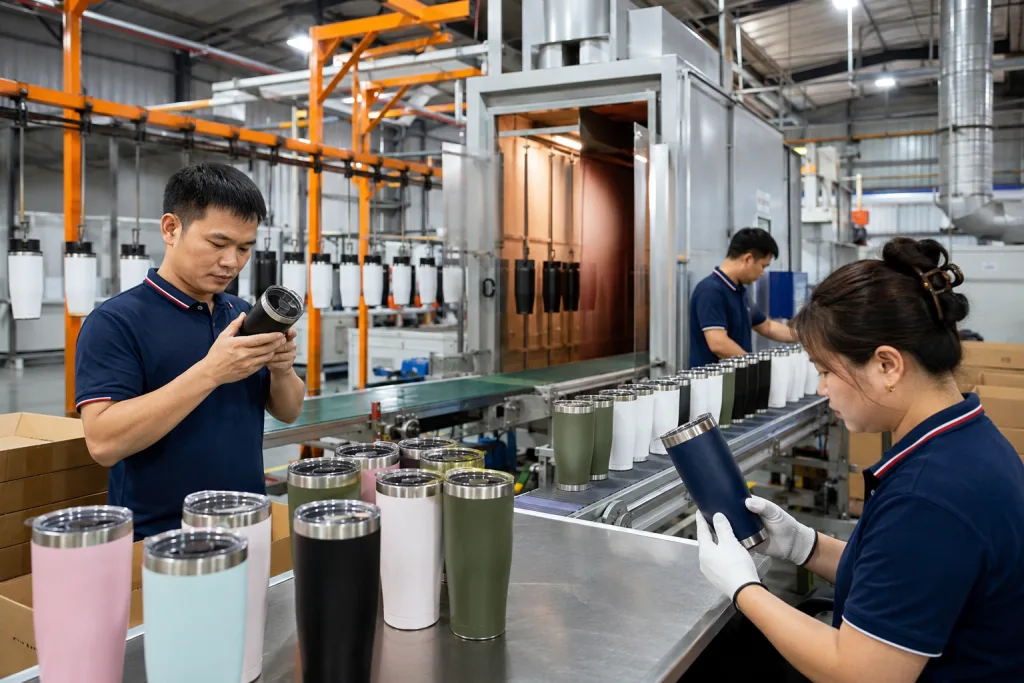
Key Takeaways
- For most insulated tumbler customized projects, practical MOQ starts at 1,000-3,000 pcs per color, with 25-35 day mass production after sample approval
- A 304 stainless steel double-wall vacuum tumbler typically lands around USD 3.20-6.80 FOB China depending on size, coating, lid type, and print method
- Logo method changes both cost and durability: silk screen can add USD 0.08-0.20, laser engraving USD 0.12-0.35, and dishwasher survival differs sharply
- Ask for AQL 2.5, leak test records, coating adhesion checks, and REACH or LFGB raw material declarations before paying the balance
You already know the tumbler market is crowded. Finding a factory in China or Zhejiang is easy. The hard part is picking an insulated tumbler customized program that fits your sales channel, margin, compliance risk, and reorder cycle. A 30 oz tumbler that looks good in a hand sample can still fail at 3,000 units: lid leakage at 15 kPa, logo rub-off after 50 tape pulls, carton drop damage from 76 cm, or a shelf-height miss by 8 mm. We’ve seen this go sideways on the line.
Most buying mistakes happen before production. Wrong steel grade. Loose artwork rules. MOQ that doesn’t match the budget. Packaging that adds USD 0.60 when the target only has room for USD 0.18, so the math doesn't work. Last month a buyer flagged a PO typo that switched 304 stainless to 201, and QC pulled the sample before mass production. If you source custom drinkware, custom canteen items, or a customized growler range, you need a checklist built around supplier questions with clear numbers, not broad requests.
Start with your actual sales channel
Before you ask a canteen manufacturer for a quote, decide where the product will sell first. This sounds basic. Still, we get 7 out of 10 RFQs asking for one universal tumbler for retail, corporate gifting, e-commerce, and distributor canteen programs. That usually gives you a middle-spec item that fits everywhere on paper and sells poorly in all four channels. We’ve seen this go sideways on the line when the buyer wants a gift-box look, FBA carton limits, and a distributor case pack in the same PO.
If you sell through retail in Europe, shelf impact and compliance documents matter more than adding three lid options; on one recent project, the buyer flagged a 2 mm logo shift on the color box before they even asked about the slider lid. If you sell to a canteen distributor network in North America, speed, stable case packs, and repeatability matter more than a new handle shape. We ship those programs in fixed 24-pack masters because the warehouse math doesn't work with mixed counts. If you are building customizable drinkware for promotional campaigns, logo area and color matching matter more than premium base material. QC pulled the sample last month because the Pantone match was off by one shade, while the 304 stainless body was fine.
Use a short internal checklist before you send an RFQ:
- Target price: ex-factory or FOB, not just “best price”
- Channel: retail, e-commerce, canteen promotional, gifting, distributor drinkware, or hospitality
- Volume: launch quantity and 90-day reorder estimate
- Compliance: REACH, LFGB, FDA, Prop 65, ASTM where relevant
- Packaging: brown box, color box, PDQ, master carton limit, FNSKU label need
- Decoration: 1-color silk screen, wrap print, powder coat with laser, or embossing
At BottleForge Industrial in Zhejiang, we see buyers save the most money by narrowing the use case first. A tumbler built for Amazon FBA needs different carton sizing than a custom growler made for brewery merchandising; one goes through carton drop tests and dimensional checks, the other usually starts with presentation. A customizable canteen line for school programs may need 350 ml and 500 ml bodies plus safer lid geometry with no sharp flip-tab edge. This is the wrong question to ask: “What is your best tumbler?” Ask for the right spec for your margin, your channel, and your reorder plan.
What specs should you lock first
Buyers ask for insulated tumbler customized and mean logo printing. That step is late. Lock the base construction first. On our line, the first sample check starts with body weight in grams and wall reading on a micrometer, not artwork size. For mainstream B2B orders, the core spec should cover steel grade, wall build, capacity, lid system, coating, and the thermal target.
Minimum spec sheet items
- Body material: 18/8 stainless steel, usually SUS304 inner and outer
- Vacuum structure: double-wall, copper-plated inner wall if premium thermal performance is needed
- Capacity: 12 oz, 20 oz, 30 oz, 40 oz are common
- Wall thickness: outer body often 0.4-0.5 mm, inner 0.3-0.4 mm
- Lid: AS, Tritan, PP, slider, straw lid, or screw lid
- Coating: spray paint, powder coat, base stainless, electroplated finish
- Performance: for example 6 hours hot, 12 hours cold minimum
Use a real price benchmark. A 20 oz powder-coated tumbler with SUS304 double wall, clear slider lid, and laser logo usually quotes around USD 3.20-4.40 FOB China at 3,000 pcs. A 40 oz handled tumbler with straw lid and more complex packaging can move to USD 5.20-6.80 FOB. If a canteen supplier quotes far below that, ask where the cost came out. We have seen QC pull samples with 0.32 mm outer walls instead of 0.45 mm, loose lid silicone, or carton drop failures on the first inspection. Cheap is not the right question here. What was cut?
If you are sourcing from a canteen factory in Zhejiang or elsewhere in China, ask for the thermal test method, not just the claim. Ask the water fill temperature, ambient room temperature, and the test duration points. We ship reports that show 0 hour, 2 hour, 4 hour, 6 hour, and 12 hour readings. Buyers should also confirm whether the bottom fits standard car cup holders, whether the handle is welded or mechanical fixed, and whether replacement lids are available. One buyer flagged a 76 mm cup-holder base on a PO after approval; the retail complaint rate went up fast. These details drive returns more than color does.
You can change artwork fast. You will not fix the wrong lid, wrong steel, or wrong body tooling cheaply after approval.
How customization changes cost and MOQ
Customization cost does not move in a straight line. A logo swap might add a few cents. A base diameter change can force a new tooling route and push sampling out by 20-35 days. If you source customized drinkware every season, split cosmetic changes from structural changes first. This is the right question. On the line, the difference is obvious: changing a silk screen plate takes minutes, but changing a mold means new drawings, new sample checks, and usually a caliper in QC checking 0.3 mm tolerance at the first article stage.
Low-impact customization usually means one-color silk screen, laser engraving, standard powder coat colors, barcode labels, and carton marks. These usually add USD 0.03-0.35 per unit depending on artwork size and quantity. We run these jobs every week. A buyer once flagged a logo that printed 4 mm too close to the seam, and QC pulled the sample before mass print, which saved a full rework on 2,000 pcs.
Medium-impact customization includes wrap print, multi-position artwork, custom color box, molded hang tag insert, and mixed-color case packs. These hit labor hours and packing speed, not just material cost. Expect MOQ of 1,000-3,000 pcs and possible setup fees of USD 50-200 per design. On packing, mixed-color case packs are where orders get messy fast; if the PO has one carton ratio typo, the warehouse catches it late and the line stops while we recount inner boxes.
High-impact customization includes new lid molds, custom handles, embossed body features, unique base diameters, and fully custom customized canteen or customizable growler bodies. Tooling can range from USD 2,000 to USD 12,000 and may need 20-35 extra days before pre-production samples. This is where buyers often underestimate the work. A new lid is not just steel cost. We also check fit, leak performance, drop test results, and thread match; if the first sample is off by 0.2 mm, the math doesn't work and the mold goes back for correction.
For buyers working with canteen vendors or canteen suppliers, the practical question is simple: does your volume pay for structural change? If your annual plan is 2,000 units, stay close to existing molds. If your annual plan is 50,000 units across several SKUs, custom tooling may pay back fast by separating your range and protecting margin. We've seen this go sideways when a buyer wants a custom handle for one trial order, then cuts the forecast after approval.
A realistic MOQ guide:
- Stock color + 1 logo: 500-1,000 pcs on some models
- Standard model + custom coating: 1,000-3,000 pcs
- Custom box + standard body: 1,000-3,000 pcs
- New mold project: usually 3,000-10,000 pcs depending on body and lid complexity
Our Hangzhou, Zhejiang production planning usually targets 600,000 units per month across drinkware lines, but mixed small orders still drag output. We ship volume, but the line slows when one PO carries 18 SKUs, 6 lid colors, and 4 packing methods. If you want better pricing from canteen manufacturers, reduce SKU fragmentation before the PO is issued. That step matters more than pushing for another USD 0.05.
Which logo method survives real use
A lot of buyers pick the logo method by the render. That is where claims start. The right choice depends on the coating, how often the cup gets handled, wash conditions, and where it will be sold. An office gift tumbler used at a desk is different from a canteen custom bottle going into outdoor retail, where the buyer will scratch it with a carabiner in week one. On our line, QC pulled samples with logos still looking fine at packing, then failing after 200 dishwasher cycles because the coating and artwork stack-up were wrong.
Common decoration choices
- Silk screen: low cost, clean for simple logos, best on flat or lightly curved areas. Typical add-on USD 0.08-0.20. We normally ask for artwork lines above 0.15 mm, or the edges start to break.
- Heat transfer: more color detail, useful for gradients or complex graphics. Typical add-on USD 0.18-0.45. Good option if the buyer flagged small text or photo-style art on a 20 oz body.
- Laser engraving: durable on powder-coated or painted surfaces, premium look. Typical add-on USD 0.12-0.35. We run this a lot on matte powder coat because the logo stays put after daily use.
- UV print: sharp detail, fast for smaller runs, but durability varies by coating and handling. We have seen this go sideways on slick finishes if adhesion is not checked first.
- Emboss/deboss or molded branding: useful for deeper differentiation, but generally tied to custom tooling. This usually means MOQ starts around 3,000 pcs and a new mold review.
For canteen distributors supplying hospitality, laser on powder coat is usually the safest cost-durability balance. That is the short answer. For a canteen promotional item tied to a one-time campaign, silk screen is often enough, and the math does not work for a heavier process. If you sell customizable canteen products online and expect repeat dishwasher use, ask for abrasion and adhesion test data first. This is the wrong question to ask after mass production. Last month, a buyer pushed back on a logo fade issue, and the root cause was simple: artwork approved on a glossy render, no physical sample, no rub test record.
Good questions to send your canteen vendor:
- Does the coating pass cross-hatch adhesion testing?
- How many rub cycles were tested for the logo area?
- Is the logo applied before or after final cure?
- What Pantone matching tolerance can you hold?
- Will seam position affect artwork placement?
Do not approve a mockup from a digital rendering alone. Ask for a physical pre-production sample with final coating, final lid, and final logo position. We ship these approval samples every week, and they catch small issues fast: seam shifted 3 mm, logo sitting too close to the handle weld, even a PO typo in the artwork code. One sample costs little. An argument over 5,000 units costs more.
What to audit before you pay deposit
Not every canteen supplier issue starts with bad intent. A lot of it is weak process control on the line. Ask procurement to collect order-linked records, not sales slides and broad claims. If you buy from canteen manufacturers in China, ask for proof on the exact SKU, lid, finish, and carton spec on your PO. We’ve seen a supplier show one nice ISO file, then fail a 0.5 mm thread-fit check on the actual sample.
Your audit checklist should include:
- Factory capability: monthly capacity, main equipment, in-house coating or outsourced coating, leak test line
- Social and system: BSCI, ISO 9001, Sedex if your account requires it
- Material declarations: stainless grade, plastic resin type, BPA-free statement where relevant
- Compliance: REACH, LFGB, FDA, Prop 65 depending on market
- Inspection plan: AQL 2.5 for major defects is common, but confirm your exact standard
- Packaging validation: carton drop test, barcode scan check, shipping marks approval
For insulated tumblers, the common major defects are leaks, bad thread fit, coating scratches, off-center logos, dented rims, and unstable base welding. Ask the canteen factory how it controls each point. This is the right question. A solid answer sounds like shop-floor language: 100% air-pressure leak test at 0.6 MPa, incoming lid fit inspection with go/no-go gauges, coating cure temperature records from the oven, and final random drop test after packing. If QC pulled the sample and found logo shift over 1.5 mm, the buyer flagged it fast.
Ask if production stays in one site or is split across workshops. Some canteen vendors quote as factories, then send coating or assembly outside. That is not always a problem. It does add another failure point, another truck transfer, and usually 2 days to 5 days to lead time. We’ve seen this go sideways when the coating shop missed color match and the assembly line kept waiting.
For balance terms, a lot of B2B projects still run 30% deposit and 70% balance against inspection or copy B/L. If your order includes custom logo retail packaging, do not release balance until carton marks, barcode readability, and pack-out count are checked against the approved file. The last 48 hours before shipment create the easiest mistakes. One common case is simple: outer carton says 24 pcs, actual pack-out is 20 pcs, or a PO typo drops one digit from the item code.
How long will the order really take
Lead-time talks go wrong when the buyer asks for one number and the factory gives one back. That is the wrong question to ask. For a standard insulated tumbler customized order from Zhejiang, we break the schedule by step: 3-7 days for quotation and artwork review, 7-12 days for sample preparation, 2-5 days for revisions, and 25-35 days for mass production after final approval and deposit. During peak season, add 7-15 days. On the line, even a 2 mm logo shift on the screen print can push a replacement sample by 2 more days because QC pulled the sample and the artwork has to be re-signed.
If your project involves custom box printing, packaging often becomes the critical path. We have seen the tumbler body finished, packed in PE bags, and sitting ready while shipment stopped because the insert size changed by 5 mm or the outer carton mark had one PO typo. Same issue with FNSKU and Amazon carton rules for e-commerce programs. The buyer flagged it, and the truck did not load.
Questions that expose lead-time risk
- Are lids stocked or made to order?
- Is powder coating done in-house?
- How many days for replacement sample if logo position is changed?
- Can body production and box printing run in parallel?
- What is the cut-off date before Chinese New Year?
Buyers working with distributor growler or distributor canteen programs should also ask about replenishment strategy. If the model is likely to repeat, lock a standard color palette and one packaging format early. That can cut reorder time by 5-10 days and reduce carton waste. We ship repeat orders faster when the factory keeps the same master carton spec, like 485 × 485 × 260 mm, across a wider custom drinkware line including custom growler, sports bottle, and tumbler. It sounds small. It saves handling cost in North America and Europe, and we have seen mixed carton sizes go sideways at 3PL warehouses.
The honest answer is simple: if a canteen vendor promises 15 days on a new customized canteen tumbler with packaging and compliance paperwork, push back. The math doesn't work. A new item with paperwork, sample sign-off, and printed packaging is not a 15-day job unless stock parts are already sitting in the factory and the packaging is plain. Fast promises are cheap. Delivered orders matter.
Questions smart buyers ask at reorder stage
The first PO shows the item is buildable. The second PO shows whether the supplier can actually run your account without drama. We’ve seen buyers switch after reorder because the sample looked fine, then the line missed details that were never a problem in sampling.
At reorder stage, check three points with numbers behind them: price stability, color stability, component stability. This is the right question to ask. Steel prices move. Resin prices move. Freight moves. Still, if a repeat order jumps more than 5-8% with no major spec change, ask for the cost split by body, lid, packing, and freight. On our side, we usually compare the last BOM revision and carton spec first; once a buyer flagged a $0.18 increase that came from a master carton change from 5-layer to 7-layer.
Color consistency trips up more first-time importers than they expect. Powder coat lots do shift. If your retailer has a fixed brand color, keep an approved retain sample in hand and ask for a fresh production sample checked against that standard, not against a photo on WeChat. QC pulled the sample once here and measured a 1.2 ΔE gap that looked small under workshop light but failed under store lighting. The same rule applies if you run custom canteen or customized growler programs across multiple seasons.
Component stability is usually where reorders go sideways. Lids, straws, gaskets, and handle fittings often come from different upstream vendors, and one silent material swap can change field performance fast. A gasket Shore A change from 50 to 60, or a straw resin shift, can alter sealing and fit even if the 304 stainless body stays the same. We ship plenty of repeat programs, and the buyer pushback is always the same: “body is unchanged, why is leakage higher?” Put change notification into the PO terms before that happens.
For long-term distributor drinkware programs, ask your canteen distributor-facing supplier these questions:
- Will you hold spare lids or gaskets for 6-12 months?
- Can you support mixed container loading across tumbler and custom growler SKUs?
- Do you keep artwork films and laser files for repeat orders?
- What was the defect rate on the first run?
- Can you provide production photos and carton loading records on each repeat PO?
Reliable sourcing from China is not one good sample. It is repeat output at volume, on schedule, with less chasing on every PO. If the factory in Zhejiang can hold the same finish, same fit, and same packing over 3 repeat orders, the math works. If not, it doesn’t. We’ve even seen a repeat PO delayed 4 days because one lid color code was typed wrong in the order sheet.
Get a tumbler quote built for your channel
Send your target price, quantity, logo file, and market. We will reply with practical MOQ, FOB pricing, lead time, and compliance options from Zhejiang.
Frequently asked questions
What is a normal MOQ for an insulated tumbler customized order?
For a standard model with one logo, MOQ is commonly 1,000 pcs per color, though some factories in China will accept 500 pcs on stock colors. If you want a custom powder coat, retail box, or mixed lid options, MOQ usually moves to 1,000-3,000 pcs. A fully custom body or lid mold can start at 3,000-10,000 pcs. If your annual demand is under 2,000 units, stay with an existing mold and customize decoration and packaging only. That keeps tooling costs off the project and shortens lead time by roughly 20-30 days.
How much should I budget per unit for custom drinkware tumblers?
For B2B planning, a 20 oz double-wall vacuum tumbler in SUS304 with standard lid and one logo often lands around USD 3.20-4.40 FOB China at 3,000 pcs. A larger 30 oz or 40 oz model with handle, straw lid, and color box is more often USD 5.20-6.80 FOB. Add roughly USD 0.08-0.20 for silk screen, USD 0.12-0.35 for laser, and USD 0.25-0.80 for upgraded packaging depending on insert complexity. If a quote is dramatically lower, check steel thickness, coating quality, and whether testing or replacement parts are excluded.
What compliance documents should European and North American buyers request?
At minimum, ask for food-contact declarations for stainless steel and plastic parts, plus market-specific testing. Europe commonly requires REACH and often LFGB depending on your customer expectation. North America usually asks for FDA-contact compliance, and some accounts require Prop 65 statements. If the item is for children, ASTM-related checks may become relevant depending on design and components. Also request BPA-free statements where applicable, carton spec confirmation, and an inspection plan such as AQL 2.5. Good factories in Zhejiang should provide document sets tied to the exact SKU, not only a generic certificate from a different product.
Which logo method is best for a canteen promotional order?
If cost is the priority and the campaign is short-term, silk screen is usually enough at around USD 0.08-0.20 per unit. If you need stronger durability and a more premium finish, laser engraving on powder coat is the safer option, usually around USD 0.12-0.35. Heat transfer works well for multicolor artwork but adds more cost and can be less forgiving on curved bodies. For promotional use, ask for a pre-production sample with final coating and final artwork placement. Also confirm logo size, Pantone tolerance, and abrasion testing so you do not approve a visual sample that fails after normal handling.
How can I reduce risk when ordering from a new canteen supplier?
Start with one standard model, one lid, and limited color count. Request a full specification sheet, pre-production sample, and packaging mockup before deposit. Use clear inspection terms such as AQL 2.5, and confirm 100% leak testing plus random carton drop testing. Ask whether coating and assembly are done in-house or outsourced. Typical payment terms are 30% deposit and 70% before shipment, but do not release balance until you approve final inspection results, barcode setup, and carton marks. For a first PO, keeping the order around 1,000-3,000 pcs is often a smart balance between factory efficiency and your exposure.