Key Takeaways
- A standard 20 oz insulated tumbler customizable project usually starts at MOQ 1,000-3,000 pcs, with ex-works pricing around USD 2.60-4.80 depending on steel grade and decoration.
- New decoration setup is often USD 40-120 per color per SKU, while simple package changes can add USD 0.18-0.65 per unit.
- Mass production lead time from Zhejiang, China is commonly 25-40 days after sample approval and deposit; peak season can push this to 45-60 days.
- AQL 2.5/4.0 inspection, leak testing, and carton drop validation usually reduce painful claims more than chasing a USD 0.05 unit price cut.
You are not short of insulated tumbler customizable suppliers. The hard part is comparing quotes that look close on page one, then split fast once sampling, logo process, testing, and delivery get added. We see this every week on the line: a 20 oz tumbler quoted at USD 2.85 turns into USD 4.10 landed after a 0.3 mm lid tweak, individual boxes, and a realistic reject allowance. That is where first-time B2B buyers give up margin.
In Zhejiang, this pattern is routine. A buyer asks for a fast price, then QC pulled the sample and the real question becomes cost per usable unit and 12 days vs 18 days to ship. If you also source custom canteen, customized drinkware, or a customizable growler line, the same math applies. You need to pin down what drives price, what stretches lead time, and what must be locked before deposit. Asking only for the lowest unit price is the wrong question.
Where your unit price really moves
For an insulated tumbler customizable program, the base cup is only part of the quote. Buyers often stare at the 20 oz body and miss the cost stack behind it. On our line, the real unit price usually moves across six cost blocks: steel grade, cup structure, lid build, decoration method, packaging spec, and defect risk. We have quoted the same 20 oz silhouette from two factories with a gap above USD 1.20 per unit, and the difference was not shape. It was wall thickness, lid parts, coating route, and pack-out.
The first driver is material, and this is where buyers should get specific. A common double-wall vacuum tumbler in 18/8 stainless steel with an inner wall around 0.304 mm and outer wall around 0.45 mm will usually cost more than a 201-grade outer wall version. If you sell in Europe or North America, 304 interior is the safer baseline for taste, corrosion, and compliance paperwork. We check wall thickness with an ultrasonic gauge, and QC pulled samples before that came in light on the outer wall by 0.03 mm. Powder coating usually adds USD 0.18-0.35 per unit. A full-wrap heat transfer print can add another USD 0.25-0.55. Laser engraving is often only USD 0.05-0.12 for a simple logo, which is why many buyers pick it for low-risk corporate orders. Asking only for the cheapest steel is the wrong question to ask.
The second driver is lid complexity. A basic slider lid is cheaper than a screw lid with a gasket, straw opening, and color matching. That extra gasket looks small on paper. It is not small on the line. Lid tooling is not always needed, but custom lid colors or mixed-material assemblies can increase defect risk and assembly time. We have seen buyers flag a 0.5 mm color mismatch between the PP lid and silicone piece, and then the whole approval stalled. We've seen this go sideways faster than cup-body changes.
- Body material: 304/304 costs more than 304/201, but claim rates are usually lower; on repeat orders above 5,000 pcs, the math often works better with fewer after-sales issues.
- Surface finish: spray paint is cheaper; powder coat is more durable, and we usually see fewer scratch findings in carton drop checks.
- Decoration: 1-color screen print is usually the lowest entry cost; if the PO logo has fine lines under 0.2 mm, the buyer should expect limits.
- Packaging: white box is standard; gift box or PDQ tray changes the math fast, especially once carton size pushes freight up.
If you also buy custom canteen, customized growler, or other customizable drinkware, use the same rule. Compare the full spec sheet, not the headline price. We ship too many projects where the low quote was based on a thinner wall, simpler lid, or cheaper insert card that nobody caught on page one.
MOQ tiers and what they change
MOQ is not some factory slogan. It decides whether we can buy 304 stainless in the right lot, book the vacuum line without dead time, and keep Pantone drift under control from first cup to last. A Zhejiang plant running 300,000 units a month still will not price every SKU cleanly at 300 pieces; the math doesn't work. For most stock molds, the workable MOQ for a custom-decorated tumbler is 1,000 pcs per size, and we usually run that across 2 colors after QC pulled the spray sample. If you add harder decoration or custom packaging, 3,000 pcs is usually the point where price starts moving in your favor.
Here is how MOQ tiers usually behave for a 20 oz vacuum tumbler:
- 500 pcs: workable on repeat orders or stock colors, but unit price is often 12%-20% higher because setup gets spread across too few pieces.
- 1,000 pcs: the normal entry point for custom logo production; this is where most buyers start, and the line runs without awkward changeovers.
- 3,000 pcs: better control on color matching, tighter carton use, and more room for packaging options; at this level we can usually ship a cleaner master carton plan.
- 5,000+ pcs: the stronger case for custom lids, gift sets, or bundled straw kits, especially if the buyer flagged retail presentation on a 62 x 42 x 28 cm carton.
Buyers often ask if one PO can be split across tumbler, customized canteen, and customizable growler items. You can do it, but MOQ sits on each SKU, not on the total PO value. This is the wrong question to ask. A good canteen manufacturer or canteen supplier may combine planning if finishes or outer cartons match, but different molds still need their own setup cost, and we've seen this go sideways when a PO had one lid code typed wrong.
If you are a distributor drinkware buyer serving 6 or 8 accounts, ask for tier pricing at 1,000 / 3,000 / 5,000 units before sample approval. Then you can see if the jump saves USD 0.22 per unit or just adds slow stock on your floor. We ship against those breakpoints every week. Experienced canteen distributors and distributor canteen importers usually buy at the factory breakpoints, not at random round numbers.
Decoration, packaging, and hidden add-ons
The fastest way to wreck a margin plan is calling decoration and packaging “small extras.” They are not. On promo and retail tumbler orders, these two lines often add 15%-30% above the plain bottle, and on the line we see it sooner than buyers do because the PO price stays flat while the add-ons keep stacking.
A basic 1-color silk screen logo usually carries a setup charge of USD 40-80 per color per artwork, then adds USD 0.04-0.10 per unit. We run this on a semi-auto screen station, and registration drift over 1.5 mm is where QC pulled the sample on one recent order. Laser engraving needs less setup in most cases and looks cleaner on powder-coated finishes. Full-wrap digital transfer hits harder at retail, but expect USD 0.25-0.55 per unit and slower artwork sign-off. Buyers push back on that number all the time. The math doesn't work if your target is a low-price giveaway.
Packaging is where newer buyers usually get caught. Standard export white box is often built into the quote. Once you ask for a custom printed mailer, insert card, barcode label, tissue wrap, or gift tube, cost starts stacking, and packing speed drops from one rhythm to another because the line has more handwork:
- Custom color box: USD 0.18-0.35
- Gift box with insert: USD 0.45-0.90
- FNSKU or barcode label: USD 0.02-0.05
- Hangtag or paper sleeve: USD 0.03-0.08
- Drop-test reinforcement: often adds carton cost and packing labor
If you are buying canteen promotional items for events, keep it simple. One logo, one stock box, ship it. If you are building a retail launch, spend where the shopper sees it first. Usually that means surface finish and front-of-pack graphics, not a fancy insert nobody remembers. A reliable canteen vendor should say that plainly. We have seen this go sideways when a buyer spent USD 0.62 on the box and argued over USD 0.08 on the print.
Ask for the quote in four lines: product, decoration, packaging, and test/other fees. This is the right question to ask. If a supplier resists that breakdown, revisions get messy later, and even a small PO typo on barcode quantity can turn into a repack bill.
The same rule applies whether you source a tumbler, a custom growler, or a customized drinkware assortment from one canteen factory or several canteen vendors. Different suppliers quote different ways, so if the cost sheet is not split cleanly, you cannot compare it cleanly.
Sample stages buyers should budget for
Lead time starts before mass production. It starts with the sample stage you ask us to run. We see delays here all the time because buyers treat every sample like the same checkpoint. They are not. On our line, a reference sample and a pre-production logo sample move through different hands, and the timing is different from day one.
Reference sample
If you pick a stock model from a China factory catalog, a blank or stock-color reference sample usually ships in 2-5 days. Cost is often free against freight, or about USD 15-35 per piece plus courier. This sample is for shape, hand feel, and basic lid function. It is not for final branding. We have seen buyers flag a color on a stock sample, then realize later the PO only asked for body shape approval. That slows the next step for no good reason.
Pre-production logo sample
Once artwork is locked, a custom logo sample usually takes 5-10 days. This is the stage to check print position, Pantone approximation, finish texture, and lid fit. Typical cost is USD 50-100, sometimes refundable against a bulk order. QC pulled the sample here against the artwork file, not against a rough mock-up, and that detail matters. If your logo sits 3 mm higher than expected or the screen print looks too warm under warehouse light, this is where you catch it. Frankly, this is the wrong sample to rush.
Tooling or packaging mock-up
If you need a new lid color, custom box, or insert, allow 7-12 extra days. New tooling, even for a small canteen accessory, can extend this to 20-30 days before production timing becomes reliable. A packaging mock-up sounds simple, but we still need to check carton size, insert fit, and drop-test risk. We once had a buyer push back on 2 mm extra headspace in the box, and they were right to ask because the tumbler moved too much inside.
Serious buyers in Europe and North America usually approve three points in writing: product specification, artwork placement, packaging layout. If one stays vague, the factory will fill in the gap. We ship against the approved file set, not assumptions. The math doesn't work any other way.
For canteen custom or canteen customized programs sold through retail chains, I also recommend a sealed golden sample kept by both sides. It is dull paperwork, but we have seen this go sideways over logo size and matte color. One retained sample with a signed date fixes a lot. Strong canteen suppliers and canteen manufacturers in Zhejiang already run this method because it cuts rework and argument after shipment.
A realistic production and shipping calendar
After sample approval and deposit, the normal production window for an insulated tumbler customizable order is 25-40 days. That is the range we actually quote for standard vacuum tumblers with custom logo and regular export cartons. On our side, if the order uses stock lids and stock color sleeves already on the shelf, the line can close in 20-25 days. If the PO lands in the August to November rush, 45-60 days is the honest number. We have seen this go sideways when a buyer asks for “fast” first and confirms artwork three days late.
A practical timeline looks like this:
- Day 1-3: PI confirmation, deposit, artwork approval; sales checks the PO line by line because we still catch basic errors like a wrong logo code or a lid color typo
- Day 4-10: pre-production sample or final packaging confirmation; QC pulled the sample and carton dieline before mass run
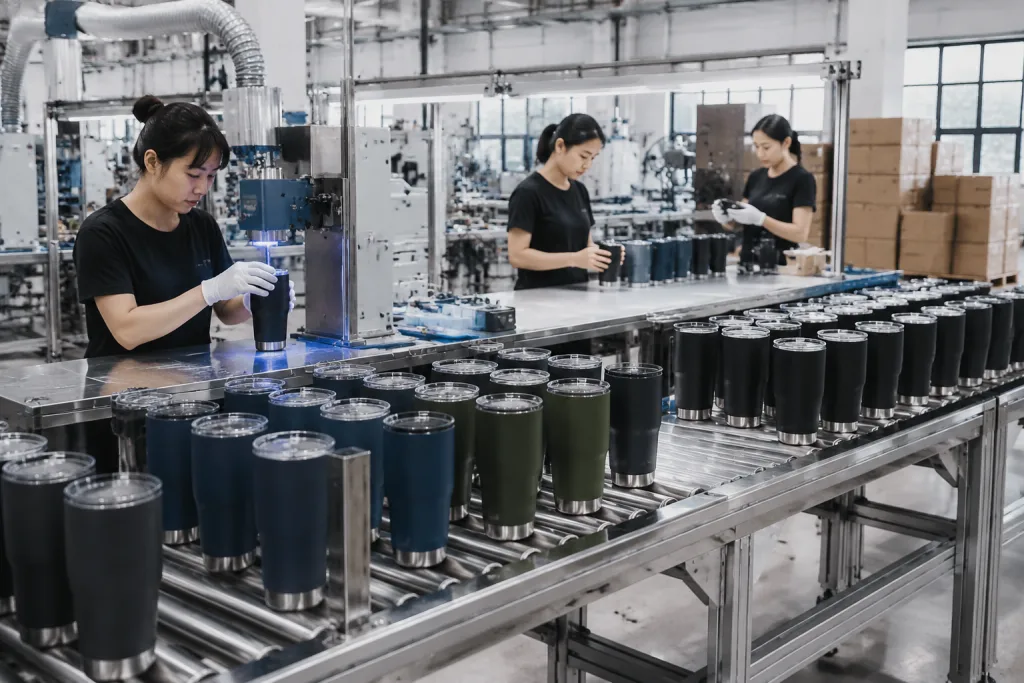
- Day 11-28: body production, vacuum process, coating; the vacuum line and powder coating booth set the pace here
- Day 29-35: decoration, assembly, packing; this is where the buyer flagged print position before, off by 2 mm on one side
- Day 36-40: inspection, balance payment, booking; if booking is tight, we reserve space before the final carton count is locked
Then shipping starts. By sea from Ningbo or Shanghai, which is standard for Zhejiang cargo, expect roughly 25-35 days to West Coast North America, 35-45 days to East Coast, and 30-40 days to main EU ports, not counting customs or inland delivery. Port choice alone can change the handoff by 1-2 days, and truck loading at our Hangzhou side usually runs on 40HQ schedules. Air freight is faster, but for stainless drinkware the math doesn’t work unless the order is small or the deadline is already broken.
If you are a canteen distributor or one of several canteen distributors serving promotional deadlines, add at least 10 buffer days. That is the safer call. Factories miss schedules for two common reasons: artwork changes after approval and packaging materials arriving late from outside vendors. We also see delays when an insert card supplier misses color correction on the first proof. That is why disciplined canteen suppliers ask for final sign-off before they book line time.
Quality controls that protect landed cost
The cheapest tumbler often turns into the most expensive batch after claims hit. We have seen a 3,000-unit order with 4% failures wipe out the price win fast: leak complaints, metallic smell, logo rub-off, then credits, repacking labor, and customer-service fallout. On the line, QC pulled the sample and found pinhole leaks at the lid seat. That is where landed cost gets wrecked.
Lock the inspection rules before mass production, not after the buyer flagged it. A common standard is AQL 2.5 for major defects and 4.0 for minor defects. For insulated tumblers, write the defect list in plain terms: vacuum retention hours, leakage angle, coating adhesion, print durability, and carton condition. For children’s lines or mixed materials, add ASTM or LFGB-related checks based on market and product type. For Europe, ask about REACH; for broader factory systems, ask whether the site works under ISO 9001 and social audit programs such as BSCI. One practical detail: if the PO says “matellic silver” instead of “metallic silver,” fix it before plating samples start, because we have seen that small typo turn into a full remake argument.
Useful factory checks include:
- 100% leak test after assembly
- Vacuum spot check on each production batch
- Salt spray or adhesion check for coated surfaces
- Carton drop test for retail or e-commerce packaging
- Barcode scan verification for Amazon or retail routing
If you buy from multiple canteen manufacturers or manage a mixed line of customizable canteen, tumbler, and distributor growler items, standardize your QC sheet across suppliers. Use the same leak standard, the same carton drop height, the same barcode checkpoint. We ship cleaner this way, and quote comparison gets more honest because one factory is not hiding behind a softer defect list. The wrong question to ask is only “What is your unit price?” Ask how each supplier records defects at final inspection.
A dependable canteen vendor should not promise zero defects. That is sales talk, and buyers know it. What you want is a supplier that states the tolerance, records the checks, and moves fast if a batch falls outside the agreed standard. If QC finds 6 leaking pieces in a 200-piece pull, the batch needs containment the same day. Otherwise, the math doesn’t work.
Get your tumbler cost and lead-time mapped clearly
Send your target size, quantity, logo method, and delivery country. We will break out MOQ, unit cost, sample timing, and production days without vague quoting.
Frequently asked questions
What is a normal MOQ for an insulated tumbler customizable order?
For a stock mold with custom logo, 1,000 pcs per size is the most common starting point. Some factories in China will accept 500 pcs for repeat business or very simple laser engraving, but the unit price is usually 12% to 20% higher. If you need custom color boxes, multiple Pantone body colors, or a special lid assembly, 3,000 pcs is a more realistic MOQ. For a completely new shape, MOQ can jump to 5,000 to 10,000 pcs depending on tooling. If you also bundle a custom canteen or customized growler in the same order, do not assume the MOQ combines across SKUs unless the supplier confirms it clearly on the PI.
How much should I budget per unit for a custom insulated tumbler?
A workable ex-works budget for a standard 20 oz double-wall vacuum tumbler is USD 2.60 to 4.80 per unit at 1,000 to 3,000 pcs. The low end usually means a stock model, simple powder coat, and one-position logo. The high end usually includes better packaging, more decoration, or more complex lids. Add-ons matter: laser logo may add only USD 0.05 to 0.12, while full-wrap transfer can add USD 0.25 to 0.55. A custom box often adds USD 0.18 to 0.35. If you need third-party testing, inspection, or special retail packaging, build another 5% to 12% into your total landed estimate.
How long does production take after sample approval?
For a standard insulated tumbler customizable order, mass production usually takes 25 to 40 days after final sample approval and deposit. If all components are standard and the factory line is open, 20 to 25 days is possible. In peak season, especially from late summer through Q4, 45 to 60 days is more realistic. Pre-production logo samples normally take 5 to 10 days before that. If you add a custom box, new lid color, or tooling changes, allow another 7 to 20 days depending on complexity. Sea transit from Zhejiang, China then adds roughly 30 to 45 days to many EU and North American destinations.
What quality documents should I ask a canteen supplier for?
Start with practical documents, not a random long list. Ask for material declarations for stainless steel and plastic contact parts, plus market-relevant compliance such as REACH for Europe or FDA/LFGB-related testing where applicable. For factory process control, ISO 9001 is useful, and BSCI is often requested by larger retail buyers. On the order itself, define AQL 2.5/4.0, leak testing, vacuum retention checks, logo adhesion checks, and carton drop requirements. If you are sourcing from a canteen manufacturer or canteen factory in China for Amazon or retail distribution, ask them to confirm barcode handling, carton marks, and whether they can support third-party inspection before shipment.
Should I buy tumblers, canteens, and growlers from one factory or several vendors?
If your main goal is speed and fewer management points, one qualified canteen factory or drinkware supplier is usually easier. You can align finishes, packaging standards, and inspection rules across tumbler, custom canteen, and custom growler items. If your goal is the absolute lowest cost on each category, specialized canteen vendors or distributor growler suppliers can sometimes price one SKU better, but you will spend more time managing samples, compliance files, and booking coordination. For most mid-sized B2B buyers, consolidating with one strong supplier in Zhejiang or nearby China clusters works well until annual volume is high enough to justify split sourcing, usually above 100,000 units across the program.