Key Takeaways
- A 30 oz double-wall 18/8 tumbler typically lands at USD 3.20-5.80 FOB Zhejiang at 1,000-3,000 pcs depending on coating, lid, and print
- MOQ is usually 500-1,000 pcs per color for stock molds, but new tooling for lid or body can add USD 2,500-8,000 and 25-40 days
- Vacuum performance claims should be tied to a test method, such as 95°C fill dropping below 60°C after 6 hours, not vague '12-hour hot' language
- AQL 2.5 for major defects and 4.0 for minor defects is a practical inspection baseline for distributor drinkware orders
You usually do not lose money on a tumbler because the silhouette looked a bit off. You lose it in the spec lines someone skimmed past: steel grade, wall structure, lid leak rate, logo process, carton drop test, or a China quote marked FOB Ningbo with insert packaging that pushes the master carton over shipable size. On our line, a 3 mm carton increase has been enough to change pallet loading. For an insulated tumbler custom project, the drawing is not the main risk. The back-end spec is.
Buyers in Europe and North America often ask for a simple quote, then find that three factories in Zhejiang priced three different products. One is 18/8 stainless, one is 18/0, one includes powder coating, one does not. QC pulled the sample once and found the PO said “304 stainless” while the inner spec sheet was written as “201 outside / 304 inside.” That is how claims start. If you buy custom drinkware, custom canteen, or customized growler programs at scale, read the spec sheet like a cost sheet and a risk sheet. Frankly, “what’s your best price?” is the wrong question to ask first.
Start with the body specification
The first line on any insulated tumbler custom spec sheet should be the body construction. That is where the cost starts. Put capacity, rim diameter, bottom diameter, height, net weight, steel grade, outer wall thickness, inner wall thickness, and vacuum structure into one table before you talk price. We check these against a caliper and scale on the line, not against a render. If a canteen manufacturer sends a nice image and one unit price, you still do not have a quote you can compare.
For most B2B programs, the standard body is double-wall vacuum stainless steel. A common 20 oz tumbler usually runs at 0.4 mm inner wall and 0.5 mm outer wall in 18/8 stainless, and QC will mic the wall at the cup mouth after forming. A lower quote often swaps to 18/0 on the outer wall, trims the gauge, or uses a bulkier shape that looks big but gives less fill volume. That hits corrosion resistance, weight, dent risk, and shelf feel. For European buyers, especially in retail and canteen promotional channels, 18/8 on contact surfaces is the safer baseline. We have seen buyers flag rust concern after salt-spray discussion, and this is not the place to shave a few cents.
- 18/8 stainless: better corrosion resistance, stronger premium position, usually +USD 0.12-0.35 per unit versus mixed grades.
- 18/0 outer wall: acceptable in some value projects, but say it on the PO. Do not let a canteen supplier switch this quietly.
- Wall thickness: 0.3 mm may save cost, but dent complaints rise fast in e-commerce and distributor growler shipments. We have seen rim deformation show up in drop-test samples.
- Base design: ask whether the bottom cap is press-fit, glued, or welded, and whether a silicone pad is standard. QC pulled the sample once and found the pad offset by 1.5 mm.
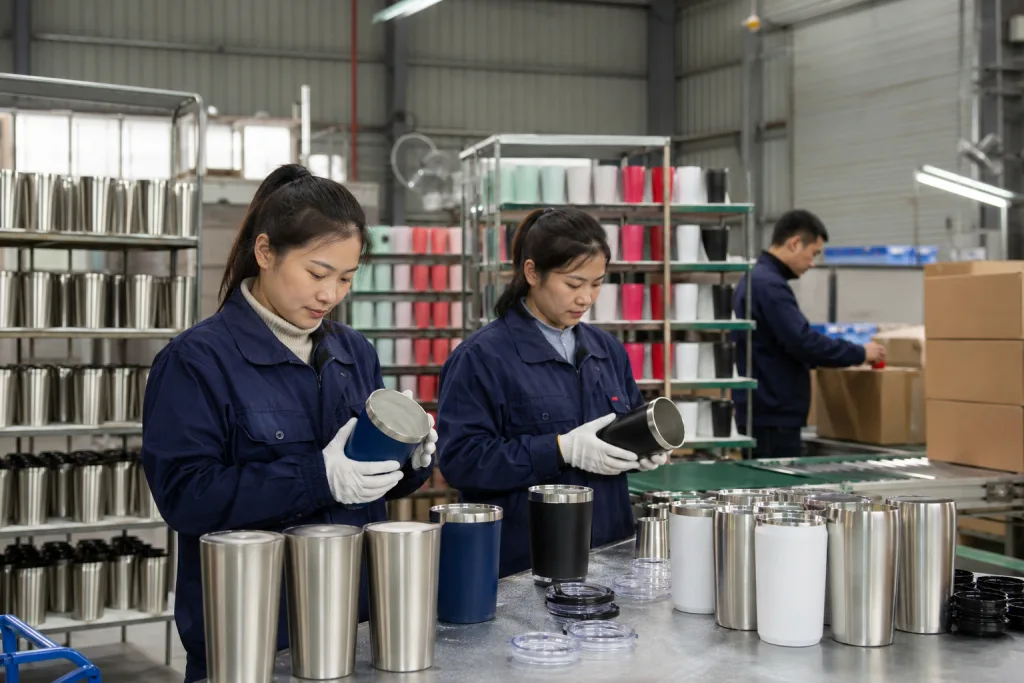
At BottleForge Industrial in Zhejiang, stock tumbler molds usually support MOQ 500 pcs per color, while monthly output can reach 300,000 units across tumblers, bottles, and canteen customized programs. That matters on repeat orders. We run shared lines, so capacity planning decides whether your reorder ships in 20 days or slips to 35. Buyers often ask only for the lowest unit price; this is the wrong question to ask if your season launch date is fixed.
If you also source a custom canteen or customizable growler line from the same canteen factory, keep body specs aligned where possible. Shared steel grade and coating systems make compliance files cleaner, spare parts easier to control, and operator training simpler on the line. Even small mismatches create noise. Last month, one PO had the outer finish code typed wrong, and the buyer flagged the sample set before mass production.
Insulation numbers that actually matter
Too many quotes still say only “hot 6-12 hours, cold 12-24 hours.” For procurement, that is not enough. You need the test condition written down: fill temperature, ambient temperature, test duration, and pass criteria. We see this on RFQs every week. Without that detail, two insulated tumbler custom samples can carry the same claim and feel different in actual use, and the buyer flagged that gap more than once after sample approval.
A workable method is straightforward: fill with 95°C water, hold at 20-25°C ambient, then record the liquid temperature after 6 hours and 12 hours. For cold retention, use 0-4°C water at the same ambient condition. On our line, QC pulled the sample with a digital probe thermometer and logged the reading by SKU. Some canteen suppliers in China also run vacuum leak checks with a water bath or vacuum gauge during production, but plenty of factories still do not keep lot-level records. Ask one direct question: is vacuum testing done on 100% of units, or by random sampling only? This is the right question. “How many hours does it keep hot?” is too loose.
Typical buyer-side benchmarks
- 20 oz tumbler: temperature above 60°C after 6 hours for hot retention
- 30 oz tumbler: ice visible after 12 hours in normal room conditions
- Surface temperature: no obvious hot outer wall when filled with near-boiling water
- Condensation: no sweating on outer wall under cold-fill test
This matters for one reason: weak vacuum performance often does not show up at inspection. It shows up 30 days later as returns, bad reviews, and distributor complaints. We have seen AQL pass, then claims fail in the market. If you are a canteen distributor, distributor canteen buyer, or distributor drinkware importer, tie the insulation wording on your sales copy to the same points on your QC sheet. If your retailer plans to print “keeps hot 8 hours,” your factory in Zhejiang should sign off on the exact test reference before mass production, not after the carton artwork is approved. We have seen this go sideways over one line of copy.
Good sourcing practice is simple: if the claim will be printed on the box, it should be measurable at pre-shipment inspection.
The same rule applies to custom growler and customized growler projects. Here the tolerance gets tighter. A 64 oz body, thicker lid gasket, or a 0.5 mm thread mismatch can change retention and carbonation performance fast, so the test standard needs to be fixed before sampling.
Lids, seals, and leak-risk points
Most tumbler failures do not come from the body. They come from the lid. We see buyers squeeze vessel cost by USD 0.10, then get hit with returns because the slider weeps in a backpack test. On an insulated tumbler custom program, lock down lid material, slider material, gasket material, thread or press-fit construction, straw option, BPA-free statement, and the exact leak standard. This is the wrong question to ask: “Is it a good lid?” Ask what it passes. “Splash resistant” and “leakproof” are different claims.
A standard AS lid in SAN or Tritan may add USD 0.28-0.85 depending on design and color. A screw lid with a silicone gasket usually costs more, but it cuts spill risk. If the tumbler is for commuter retail, ask for inversion testing on the line, not just a sales sample. Our usual check is 45° tilt, full inversion for 30 seconds, then open-close cycling; QC pulled the sample last month and found seepage after 600 cycles on a press-fit lid. If the buyer says leakproof is mandatory, put it in the PO and artwork notes, because a lot of stock tumbler lids are only splash resistant.
- Material: Tritan usually sells better than generic AS and gets fewer questions on shelf in North America. We’ve had buyers flag AS by name before they even saw the sample.
- Seal: food-grade silicone should be specified by hardness range or approved sample. Shore A 50-60 is common; if you leave it open, the line may source a softer ring that twists during assembly.
- Slider: easy to clean matters if you sell through premium custom drinkware channels. If the slider gap is under 1.2 mm, residue complaints go up fast.
- Replacement parts: ask if spare lids can be ordered at 500-1,000 pcs without body purchase. This point saves programs after the first complaint batch.
This is where canteen customizable and customized canteen projects start to overlap with tumbler sourcing. The same team often buys 3 categories in one buy: tumblers, a custom canteen, and a customizable canteen. Standardize lid tests across all of them. We’ve seen this go sideways when one vendor runs inversion tests and another only does a visual check with an AQL 2.5 table. If you inspect one SKU for leakage and skip the others, you set yourself up for mixed complaint data and arguments no one wins.
Ask about mold ownership too. A new lid tool may cost USD 2,500-8,000 and add 25-40 days. We normally quote a T1 sample after CNC and trial shot, and if the thread is off by 0.3 mm, you lose another week in rework. For many canteen promotional orders under 5,000 pcs, the math doesn’t work. It is usually smarter to change decoration on an existing lid than open a new tool.
Surface finish and logo method
Decoration is where quotes go off track fast. On tumblers, powder coating, spray paint, electroplating, pad print, silkscreen, heat transfer, UV print, laser engraving, and embossed patches all look cheap on the sheet, then one tape-pull failure turns a small add-on into a full rework. We have seen QC pull the sample after a 3M tape test and find the logo edge lifting at 2 mm near the seam. For insulated tumbler custom work, ask the factory to break out the base finish and logo process as two separate cost lines. This is the right question.
Powder coating is still the common premium option. It gives better grip, covers handling marks from the line, and usually holds up better in abrasion than plain spray paint. Expect roughly +USD 0.20-0.55 per unit depending on color and texture. A fine-sand texture and a smooth matte do not price the same, and MOQ for a custom color is often 3,000 pcs. Standard silkscreen for a one-color logo can be economical, often +USD 0.05-0.12. Laser engraving works well for stainless exposure effects and removes the ink-migration issue, but dark matte coatings need sample confirmation because contrast shifts by batch; last season one black lot engraved charcoal instead of silver, and the buyer flagged it.
Questions worth asking before PO approval
- What is the adhesion test standard: cross-hatch, tape pull, or both?
- Is the logo positioned from the handle, seam, or a fixed body datum?
- What is the print size tolerance, such as plus or minus 1.5 mm?
- Can Pantone matching be controlled across multiple production lots?
If you buy customizable growler, customized drinkware, or canteen custom projects for brand programs, decoration repeatability matters more than how the first sample looks under showroom lights. We ship plenty of first samples that pass visual check, then lot No. 2 shifts 1.5 mm because the fixture was set from the seam instead of the handle. Ask for a golden sample signed by both sides. For large distributor growler or canteen distributor accounts, insist that the approved sample records coating code, logo process, and placement dimensions. Put the datum on the record too. We have even seen a PO typo swap matte navy for matte black.
Some buyers in Europe also need proof that coatings and inks align with REACH-related expectations. Your canteen supplier in Zhejiang should be able to provide material declarations or third-party reports for relevant components, and if the coating vendor changed, ask for the updated file, not last year’s PDF. The math does not work if the factory shows a clean sample but cannot trace the ink batch used on the line. Do not assume a factory that can make a strong-looking sample can also document the chemistry behind it.
Packaging, cartons, and shipping math
Freight is where a cheap tumbler turns into an expensive one. Packaging spec is not office paperwork. It hits breakage, cube, FBA prep cost, and your final margin line by line. For each insulated tumbler custom SKU, ask for unit box size, carton size, pcs per carton, gross weight, net weight, and loading quantity for 20GP, 40GP, and 40HQ. We usually lock this with a tape measure and floor scale during sampling, not after. If the canteen factory cannot give you this before sampling ends, your logistics plan is already late.
A 30 oz tumbler packed 24 pcs per export carton might save packing labor, but we have seen the outer carton climb past 18 kg once inserts, lids, and straws are added. That is where buyers push back. In North America, many importers prefer keeping master cartons under roughly 15-18 kg where possible. Amazon-focused buyers should also confirm whether FNSKU labeling, suffocation warnings, barcode placement, and drop test standards are included. QC pulled one sample last year where the barcode sat over the box seam; the buyer flagged it right away. FNSKU labeling can add around USD 0.02-0.05 per unit, but relabeling at destination costs far more.
- Unit packaging: polybag only, white box, color box, or PDQ tray
- Carton spec: 5-layer corrugated is common; ask board grade if loads are heavy, especially on 24 pcs/carton packs
- Drop testing: request carton drop test records for fragile lid designs; we usually check corner and edge drops first on the line
- Palletization: needed if your retailer or 3PL rejects floor-loaded cargo; standard pallet height limits can kill loading qty fast
This section matters just as much for custom growler and custom canteen orders because larger diameters and side handles change carton efficiency by a lot. A 3 mm handle offset or a wider shoulder can force a bigger divider set, and then your 40HQ count drops. Distributor canteen and distributor drinkware buyers often run mixed containers from China, so cube control across product families matters. A canteen vendor quoting a lower FOB Zhejiang price may still lose once you compare cartons per container and damage rate. This is the wrong question to ask: do not ask only for FOB.
Use simple landed-cost math early. A tumbler that is USD 0.18 cheaper but loads 8% fewer units per 40HQ is not cheaper in practice. We have seen buyers miss this because the PO showed the right unit price and the wrong carton count. The math does not work.
Compliance files and inspection rules
Buyers say “quality,” but what they usually want is fewer surprises after the PO is placed. The fix is simple: lock the compliance file list and inspection rules before deposit. For insulated tumbler custom orders shipping to Europe or North America, we usually see 4 checks come up first: food-contact safety, heavy metals in coatings, BPA-free statements for plastic parts, and mechanical safety on handles, lids, and straws. The test package changes by market and by structure. A 40 oz tumbler with PP lid, silicone seal, and straw is not reviewed the same way as a straight-body 500 ml bottle. This is the wrong question to ask: “Do you have tests?” Ask which SKU, which color, which lid set, and which lab report date.
B2B buyers often ask us for factory audit reports such as BSCI, ISO 9001 quality system records, and product test reports from accredited labs. Some programs also require REACH screening, LFGB-related food-contact testing, or ASTM-related checks for accessories, especially if the item edges into kids use. QC pulled one sample last month because the powder coat on a navy lid showed a different supplier batch code on the carton. If you are sourcing customized canteen, customized growler, or customizable drinkware across 6 or 12 SKUs, do not assume one old report covers all colors, lids, and decorations. We have seen this go sideways over a logo change that looked minor on the artwork file but changed the print ink system.
A practical QC framework
- Pre-production: signed spec sheet, artwork file, golden sample, packaging approval, and clear dimensions such as logo position within ±1.5 mm
- During production: first article review on the line and random vacuum/lid checks, usually every 2 hours per shift
- Pre-shipment: AQL 2.5 major, 4.0 minor; workmanship, print, quantity, carton marks, barcode scan, and outer carton drop check if the buyer flagged transit risk
- Functional tests: leakage, retention spot checks, handle pull where applicable, plus straw fit and thread engagement on screw lids
Lead time for stock-mold decorated tumblers is usually 20-35 days after deposit and artwork approval. Reorders may be 15-25 days in normal season. In peak months, one overloaded coating line can turn 22 days into 31 days, and that is common in Zhejiang. We run into this most on double-wall powder-coated colors that need a longer curing queue in the oven. Honest timing beats a pretty promise every time. The math does not work if a factory says 7 days for 10,000 pcs with custom print and packed color boxes.
If you are vetting canteen vendors or canteen manufacturers for a longer-term program, ask who controls incoming steel, who signs off coatings, and who does final inspection: in-house QC, third party, or both. Ask to see the incoming material record for 304 stainless, the coating approval sheet, and one finished inspection report with defect photos. We once caught a PO typo where “matte black” became “matt back” on the internal sheet, and the buyer flagged it before mass packing. “Everything in-house” is not automatically the best answer. The right answer is the one the supplier can prove with records, samples, and a clean release process.
MOQ, tooling, and quote comparison
Most sourcing mistakes start before the first price comparison. Buyers line up 3 quotes, but the specs are not lined up. For insulated tumbler custom, use one quote sheet and make every canteen manufacturer or canteen supplier fill the same boxes: material grade, wall thickness, lid type, finish, logo process, packaging, test requirements, MOQ, sample charge, tooling fee, and lead time. We run this way because the wrong question is “who is cheapest?” The right question is “are these the same cup?” If one factory quotes 0.4 mm outer wall and another quotes 0.5 mm, the math doesn't work.
Typical MOQ for a stock tumbler body is 500-1,000 pcs per color with one logo. Some canteen factories in Zhejiang will take 300 pcs for stock colors, though they usually add margin back in the unit price or cut the packing from color box to plain white box. For custom color matching, mixed body and lid colors, or individual box printing, the realistic MOQ usually moves to 1,000 pcs or more. New tooling for a body, handle, or lid can start around USD 2,500 and exceed USD 8,000 depending on complexity. Sample lead time for a decorated existing mold is often 5-10 days; tooling samples are more like 15-25 days after drawing confirmation. On the line, a new lid tool can lose 3 days fast if the silicone ring groove is off by 0.2 mm.
- FOB terms: verify port, usually Ningbo or Shanghai, and state exactly what packaging is included; we have seen buyers flag a quote later because the insert card was missing
- Payment: 30% deposit and 70% balance before shipment is still common; for a first order, most factories will not move on this
- Spare rate: ask for 0.2-0.5% spare units on bulk orders if cartons are mixed by PO; QC pulled the sample once on a mixed order because one PO line was short by 6 pcs
- Price validity: stainless and freight swings can make 30-day validity more realistic than 90; we ship against raw material moves every month
If you are also buying a custom growler, custom canteen, or broader customized drinkware range, ask whether the canteen factory can consolidate across SKUs to improve MOQ and shipment planning. This matters more than buyers expect. One organized supplier can combine 500 tumblers, 300 growlers, and 200 canteens into one booking and one inspection plan. We have seen this go sideways with five low-price factories, especially when one PO had the logo position typed as 35 mm instead of 53 mm.
Your best supplier in China is not the cheapest canteen vendor on the first spreadsheet. It is the one whose spec sheet, compliance file, and production plan still hold up after you push back. If the buyer asks for FDA, LFGB, carton marks, and AQL 2.5 details, the good factory answers fast. The weak one goes quiet.
Send your tumbler spec for a real factory quote
Share target capacity, steel grade, lid type, finish, logo, MOQ, and ship date. We will review the spec sheet and flag cost or quality risks fast.
Frequently asked questions
What is a realistic MOQ for an insulated tumbler custom order?
For stock molds, 500-1,000 pcs per color is the normal working MOQ in China. Some factories in Zhejiang will offer 300 pcs, but usually with fewer color options, a higher unit price, or plain white-box packaging. If you need Pantone body color, custom lid color, printed box, and a special logo process, plan closer to 1,000 pcs. New tooling changes the picture completely. A custom lid or body can require USD 2,500-8,000 in tooling and 25-40 extra days. If you are combining tumblers with custom canteen or customized growler items, ask whether mixed-SKU consolidation can help you reach total monthly MOQ without overbuying one model.
How much should I budget per unit for a custom insulated tumbler?
A useful budget range for a 20 oz to 30 oz insulated tumbler custom project is USD 3.20-5.80 FOB Zhejiang at 1,000-3,000 pcs using stock molds. Entry pricing usually means standard lid, one-color logo, and simple packaging. Premium features move cost quickly: powder coating can add USD 0.20-0.55, Tritan lid upgrades USD 0.15-0.40, laser marking USD 0.05-0.18, and custom color box USD 0.18-0.60. Larger handles, special bases, or fully leakproof screw lids add more. Always compare quotes line by line. Many buyers think one canteen supplier is cheaper, then find the price excluded the exact lid, coating, or carton spec they assumed was included.
What tests should I require before approving mass production?
At minimum, require a signed golden sample, coating adhesion check, logo position approval, leakage test for the lid, and a basic insulation test with stated conditions. A practical hot-retention reference is 95°C fill at 20-25°C ambient, checked after 6 hours. For QC, many B2B buyers use AQL 2.5 for major defects and 4.0 for minor defects at pre-shipment. If your product will be sold in Europe or North America, ask for applicable food-contact and chemical documentation for steel, plastic, silicone, and coating systems. If the tumbler is part of a broader customizable drinkware or custom growler line, align your standards across all SKUs so your distributors are not handling different quality rules by product.
How long does production usually take from PO to shipment?
For a stock-mold tumbler with standard decoration, 20-35 days after deposit, artwork approval, and sample sign-off is a normal lead time in Zhejiang, China. Reorders can drop to 15-25 days if the same color, lid, and packaging are repeated. New tooling adds roughly 25-40 days depending on whether you are changing the body, lid, or both. Peak-season congestion, especially before major holidays, can extend timelines further. Ask your canteen manufacturer for a schedule that breaks out sample time, material purchasing, coating, printing, packing, and final inspection. A realistic plan beats a fast promise. If you are shipping mixed custom drinkware, allow extra days for consolidation.
Should I buy from a trading company or a factory for custom drinkware?
It depends on your order structure, but the key is transparency. A real canteen factory gives you stronger control over engineering details, QC response, and production scheduling, especially for insulated tumbler custom projects with repeat orders above 5,000 pcs. A capable exporter can still be useful if you are buying mixed categories such as tumbler, custom canteen, customized canteen, and customizable growler in one shipment. What you need is clarity on who owns the process. Ask where production happens, who manages QA, and whether the company can provide audit records, testing files, and line photos. If lead time, spec changes, and complaint handling become vague, you are probably too far from the actual factory.