Key Takeaways
- Most infuser bottle wholesale projects start at 1,000-3,000 units per color, with custom logo orders often landing at USD 2.40-4.80 FOB Ningbo depending on material and decoration
- A leak-risk review of lid thread, silicone seal hardness, and infuser basket fit should happen before sampling, not after the first 500 units are packed
- For Europe and North America, ask for REACH, LFGB or FDA-contact compliance, plus ASTM or CPSIA checks if the bottle is intended for kids or youth programs
- AQL 2.5 for major defects and 4.0 for minor defects is a sensible shipment inspection baseline for bulk infuser bottle orders from China
You are not sourcing a basic water bottle in infuser bottle wholesale. You are buying the full build: bottle body, infuser basket, lid, silicone seal, packaging, compliance file set, and the discipline on the line to hold it all together. Most costly errors show up before mass production, not after. We have seen projects stall over a basket that sat 18 mm too short for fruit slices, a handle that failed a 5 kg hang test, a seal that wept at the thread start, or a carton layout that added 12% to freight because the master carton was 8 mm too tall.
The safer approach is simple: treat the project like a live PO from day one. At our factory in Zhejiang, China, we run buyers through the same order flow: define the use case, lock the bottle structure, confirm compliance, sample decoration, approve packaging, then run production under AQL. QC pulled one pre-production sample last month because the logo rub test failed after 30 cycles, and that saved a full rework round. This is the wrong question to ask if the buyer only wants the lowest unit price first; the bigger risk is losing 12 days to fixes that should have been caught before the line starts.
Start with one realistic PO
Say you run a wellness brand launching a hydration challenge kit for spring retail. You need 5,000 units of a custom infuser bottle, split into two colors, with a fruit basket long enough for citrus slices and berries, and a mouth wide enough to get a 38 mm sponge brush inside. Your target retail is USD 24.99, so landed cost usually has to sit around 22% to 28% of retail, or the math doesn't work once ad spend, distributor margin, and markdowns hit the P&L.
Your sourcing brief needs numbers. Not mood words. A usable RFQ for infuser bottle wholesale should specify:
- Capacity: 650 ml or 22 oz
- Body material: Tritan, borosilicate glass, or 18/8 stainless outer with Tritan inner chamber
- Infuser type: full-length fruit basket or short tea basket
- Lid style: carry loop, flip straw, or screw cap
- Logo method: 1-color silkscreen, UV print, laser, or heat transfer
- Packaging: white box, color box, or mailer-ready pack
- Target MOQ: 2,000 units total, 1,000 per color
- Target lead time: 30-45 days after sample approval
This is where buyers mix up a bulk fruit infuser bottle and a bulk tea infuser bottle. Same family, different use. A fruit bottle needs a wider mouth, a stronger basket lock, and enough inside clearance for ice cubes and cut fruit; on our line, QC pulled a sample last month because the basket tabs popped loose after a 1.2 m drop test. A tea bottle usually needs finer mesh, better heat tolerance, and a grip that still feels safe with warm liquid. If your real demand is a custom tea infuser bottle, do not approve a fruit layout just because it is cheaper by USD 0.18. We've seen this go sideways.
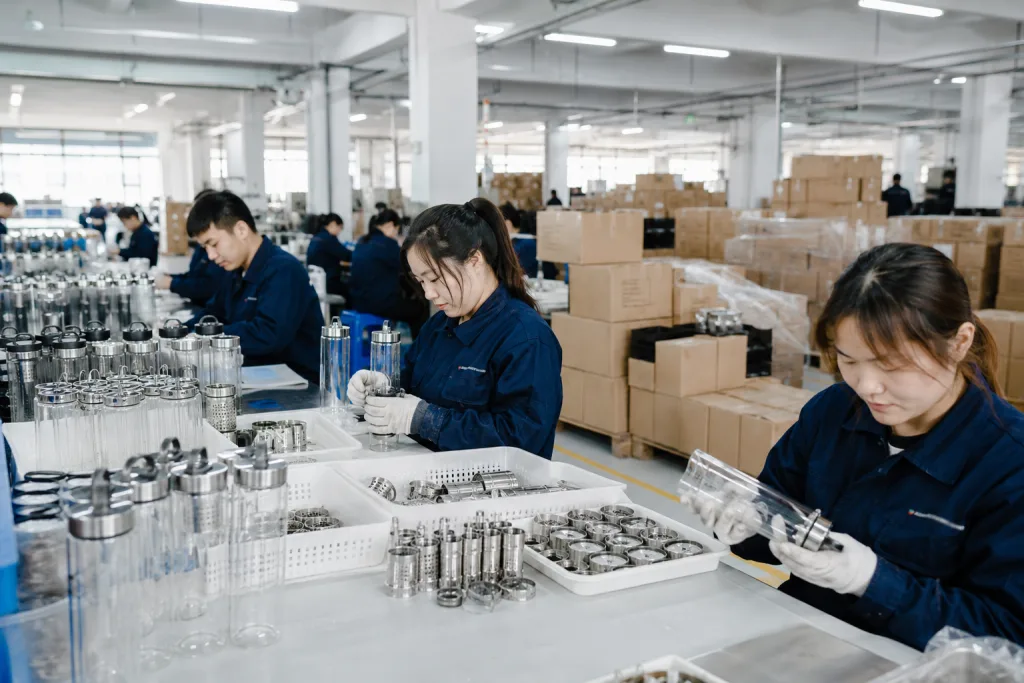
At BottleForge Industrial in Zhejiang, China, we usually tell new buyers to build the PO around one hero SKU first. We run one stable bottle, one decoration method, and one packout before adding bundles or extra lids. Last season a buyer flagged a PO typo that changed matte green to mint green across 3,000 units, and that small miss cost more time than the mold setup. It is easier to scale a stable factory direct infuser bottle program than to rescue an overloaded launch plan.
Choose the structure before the logo
Buyers love to start with artwork. That is backwards. On a custom made infuser bottle, the structure decides if the bottle survives daily use, carton drop, and a month on shelf. We ask buyers to lock 4 points first: body wall thickness, lid construction, infuser basket material, and bottom stability. If the base rocks more than 1.5 mm on the flat table at the line, QC pulls it.
For Tritan bodies, a common wall thickness is 2.2-2.8 mm. Under that range, the bottle feels light in the wrong way and flexes too much in a squeeze test. For borosilicate glass, commercial programs usually run 3.0-3.5 mm single-wall glass with a protective sleeve, and we still check the mouth roundness with a go/no-go gauge before lid fit. For stainless options, 0.4-0.5 mm outer wall is common on single-wall models, while vacuum styles may use 0.4 mm outer and 0.3-0.35 mm inner. This is the wrong question to ask if you stop at material only; the same material sells well or fails fast depending on the lid and basket match.
What your startup actually needs
If your audience is gym, yoga, and office hydration, a Tritan customizable fruit infuser bottle is usually the safer first order. It is lighter, takes fewer hits in transit, and is usually easier to fit into a 5,000-unit budget. We ship more first runs in Tritan for this reason. If your brand story is more premium tea ritual, then a customizable tea infuser bottle in borosilicate may fit better, but you need tighter freight protection; one buyer pushed back after 12 days on water freight because 18 cartons had sleeve scuffing.
The infuser basket matters more than buyers think. A short basket works for loose leaf tea. It fails for fruit because half the bottle turns into plain water too fast. For a fruit infuser bottle bulk order, ask for basket length in millimeters, perforation size, and locking method. We have seen this go sideways: the approved sample used a threaded lock, then production switched to a cheaper snap fit, and failure rate went above 3%. The buyer flagged leaks after first use, and the math didn't work on replacements.
You are not sourcing one bottle. You are sourcing a repeatable assembly process.
If you talk with distributor infuser bottle or distributor tea infuser bottle buyers in North America, they usually care less about novelty and more about return rate. That is how the wholesale side thinks. A bottle that looks simpler but leaks 1% less is usually the better product, and on one 10,000-piece run that 1% meant 100 fewer complaint units to sort through after arrival.
Price the order the right way
To compare quotes for a bulk infuser bottle, line up the scope first. We see this every week: one FOB Ningbo quote looks USD 0.35 lower, then QC pulls the sample and the tea basket is missing from the spec, the color box has no insert, or the second logo position was never priced.
For a typical 650 ml Tritan factory infuser bottle with full-length basket, carry loop lid, and one-color silkscreen logo, a realistic FOB China range for 2,000-5,000 units is often USD 2.40-3.20. Add a custom color lid, individual color box, and two-position print, and you may move to USD 3.10-3.90. A borosilicate factory tea infuser bottle with sleeve and stainless basket may land around USD 3.80-5.60 FOB depending on packing and decoration. If a supplier is far below that range, this is the wrong question to ask: do not ask how they got so cheap; ask what they removed. On the line, the usual cut is thinner packaging, fewer print passes, or a shorter basket tube.
Ask every supplier to break pricing into:
- Unit bottle cost
- Mold or tooling fee, if any
- Logo setup charge
- Sample fee and refund condition
- Inner box and master carton cost
- Export carton dimensions and gross weight
This part affects landed cost more than buyers expect. We have seen a color box grow by 18 mm in height after the artwork revision, and the carton packout dropped enough to push sea freight cost per unit up by 6% to 10%. For Amazon FBA projects, the buyer flagged this fast. One oversize pack can trigger relabeling fees or over-dimension charges at check-in.
If you are talking to distributors infuser bottle or distributors fruit infuser bottle channels, ask for a neutral packaging option next to your branded box. A lot of distributor buyers want two SKUs from one line: a retail-ready version and a plain wholesale version. We ship both from the same run, but only if carton count is fixed early, such as 24 units per master carton at 48 x 32 x 42 cm. If you change that after production starts, the math doesn't work.
At our Zhejiang facility, capacity on drinkware programs can reach 300,000 units per month across categories, but a decorated custom logo infuser bottle run still needs tight scheduling. A one-color print is not the same as an easy booking slot. We run into this with PO details all the time, even small errors like a lid color typo or missing insert note. If your target ship window is tight, ask for lead time, print queue timing, and packaging material readiness. We have seen this go sideways when color boxes were still waiting on die-line approval while bottles were already off the injection line.
Sampling should try to break it
A pre-production sample is not a beauty check. It is the stage where you try to make the weak points fail on purpose. On a customized infuser bottle project, we usually run 3 sample stages: reference sample, logo sample, and pre-production sample. If a supplier wants to skip one to save 4 days, this is the wrong question to ask.
The reference sample checks the basics: overall size, hand grip, basket length, and lid feel in the hand. We usually put a caliper on the mouth diameter and basket depth, because 2 mm off is enough for a loose fit or a hard assembly. The logo sample is for artwork only—Pantone match, edge sharpness, and scratch resistance after the print cures. The pre-production sample is the real checkpoint. QC pulled the sample from the line setup to confirm the approved material, color, seal, and assembly process match what we will ship from China in bulk.
For a customized fruit infuser bottle, test these points hard, not gently:
- Leak test after 30 minutes upside down and after shaking 20 times
- Carry loop pull test at 5-7 kg force
- Odor check after 24 hours with lemon water
- Dishwasher claim verification if marketed as dishwasher safe
- Basket removal and cleaning time by a normal user
On fruit infuser styles, we also watch cleaning access. The buyer flagged this on one 700 ml model because pulp got stuck under the basket shoulder, and a normal user needed 90 seconds to clean it with a standard sponge. If the opening is too narrow or the basket tabs are sharp, we have seen this go sideways after first use.
For a customized tea infuser bottle, add heat checks. Fill with 85-95°C water if the design is meant for hot drinks, then leave it 15 minutes and handle it like an end user would. Check whether the basket warps, whether the lid gets too hot at the touch point, and whether the seal changes shape. We run this on the bench with an IR thermometer, because “hot drink suitable” means nothing if the cap surface jumps past a comfortable hand feel.
Ask the factory for photos or video of the leak setup, not only a pass/fail note. A short clip showing the bottle inverted on the test bench tells you more than a one-line report. Most serious suppliers in Zhejiang know this routine. If they push back on basic validation, that tells you enough.
Check decoration adhesion early. A custom logo infuser bottle can look clean on day one and still scratch badly after carton vibration or loose packing dividers. We normally compare print methods with cross-hatch adhesion, 75% alcohol rub, and tape pull on the sample set before a buyer signs off on 5,000 units. The math does not work if you find weak ink after mass production starts.
Compliance and QC are not optional
Wellness brands often treat a bottle as low risk because it is not electrical and nobody eats it. This is the wrong question to ask. Your custom fruit infuser bottle still sits in contact with liquid, often acidic tea, lemon water, or fruit soak, and buyers in the EU or North America will ask for paperwork the minute QC pulls the sample and sees it is a food-contact item.
For Europe, ask for REACH and, if the material setup fits the program, LFGB contact-material testing. For the US and Canada, ask for food-contact declarations aligned with FDA expectations, then check Proposition 65 exposure points if the project needs it. If the line is for schools, youth sports, or gift sets aimed at children, ASTM and CPSIA can come into play fast. We have seen buyers add that requirement after PO issue because one carton label said “kids hydration set.”
On the factory side, paperwork alone does not save a shipment. The line has to run clean. Useful checkpoints include:
- Incoming inspection for resin, glass tube, silicone, and basket mesh
- In-process leak testing during assembly
- Print position control with approved artwork board
- Drop and carton compression checks before shipment
- Final random inspection to AQL standard
A practical inspection plan for factory fruit infuser bottle or factory tea infuser bottle orders is AQL 2.5 for major defects and 4.0 for minor defects. That standard is common for a reason. Major defects include leaks, cracked bodies, missing baskets, dangerous sharp edges, or wrong logo color. Minor defects include 1 mm to 2 mm print misalignment, light specks, or shade variation inside the approved tolerance. We ship plenty of retailer orders on this basis, and the buyer usually flags logo color before anything else.
If you are working with distributors tea infuser bottle or large retail accounts, ask early whether they require BSCI, ISO 9001, or specific social audit records. Do not leave this until deposit stage. In Zhejiang export manufacturing, buyers often want product compliance and factory compliance in one vendor file, and we have seen approvals slip 12 days vs 18 days just because one audit report expired before booking.
Production, packaging, and shipment control
After the pre-production sample is signed off, run the order with one control sheet, not loose chat messages: approved spec, approved artwork, approved carton mark, production quantity by color, overrun allowance, and ship date. We’ve seen this go sideways over one small edit. Last month a buyer changed a lid Pantone in WeChat, but the final PO still showed the old code, so the line ran 2,000 pcs before QC caught it against the signed sample.
For a 5,000-unit customizable infuser bottle order, a realistic timeline from deposit to shipment is often 35-45 days in normal season. On our side, that usually breaks into 7-10 days for packaging materials, 15-20 days for molding and assembly, 3-5 days for printing plus rework buffer, and 2-3 days for packing and final inspection. In peak season, add 7-10 days. If the bottle uses a new insert or custom carton, the die-cut sample alone can eat 3 days, so asking for shipment “next week” is the wrong question to ask.
Packaging gets ignored too often. A glossy retail box sells well on screen, but if the insert does not hold the lid and bottle apart with a proper 2-3 mm gap, the print can rub during transit. QC pulled the sample on one order and found abrasion after a basic carton shake test. For glass styles, ask for drop-tested inner protection. For Tritan styles, confirm whether each unit goes into a PE bag before boxing, or the line will ship clean bottles that still arrive scuffed.
If your program ships to Amazon, lock carton labels, FNSKU placement, suffocation warnings for polybags, and carton weight limits before production ends. We ship plenty of Amazon orders, and the buyer flagged one batch because the FNSKU sat across the curve of the bottle instead of a flat panel. If your order goes to a distributor, you may need both retail barcode and wholesale carton label formats, and those files should be checked before the first master carton is taped.
For startups testing multiple channels, a two-pack setup often works better than forcing one SKU into every account. One version can be a branded custom made infuser bottle for DTC, and the other a neutral factory direct infuser bottle pack for wholesale. Same bottle, different packaging. We run this format often because it keeps MOQ at a workable level—say 1,000 pcs per packaging version instead of 3 custom formats at 500 each, where the math doesn't work.
The goal is not to make sourcing look complicated. The goal is to keep every change visible from sample room to packing line. A clean production handoff usually saves more money than pushing for the last USD 0.05, especially after one typo on a PO or carton mark turns into a full rework.
Get your infuser bottle spec reviewed today
Send your target size, material, quantity, and logo file. We will review feasibility, MOQ, pricing, and QC points before you place a trial order.
Frequently asked questions
What MOQ should I expect for infuser bottle wholesale?
For standard models, you can usually expect 1,000-3,000 units per style, with 500-1,000 units per color if the factory already has the mold. A custom logo infuser bottle often starts around 1,000 units, while a fully custom made infuser bottle with new tooling may require 3,000-5,000 units to make the numbers work. In Zhejiang, China, some factories will support a trial run at 500 units, but the unit cost can jump by USD 0.40-0.90 because setup cost is spread over fewer pieces. If you are a startup, it is smarter to choose an existing bottle platform, customize the logo, lid color, and box, then scale after the first sales cycle proves demand.
Which material is best for a bulk fruit infuser bottle program?
For most wellness brands, Tritan is the safest first choice. It is lightweight, more impact resistant than glass, and usually easier to keep below USD 3.50 FOB for a 650 ml bottle at 2,000-5,000 units. Borosilicate glass feels more premium and works well for a custom tea infuser bottle line, but freight breakage risk is higher and packaging cost goes up. Stainless can work if insulation is part of your brand story, but it is not always ideal for visually showing fruit infusion. If your main sales angle is color, fruit visibility, and everyday hydration, start with a Tritan custom fruit infuser bottle and spend your budget on a better lid, better basket, and stronger packaging.
How do I check if a custom infuser bottle will leak before mass production?
Do not rely on a casual hand check. Ask for a defined leak protocol on the pre-production sample: fill to normal capacity, tighten to the specified torque, invert for 30 minutes, then shake 20 times and recheck. If the bottle has a straw or spout, test that separately. Also review the silicone seal hardness, usually in the 50-70 Shore A range, and confirm the seal cross-section matches the lid groove correctly. For larger orders, require in-line leak testing during production plus a final random inspection under AQL 2.5/4.0. In China, good factories can provide video proof and inspection photos. That is especially important for distributor infuser bottle orders where returns hurt you more than a slightly higher factory price.
What documents should I ask for when importing infuser bottles to Europe or North America?
Start with a product specification sheet, packing list format, and food-contact compliance paperwork. For Europe, ask about REACH and, if relevant to your market, LFGB-related material testing. For the US, request food-contact declarations aligned with FDA expectations and discuss Proposition 65 exposure review where applicable. If the bottle is sold to children, schools, or youth programs, ask whether ASTM and CPSIA requirements apply. On the factory side, some buyers also want BSCI or ISO 9001 records. Keep the paperwork tied to the exact bottle configuration you are buying, including basket and seal materials. A report for a different lid or a different resin grade is not enough if you want clean importer records.
How long does a custom logo infuser bottle order usually take?
For an existing mold with standard packaging, 30-45 days after sample approval is normal. If you need a new mold, add 20-30 days for development and confirmation. A realistic schedule for 2,000-5,000 units is about 7 days for final sample approval, 7-10 days for packaging material prep, 15-20 days for production, and 2-3 days for final packing and inspection. During peak periods before summer promotions or Q4 gifting, lead time can extend by another 7-10 days. In Zhejiang, China, faster turnaround is possible on some standard items, but only if decoration, carton marks, and compliance documents are all confirmed early. The usual delay is not molding. It is missing approvals.