Key Takeaways
- Lock 4 decisions first: material, infuser design, decoration, and compliance; this can cut sampling revisions by 30% to 50%
- Typical MOQ for a custom infuser bottle is 1,000 to 3,000 pcs per SKU, while new molds often add USD 1,500 to 4,500
- A practical target for mass production is AQL 2.5, leak test at 100%, and lead time of 30 to 45 days after sample approval
- For wellness retail, Tritan and 18/8 stainless steel usually outperform cheaper AS or 201 steel on durability, odor control, and claim risk
If you are building a wellness brand or hydration startup, an infuser bottle looks easy until you try to buy 3,000 pcs. Then the problems show up on the line: leak points around the basket thread, fruit pulp blocking a 3 mm drinking spout, logo printing that fades before 200 dishwasher cycles, and MOQ numbers that don't match a first launch. We hear the same pushback from new buyers every month: "Why is the quote higher than a basic sports bottle?" Because it is not a basic sports bottle. Choosing an infuser bottle supplier is not about the lowest unit price; it is about which defects, cost points, and launch limits you are willing to accept.
Most buyers sourcing from Zhejiang start with the wrong question. They ask for price first, before they lock the four items that actually move cost: bottle material, infuser structure, packaging route, and compliance scope. QC pulled the sample last week on a project where the PO even had the lid color typo, and the quote changed twice because the buyer had not fixed those basics. Get those four points set early, and a factory in China can quote cleanly, hold a 30- to 45-day lead time, and cut the usual revision loop from 18 days to 12 days. That math matters.
Start with the four buying decisions
You do not need 25 supplier comparisons. You need 4 buying decisions locked first. On a custom infuser bottle, these 4 points drive most of your cost and most of the complaints that show up 60 days after goods land. We’ve seen this go sideways on the sample bench over a 1.5 mm wall change.
- First: body material. Tritan, borosilicate glass, or stainless steel. This sets bottle weight, breakage rate, freight cost, and which branding process the line can run without trouble. A 304 stainless body ships differently from glass, and buyers usually feel that in carton drop-test results before they feel it in the quote.
- Second: infuser structure. Full-length fruit rod, short tea basket, or dual-use insert. This decides flavor extraction, cleaning time, and leak risk at the lid seat. QC pulled the sample on one project because the basket slot width was off by 0.3 mm and tea leaf fines came through.
- Third: customization route. Off-the-shelf model with a custom logo infuser bottle treatment, or a custom made infuser bottle with new tooling. This is where lead time and MOQ change fast. A logo print on an existing cap is one conversation; a new mold with a revised handle is another, and the math doesn't work for small runs.
- Fourth: market compliance. EU REACH and LFGB expectations are different from US FDA and California Proposition 65 review. Your test plan must match where you will sell. If the bottle has a silicone seal, PP lid, and printed gift box, we run reviews by material set, not by one nice-looking approval sheet.
Buyers mix these decisions together all the time. First they ask for a bulk fruit infuser bottle. After sampling, they switch to a bulk tea infuser bottle. Then they add a retail gift box and ask for dishwasher-safe ink after the PO already says hand wash only. The buyer flagged it late, and landed cost jumped 20% to 35%.
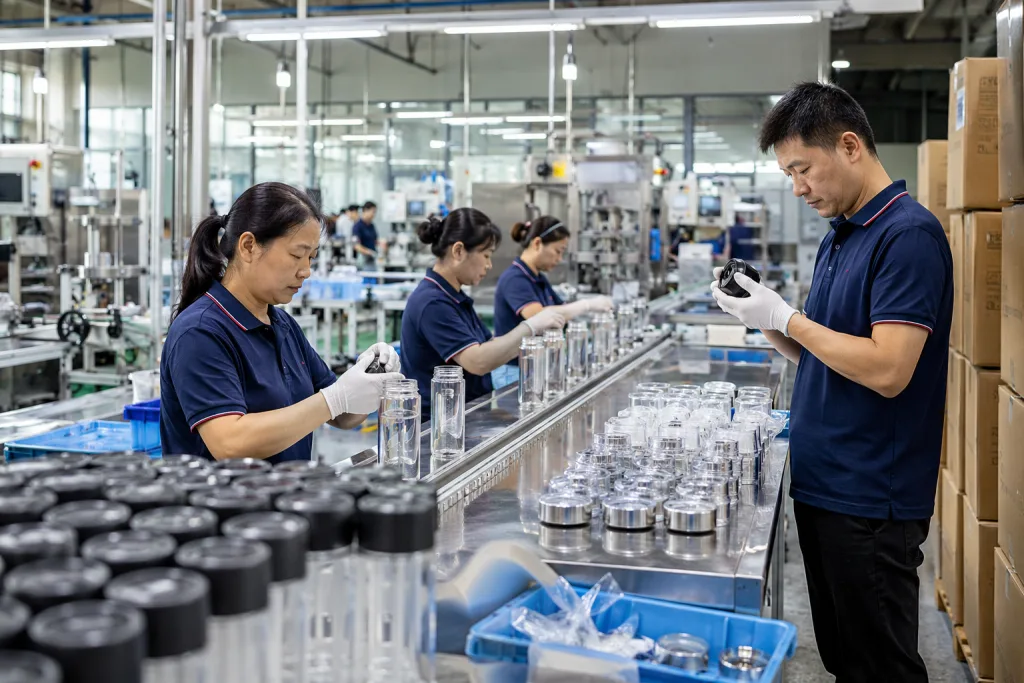
At BottleForge Industrial in Zhejiang, China, we tell new buyers to freeze one base platform first. If your launch channel is DTC or boutique retail, start with one 650 ml or 700 ml bottle, one lid color, and one packaging format. We ship up to 300,000 units a month across drinkware categories, but the line runs clean only when specs stay clean. One SKU. One insert. One box.
Good sourcing is not getting the lowest unit price. It is getting the lowest total cost after returns, delays, relabeling, and retesting.
This is why a solid infuser bottle supplier pushes practical questions early. Do you want cold fruit infusion, hot tea steeping, or both? Will the bottle clip to gym bags and take drop impact from about 1.2 m? Is your target retail price USD 19.99 or USD 29.99? Start there. Decoration color codes are the wrong first question.
Pick the right bottle platform
Most wellness brands end up choosing between three bottle platforms: plastic, glass, or stainless steel. None wins by default. The right pick depends on how you plan to sell it, how rough the use case is, and what margin the line needs to carry.
Tritan plastic
For a customizable fruit infuser bottle built around gym, commute, and daily hydration, Tritan is the clean starting point. It weighs less than glass, takes drops better, and our line can match Pantone lids faster on Tritan than on coated steel. A 700 ml Tritan bottle with infuser basket commonly lands around 180 to 260 g depending on wall thickness. Typical wall thickness is 2.5 to 3.0 mm. We usually check the neck finish with a go/no-go gauge before mass production. For bulk infuser bottle programs, the cost-to-durability balance is hard to beat.
Borosilicate glass
Glass sells a cleaner, more premium story, especially for tea and flavored water. It does not hold odor, and staining is less of an issue after repeated use. Breakage claims are the real issue. We have seen this go sideways in retail packs where the buyer wanted thinner inner protection to save freight. A double-wall or protected-sleeve design cuts damage risk, but it also adds cost and carton volume. If you are selling a custom tea infuser bottle through retail stores, plan for stricter packaging drop testing and more inner protection. QC pulled one sample last season with a 1.8 mm chip at the rim, and that single defect was enough to fail the lot review.
Stainless steel
18/8 stainless steel makes sense when insulation matters or the bottle needs to feel like a gift item. For hot tea, a bulk tea infuser bottle in double-wall vacuum stainless can support stronger pricing. This is a different SKU from a simple fruit infusion bottle, and this is the wrong question to skip. Buyers sometimes compare them on unit price alone, and the math doesn't work. Tooling, welding consistency, and vacuum yield all matter. On the floor, we run vacuum testing lot by lot, and low yield will hit both cost and lead time fast.
For Europe and North America, do not accept vague material wording. Your infuser bottle supplier should specify Tritan, PP, silicone, borosilicate glass, or 18/8 stainless steel clearly on the BOM. If the sheet says only “food grade plastic,” ask harder questions. We once saw a PO typo swap Tritan for AS on a draft BOM, and the buyer flagged it before sampling.
As a rough FOB China guide for standard-volume projects at 3,000 pcs:
- Tritan custom infuser bottle: about USD 2.20 to 3.80
- Glass with infuser and sleeve: about USD 2.80 to 4.80
- Vacuum stainless custom tea infuser bottle: about USD 4.50 to 7.50
These numbers move with decoration, lid complexity, and packaging. A laser logo and basic white box price differently from a silk-print body with an EVA insert. If a quote lands far below this range, something is usually missing: material grade, wall thickness, carton strength, or inspection depth. We have opened low-price samples where carton board dropped from 5-ply to 3-ply, and the failure showed up before the goods even left Ningbo.
Choose an infuser design buyers will keep using
A bottle can pass all lab tests and still flop at retail if the insert is a pain to use. We see that a lot on infuser items. The real question is simple: what will the end user put inside, and are they cleaning it once a day or once a week? On our line, QC pulled a sample last month with kiwi seeds stuck in 1.5 mm slots after one use. That tells you more than the spec sheet.
For a custom fruit infuser bottle, full-length infusion rods sell the first look. Fruit pieces show well. Photos look clean. The problem starts after use. Pulp, seeds, and fibrous cuts get stuck fast, especially in narrow side openings. One EU buyer flagged this after a 3,000-piece run because users needed a brush for basic cleaning. If your target is daily gym users, go with wider perforations and a basket that unscrews by hand, no tool, no coin-slot cap.
For a customizable tea infuser bottle, a short fine-mesh basket is usually the better setup. It handles loose leaf tea well and rinses faster at the sink. Still, mesh that is too fine holds residue, and thin mesh dents on the first drop test. Ask for wire gauge and mesh count on stainless baskets, not just “tea filter included.” This is the wrong question to skip. We’ve seen 304 stainless baskets look fine on a photo and arrive with soft mesh that deforms under thumb pressure.
Some buyers ask for one bottle for both fruit and tea. It can be done, but the math doesn't work if you expect one insert to do both jobs well. A basket that works for sliced lemon usually fails with fine rooibos or green tea dust. The practical fix is shared tooling: keep one bottle body, then run two inserts. That gives you a customized tea infuser bottle and a customized fruit infuser bottle under the same shell. MOQ stays friendlier, and you ship two SKUs without opening a full new mold.
Ask every distributor tea infuser bottle or distributor fruit infuser bottle supplier these practical questions:
- How many parts does the bottle have?
- Can consumers disassemble all food-contact parts?
- What is the leak-test method and pressure standard?
- Can the infuser be replaced separately for after-sales support?
- Does the cap use a single silicone ring or double sealing structure?
If the supplier can’t answer those points, move on. We ship from Zhejiang, China, and we’ve seen this go sideways more than once. Return rates on infuser drinkware usually come from cleaning complaints and small leaks, not broken bodies. Last quarter, one buyer’s claim file showed 12 leaking units out of 800 samples checked, all tied to cap fit, not the bottle wall. Good design cuts those problems early.
Know when customization is worth it
Startups ask for full custom too early. We see it every month. If your first order is 1,000 to 2,000 pcs, new tooling usually burns cash without fixing a real product issue. Unless the design solves leakage, fit, or cleaning trouble, the math doesn't work. A stock mold with your logo, color card, and retail box gets you selling faster; on our line that often means 20 to 35 days instead of adding another 25 to 45 days for mold work and sample rounds.
There are three practical ways to customize, and this is the right question to ask first.
- Level 1: stock model plus logo. Fastest route for a custom logo infuser bottle. MOQ may start at 500 to 1,000 pcs depending on color and print method. Lead time is often 20 to 35 days. On simple silk print jobs, we run pre-production approval from a Pantone chip and a logo position drawing marked in mm.
- Level 2: platform customization. You keep the current bottle body and change the lid color, carry loop, basket color, or package. This works well for a customizable infuser bottle launch because you avoid body tooling but still get a different shelf look. MOQ is commonly 1,000 to 3,000 pcs. Last season, one buyer flagged a loop hardness issue, so we switched the TPE grade without touching the bottle mold.
- Level 3: full custom development. New mold, new dimensions, or a unique infuser mechanism. Tooling can cost USD 1,500 to 4,500 for simpler components and more for complex assemblies. Development time can add 25 to 45 days. QC usually pulls the first sample set to check thread match, basket insertion force, and cap drop test before we approve the steel cut.
For wellness brands, Level 2 is usually the sweet spot. You get enough difference for the shelf without freezing money in risky tooling. If your channel includes Amazon FBA, simplify the packout. Every extra loose part adds prep work, sticker mistakes, and review risk. We've seen this go sideways over one small tea basket packed loose in a polybag.
Decoration needs to match actual use. Silkscreen is cost-effective, but frequent dishwasher cycles can fade some inks; we have seen print loss after repeated hot-wash testing on glossy coatings. Laser marking on metal parts holds up better. UV print gives stronger color, but on high-touch areas it can scratch faster if the bottle rides in cup holders or gym bags. Your infuser bottle supplier should say this plainly. If a sales team promises every finish does everything, ask for a tape test report and a dishwasher-cycle result.
If you are speaking with distributors fruit infuser bottle or distributors tea infuser bottle partners, ask if they support mixed-color cartons or assortments. This point matters. Some programs save cash by ordering one neutral body and changing only lids and packaging sleeves, with a carton ratio like 12 pcs split across 3 colors. That is often smarter than carrying four separate finished SKUs, and it cuts dead stock if one color stalls.
Price, MOQ, and landed cost reality
Unit price matters, but landed cost decides margin. New China buyers often stare at FOB and miss the costs that hit later: freight cube, pack-out count, defect allowance, and warehouse handling. We ship by carton volume, not by guesswork. Last month a buyer cut USD 0.07 on unit price, then lost it on a 68 x 42 x 38 cm carton that packed fewer pieces than the first spec.
In an infuser bottle program, MOQ usually follows the most expensive custom part. If the body is standard and only the lid needs a custom Pantone, the lid vendor often sets the floor. We see this every week. If the project is a custom made infuser bottle with a private mold, the factory may ask for 3,000 pcs or more to run the line without waste; below that, the math doesn't work once mold setup, color change, and first-article checks are counted.
Typical working ranges for an infuser bottle supplier in China look like this:
- Stock color with logo: 500 to 1,000 pcs
- Custom color and standard package: 1,000 to 3,000 pcs
- Retail gift box with inserts: 1,000 to 3,000 pcs, sometimes higher
- New mold or major structural change: 3,000 to 5,000 pcs
For fruit infuser bottle bulk orders, packaging shifts freight cost more than most buyers expect. A premium window box may add only USD 0.25 to 0.45 ex-works, but it can cut carton density enough to push ocean freight per unit up by 8% to 15%. For glass, it can be more. QC pulled the sample on one order and found the box height was 12 mm taller than the approved dummy, which dropped the carton pack count before the buyer even noticed.
Ask for a cost breakdown by component:
- bottle body
- infuser insert
- lid and gasket
- decoration
- individual packaging
- master carton specs
This matters when you need to cut cost without changing the whole product. A practical supplier should tell you where the savings are real and where they create claims later. For example, changing from a two-color print to one color may save USD 0.04. Changing from a custom EVA insert to a folded card structure may save USD 0.18. Thinning a Tritan wall to chase USD 0.06 is the wrong move if the wall drops from 2.2 mm to 1.8 mm and crack complaints show up 60 days after launch.
If you buy a factory fruit infuser bottle or factory tea infuser bottle program for retail, ask for carton drop test standards and palletization advice too. The cheapest quote gets expensive fast if 2% of units arrive damaged. We've seen this go sideways when the buyer flagged breakage but skipped the 76 cm drop test and corner protection in the first PO.
Verify compliance and quality before deposit
For Europe and North America, compliance is not paperwork to file away. It starts in product design. A capable infuser bottle supplier should tell you exactly which parts touch food, which test reports match that structure, and how each batch is controlled on the line. We usually ask first about the lid seal, filter basket, and bottle body resin, because that is where buyers get caught later.
At minimum, ask for:
- material declarations for all food-contact parts
- test reports relevant to FDA or LFGB expectations
- REACH screening if selling into Europe
- BSCI or equivalent social compliance if your retailer requires it
- factory quality process and incoming inspection records
Do not assume one old report covers your exact SKU. It does not. If you change resin, colorant, gasket supplier, or coating, the test basis may change with it. We have seen buyers swap a silicone ring from 60 shore to 50 shore and think the old file still works; QC pulled the sample and stopped it before mass production.
On quality control, the basics are non-negotiable. For a bulk infuser bottle order, we ask for leak testing on every assembled unit, AQL 2.5 for major defects, and a real drop test tied to the packaging you ship in. If the bottle is glass, test the actual inner tray and master carton, not a lab setup that never reaches the warehouse.
- 100% leak test on assembled units
- AQL 2.5 for major defects, with tighter visual standards on logo placement if branding is prominent
- Drop test review based on packaging format, especially for glass
- Dishwasher or wash-cycle verification when you make durability claims
Sampling should not stop at one “golden sample.” This is the wrong question to ask. You also need a pre-production sample with the real decoration and actual packaging, plus one sealed production sample kept by each side. We ship that sample with date, PO number, and signature marked on the carton, because one typo on a PO label can turn into a claim later.
Lead time is also a quality issue. If a supplier promises 18 days for a fully customized infuser bottle with custom packaging, be careful. In Zhejiang and other drinkware hubs in China, realistic lead times for custom programs are usually 30 to 45 days after sample approval and deposit, longer in peak season. The math doesn't work if tooling changes, logo printing approval, and carton confirmation are all inside that 18-day window. Rushed production is where gasket mix-ups, color inconsistency, and carton errors show up, and we have seen this go sideways during holiday rush when the line swaps from one lid color to another.
Good factories do not hide from clear specifications. They want drawings, Pantone references, tolerance notes, and approval points down to 0.5 mm if needed. Weak factories stay vague because vagueness gives them room to argue after the buyer flagged it.
What to ask your short list suppliers
Once you cut the list to three suppliers, drop the broad questions. Ask shop-floor questions. That is how you find out who can actually run your program and who is still talking in sales language. On our side, this usually shows up fast: one factory answers with "MOQ 1,000 pcs per SKU, 500 pcs per color," another sends two vague lines and no packing breakdown.
- What is your MOQ by SKU, by color, and by packaging format?
- What are your standard lead times for sample, repeat order, and peak season?
- Which parts are made in-house and which are outsourced?
- Can you provide a BOM with material grades for body, lid, infuser, gasket, and coatings?
- What percentage of units receive leak testing?
- What is your standard AQL level and defect definition?
- Can you support FNSKU labeling, carton marks, and retailer-specific packing instructions?
- What are the payment terms for first order versus repeat order?
A serious infuser bottle supplier answers these straight. No circling. You are reducing risk, not making trouble. If the buyer flagged a basic question like gasket material or drop-test standard and the supplier still cannot answer after 24 hours, we have seen this go sideways.
For hydration startups, one more point matters: reorder stability. This is the wrong question to skip. A factory might make a sharp-looking pilot run of 500 pcs, then miss color on the second 3,000-pc order because they did not lock the Pantone sample or control lid fit within 0.3 mm. Ask for repeat-order records, color-control sheets, or at least photos from two production lots. Even a simple custom logo infuser bottle becomes a shelf problem if batch two looks darker than batch one.
If you sell into wholesale or retail chains, ask about labeling, compliance file retention, and spare component support. We ship plenty of programs that need replacement lids or infuser baskets 6 months later. A PO typo on carton marks or a missing FNSKU label can hold stock at the warehouse, and that costs more than carrying spare parts from day one.
The best supplier relationship is plain and practical. You give the channel, target price, and annual volume—say 20,000 pcs, not "many units." The factory gives you the engineering limits, MOQ, and a real production schedule. If the line needs 7 days for color matching and 18 days for bulk, say that clearly. That is how custom infuser bottle sourcing should work.
Get a practical infuser bottle quote that matches your channel
Send your target price, market, volume, and artwork. We will recommend the right bottle platform, MOQ, compliance route, and realistic lead time.
Frequently asked questions
What MOQ should I expect from an infuser bottle supplier?
For a stock model with only logo decoration, MOQ is often 500 to 1,000 pcs. For a custom infuser bottle with custom body or lid colors, 1,000 to 3,000 pcs per SKU is more typical. If you want a custom made infuser bottle with new tooling, expect 3,000 to 5,000 pcs plus mold cost. The practical MOQ is usually driven by the most customized component, not the finished bottle itself. For example, a custom Pantone lid or retail gift box may set the minimum. If you are a startup, ask whether the supplier can use an existing bottle mold and customize only insert color, logo, and packaging. That usually gives the best balance of margin and cash flow.
Which material is best for a bulk fruit infuser bottle program?
For most wellness brands, Tritan is the easiest material to launch with. It is impact-resistant, lighter than glass, and usually costs less to ship. A 650 to 700 ml Tritan bottle with infuser commonly falls in the USD 2.20 to 3.80 FOB China range at 3,000 pcs. Borosilicate glass looks more premium and handles odor well, but you need stronger packaging and should expect higher breakage risk in transit. Stainless steel fits insulated tea use better than fruit display. If your product story depends on visible fruit infusion, stainless is usually the wrong first choice. Ask your supplier to state exact materials for body, lid, infuser, and gasket instead of using generic terms like food grade plastic.
How long does a custom logo infuser bottle order usually take?
If you use an existing model and only add logo printing, sample approval can take 5 to 10 days and mass production usually takes 20 to 35 days after deposit. If you change body color, lid color, or custom packaging, 30 to 45 days is a more realistic lead time. A fully customized infuser bottle with new tooling often needs an extra 25 to 45 days before production even starts. Peak season can add 7 to 15 days. Be careful with quotes that sound too fast. On drinkware from China, short lead times often mean compressed QC, unstable material scheduling, or decoration errors. Ask for a timeline that separates sample, packaging approval, production, and final inspection.
What quality checks matter most for infuser bottles?
Leak performance is number one, so insist on 100% leak testing of assembled bottles. After that, focus on fit and cleaning. The infuser insert should thread or lock smoothly, and all food-contact parts should be removable for washing. For mass orders, AQL 2.5 is a practical starting point for major defects. If you sell retail, also define acceptable logo position tolerance, color deviation, and carton drop performance. For glass, ask for additional packaging verification. If the bottle makes dishwasher-safe or hot-tea claims, request wash-cycle or use-condition validation. One golden sample is not enough. Keep a signed production sample and approved packaging sample so your supplier cannot substitute parts or artwork later.
Should I choose a factory direct infuser bottle supplier or a trading company?
A factory direct infuser bottle source usually gives better control over lead time, engineering feedback, and problem solving, especially when you need custom colors, packaging, or structure changes. You can discuss wall thickness, gasket hardness, or mesh details directly with the people making the product. A good trading company can still be useful if you are buying several categories together or need strong English support and project coordination. The key is transparency. Ask who owns the mold, where assembly happens, who handles QA, and who is responsible if a batch fails testing. Whether the company is in Zhejiang or another part of China, a reliable supplier should answer these questions clearly and put the details in writing.