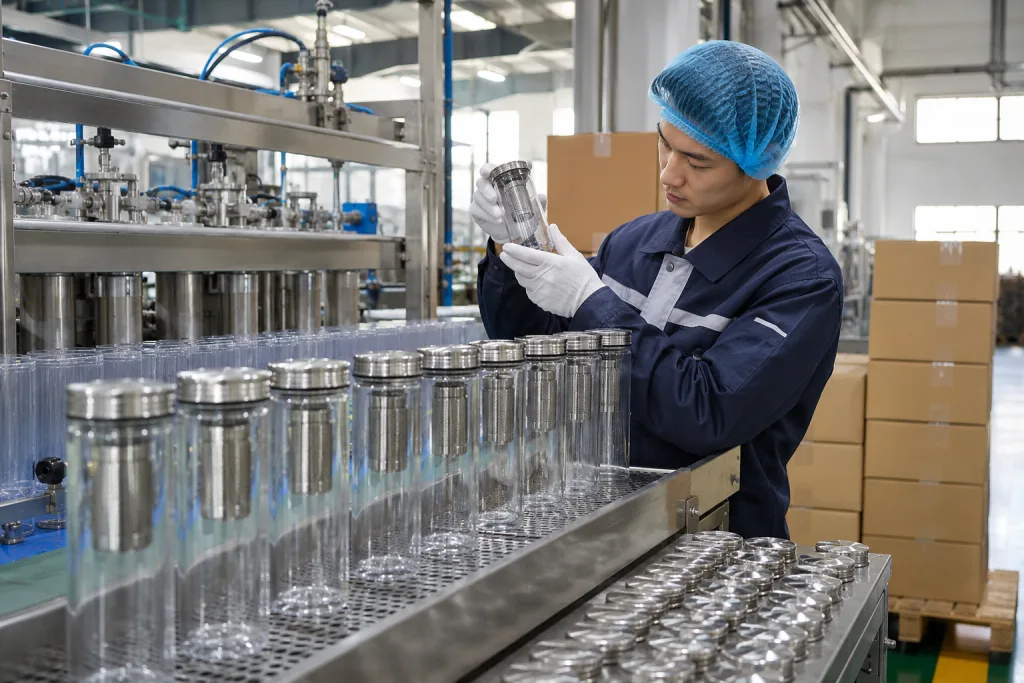
Key Takeaways
- For a custom infuser bottle, expect MOQ around 1,000-3,000 units per color and lead time of 30-45 days after sample approval.
- A realistic FOB China target for a 700ml Tritan bulk fruit infuser bottle is often USD 2.10-3.80 depending on lid, basket, print, and packaging.
- Set QC at AQL 2.5 major and 4.0 minor, with 100% leak testing and random drop tests from 1.2m before balance payment.
- Ask for REACH, LFGB or FDA contact-material compliance, plus packaging specs, carton weight under 15kg, and spare-part policy for baskets and seals.
You do not need a long infuser bottle supplier list. You need 2 or 3 factories that can build the exact bottle your market will buy, print your branding cleanly, and ship against your launch date. We see wellness brands and hydration startups start with the wrong filter. They compare catalog photos, push for the lowest FOB, and find out late that the infuser basket leaks at the thread, the logo fails a 3M tape test, or the export carton collapses in a drop test. QC pulled this sample last month. The buyer had approved the photo, but the lid thread was off by 0.3 mm and the fit was wrong from the first pilot run.
A better method is to walk one order from concept to final inspection. That is how experienced buyers in Europe and North America qualify a supplier in China, and the math works better. In Zhejiang, where a large share of stainless and Tritan drinkware is made, the gap between a workable custom infuser bottle program and an expensive headache usually comes down to six checks: structure, materials, decoration, MOQ, compliance, and in-line QC. This is the right question to ask on day one. We run into the same buyer pushback all the time—"why not just quote from the catalog?" Because we have seen that go sideways after sampling, after tooling, and sometimes after 5,000 pcs are already on the line.
Start with one buyer scenario
Say you are launching a hydration line for yoga studios and online DTC sales. Your first PO is 3,000 units of a custom fruit infuser bottle, 700ml capacity, clear body, colored lid, removable fruit basket, one-color logo, and retail box. You want two colors, 1,500 units each, shipping FOB Ningbo. We see this setup every month on the line in Hangzhou. It is a standard opening order from Zhejiang or broader China, not a big-volume project.
Now break the job into quote points the factory can price without guessing. Bottle body: Tritan or borosilicate glass? For a wellness brand, Tritan usually wins on the first order because breakage claims are lower, freight cost is lower, and returns are easier to handle. On our side, a common Tritan wall thickness is 2.5mm to 3.0mm for sports-style bottles, and QC will check it with a digital caliper at the shoulder and base. Basket material matters. If you are sourcing a bulk tea infuser bottle for loose leaf tea, this is the wrong question to skip: perforation size and fit tolerance matter more than they do for fruit slices. We have seen buyers approve a nice-looking basket, then flag the sample after brew test because tea dust passed through 0.8mm holes. Go too open and you get sediment. Go too tight and the infusion gets weak.
At this stage, your supplier list should not be fifteen names. Keep an infuser bottle supplier list to three factories and send the same spec sheet to all three. We ship cleaner quotes that way, and the math doesn't work if one factory prices 304 stainless infuser, another prices Tritan infuser, and the third assumes a plain white box. Ask each factory to quote:
- 700ml usable capacity, not brimful capacity
- BPA-free Tritan body, PP lid, silicone gasket, Tritan or stainless infuser
- Leakproof requirement: no leakage after 2 hours horizontal lay test
- Decoration: silk screen or UV print, Pantone color reference
- Unit packing: white box or custom color box
- Carton pack quantity, carton size, gross weight
- MOQ by color and by logo version
- Sample cost and sample lead time
If buyers skip this step, factories quote different constructions, different pack-outs, even different gasket hardness. Last month one PO said “grey lid” and the buyer meant warm gray 7C, while the factory matched cool gray from a phone photo. Then you are not comparing prices. You are comparing apples to bolts.
What the quote should really tell you
A quote that matters is not just a unit price. For a bulk infuser bottle or fruit infuser bottle bulk order, the supplier should show each cost driver line by line. On a 3,000-unit Tritan program, FOB pricing often lands between USD 2.10 and USD 3.80 per unit. That gap is normal. We see it on the line every week. On one recent RFQ, the buyer wrote “Triton” on the PO instead of Tritan, and we had to stop the quote until the material spec was fixed. Four cost points usually explain the range.
1. Lid construction
A basic screw lid with carry loop may cost 12% to 18% less than a flip-top or double-injection lid. The reason is simple: more parts, more assembly time, more rejects. A double-injection lid also needs tighter tool control, and if the hinge pin is off by 0.2 mm, QC pulled the sample fast. Buyers often ask for the fancy lid first. This is the wrong question to ask. Ask how the lid performs after 3,000 open-close cycles.
2. Infuser design
A full-length basket for tea or fruit costs more than a short fruit core insert. If you are buying a custom tea infuser bottle, ask whether the strainer holes are molded or laser-perforated stainless. Stainless adds cost and usually gives better heat resistance and better shelf appeal. We have also seen buyer pushback on hole size—0.8 mm for tea leaf control is a different job from a wide fruit infuser core. The math doesn't work if the factory prices both designs the same.
3. Decoration method
Silk screen is cheaper for 1-color runs. UV print handles gradients but may increase cost by USD 0.12 to 0.30 per unit. A custom logo infuser bottle with laser marking on a stainless cap can look premium, but only if the cap surface finish is consistent. We run a 3M tape test after printing, and brushed caps from two polishing batches will not laser the same. The buyer flagged this once on a black cap order because half the logos looked gray, not silver.
4. Packaging
Retail-ready packaging is where startups often underbudget. A plain white box may add USD 0.10 to 0.18. A custom printed box with inner tray may add USD 0.28 to 0.65. That sounds manageable until carton size jumps and freight follows it up. We ship plenty of 24-pack master cartons, and adding a thicker EVA insert can push gross weight over the target by 1.2 kg. If you sell through distributors, stronger packaging cuts warehouse damage claims. If you sell online, ask for a drop-test standard, not just a nice box mockup.
Do not accept a quote without mold status, unit net weight, carton gross weight, and HS code. Those details affect freight and import cost more than new buyers think. We have seen one missing carton weight add 12 days to booking because the forwarder had to recalculate the load plan.
If a factory says it can do any customizable infuser bottle at the same price, treat that as a warning. We have seen this go sideways. Different lids, baskets, print methods, and pack-outs do not cost the same, and any quote that hides that is not ready for production.
Filter factories before paying samples
You are not buying from a website. You are buying from a process. Before you pay for samples from anyone on your infuser bottle supplier list, screen the factory with practical questions. Ask for monthly output, not soft capacity talk. On this category, we would ask if the line can support 150,000 to 300,000 units per month across similar plastic drinkware, and whether your order shares molds, Pantone colors, or assembly workers with other programs. On our floor in Hangzhou, one 8-cavity injection mold can shift your timing fast, so this is the right question to ask.
Ask for audit and system basics early. For Europe and North America, the common checkpoints are BSCI for social compliance, ISO 9001 for quality system control, and product material declarations aligned with REACH, LFGB, or FDA food-contact expectations based on your market. If your launch goes into children or school channels, ask whether any parts touch ASTM or CPSIA issues, especially print decoration and small detachable parts under 6 mm. We have seen buyers miss the silicone straw topper and then QC pulled the sample for small-parts review.
Then get specific about experience. A factory that ships generic tumblers is not always strong on a custom made infuser bottle. The basket seal leaks. The cap torque drifts. The body-neck fit goes out by 0.3 mm and the buyer flagged it at sample stage. Ask these questions:
- How many infuser bottle SKUs have you exported in the last 12 months?
- What is your normal MOQ for a factory direct infuser bottle order with custom logo?
- Can you supply spare gaskets or replacement infusers at 2% of order quantity?
- What is your sample lead time: 5 days, 10 days, or 15 days?
- Can you provide drop-test and leak-test records from the last production run?
If the answers come back slow or don’t match from sales to engineering, cut them from your list. We have seen this go sideways. A distributor infuser bottle program lives or dies on repeatability. Across Zhejiang factory clusters, the cheapest quote often hides shared tooling, unstable labor, or a PO typo that turns a 45 mm mouth into 54 mm. Good suppliers answer technical questions cleanly, and they answer the same way every time.
Lock the spec before color sample approval
Most avoidable failures start after the nice-looking pre-production sample and before bulk production runs. We see this on the line all the time. An approved sample for a customized fruit infuser bottle or customized tea infuser bottle needs a full spec sheet tied to that sample, not just a WeChat message and a marked-up photo. If the details stay verbal, QC pulls the sample, production follows a different assumption, and the buyer flagged it only after 5,000 pcs were packed. That is the wrong stage to argue.
Your spec sheet should cover:
- Body material: Tritan TX1001 or equivalent, color clear or tinted
- Capacity: 700ml usable, tolerance plus or minus 3%
- Body weight: for example 165g plus or minus 5g
- Wall thickness: 2.8mm target, tolerance plus or minus 0.2mm
- Lid material and finish: PP matte pink Pantone 707C
- Seal material: food-grade silicone, hardness if applicable
- Infuser basket length, opening diameter, perforation pattern
- Logo size and position: 35mm wide, centered, 60mm above base
- Print adhesion requirement: pass 3M tape test, no visible peel
- Leak test standard: no leak after 2 hours inverted and horizontal
If you need a customizable tea infuser bottle for hot-fill or warm drinks, state the real temperature in °C. Write 60°C, 80°C, or 95°C, not “for hot water.” We have seen buyers approve a Tritan body for daily hydration, then add boiling-water use on the Amazon page later; this goes sideways fast. Most plastic bodies are fine for routine cold or warm use, but they should not be sold as boiling-water bottles unless the structure was built for that use and tested. If you actually need double-wall stainless, switch early. The math doesn’t work if you try to force a plastic concept into a heat-use claim.
For ecommerce, lock barcode placement, FNSKU if needed, and the master carton label format before artwork sign-off. A 20mm shift sounds small until the warehouse scanner misses it. For distributor orders, pallet pattern and carton mark matter more than shelf graphics; we ship plenty of orders where the buyer cares more about 48 cartons per pallet than the front-panel design. A customizable fruit infuser bottle for a chain distributor may ship in PDQ trays, while a DTC startup usually wants tighter individual boxes to cut fulfillment fees by a few RMB per unit.
Run QC like a buyer, not a designer
Once production starts, branding is done. Now it’s risk control. For a bulk fruit infuser bottle or bulk tea infuser bottle order, we run both in-line checks and final random inspection. For most first orders, set the final inspection at AQL 2.5 major, 4.0 minor. Critical defects stay at zero acceptance, especially odor, sharp edges, contamination, and leaks. QC pulled the sample at line start, not after packing.
Use a checkpoint sequence like this:
- Incoming material check: confirm resin, silicone color, and print ink against approved sample
- First article confirmation: verify dimensions, weight, cap fit, logo position before full run
- In-line assembly audit: monitor gasket seating and thread engagement every 1 to 2 hours
- 100% leak test: vacuum or water test depending on structure
- Final random inspection: appearance, function, quantity, carton marks, carton drop test
For appearance, write the limit clearly. On clear Tritan, a flow mark near the gate can pass if it sits outside the visual panel; we usually mark that panel on the golden sample with tape before mass production. Deep scratches, black specks, haze, and off-center logos do not pass. For function, check cap torque consistency with a torque tester, not by hand feel alone. If one batch needs extra force to seal, users will cross-thread lids. Returns come next. We’ve seen this go sideways on a 10,000-piece run.
Cartons matter more than first-time buyers expect. Keep gross weight under 15kg if possible for easier handling and lower damage risk. Run drop tests from 1.2m on one corner, three edges, and six faces for export cartons. We also check carton tape hold after 24 hours because one wrong board grade or weak glue line will show up fast in transit. If you sell to distributors infuser bottle channels, damaged cartons can trigger shortage claims even when the bottles inside are fine. The buyer flagged this on us once because the PO mark had one letter wrong.
If a factory says final inspection alone is enough, that is the wrong plan. It usually means the line will make defects first and sort them later. The math doesn’t work. Good factories in Zhejiang build checks into the line because rework on printed bottles is slow, and scrap climbs fast once silk-screen ink cures. On one bottle body, removing a bad print can take 40 seconds. Across 8,000 units, that’s a bad afternoon.
Plan the shipment and after-sales details
After inspection passes, hold the balance payment until shipment details match the PO line by line. Check quantity by color, spare parts, packaging, and shipping marks. We still see startups miss this. Last month a buyer’s PO had 3 color SKUs correct, but the replacement seal count was left blank and the line packed zero extras. For a customized infuser bottle, ask for extra silicone seals and infuser baskets equal to 1% to 2% of the order. Add them before loading. A seal that costs cents in bulk turns into an expensive courier job once the goods land.
Lead time for a first custom order is usually 30 to 45 days after sample approval and deposit, assuming standard materials and no new mold. New tooling can add 20 to 30 days. If a supplier offers 18 days for a fully boxed factory fruit infuser bottle order in peak season, ask what is already in production and whether print slots are booked. This is the right question. We have seen factories quote before checking screen printing capacity, assembly labor, or carton delivery, then lose 6 days waiting on one missing insert tray.
For freight, compare FOB Ningbo or Shanghai versus DDP only after you have the carton data in hand. Ask for carton size, gross weight, and loading qty per 40HQ. We ship by cube, not by guess. A bottle that looks USD 0.20 cheaper can cost more if the gift box wastes 8 mm on each side and kills container efficiency. If you are building a distributor tea infuser bottle line, landed cost decides repeat orders. If you sell online, do a parcel drop test and check whether the FNSKU or 3PL barcode sits flat for scanner reading; QC pulled one sample last quarter where the label crossed the box edge and failed intake.
After arrival, keep a failure log by defect code: leak, crack, loose basket, print rub, odor, missing part. Use actual percentages and send photos with lot number or carton mark. If field complaints stay below 0.5%, the process is under control. If leakage rises above 1%, check gasket compression, thread tolerance, and user instructions first. We have seen this go sideways from a 0.3 mm seal change that looked harmless at pre-production stage. The best supplier relationship in China is built on data, fast feedback, and corrective action on each repeat PO.
Send your infuser bottle spec for a fast factory review
Share your target capacity, material, logo method, MOQ, and market. We will review feasibility, lead time, and likely FOB range before you commit to samples.
Frequently asked questions
What MOQ should I expect for a custom infuser bottle order?
For a standard Tritan custom infuser bottle with one logo print, MOQ is usually 1,000 to 3,000 units per model, often split by 500 to 1,000 units per color. If you want a fully custom lid or basket mold, factories in China may ask for 3,000 to 5,000 units plus tooling cost. For a custom logo infuser bottle using an existing mold, 1,000 units is sometimes workable, but packaging, color matching, and print setup still affect pricing. Ask whether MOQ is based on total units, per color, or per packaging style. Many buyers miss that detail and end up paying a surcharge for mixed SKUs.
Is Tritan or glass better for a bulk fruit infuser bottle program?
For most wellness brands, Tritan is the safer first choice. It is lighter, has lower breakage risk, and usually lands around USD 2.10 to 3.80 FOB for a 600ml to 800ml bottle depending on lid and packaging. Borosilicate glass can look more premium, especially for tea positioning, but freight cost and damage rates are higher. If you sell ecommerce in North America, Tritan usually creates fewer claims. If you sell boutique retail with a premium shelf story, glass may justify the extra cost. Either way, define body thickness, leak standard, and carton protection before mass production starts.
What compliance documents should I ask an infuser bottle supplier for?
At minimum, ask for food-contact material declarations and test reports relevant to your market: REACH for Europe, LFGB if required by your customers, and FDA-style food-contact support for the US market. Also ask for factory quality system details such as ISO 9001 and social audit status such as BSCI if your brand requires it. For packaging and labeling, confirm carton markings, barcode format, and country-of-origin labeling. If the bottle has painted, printed, or soft-touch parts, ask whether the decoration has its own chemical compliance support. A clean report on raw material alone does not automatically cover inks, coatings, or adhesives.
How do I check whether a factory can really handle distributor orders?
Ask for specifics, not claims. A capable distributor infuser bottle supplier should state monthly capacity, normal lead time, carton specs, pallet loading, and spare-part policy. For example, a factory that can support 150,000 to 300,000 units per month and still hold a 35-day lead time is different from one that relies on ad hoc subcontract assembly. Ask whether they can keep carton weight under 15kg, provide 1% to 2% spare gaskets, and run AQL 2.5/4.0 inspections. Also ask for examples of past export markets in Europe or North America. Distributors need consistency across repeat orders more than flashy customization options.
What are the most common defects on a customized tea infuser bottle or fruit infuser bottle?
The big four are leaks, print rub, haze or scratches on the body, and loose or poorly fitted infuser baskets. Leakage usually comes from gasket seating, cap thread tolerance, or inconsistent torque during assembly. Print rub shows up when ink curing or adhesion testing is weak. On clear Tritan, cosmetic defects are visible quickly, so define your visual standard before production. Basket issues are common on customized tea infuser bottle designs because hole size, basket length, and fit all affect function. Require 100% leak testing, first article approval, and final random inspection. On first orders, ask your third-party inspector to check at least 200 units for function and appearance.