Key Takeaways
- A workable starting MOQ for a custom infuser bottle is usually 1,000-3,000 pcs per SKU, while stock-color bottles with one-color logo can start around 500 pcs.
- Typical FOB China pricing for a Tritan bulk fruit infuser bottle is about USD 2.10-4.80, while double-wall stainless infuser styles often land at USD 4.80-8.50 depending on lid and basket design.
- Normal production lead time is 25-35 days after sample approval; new mold development usually adds 20-35 days and USD 2,500-8,000 in tooling.
- Ask for AQL 2.5 inspection, REACH or LFGB material declarations, and leak testing at 100% line check level before paying the balance.
You do not need a giant supplier list. You need 6 to 8 factories that can build the infuser bottle you plan to sell, test it properly, and ship it on time. That is where most wellness brands and hydration startups burn 2 to 3 weeks. A clean catalog page tells you almost nothing about leak rate at 0.03 MPa, basket fit tolerance at 0.5 mm, odor migration after hot-water filling, carton drop performance, or whether the factory can place a logo straight on a curved bottle body. We run into this on the line all the time.
From Zhejiang, China, we see the same pattern every month: a buyer asks for a custom infuser bottle, gets 10 quotes, and still cannot compare them because each factory priced a different spec, and one PO even says "tritan" on page 1 and "AS" on page 2. A useful infuser bottle supplier directory should sort factories by material, MOQ, tooling cost, compliance, and actual daily output, not by pretty renderings. If you buy for Europe or North America, those details matter more. This is the wrong question to ask: "Who is cheapest?" Ask who can hold spec, pass inspection, and still ship on the agreed date. QC pulled a sample last month with a loose infuser basket, and the buyer had already approved the artwork.
What belongs in a useful directory
A useful infuser bottle supplier directory is not a dump of trading company names and factory names. For a procurement manager, it should sort suppliers by product build and execution risk. Start with these product families: plastic fruit infuser bottles, stainless vacuum infuser bottles, and glass infuser bottles with sleeve or cage protection. If one supplier says they make all three, ask for model-level details and line photos. We ask for neck finish, basket structure, and body process on the same sheet. About 30% of suppliers we screen can source across categories; far fewer run stable production batch after batch.
Your shortlist should capture at least seven data points per supplier: material, capacity range, MOQ, tooling ability, compliance history, decorating options, and lead time. Put real numbers in the directory. A factory direct infuser bottle supplier should tell you whether the body is Eastman Tritan, PP, 18/8 stainless steel, borosilicate glass, or a lower-cost substitute. They should also state wall thickness, such as 0.55 mm for a single-wall stainless body or 2.5-3.0 mm for borosilicate glass. On our line, QC pulled a sample last month where the PO said “304 stainless” but the cup weight was 22 g light, so we cut it open to confirm the spec.
At BottleForge Industrial in Zhejiang, China, our team usually tells buyers to ignore vague labels like premium, eco, or bestselling until the technical sheet is clear. This is the wrong question to ask at the start. A good directory entry should say if the infuser basket is twist-lock or press-fit, whether the seal is food-grade silicone with a Shore A range, and whether replacement parts can be supplied for after-sales service. If you are buying bulk tea infuser bottle styles, tea basket hole size matters. Fine tea needs a tighter perforation pattern than fruit water infusers, where 1.5 mm slots often clean faster than micro-perf baskets. We’ve seen this go sideways when the buyer flagged leaf leakage only after mass production.
- Stock mold or new mold availability
- Logo methods: silk screen, heat transfer, laser, pad print, UV print
- Packaging options: white box, color box, mailer-safe insert, PDQ
- Certifications: BSCI, ISO 9001, audit reports, test reports
If the directory cannot tell you which factories actually make a bulk infuser bottle versus simply resell one, it is not helping you buy smarter. Ask who owns the mold, what the MOQ is—often 1,000 pcs for stock color and 3,000 pcs for custom—and whether the factory has an in-house leak test station. If they cannot answer in 10 minutes, we ship samples first and treat them as a trader.
Questions to ask before requesting quotes
The fastest way to get junk pricing is to ask, “Please quote your best custom made infuser bottle.” One factory prices a 500 ml Tritan bottle with a silk-screen logo, another quotes 750 ml borosilicate with a color box, and your sheet is dead on arrival. We’ve seen buyers send that one-line RFQ and end up with 6 quotes that cannot be matched line by line. Send a short RFQ checklist with the exact spec.
Minimum RFQ checklist
- Target market: EU, US, Canada, UK
- Bottle type: bulk fruit infuser bottle, bulk tea infuser bottle, or sports-style infuser
- Capacity: 500 ml, 650 ml, 750 ml, 1,000 ml
- Material: Tritan, borosilicate, or 18/8 stainless
- Color: body, lid, basket, strap
- Logo method and print size
- Packaging: individual box or e-commerce pack
- Required tests: REACH, LFGB, FDA, California Proposition 65 as needed
- Incoterm: FOB Ningbo, FOB Shanghai, or DDP if requested
Then ask 3 practical questions. First: what is the MOQ by color and by logo? Buyers hear “MOQ 1,000 pcs” all the time, but the line usually means 1,000 pcs per model, 500 pcs per color, and 1,000 pcs per logo artwork. We had one PO where the buyer flagged this after sampling because navy blue and black were counted as separate runs. Second: what is the leakage control method? Ask if they run 100% vacuum testing or inverted water testing for 30 minutes, not “we check carefully.” QC pulled the sample once and found 3 leaking lids from a silicone ring seated 0.8 mm off. Third: can the supplier share carton dimensions and gross weight before sampling? This is not a small detail. It affects landed cost and Amazon FBA math from day one.
You are not buying a render. You are buying repeatability over two or three reorders.
For a custom logo infuser bottle, ask if the artwork area lands on a textured grip, measurement scale, or seam line. This is where jobs go sideways. Most custom tea infuser bottle issues are not big factory failures; they are spec mistakes like a logo crossing a mold split line, a print rubbing after a tape test, or an infuser basket with 2 mm play that rattles in transit. We ship cleaner quotes when the RFQ is tight, and both factory infuser bottle suppliers and trading partners price faster when the drawing and packing spec are clear.
How to compare factory claims
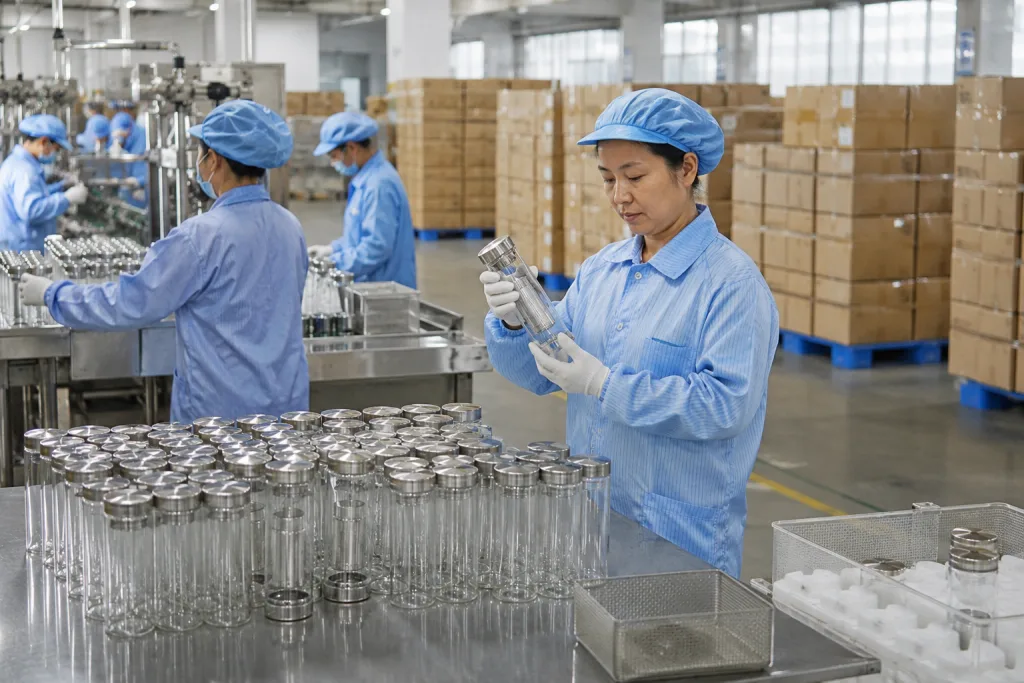
Every supplier looks solid on a PDF. The real comparison starts when you ask for proof. If a supplier says they are a factory fruit infuser bottle source, ask for workshop photos or short videos from the floor: blow molding or injection lines, ultrasonic welding if used, final assembly, leak-test stations, and packing. We usually send photos with machine tags in frame, not cropped marketing shots. If they claim strong custom capability, ask how many new molds they opened in the last 12 months and the normal mold lead time in days. Also ask mold size or cavity count. A 2-cavity tool and an 8-cavity tool are not the same story.
Production capacity matters, but only in the right context. A factory saying “500,000 units per month” sounds good, but this is the wrong question to ask if your bottle has a complex lid set. An infuser lid with 3 silicone parts, a threaded basket, and a carry loop runs slower on the line than a simple sports bottle. In Zhejiang, some plants can run 300,000-600,000 bottles per month across categories, but only part of that is open for customizable infuser bottle programs. We have seen buyers push for 80,000 pcs in 25 days, then flag the schedule once they learn the shared assembly line is already loaded with promo tumblers. Ask for capacity by SKU family, shift count, and peak-season loading plan before August if you sell Q4 wellness gift sets.
Quality control is where generic answers burn time. Ask for the inspection standard in writing. A reasonable baseline is AQL 2.5 for major defects and AQL 4.0 for minor defects, with 100% leak testing on the line. Ask what the factory counts as a major defect, and ask for defect photos from the last 2 inspections. For a customized tea infuser bottle, major issues include lid cross-threading, loose basket engagement, an exposed sharp stainless edge, and visible contamination inside the body. QC pulled a sample for us once with a 0.4 mm steel burr under the basket rim; that unit should never pass.
For compliance, do not stop at “Do you have certificates?” Ask which parts were tested, which lab issued the report, and the test date. The bottle body, lid resin, straw if any, paint, decal, and silicone ring can all sit under different compliance files. A supplier shipping to Europe should know REACH and LFGB without guessing. For North America, ASTM protocol can matter for kids-related claims, and California chemical disclosure questions come up on coatings and decorations. The buyer flagged this on a matte spray finish once, and the math did not work because the coating had to be changed after sampling.
- Ask for the latest audit date for BSCI or social compliance
- Ask whether test reports are model-specific or material-generic
- Confirm if spare gaskets and baskets are available for reorder, and ask the MOQ—500 pcs or 5,000 pcs changes the after-sales plan
- Check whether packaging passes 1.2 m carton drop expectations; we usually run a corner drop and one flat drop before shipment
If a supplier cannot answer these points clearly, they may still be honest. Still, they are not ready for a demanding custom infuser bottle program. We have seen this go sideways after the PO, usually on lead time, spare parts, or test scope.
MOQ, tooling, and realistic pricing
Buyers ask to make this part simple. That is the wrong question. MOQ moves with decoration, gift box, color split, and whether we run an existing mold or cut new steel. For a stock customizable fruit infuser bottle in Tritan with a one-color silk screen logo, 500-1,000 pcs is possible with some suppliers. Once you move to custom Pantone matching, a new lid shape, and a retail color box, 2,000-3,000 pcs per SKU is the range we usually quote. We have seen POs for 1,200 pcs across 6 colors go sideways because the line changeover ate the margin.
Tooling is where buyers get burned. A small logo insert or emboss revision can stay under USD 300 if the cavity is clean and the texture match is simple. A new injection mold for a lid or infuser basket usually lands at USD 1,200-3,500. A full custom body plus closure set often falls between USD 2,500 and USD 8,000, with 20-35 days for development, T1 sampling, and corrections. On the factory floor, T1 often shows the same issues: basket fit off by 0.3 mm, lid thread too tight, or sink marks near the shoulder. If a supplier promises brand-new tooling in 10 days, be cautious. We do not quote that unless the tool is tiny and the structure is already proven.
FOB pricing in China also needs context. As a rough planning range:
- Plastic bulk infuser bottle, 650-750 ml, stock mold: USD 2.10-3.60 FOB
- Higher-spec Tritan with carry loop and better basket fit: USD 3.20-4.80 FOB
- Borosilicate glass with sleeve and steel infuser: USD 2.80-5.50 FOB
- Vacuum stainless bulk tea infuser bottle, 450-520 ml: USD 4.80-8.50 FOB
Those numbers move fast with quantity, steel grade, print process, and packing method. A custom fruit infuser bottle packed in a plain white box may be USD 0.35-0.80 cheaper than the same unit in a full-color retail box with insert. The buyer usually flags the box first, not the bottle, because a 4-color box, inner tray, and barcode label can add more than expected. If you are a distributor fruit infuser bottle buyer testing a market, ask whether mixed colors are allowed within one MOQ. Some factories in Zhejiang will accept four colors in 1,000 pcs if the packaging and print stay identical.
The cheapest quote usually dropped something. We have seen missing 1 item turn into a claim later: thicker gasket, polished mold surface, individual polybag, drop-tested carton, or replacement infuser basket. QC pulled the sample once and found the PO said “opp bag” while the approved spec said “individual polybag with warning sticker.” That small typo changed the packing cost. Make suppliers break out unit price, sample fee, tooling fee, packaging upcharge, and testing cost. That is how you compare a custom logo infuser bottle quote honestly.
Sampling and pre-production checkpoints
Before you place a bulk order, sample in the same sequence the factory will run on the line. Start with the existing model sample or a 3D rendering, then sign off the color and logo sample. If tooling is new, approve a pre-production sample made from production-equivalent tooling. Skip that third step and things go sideways fast. We have seen a customized fruit infuser bottle look clean in a resin print, then fail on the real mold with a 0.3 mm mismatch at the basket seat and a leak at the seal.
Your sample checklist should be boring and specific. That is the right standard. Check net weight, body thickness in mm, basket engagement, thread smoothness, and logo position from the bottle shoulder. Fill the bottle, invert it for 30 minutes, shake it 20 times, and leave it overnight. QC pulled a sample last month where the lid felt fine dry but bound up after a soak test. If it is a bulk tea infuser bottle, brew loose leaf tea and see whether fine particles pass through the filter. If it is a fruit infuser bottle bulk program, load citrus wedges and berry pieces to confirm the basket opening works for actual users, not just for a photo.
Pre-production approval list
- Approved Pantone references or color chip tolerance
- Final barcode, FNSKU, and carton mark layout
- Packaging dieline and insert wording
- Drop test expectation and master carton spec
- Leak test procedure and pass rate threshold
- Golden sample kept by both buyer and factory
Lead time should be locked at this stage, not after deposit. A typical stock-model customized infuser bottle order runs 25-35 days after deposit and sample approval. New molds add 20-35 days. During peak season, add a buffer of 7-10 days for assembly-heavy SKUs. We tell new buyers to freeze packaging artwork early because the buyer flagged a carton mark typo on one PO, and that correction cost 6 days while bottle production stayed on schedule. This is the wrong question to ask: “How fast can you ship?” Ask what is already approved, what is still open, and which step is gating the line.
If you buy for distributors tea infuser bottle channels, ask the supplier to reserve spare components equal to 1%-2% of order quantity. On a 10,000-piece order, that is 100 to 200 extra lids, baskets, or seals. The math works. We ship these in one inner carton with the bulk order, and it saves messy after-sales claims when cartons are opened in North America 90 days later.
What wellness brands often overlook
Hydration startups usually fixate on shape, handle style, and Instagram appeal. Fair enough. The margin is won later, in lower return rates and clean repeat POs. The blind spots we see most on the line are odor retention, cleaning access, and replacement-part policy. A custom tea infuser bottle can hold heat well and still get hammered in reviews if the silicone gasket holds ginger or lemon smell after 3 washes. We have seen QC pull a sample where the neck opening was only 38 mm, and the buyer flagged it because a standard sponge brush could not reach the shoulder. Ask whether the infuser basket is dishwasher safe, top-rack only, or hand-wash only, then match that language on the box and insert card. This is the wrong place to improvise.
Channel fit gets missed all the time. A direct-to-consumer brand may need e-commerce drop-test packaging, FNSKU labeling, and inner packs that survive parcel handling at 1.2 m drop height. A distributor infuser bottle program for retail stores usually needs shelf-ready packaging, tighter carton dimensions, and mixed-SKU replenishment that ships in 12 days vs 18 days. If you are building a distributor tea infuser bottle line, ask whether the supplier keeps common accessories in stock—lids, baskets, and 2 silicone colors, for example—so reorders do not stall while every part gets remade. We ship both models, and mixing them up early usually goes sideways.
Sustainability claims need discipline. If you market a custom logo infuser bottle as reusable and durable, the material has to support that claim under actual use, not just on a render. Tritan is a practical middle ground for impact resistance and clarity. Borosilicate looks premium, but we see more transit breakage on packed samples unless the divider board and EPE setup are done right. Stainless gives better thermal retention, though it adds cost and weight; on one 500 ml model, freight weight moved by 0.18 kg per unit after the structure changed. There is no perfect option. The math has to work for your audience and your return-rate target.
Version control matters more than most buyers expect. If the first order runs well, the second order should not quietly switch resin source, gasket hardness, or print vendor because one PO note was vague. We have seen a reorder where the Pantone was right but the logo position moved 3 mm because the approved sample and the line SOP did not match. Ask the factory to freeze the BOM, sample reference, and key specs. Good factories in China usually manage this internally, but serious buyers still ask for the signed sample, BOM revision, and accessory list in writing. That is a must for custom made infuser bottle programs under a wellness brand, where consistency drives repeat purchase.
Treat the supplier directory as a starting point, not a shortcut, and you avoid expensive surprises before the first container ships.
Shortlist the right infuser bottle factory faster
Send your target spec, quantity, and market. Our Zhejiang team will review MOQ, tooling, compliance, and FOB options before you waste time on mismatched quotes.
Frequently asked questions
What is a realistic MOQ for a custom infuser bottle launch?
For a startup, the most realistic MOQ is usually 1,000-3,000 pcs per SKU, not 10,000. If you choose a stock mold and one-color logo, some China suppliers can start at 500 pcs, especially for a Tritan body in standard colors. Once you ask for custom Pantone matching, molded logo parts, or a new lid and basket, MOQ usually moves to 2,000 pcs or more. Also check whether MOQ means per model, per color, or per artwork. A quote saying 1,000 pcs can still hide a 500 pcs per color rule. If you want mixed colors for a distributor infuser bottle order, ask early. That flexibility affects inventory risk more than the nominal MOQ itself.
How much should I budget for a bulk fruit infuser bottle order?
A stock-mold plastic fruit infuser bottle in bulk usually lands around USD 2.10-3.60 FOB China for 1,000-3,000 pcs, depending on capacity, lid complexity, and print method. Better Tritan resin, heavier wall thickness, and retail packaging can push that to USD 3.20-4.80 FOB. Glass versions often range from USD 2.80-5.50, while stainless insulated infuser bottles run USD 4.80-8.50. Add sample fees, tooling if needed, and testing costs. Freight, duty, and destination delivery can easily add 20%-40% to landed cost depending on season and route. Ask for carton dimensions and gross weight before approval so you can model the real landed number, not just compare FOB prices.
Which tests matter most for Europe and North America?
For Europe, buyers usually start with REACH-related material compliance and often ask for LFGB-style food-contact confidence depending on the market and retailer requirement. For North America, FDA food-contact expectations are common, and some buyers also review California Proposition 65 exposure questions for coatings, prints, or certain components. Beyond chemistry, practical performance testing matters just as much: 100% leak testing on line, carton drop testing at about 1.2 m, and thermal or dishwasher verification if claims are printed on packaging. Ask whether reports are specific to the exact model or just to a generic raw material. A custom infuser bottle with new paint or silicone color may need updated testing even if the base body was tested earlier.
How long does custom development usually take?
If you use an existing bottle and only change logo and color, sampling can take 5-10 days and production usually takes 25-35 days after deposit and approval. If you need a custom made infuser bottle with new tooling, allow 20-35 days for mold work and T1 sampling before mass production timing even starts. Revisions to lid threads, basket fit, or gasket hardness can add another 7-14 days. During the August to November rush, assembly-heavy drinkware often slips by a week if packaging files are late. In Zhejiang and other China manufacturing hubs, the factories that manage timing best are the ones that lock artwork, BOM, and test requirements before they schedule the line.
How do I tell if a supplier is truly factory direct?
Ask for evidence that matches the product, not just a business license. A factory direct infuser bottle supplier should show actual production photos or video of molding, assembly, leak testing, and packing for infuser bottles, not only generic warehouse shots. Ask which parts they make in-house and which are outsourced. Many good suppliers outsource some processes, but they should say so clearly. Request their normal MOQ, monthly capacity for drinkware, and current lead time. A real factory can usually answer with specifics such as 300,000 units per month, 1,000 pcs MOQ on stock molds, and 30-day lead time. Also ask about AQL standards, spare parts policy, and whether they can keep a golden sample on file for repeat orders.