Key Takeaways
- Most infuser bottle private labeling programs start at 1,000-3,000 pcs per color, with FOB prices commonly USD 2.10-5.80 depending on material and tooling
- For North America and Europe, ask for REACH, LFGB or FDA contact material declarations, plus AQL 2.5 final inspection before shipment
- A 650-750 ml Tritan bottle with 0.7-1.0 mm wall thickness usually gives the best cost-to-durability balance for startups
- New custom molds for lids or infuser baskets often add USD 1,500-6,000 and 20-35 days, so avoid tooling unless volume justifies it
If you are launching a hydration line, an infuser bottle looks easy on the sample table until you need to buy 3,000 pcs. Then the cost starts leaking out of small points: basket length by 8 mm, Tritan grade, leak rate, decoration method, replacement lid fit, and whether a Zhejiang factory can hold the same Pantone shade across two runs. We’ve seen buyers approve a nice-looking sample, then flag the second batch because the lid thread felt tight after a drop test. For wellness brands and hydration startups, infuser bottle private labeling is not about picking the best-looking bottle. It is about choosing a structure that holds up in retail cartons, ecommerce parcel drops, and repeat orders on the line.
You also need to match the bottle to the actual use case. A bulk fruit infuser bottle for gym chains is not the same item as a custom tea infuser bottle for a premium gift set with a printed sleeve and tighter scratch standards. This is the wrong question to ask: “Which bottle is cheapest?” The better question is which spec survives the channel. In China, especially Zhejiang, the safer decision usually comes from checking specifications head to head, then backing that up with AQL, compliance files, and lead time control. QC pulled the sample on one project because the PO typo showed 0.5 mm thicker silicone, and that small miss changed lid fit across the batch.
Start with the bottle architecture
Most buyers ask for a custom infuser bottle. That is too broad to quote. We need to fix the bottle architecture first, or the price range comes back all over the board and the buyer flags it. For private labeling, we usually quote 4 structures: single-wall Tritan bottle with center basket, double-wall plastic bottle, single-wall stainless bottle with tea strainer, and borosilicate glass bottle with sleeve and infuser. Each one solves a different use case, and each runs on a different tooling and assembly setup on the line.
A practical head-to-head comparison looks like this:
- Tritan 650-750 ml: FOB roughly USD 2.10-3.40 at 3,000 pcs, light weight, good for ecommerce, easiest for a custom logo infuser bottle.
- Double-wall plastic 700 ml: FOB USD 3.20-4.60 at 2,000 pcs, better hand feel, but more parts and higher scrap risk.
- 304 stainless 500-600 ml: FOB USD 4.20-5.80 at 1,000-2,000 pcs, stronger premium positioning, better for a custom tea infuser bottle.
- Borosilicate glass 450-600 ml: FOB USD 2.80-4.50 at 2,000 pcs, clean taste, but breakage risk in parcel shipping is real.
For wellness brands, a custom fruit infuser bottle usually sells best in Tritan. The clear body shows fruit color on shelf and in product photos, and the landed cost stays under control. We see this most at 700 ml with a 1-color silk print and 3,000 pcs MOQ. For a premium tea line, a customizable tea infuser bottle in stainless or glass is the better call. Users care about heat retention and clean infusion, not just bottle weight. If the buyer asks only for the lowest FOB, this is the wrong question to ask.
The cheapest sample is not the cheapest production item. A bottle with six plastic parts, two silicone rings, and one metal basket can cost you more in defects than a bottle priced 20 cents higher.
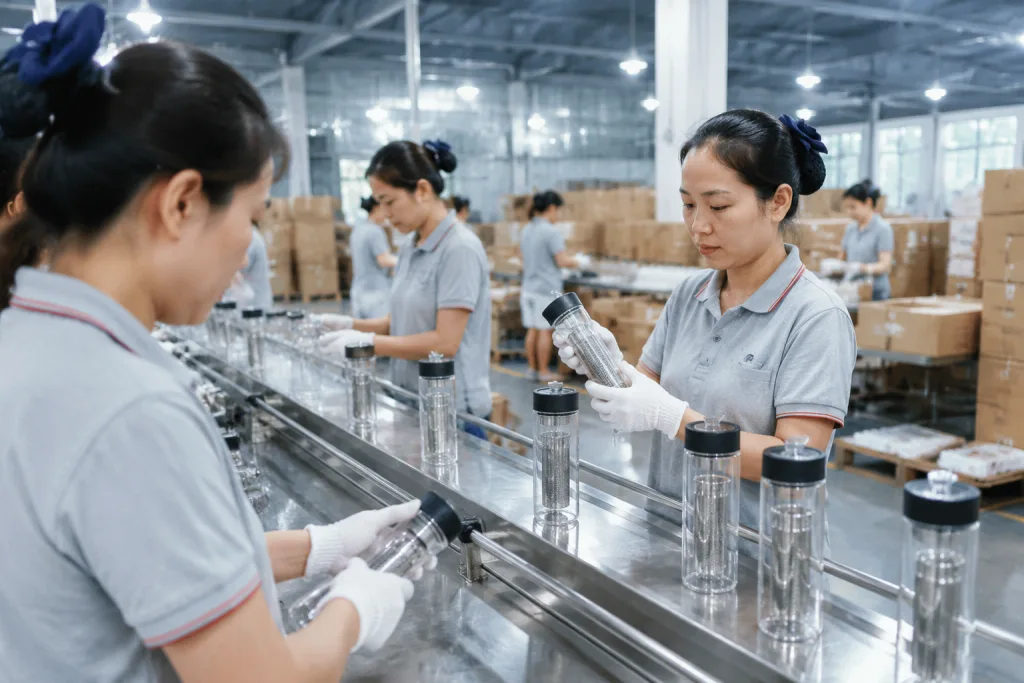
At BottleForge Industrial in Hangzhou, Zhejiang, we usually push new buyers toward stock-body programs first. We ship faster that way: 12 days for a stock body with custom color and logo vs 18 days or more once you start changing core dimensions. You can still build a customized infuser bottle through color, lid finish, basket geometry, logo process, and packaging without opening a full mold on the first order. Last month QC pulled the sample on a new basket fit because the silicone ring was 0.5 mm thin, and that small miss turned into leaks after drop test. We have seen this go sideways.
Spec table that actually matters
Procurement teams need more than a catalog photo. They need the spec sheet that predicts claims, returns, and margin before we run the line. Last month QC pulled a pre-production sample because the drawing showed a 0.8 mm wall, but the first blow-molded body averaged 0.74 mm at the shoulder.
Core spec points to compare
- Body material: Eastman Tritan TX1001, PETG, borosilicate glass, or 18/8 stainless steel.
- Wall thickness: 0.7-1.0 mm for Tritan, 0.35-0.5 mm for stainless inner/outer shells, 2.2-2.8 mm for glass.
- Capacity tolerance: normally +/-3%.
- Leakproof design: single or double silicone gasket, thread pitch consistency, torque target 8-12 kgf-cm.
- Infuser type: full-length fruit rod, short tea basket, bottom-loading basket, or top strainer.
- Decoration: 1-color silkscreen, 2-color print, heat transfer, laser marking, or wrap label.
- Carton drop performance: usually 1A or internal standard equivalent for ecommerce programs.
For a bulk infuser bottle order, these details decide whether production runs clean or turns into a claim file. A 700 ml Tritan body with 0.8 mm wall thickness and a PP lid is usually fine for retail shelf programs at 3,000 pcs MOQ. For Amazon FBA or DTC parcel, we often tighten the cap torque window to 9-10 kgf-cm, add a 1.5 mm insert tray, and pack each bottle in an individual polybag so the body does not scuff in transit. This is the wrong question to ask: “Is the bottle leakproof?” Ask instead what the pass rate was after carton drop and vibration test.
If your product concept is a custom made infuser bottle for fruit blends, ask for basket perforation size in millimeters. This matters. Holes around 2.0-3.0 mm work for fruit chunks, but they are too open for fine tea leaves, and we have seen buyers flag residue after first use. For a customized tea infuser bottle, mesh or perforation often needs to be 0.5-0.8 mm equivalent to limit residue. On one PO, the buyer typed “2.5 mm tea filter” by mistake, and the approval sample brewed like an open cup. That one detail affects user satisfaction more than a metallic paint lid.
For distributor programs, especially a distributor infuser bottle or distributor tea infuser bottle line, choose shared parts across SKUs. One lid platform used across 500 ml, 650 ml, and 750 ml bottles cuts spare-part issues and lowers future MOQ pressure. We ship this setup often. The math works better too: one common lid mold, one silicone gasket size, and one torque standard at 8-12 kgf-cm usually reduce dead stock after the season.
Use-case fit by sales channel
Not every bottle belongs in every channel. The right factory direct infuser bottle program starts with where you expect to ship volume, not with a pretty rendering on page 1 of the PO.
Best fit for wellness retail
For yoga studios, spa retail, or health stores, a 650-700 ml customizable fruit infuser bottle with a carry loop is the safe SKU. We usually run a clear Tritan body, one-color logo, and full-length fruit basket because shelf staff can explain it in 10 seconds and the mold cost stays under control. MOQ is commonly 2,000-3,000 pcs per color, lead time 25-35 days after sample approval. On the line, QC pulled a sample last month because the loop gate left a 0.6 mm burr, and that kind of small finish issue shows fast on clear bottles.
Best fit for subscription and DTC
DTC buyers look hard at unboxing and replacement rate. A customized fruit infuser bottle in Tritan or coated stainless works well if you pack a spare seal and a clear usage insert inside the unit box. Skip glass unless your average order value covers heavier freight and a damage reserve that usually lands 2-4% higher in parcel shipping. Carton engineering matters as much as bottle design. We have seen this go sideways when the buyer flagged scratches, but the real problem was a loose divider and a 32 ECT carton that was too weak for courier drops.
Best fit for tea-focused brands
A bulk tea infuser bottle needs a shorter basket or top strainer. Long fruit cores look wrong for loose-leaf tea, and this is the wrong question to ask if the discussion stays on logo size first. Stainless or glass usually fits a premium tea position better. If your audience brews hot liquids, confirm the temperature range and check whether the outer wall gets too hot to hold at 85°C. Sounds obvious. We still see startups miss it, then ask for a silicone sleeve after tooling is already cut.
Best fit for wholesale and distributor networks
For a distributors infuser bottle or distributors fruit infuser bottle program, keep decoration simple and inventory flexible. Stock colors with private label packaging usually beat heavy custom SKUs because distributors want to reorder fast, mix colors in one PO, and keep shelf codes clean. In Europe and North America, buyers often ask for lower MOQ mixed-color runs, EAN-ready packaging, and stable replenishment. We ship these programs more smoothly from a Zhejiang factory running 300,000 units/month than from a workshop that is good at samples but stalls on repeat orders. Last quarter, one buyer PO even had the color code typoed from BK to BL, and simple stock colors saved the shipment.
The rule is simple: choose the bottle for the channel first, then decorate it. Too many startups do it backward, and the math doesn't work later.
What customization really costs
Private labeling does not always mean a new mold. On first orders, we usually run existing tooling and put the budget into the details buyers actually see at first touch: color, logo, box, and strap feel. For a custom logo infuser bottle, pricing usually moves in these small increments. Last month one PO even misspelled Pantone on the remark line, but the buyer still cared more about logo position than the cap structure.
- Body color matching: add roughly USD 0.05-0.18 depending on resin and transparency.
- Silkscreen logo: USD 0.05-0.12 for 1 color, higher for 2-color registration.
- Laser mark on stainless: USD 0.06-0.15.
- Individual color box: USD 0.18-0.45 depending on print coverage and insert style.
- Sleeve or strap accessory: USD 0.20-0.60.
Tooling is where buyers usually lose the plot. A new lid mold, basket mold, or handle insert can add USD 1,500-6,000 and push development by 20-35 days, and that is before the first T1 sample shows a 0.3 mm fit issue on the thread. We have seen this go sideways. Unless your forecast is above 20,000 pcs in the first 12 months, custom tooling is hard to justify unless that feature is the whole selling point.
For a factory fruit infuser bottle or factory tea infuser bottle project, staged customization is the safer move. Phase one: stock body, private color, custom packaging. Ship it. Phase two comes after reorder data proves the item has legs, then you open a custom basket or lid. QC pulled a sample last quarter where the stock body sold fine, but the new basket idea cut fill volume by 40 ml, and the buyer flagged it right away. Better to keep cash in marketing and inventory than bury it in molds in China.
Low MOQ claims hide cost in other places. This is the wrong question to ask. A factory may quote 500 pcs, but then the unit price jumps, color choices shrink, printing registration drifts, or carton drop performance gets weaker because they pack by hand instead of running the line with a fixed insert. For a serious bulk infuser bottle program, 2,000-3,000 pcs per model is usually where pricing and consistency start to make sense.
If you are talking to a factory infuser bottle supplier in Zhejiang, ask one direct question: what is the repeat-order price at 5,000 pcs and 10,000 pcs using the same packaging? Ask for both numbers on one sheet. That tells you more than a sample quote. We ship plenty of first orders at one price, then the real story shows up on reorder once setup cost, print screens, and packing speed are spread over volume.
Compliance, testing, and inspection discipline
Your bottle can look good on the screen and still fail at the dock. For Europe and North America, infuser bottle private labeling needs a compliance file tied to the exact BOM used on the line—304 stainless basket, Tritan body, silicone seal hardness, logo ink, adhesive, all of it. We have seen suppliers send a generic report from a similar bottle with a 1.5 mm wall, then ship production at 1.2 mm with a different seal compound. That file does not hold up.
- EU market: ask for REACH SVHC status, LFGB where relevant, and migration testing if required by the material/contact scenario.
- US market: request FDA food-contact declaration and, for children-oriented products, check whether ASTM or CPSIA-adjacent issues apply to packaging or decoration.
- Factory systems: ISO 9001 helps, BSCI is often requested by larger retail buyers, and documented incoming material control is more useful than a framed certificate alone.
Set inspection terms before PO release. AQL 2.5 for major defects and 4.0 for minor defects is a common baseline for drinkware. Spell out major defects in plain words: leakage, cracked body, missing seal, sharp edge on basket, failed logo adhesion, wrong carton marking. QC pulled the sample once for a basket burr over 0.3 mm, and the buyer flagged it at once. If this section stays vague, the argument starts later, not now.
For a customizable infuser bottle with printed logo, use a practical test plan. No fancy wording. Run a 24-hour upside-down leak test, a 500-times lid cycle test, dishwashing guidance confirmation, odor check after hot-water fill, and barcode scan check if the item goes into retail. We also check logo rub resistance with 3M tape on decorated lids because this is where claims start. For Amazon or marketplace programs, verify carton labeling and FNSKU application before production starts. After goods hit the warehouse, the math doesn't work.
Buyers looking for a distributor fruit infuser bottle or distributor tea infuser bottle usually care more about repeatability than new features. They are right. A stable bottle with complete paperwork and a 30-day lead time beats a flashy design with weak inspection discipline every time. We ship this every season. In Zhejiang and across China, the factories worth keeping are the ones that answer compliance questions straight, send part drawings with dimensions, and accept pre-shipment inspection without drama. If a factory pushes back on third-party inspection at the PO stage, we have seen this go sideways.
How to shortlist the right supplier
If you are comparing factories, stop looking only at sample appearance. A clean sample proves little. We have seen trading offices send out polished pieces packed in EVA, then struggle once the order hits the line. For a reliable factory direct infuser bottle source, ask questions that show what the plant actually runs: output by model, wall thickness in mm, and which parts they make themselves.
Questions worth asking on the first call
- What is your MOQ by color and by decoration method?
- What is your monthly output for infuser bottles specifically, not all drinkware combined?
- Can you share the material grade and wall thickness for the quoted model?
- Which parts are made in-house and which are outsourced?
- What is your normal lead time for repeat orders: 20 days, 30 days, or 45 days?
- Do you support AQL inspection and provide production photos by stage?
A credible answer is specific. Example: MOQ 2,000 pcs, 35 days first order, 25 days repeat, 200,000 infuser bottles per month on two assembly lines, and standard AQL 2.5 inspection. Better if they add details like 0.5 mm outer wall, silicone gasket sourced locally, and screen printing done on line 2. QC pulled the sample. Vague claims are a warning.
For a customized tea infuser bottle or custom made infuser bottle project, ask for a pre-production sample made with actual production materials and the final decoration method. This is the right question. A prototype is fine for shape approval, but it will not show whether the logo passes a tape test, whether the gasket has odor after 24 hours sealed, or whether the Pantone shifts after oven curing. We have seen this go sideways at 3,000 pcs.
Choose the supplier that understands your business model. Startups usually need flexibility more than the lowest FOB quote. If your reorder pattern is 3,000 pcs every 60 days, say it early. A good China supplier will suggest shared carton specs, stock resin planning, or holding 1 set of infuser components for your next PO. The buyer flagged this once after a PO typo changed 3,000 pcs to 30,000 pcs. Saving 8 cents on the first order sounds good; the math doesn't work if the second order slips 12 days.
The best fruit infuser bottle bulk or bulk infuser bottle program is boring in the right way: clear specs, proven parts, predictable lead time, and no surprises when the second order lands. We ship these every week. That is what you want.
Quote your infuser bottle line with real factory specs
Send your target market, capacity, material, and forecast. We will recommend the right bottle structure, MOQ, compliance path, and FOB range within one working day.
Frequently asked questions
What MOQ should I expect for infuser bottle private labeling?
For most China factories, including Zhejiang suppliers, MOQ for infuser bottle private labeling is usually 1,000-3,000 pcs per model per color. A stock-body program with one-color silkscreen may start at 1,000 pcs, but better pricing usually begins around 2,000-3,000 pcs. If you want custom color matching, printed packaging, and a custom logo infuser bottle with multiple accessories, expect the practical MOQ to move up. For stainless or glass, MOQ may be 1,000-2,000 pcs because unit value is higher. If a supplier offers only 300-500 pcs, check whether they are using leftover components, charging a steep setup fee, or limiting your decoration options.
Which material is best for a bulk fruit infuser bottle line?
For most wellness brands, Tritan is the safest starting point for a bulk fruit infuser bottle line. It is clear, lightweight, BPA-free by material positioning, and usually lands at USD 2.10-3.40 FOB for a 650-750 ml bottle at 3,000 pcs. That makes it easier for ecommerce and wholesale. Borosilicate glass gives a cleaner premium look, but shipping damage and heavier freight can hurt margin. Stainless steel works if you want a premium or insulated story, but customers cannot see the fruit, which reduces visual appeal. If your main channel is DTC or gym retail, Tritan usually gives the best balance of cost, durability, and merchandising.
How long does a custom infuser bottle order usually take?
A realistic schedule for a custom infuser bottle order is 7-12 days for samples, then 25-35 days for mass production after sample approval and deposit. If you add new tooling for a lid or infuser basket, development can add 20-35 more days. Repeat orders are faster, often 20-30 days if the Zhejiang factory has stable component supply and no major packaging changes. During peak season in China, especially before long holidays, add a buffer of 7-10 days. If you need barcode labels, FNSKU application, or retail display packaging, confirm those details before production starts because late changes often cause shipment delays.
What tests and documents should I ask for before shipping?
At minimum, ask for food-contact material declarations matched to the exact SKU, plus REACH status for Europe and FDA-related food contact documentation for the US market. For some buyers, LFGB is also requested. On product quality, require a 24-hour leak test standard, carton drop test results if you sell online, and a pre-shipment inspection using AQL 2.5 for major defects. If your bottle has printed graphics, ask for adhesion testing details. If the supplier claims BSCI or ISO 9001, request current copies, but do not stop there. The more important point is whether the factory can show incoming material checks, in-process QC records, and final inspection reports.
When does it make sense to invest in a new mold?
A new mold only makes sense when the feature will either improve sell-through clearly or support enough volume to recover the cost. For infuser bottles, new tooling commonly costs USD 1,500-6,000 for a lid, basket, or accessory part, and full bottle tooling can be much higher. As a rough rule, if your 12-month forecast is below 20,000 pcs, you are usually better off using an existing platform and customizing color, logo, and packaging first. If your product concept depends on a patented-looking lid, a unique tea basket, or a distinctive carry system, then tooling may be justified. Otherwise, keep your cash for inventory, compliance, and marketing.