Key Takeaways
- A realistic MOQ for a custom infuser bottle is usually 3,000-5,000 pcs per color, with sample time 7-12 days and production 30-45 days
- Factory FOB pricing often lands around USD 2.10-4.80 per unit depending on Tritan, stainless steel infuser, print, and gift box
- Use AQL 2.5 for major defects and confirm leak, drop, odor, dishwasher, and logo adhesion tests before mass production
- For Zhejiang and wider China sourcing, the biggest cost mistakes come from unclear lid, seal, and packaging specs rather than body material alone
You have a hydration SKU in mind, a target retail price, and a launch date your sales team already put on the calendar. Then you start talking to infuser bottle manufacturers, and one bottle comes back with five prices, three lid builds, two resin options, and a lead time that shifts from 12 days to 18 days. That part is normal. The hard part is freezing the spec before tooling, sampling, and printing charges start creeping. Last month a buyer sent a PO with the lid color code typed wrong by one digit, and the sample room caught it only because QC pulled the sample against the Pantone card.
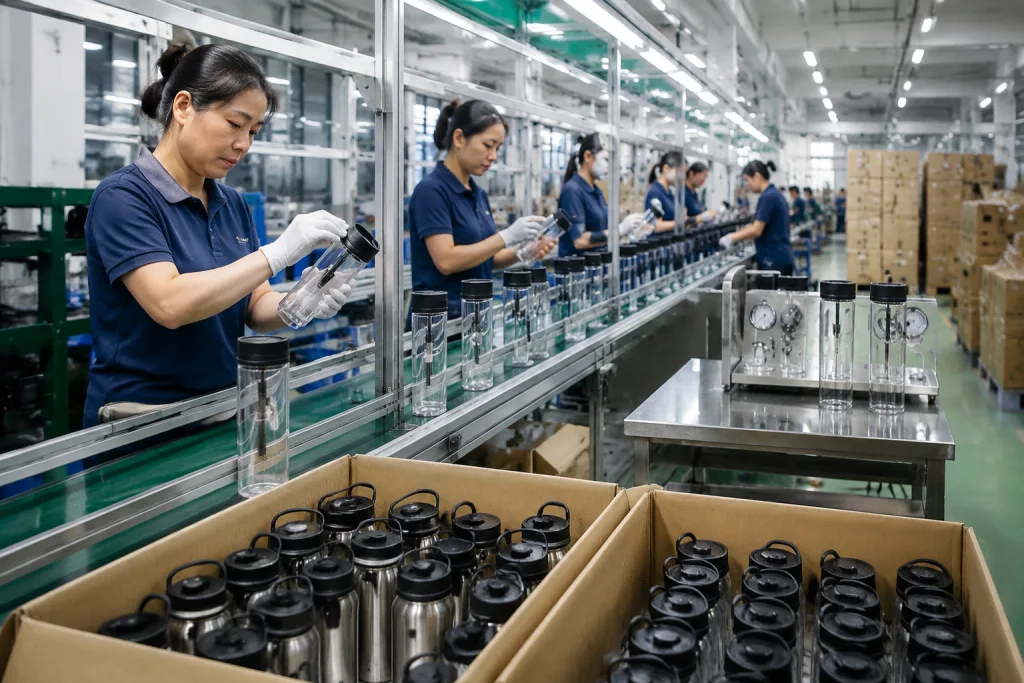
For wellness brands and hydration startups, an infuser bottle looks simple on the shelf. On the line in Zhejiang, it is body material, basket tolerance, seal compression, print method, pack-out, compliance, and drop performance, all tied together. Miss one point and your bulk infuser bottle lands looking fine but leaking at 0.03 mm seal gap, fogging after hot fill, or failing a retail drop test. You need a sourcing process that follows one order from quote to final inspection. Anything less, and we've seen this go sideways fast.
Start with one realistic order
Here’s a real order we see on the line. A wellness brand in Europe plans a 700 ml custom fruit infuser bottle for gym retail, online DTC, and a small distributor infuser bottle program. Target retail is EUR 24.90. Spec draft: Tritan body, removable fruit basket, carry-loop lid, one-color logo, and a branded kraft box. Opening order is 5,000 pcs, split into 2 body colors. That split matters. At 2,500 pcs per color, some factories will change carton pack-out or bump the print setup charge.
It sounds simple. It isn’t. An export-ready RFQ needs more than one reference photo and a message saying “same as this.” A factory in Zhejiang needs the hard points below, or QC will be asking questions after tooling samples instead of before:
- Capacity: 700 ml filled to brim, not 700 ml usable volume
- Material: Tritan TX1001 or food-grade PP + AS, depending target cost
- Infuser type: full-length fruit basket or short tea basket
- Lid structure: screw lid with silicone gasket, flip top, or threaded cap with handle
- Branding: 1-color silk screen, wrap print, heat transfer, or laser on stainless part
- Packaging: polybag + egg tray, white box, or retail gift box
- Compliance: REACH, LFGB, FDA contact declaration, and colorant statement if needed
At this stage, ask all infuser bottle manufacturers to quote on the same basis: FOB Ningbo or FOB Shanghai, same carton standard, same sample policy, same mold status. This is the right question to ask. At BottleForge Industrial in Hangzhou, Zhejiang, we often see 5 quotations side by side that are pricing 5 different bottles. One supplier includes a stainless steel filter. One swaps Tritan for AS. One leaves out logo plate setup. One assumes a plain box with no insert. Last month a buyer flagged a USD 0.18 gap and thought it was factory margin; it was just the difference between a 350 gsm kraft box and a white folding box. The math doesn’t work if the quote basis is different. Cheapest first quote often turns into the most expensive PO.
If you are building a bulk tea infuser bottle instead of a fruit version, lock the leaf size and basket mesh opening early. We’ve seen this go sideways. Tea use changes filter hole diameter, cleaning time, and flow rate, and QC pulled one sample last season where the 0.8 mm mesh worked for fruit water but choked on broken black tea leaves. This is not a marketing tweak. It changes the bottle structure.
Build the bottle specification properly
After you cut the supplier list down, do not start with price. Freeze the specification sheet first. For a custom made infuser bottle, that sheet sets cost, fit, and yield on the line. If it stays vague, your approved sample and mass production can drift by 0.3 mm on the thread, and QC will find leaks at the vacuum tester.
A practical spec sheet for a customizable infuser bottle should include:
- Body: Tritan, borosilicate glass, or single-wall stainless steel; wall thickness 2.2-2.8 mm for Tritan is common at 700 ml
- Lid: PP or ABS outer, food-grade PP inner, silicone seal Shore A 50-60
- Infuser: PP basket, Tritan basket, or 304 stainless steel basket with perforation size stated
- Weight: for example 228 g ± 8 g including lid and infuser
- Color: Pantone reference for lid, loop, and body tint
- Decoration area: print width, height, and distance from base seam
- Packaging: barcode label position, instruction insert, carton drop standard
For a custom logo infuser bottle, ask the factory to write down the print method and adhesion standard. This is the wrong question to skip. A simple one-color silk screen is usually USD 0.08-0.18 per unit at 5,000 pcs. Heat transfer can run USD 0.20-0.45. If your brand needs a matte metallic effect, test abrasion resistance before sign-off; we have seen 3M tape tests pass while the first carton still scuffed during pack-out. Buyers often stare at the bottle body and miss the logo finish, but the buyer flagged that issue faster than a 1-shade color difference on a recent PO with the logo position typed 12 mm too high.
Wellness brands also need to think about cleaning. Looks sell once. Repeat orders come from daily use. A customizable tea infuser bottle with a narrow neck can look sleek, but if the basket sticks after hot fill or fruit pulp traps under a 1.5 mm seal lip, the math doesn't work. Ask for neck inner diameter, basket insertion depth, and exploded drawings. We run into this often: the sample looks fine, then the line packs it, and customers cannot get the basket out without twisting hard. Good factory infuser bottle suppliers in China will give you 2D dimensions and assembly sequence, not just pretty renders.
You are not buying a picture. You are buying a repeatable assembly with tolerances.
Price the order without fooling yourself
Now you’re at the pricing stage. For a 5,000 pc order of a custom infuser bottle in Zhejiang, FOB usually lands in these bands, based on standard packing and a line run with no special rework:
- Economy AS/PP bottle: USD 1.60-2.20
- Tritan body + PP infuser: USD 2.10-3.20
- Tritan body + 304 SS infuser: USD 2.60-3.80
- Borosilicate glass + sleeve + infuser: USD 3.20-4.80
- Retail gift box: add USD 0.28-0.75
- One-color logo: add USD 0.08-0.18
You can skip tooling if you stay on an existing body and only change color, logo, and packaging. That is how most 5,000 pc programs start. For a custom fruit infuser bottle on an existing mold, sample charges are usually USD 50-150 per version, and we often credit that back on the bulk PO. If you ask for a new lid or basket structure, simple tooling usually runs USD 1,500-4,000. A full new bottle mold can exceed USD 6,000-12,000 depending on cavities. We’ve seen this go sideways when a buyer approves a nice-looking 3D drawing but misses a 0.3 mm snap-fit tolerance on the lid.
MOQ matters. This is the wrong question to ask if you only ask for the lowest number. We get 6 or 7 distributor inquiries a month asking for 1,000 pcs with full customization on a fruit infuser bottle, and the math doesn’t work for efficient unit pricing. In our segment, MOQ is commonly 3,000 pcs per color for an existing model, or 5,000 pcs if you want a custom logo infuser bottle with dedicated color masterbatch and retail packaging. Even a China factory with 300,000 units/month total drinkware capacity still needs to book cartons, run printing, and set the line. Last month a buyer flagged a 1,000 pc request after seeing the setup charge for a Pantone-matched masterbatch lot at 25 kg minimum.
Be just as honest on logistics. A fruit infuser bottle bulk order ships badly by air on volumetric weight because the bottle is light and the carton cube is not. If you ship to Amazon FBA, ask for carton dimensions, unit polybag status, suffocation warning, and FNSKU application at quote stage, not after the PI is signed. QC pulled the sample on one order and the bottle was fine, but the outer carton came in at 61 cm, which pushed the freight bracket up. Freight surprises are often bigger than the savings from pushing unit price down by USD 0.06.
Approve samples like a buyer, not a fan
Sample approval is where 7 out of 10 hydration startups lose discipline. They get a nice-looking customized fruit infuser bottle, fill it once at a desk, and sign off. Then we run mass production and the defects show up on the line. You need a routine, not a first impression. We’ve seen this go sideways after one unchecked cap sample with a 0.3 mm thread mismatch.
What to check on the pre-production sample
- Leak test: fill at 60-70°C, invert 30 minutes, shake 50 cycles, inspect seal and thread
- Odor test: close for 24 hours, then open and smell body, lid, and infuser separately
- Fit: basket should lock consistently without cross-threading or wobble
- Print: tape adhesion and 100 dry rub cycles minimum
- Drop test: packed sample from 76 cm on edges and corners for retail box check
- Dishwasher claim: only approve if tested; otherwise mark hand wash only
If your program includes a custom tea infuser bottle, brew loose leaf tea in the sample. Do not just pour hot water and call it done. Check extraction speed after 3 minutes, sediment passing through the holes, and staining around the lid ribs where tea film builds fast. If your program is a customizable fruit infuser bottle, load citrus, berries, and mint, then leave it 12 hours. Seed clogging is common. Basket cleaning matters. One buyer flagged a basket last spring because blueberry skin stuck in four laser-cut holes and the sample looked dirty after one use.
Ask the supplier for a signed golden sample and a production tolerance table. This is the right question to ask. The table should show color variance allowance, weight tolerance, body height tolerance, neck thread gauge standard, and acceptable cosmetic range, with actual numbers like ±2 g or ±0.5 mm instead of “within standard.” Better infuser bottle manufacturers in China keep approved samples in both the sales office and QC room. QC pulled the sample, sales had another one, and the logo position was off by 1.5 mm on one set — that argument disappears if both are signed and dated. It sounds basic, but it stops the usual factory-floor line: “we made it according to last sample,” when nobody can prove which sample that was.
At BottleForge Industrial in Hangzhou, Zhejiang, pre-production sample lead time is typically 7-12 days for existing molds and 20-30 days if new tooling is required. That timing is normal. If your supplier promises a 3-day custom made infuser bottle sample with new print, new color, and new package, the math doesn’t work. They are rushing or skipping controls. We ship faster only when the mold, Pantone match, and carton dieline are already approved, and even then QC still checks thread gauge, print position, and gross weight before the sample goes out.
Control production before defects multiply
Once the PO is signed and the deposit lands, the risk shifts from spec mistakes to line drift. A bulk infuser bottle order usually runs through injection molding or blow molding, printing, sub-assembly, washing, packing, and carton sealing. If those steps do not have hard checks, defects stack fast. We have seen that go sideways on a 5,000 pc run when one missed gasket lot kept moving for two shifts.
Ask for three control stages:
- IQC: incoming resin, silicone gaskets, stainless baskets, packaging materials
- DUPRO: during production inspection at 20-50% completion
- PSI: final pre-shipment inspection based on AQL
For a customized infuser bottle, use an AQL plan such as Major 2.5 / Minor 4.0 / Critical 0. Critical defects should include leakage, sharp burrs, wrong material declaration, mold contamination, and missing compliance marks if required. Major defects can include severe print shift, cracked infuser basket, lid thread mismatch, and strong odor. Minor defects cover light scuffs inside the agreed cosmetic limit. This is the wrong question to ask if someone says "the bottles look fine" at packing. QC pulled the sample and found a 0.3 mm flash on the rim; that kind of miss becomes a customer complaint after the carton is closed.
Do not rely on visual QC alone. Practical factory tests for a factory direct infuser bottle shipment should include:
- 100% vacuum or air-pressure leak check if the design allows
- Random torque test for lids
- Thread gauge verification at line start and line end
- Carton barcode scan accuracy
- Net weight spot checks every 1-2 hours
If you are selling through distributors tea infuser bottle channels, carton consistency matters more than a lot of startups expect. Distributors want steady master carton dimensions, label placement, and pallet pattern. One buyer flagged a PO because the carton height changed by 6 mm and the warehouse math stopped working. Mixed carton heights can trigger refusal fees in Europe and North America.
Lead time for a 5,000 pc order is usually 30-45 days after sample approval and deposit, depending on print complexity and packaging. Peak season in China, especially before CNY and during autumn gifting cycles, can push that to 50-60 days. Ask early whether your supplier makes key parts in-house or buys lids and baskets externally. A line with outsourced lids runs different from a line that molds its own parts, and the gap is usually 12 days versus 18 days on paper, then longer when the buyer changes artwork. A supplier with a typo on the packing list will usually also be loose on timing.
Documents and compliance buyers actually need
By the time your factory tea infuser bottle order is ready to ship, the fight is usually about paperwork, not print colors. We have seen a buyer hold back 40% balance payment over one missing carton mark. If your wellness brand sells into the EU, UK, US, or Canada, get the documents locked before you pay the final invoice.
For most custom infuser bottle projects, ask for these files:
- Commercial invoice and packing list
- Bill of lading instructions
- Declaration of food-contact compliance: FDA or LFGB basis depending market
- REACH statement: especially for colorants, coatings, and silicone components
- Test report: migration or food-contact report from a recognized lab when needed
- BSCI or social audit copy: if your retailer requires it
- Carton marks and barcode file confirmation
For US ecommerce, if you are shipping a bulk tea infuser bottle or fruit infuser bottle bulk program into FBA, freeze the sell-unit label plan before pack-out. Once the cartons are taped, FNSKU relabeling turns into extra labor and a missed ship slot. For Europe, check the gift box copy line by line. We have had buyers flag “100% leakproof” and “dishwasher safe” because the test basis was thin, and that is the wrong question to ask after the boxes are printed.
One more practical point: ask whether replacement parts are on hand. A custom tea infuser bottle often needs spare baskets or seals for after-sales support. We run 2% extra silicone gaskets and 1% extra lids on first orders, and that is cheap insurance when a distributor reports a cracked seal on day 18 instead of day 12. The math works.
If the supplier can explain the process plainly, state MOQ and lead time clearly, and show how they control incoming seals, printing adhesion, and final AQL, you are probably dealing with a workable manufacturer. If the answer stays soft, move on. QC pulled the sample and the seal size was off by 0.8 mm once; that kind of miss shows up again in shipping.
Get your infuser bottle spec reviewed by engineers
Send your target price, quantity, and reference design. We will flag leakage, MOQ, packaging, and compliance risks before you place the order.
Frequently asked questions
What MOQ should I expect from infuser bottle manufacturers?
For an existing mold with custom color and logo, a workable MOQ is usually 3,000 pcs per color, sometimes 2,000 pcs if packaging is simple. For a fully customized infuser bottle with retail gift box and dedicated color masterbatch, 5,000 pcs is more common. If you need a new lid or infuser basket, some factories in China will ask 5,000-10,000 pcs to justify tooling and setup time. You can ask for a trial order below MOQ, but expect unit price to rise by 10-25% and fewer packaging options.
How do I choose between Tritan, glass, and stainless steel for a custom infuser bottle?
Tritan is usually the safest starting point for wellness brands because it is light, clear, durable, and easy to mold in volume. At 700 ml, a Tritan bottle may weigh around 220-260 g, while borosilicate glass versions can reach 380-520 g before packaging. Glass feels premium but breakage risk and freight cost are higher. Single-wall stainless works for durability, but you lose the visible fruit-and-tea effect many buyers want. For a bulk fruit infuser bottle sold online, Tritan often gives the best balance of cost, appearance, and transit performance.
What tests should I require before approving mass production?
At minimum, require leak testing, odor testing, print adhesion, assembly fit check, and packed drop test. A practical routine is 30-minute inverted leak test, 50 shake cycles, 24-hour closed odor check, tape adhesion plus 100 dry rub cycles on the logo, and a 76 cm packed drop test on edges and corners. If you claim dishwasher safe, test at least 20 cycles. If the bottle is a custom tea infuser bottle, also check sediment control and basket removal after brewing. Put pass/fail standards in writing before the factory starts bulk production.
What is a realistic lead time for a bulk infuser bottle order from China?
For an existing model, custom sample time is often 7-12 days. After sample approval and deposit, mass production usually takes 30-45 days for 3,000-10,000 pcs. If your order includes a new mold, add roughly 20-30 days for tooling and first sample correction. Peak periods in China can push production to 50-60 days, especially before Chinese New Year. Sea freight from Ningbo or Shanghai to Europe often adds 30-40 days port to port, and to the US around 20-35 days depending on coast and routing.
How can I reduce risk with a new factory infuser bottle supplier?
Start with one existing model instead of a full new mold, and freeze a proper specification sheet before paying deposit. Use FOB pricing, ask for a golden sample, and require AQL-based final inspection by a third party or your own team. Confirm material declarations for Tritan, PP, silicone, and any stainless parts. Ask who makes the lid, basket, and body, because outsourced sub-components create hidden risk. Finally, buy spare seals and lids with the first PO. On a 5,000 pc order, carrying 2-3% extra seals costs very little and protects after-sales performance.