Key Takeaways
- Start with 4 decisions: bottle platform, material, decoration, and QC; changing any of them after sample approval can add 12-20 days
- Typical MOQ for a custom infuser bottle is 1,000-3,000 pcs per color, with FOB China pricing often around USD 2.10-4.80 depending on Tritan, stainless steel, and decoration
- Ask for AQL 2.5 inspection, leak test at 100%, and migration testing to REACH, LFGB, or FDA standards before mass production
- A practical lead time is 7-12 days for pre-production samples and 25-40 days for bulk infuser bottle orders after deposit and artwork sign-off
You can launch a hydration product fast and still miss the mark. We see it on the line. The brief starts with a sketch and a target price, then skips the questions that decide whether the item sells after the first reorder: which fruit basket hole size actually infuses well, which lid setup holds leak rate below 0.3%, which body survives a 76 cm drop test, and whether end users still carry it after 90 days. If you are comparing an infuser bottle manufacturer, those points matter more than a mood board. This is the wrong question to ask if the first email is only “best price for 5,000 pcs.”
Most wellness brands and hydration startups come to Zhejiang, and often Hangzhou first, because they want speed, low MOQ, and a custom logo infuser bottle that feels premium on shelf. Fair enough. We ship those programs every month. But a better sourcing call is not factory direct infuser bottle pricing alone; it is picking the right bottle platform, material set, decoration method, and QC plan before sample approval. QC pulled one sample last month because the silicone ring was 0.4 mm out of spec, and that small miss is exactly how a “good-looking” bottle turns into a leak claim.
The four decisions that shape your order
Sourcing from an infuser bottle manufacturer looks easy on page one. It isn’t. You see a bottle, pick a Pantone, add a logo, then ask for a landed price. That is usually where the delay starts, because the factory still has 4 decisions to lock before costing is real: platform, material, branding method, and quality standard. On our side, sales cannot release a clean quote until the line has the lid structure, bottle volume, and print area in mm.
Platform means the actual bottle architecture, not the hero photo: bottom infuser, full-length core infuser, tea basket, flip straw lid, carry loop, single wall, or double wall. These are different tools, different molds, different complaint patterns. A bulk fruit infuser bottle for gym retail does not behave like a bulk tea infuser bottle for office use. Fruit users usually want 700 ml to 1000 ml water volume and fast cleaning; tea buyers ask about 0.5 mm mesh, infusion control, and heat resistance. We’ve seen this go sideways when a buyer picked a narrow core infuser for cut fruit, then flagged cleaning complaints after the first 2,000 units shipped.
Material sets your cost, compliance path, and complaint risk. Tritan is common for a customizable infuser bottle because it is clear, impact resistant, and lighter than glass; on the floor, that also means lower breakage during carton drop tests. Borosilicate glass looks premium, but parcel shipping claims go up fast if the packout is thin or the insert is only 1.5 mm EPE. Stainless steel works well for insulated custom tea infuser bottle programs, but it kills visible fruit display, and some wellness brands sell on that shelf look. This is the wrong question to ask: not “which material is best,” but “which material fits your sales channel and return-risk math.”
Branding method changes both unit cost and defect rate. A custom logo infuser bottle with one-color silkscreen is cheaper than wrap printing or powder-coated laser marking. Simple. Once artwork adds gradients, metallic accents, or a seam-critical wrap, the base bottle and packaging often change with it. We run into this on curved bodies: a 180 mm print height may look fine on screen, then QC pulled the sample and found logo distortion near the shoulder radius. One buyer even sent a PO with the logo position typed as “centered” but the dieline was off by 6 mm. That small typo costs days.
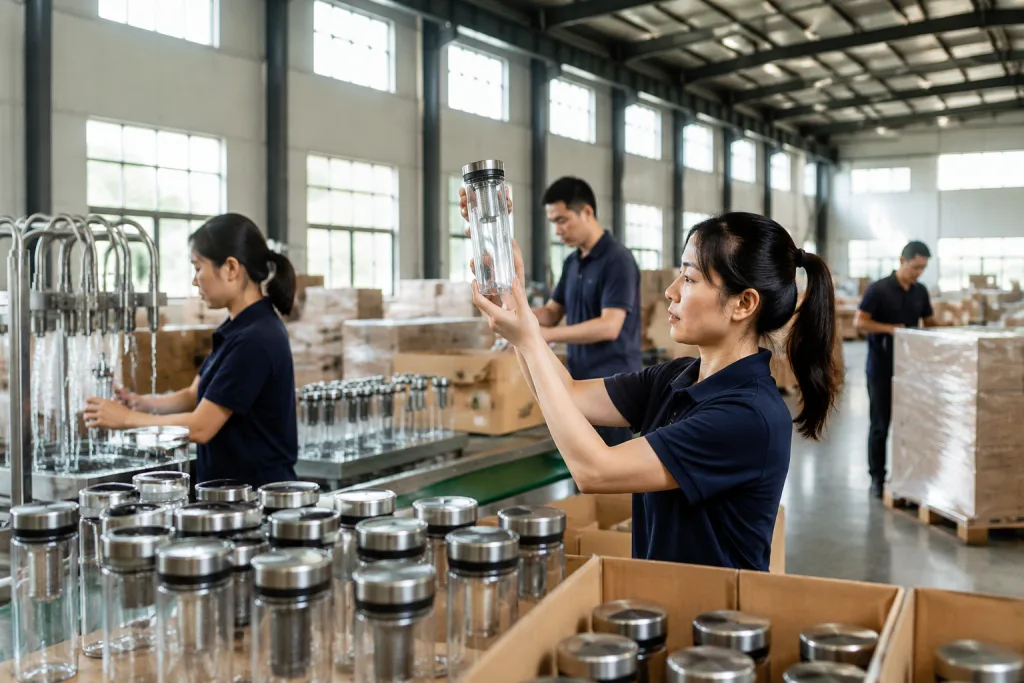
Quality standard is where many startups stay vague. Don’t. Put numbers in the PO. At BottleForge Industrial in Zhejiang, a normal OEM run can be 300,000 units/month across categories, but for infuser projects we still define leak rate, scratch tolerance, color delta, carton drop requirement, and AQL before production. For example, if the lid torque range, acceptable ΔE, and drop test height are missing, the factory and buyer are judging different products. The math doesn’t work. If your supplier cannot turn your concept into a measurable spec sheet, you are not buying well.
Choose the bottle type before chasing price
If you send the same custom infuser bottle RFQ to 3 China factories before locking the bottle type, you will get 3 quotes built on 3 different assumptions. Those prices are not apples to apples. The real trade-off is not cheap versus premium. It is use case versus return risk. We see this on the line all the time: one buyer asks for “best price,” then later flags a leak because the lid structure was never defined.
Common infuser configurations
- Bottom fruit chamber: simpler tooling, fewer mold actions, and easier to run for a factory fruit infuser bottle program. Cost is usually lower. Infusion is weaker if the user does not shake the bottle, and we have seen buyers come back on this point after the first 500 pcs hit retail.
- Full-length infuser rod: more contact area for water and fruit, and the bottle looks better on shelf for a customized fruit infuser bottle. It adds parts, assembly time, and cleaning complaints if the mesh opening is too fine; QC pulled one sample last season with pulp trapped in a 0.5 mm mesh section.
- Tea basket under lid: a good fit for a custom tea infuser bottle, especially with stainless micro-mesh. The weak point is assembly tolerance. If thread fit is loose by even 0.3 mm, baskets can back off during transport, and the buyer flagged it as “missing parts” on arrival.
- Dual-use designs: the bottle runs with or without the infuser, which suits distributors infuser bottle programs. Spare-part control gets messy fast. This is where POs go sideways; we once received a reorder with “include 1 extra filter per bottle” typed on page 2 only, and the packing ratio had to be redone.
For hydration startups, the safest first launch is often a 650-750 ml single-wall Tritan bottle with removable full-length infuser and screw lid. That spec keeps FOB pricing realistic, usually around USD 2.30-3.20 at 2,000 pcs, and avoids the freight penalty of insulated steel. We ship this format every month because the math works. A 2-cavity cap mold and standard leak test at 0.2 MPa are usually enough to keep the first run under control.
For premium wellness retail, a 500-600 ml borosilicate custom fruit infuser bottle or customizable tea infuser bottle supports a higher ticket. It also needs more protective packaging and a higher claim reserve. We have seen 12 days vs 18 days lead-time swing here just from inner pack revision and carton drop prep. If you sell online in North America, ask your infuser bottle manufacturer to validate bottle-plus-color-box performance with a 1A-style drop approach, even if you do not run a formal ISTA protocol. This is not overkill. One cracked base in a color box can wipe out the margin on a small launch.
If your product story depends on seeing sliced citrus or berries inside the bottle, stainless steel may make sourcing easier but selling harder.
The right opening question is not “What is your best price?” This is the wrong question to ask. Ask instead: “Which bottle architecture best fits my channel, user habit, and damage tolerance?” Once that is clear, we can quote the right build, the right MOQ, and the right packing from day one.
Materials decide compliance and customer complaints
Material choice decides two things fast: compliance risk and return rate. A custom infuser bottle may look clean in a sample photo, then start causing trouble on the line if the resin, gasket, and filter mesh do not match. We have seen lids pass hand assembly, then fail after torque testing at 12 N·m because the seal was too soft for the thread set.
Tritan is the workhorse for bulk infuser bottle orders in wellness and fitness. It is BPA-free, clear, and more impact resistant than standard AS or PC. Typical bottle wall thickness is 2.2-2.8 mm depending on capacity and mold design. Go too thin and the panel pulls in near the thread; go too thick and cycle time stretches from 28 seconds to 34 seconds, so the math doesn't work. For a factory direct infuser bottle program, Tritan usually gives the best balance of price, durability, and shelf presentation. On our side, QC pulled the sample more than once for blush marks around the gate on clear Tritan, so mold polishing matters too.
Borosilicate glass suits premium custom tea infuser bottle and spa gifting lines. It handles heat well and feels cleaner to some consumers. The downside is obvious: breakage. You can cut the risk with a silicone sleeve and EPE protection, but you will not remove it. Carton design matters more here than buyers expect; we have seen a 24-bottle master carton pass drop test after changing only the divider thickness from 2 mm to 3 mm. Buyers still ask about cheaper inner packing. This is the wrong question to ask.
304 stainless steel works for insulated custom tea infuser bottle designs, usually with 0.4 mm inner and 0.5 mm outer wall in standard vacuum structures. It supports hot and cold claims, but you lose the fruit visual. If you still want an infused-water concept, steel usually sells better for tea than fruit. We run vacuum checks with a bath test and have seen pinhole leaks show up only after powder coating, which is why sample approval alone is not enough.
Then there are the hidden materials: silicone seals, PP lids, tritan straws, and mesh filters. Ask for food-contact declarations and test reports relevant to your market. Europe may require REACH attention and often LFGB expectations from buyers; North America often centers on FDA food-contact requirements and retailer-specific testing. If your target includes kids or family retail, ASTM and CPSIA questions can appear even for bottles. One small part can hold the whole PO. Last year a buyer flagged a mesh filter odor issue, and the problem was not the steel mesh but a silicone ring packed before full post-cure.
In Zhejiang, experienced factories should already know which combinations have stable assembly yields. Ask direct questions: what is the gasket hardness, what mesh opening is used for tea leaves, and what is the leak-test method? We would expect answers like 50-60 Shore A, 0.35 mm mesh opening, and 100% air-pressure leak test at 0.03 MPa for 5 seconds. If the supplier cannot answer fast, they may be trading more than manufacturing. We have seen this go sideways, including one PO with the lid resin typed as “AS” instead of Tritan.
Branding choices affect margin more than you think
A customized infuser bottle is not a plain bottle with a logo dropped on at the end. Decoration changes yield, packing speed, and repeat-order consistency on the line. We’ve seen a day-one “cheap” quote turn expensive by shipment day after screen rework, carton delays, and a 3 mm logo shift that the buyer flagged.
For most distributor fruit infuser bottle and distributor tea infuser bottle programs, the decoration options that make sense are:
- Silkscreen: usually USD 0.08-0.18 per color per position. Good for simple logos. Best value once you run volume, especially above 3,000 pcs.
- Heat transfer or water transfer: works for wrap graphics, but there are more steps, more handling, and more defect risk. QC pulled the sample last month for edge lift near the seam.
- Laser engraving: common on powder-coated steel parts, less common on clear Tritan main bodies. Clean look, but the math doesn’t work if you expect bright artwork on transparent bottles.
- Embossed or debossed mold logo: clean result but adds tooling complexity and locks you into a mold decision early. A mold insert change is not a small favor once steel is cut.
If you are building a wellness brand, consistency usually pays better than decorative ambition. A custom logo infuser bottle in one Pantone on a matte carry loop often looks cleaner than a full-wrap print that starts scratching in transit after 12 days instead of arriving clean at 18 days. For distributors infuser bottle business, simple decoration also makes replenishment easier because artwork approval moves faster and color drift is easier to hold under the light box.
Ask your supplier how they control decoration defects. Good answers are specific: incoming ink verification, adhesion test with 3M tape, cure check, and post-decoration visual inspection under set lighting at the inspection table. Also ask what percentage of bottles are leak tested after logo application. The right answer is still 100%. This is not a paperwork question. Decoration can hide assembly marks that operators would have caught before printing.
For low-MOQ market testing, a customizable fruit infuser bottle with stock color body and custom packaging is often a better move than fully custom plastic color matching. We’ve seen startups spend on bottle color chips and then miss a carton barcode digit on the PO. That goes sideways fast. If you are shipping to Amazon FBA, include FNSKU placement, carton labels, and polybag warning requirements in your spec package before production starts, not after the first sample is approved.
How to compare factories without guessing
I’ll rewrite the section in-place style, keep the HTML tags unchanged, and tighten the sales-engineer voice while preserving the specific numbers and inspection terms.Not every supplier calling itself an infuser bottle manufacturer runs the same shop. Some own molding and assembly. Some only print, pack, and pass the work down the road. Some are trading companies with decent service but weak process control. You do not need to reject one model on sight, but you do need to know what sits behind the quote.
Start with the basics:
- MOQ by SKU, by color, and by decoration
- Sampling lead time and whether sample cost is refunded
- Mass production lead time in peak and off-peak months
- Whether tooling is proprietary or shared
- Test capability: leak, dishwasher, drop, odor, migration
- Audit status such as BSCI or ISO-based systems
A serious factory infuser bottle supplier should quote cleanly. We run this every week: MOQ 1,000 pcs for stock mold with one logo, 3,000 pcs for custom color body; sample lead time 7-10 days; production 30-35 days after deposit and PPS approval; leak test 100%; AQL 2.5 for final inspection. A buyer once sent us a PO with the color code typed wrong, and the whole order had to be rechecked on the line. That is useful information. “We can do anything” is not.
Ask for photos or video of the line where bottles are assembled, leak tested, and packed. Ask how they handle spare parts. A removable infuser means replacement demand. If your distributors’ fruit infuser bottle business grows, can the supplier sell spare baskets, seals, and lids for 12 months after the main order? We’ve seen this go sideways when the seller had no spare gasket stock and the buyer had to wait for a new injection run. That matters.
China gives you deep supply-chain options, especially in Zhejiang where plastic molding, steel fabrication, and packaging vendors sit close together. That shortens problem-solving time. But it also means many factories can source similar-looking components from the same vendor network. The real gap is not who can find parts. It is who can hold a 0.3 mm tolerance, document change control, and ship the same bottle on reorder six months later without the buyer flagging a mismatch.
Build the QC plan into the PO
The safest point to stop a quality dispute is before the line starts. After a bulk tea infuser bottle or fruit infuser bottle bulk order is on the water, your leverage drops fast, and a 12-day fix turns into an 18-day argument. We have seen this go sideways over a 1.5 mm seal gap that nobody wrote into the PO.
Your PO and specification sheet need to cover more than size and logo. This is the wrong question to ask if you only compare unit price. Include:
- Capacity tolerance: for example 700 ml plus or minus 3%
- Material grade: Tritan TX1001, borosilicate glass, 304 stainless, food-grade silicone
- Color standard: Pantone reference and acceptable delta
- Leak test: 100% air-pressure or inverted water test for a defined time
- Finish standard: no sharp burrs, no black specks above agreed size, no visible scratches at 30 cm
- Packaging: barcode, insert language, carton drop requirement, carton gross weight limit
Use AQL for final inspection, but do not hide behind it. For drinkware, a lot of buyers run AQL 2.5 major and 4.0 minor. Fine for print defects or small cosmetic marks. Not fine for leaks. Leak risk should sit under functional zero tolerance inside the tested sample plan, and the better setup is 100% line testing. QC pulled the sample once on a lid that passed appearance but failed after a 30-minute inverted water test.
Pre-production sample approval should cover both visual and functional sign-off. Ask for a sealed golden sample. Then request an in-line photo report once the first 200-500 pcs are assembled. This catches easy mistakes fast: wrong mesh count on the infuser basket, reversed silicone seal, a straw cut 8 mm short, or a logo facing 90 degrees off. We ship fewer claims when this step is written into the PO instead of discussed on WeChat.
If you are a startup, you might see third-party inspection as optional. On a 2,000-piece first order, maybe the risk is acceptable. On a 10,000-piece distributor infuser bottle shipment, the math does not work. In China, a USD 250-350 final inspection can block a five-figure problem before loading. That is standard factory sense. We have even seen a simple PO typo on barcode artwork trigger a full carton relabel job.
Cost, MOQ, and launch timing trade-offs
You do not need the lowest FOB. You need a cost structure that still works on the second PO, after ad spend, freight swings, and 2% to 3% returns. On custom infuser bottles, we see three cost traps on the line again and again.
First, low MOQ that depends on too much handwork. A factory may quote 500 pcs for a customized tea infuser bottle, but if workers are fitting infuser parts by hand and the logo goes to an outside print shop, consistency usually slips. QC pulled samples before with logo position off by 2 mm and filter baskets seated unevenly. A steadier first run is often 1,000-2,000 pcs on a stock mold with controlled customization. Buyers sometimes push back on that MOQ, but this is the wrong question to ask; the better question is whether 500 pcs can be repeated cleanly on the reorder.
Second, packaging gets missed in the early math. A plain PE bag and export carton can save USD 0.20-0.50 per unit, but plenty of wellness brands still need a retail box, paper insert, and a cleaner shelf look. On glass programs, the gift box often adds more cost than the one-color logo print. We have seen a 1.2 mm E-flute box pass drop test while a thinner box crushed at the corner, so the pack spec matters. Put packaging into the quote sheet from day one or the landed-cost comparison is off.
Third, teams ignore logistics and reorder timing until the launch date is already tight. Sea freight ex-China is still the margin-friendly option for most programs, but if your sell-in depends on influencer posts or summer hydration timing, you need real buffer, not hope. A workable schedule is 7-12 days for samples, 3-5 days for revisions, 25-40 days for production, and 20-40 days in transit depending on lane. If you need custom color masterbatch, add another 3-7 days. We have seen this go sideways over one PO typo on Pantone callout, and that small mistake cost 6 days.
For reference, a stock-mold bulk infuser bottle in Tritan with one-color print may land around USD 2.10-3.00 FOB China at 2,000-5,000 pcs. A custom fruit infuser bottle in borosilicate with sleeve and gift box can move to USD 3.80-5.80. A steel customizable tea infuser bottle may run higher depending on vacuum structure and coating. The math changes fast if the lid needs a separate spray finish or the sleeve goes from standard silicone to a custom-durometer part.
The right manufacturer in Zhejiang will not promise what the factory cannot ship. They will show where the cost sits, where the MOQ has room, and where one feature change adds 15% cost for only 5% more customer value. We run these comparisons every week. That is the supplier you can build with.
Get a practical infuser bottle sourcing review
Send your target price, volume, and channel. We will recommend the right bottle platform, MOQ, and QC plan before you commit to samples.
Frequently asked questions
What MOQ should I expect from an infuser bottle manufacturer?
For a stock mold custom infuser bottle, a realistic MOQ is 1,000 pcs per model with one logo and standard color components. If you want custom body color, custom lid tooling, or a special infuser basket, MOQ often moves to 2,000-3,000 pcs per SKU. Some China suppliers will offer 500 pcs, but usually with higher unit cost, fewer color options, or mixed stock components. For startups, 1,000-2,000 pcs is often the best balance. It is enough to get stable production and a better FOB price, usually around USD 2.30-3.50 for Tritan, while keeping inventory risk under control.
Which material is best for a custom fruit infuser bottle?
If your priority is visible fruit, low breakage, and practical retail pricing, Tritan is usually the best choice. It is clear, BPA-free, impact resistant, and works well for 650-750 ml bottles with removable infusers. Typical wall thickness is around 2.2-2.8 mm. Borosilicate glass looks more premium and handles hot liquids better, but you need stronger packaging and should expect a higher damage risk in parcel delivery. Stainless steel is durable and good for tea or insulation, but you lose the fruit display that helps many wellness brands sell. For most North American and European launches, Tritan is the safest first version.
How long does a bulk infuser bottle order usually take?
For a stock mold project, sample lead time is typically 7-10 days if you only need logo and basic color confirmation. If you change artwork, lid color, or packaging after the first sample, add 3-5 days. Mass production usually takes 25-35 days after deposit, artwork approval, and pre-production sample sign-off. During peak shipping periods or before major holidays in China, 35-40 days is more realistic. If you need new tooling for a custom made infuser bottle, tooling and validation can add 20-35 days before mass production. Always leave at least a 2-week buffer for inspection and booking.
What tests should I ask for before shipping custom tea infuser bottles?
At minimum, ask for 100% leak testing, final inspection to AQL 2.5, and food-contact compliance documents for the bottle body, infuser mesh, silicone seals, and lid plastics. For Europe, many buyers ask about REACH and often expect LFGB-level confidence. For North America, FDA food-contact documentation is common. Functional checks should include lid torque, infuser fit, odor check, and dishwasher or hot-water resistance if those claims are on-pack. If you are selling online, ask for carton drop validation and barcode checks too. For a first order over 5,000 pcs, a third-party inspection in China usually costs around USD 250-350 and is worth it.
Is factory direct infuser bottle sourcing always the best option?
Not automatically. Factory direct infuser bottle buying can reduce cost and speed up technical communication, especially when the factory controls molding, assembly, and decoration in-house. But a good trading company can still be useful if they manage QA tightly and consolidate several product types. The key is transparency. Ask who owns the mold, who assembles the bottle, who performs leak testing, and who handles corrective action if defect rates exceed target. If the supplier in Zhejiang or elsewhere in China gives clear answers, stable lead times, and documented QC, the model matters less. If they stay vague, lower pricing will not save the project.