Key Takeaways
- A usable RFQ for an infuser bottle in bulk should specify capacity, material, wall thickness, lid seal, logo method, and AQL 2.5 before sampling starts.
- Typical MOQ is 3,000-5,000 pcs per color, with sample lead time of 7-12 days and bulk production of 25-40 days after deposit and sample sign-off.
- For custom logo infuser bottle programs, expect unit pricing around USD 2.20-4.80 FOB China depending on Tritan vs stainless, decoration, and packaging.
- Put carton size, barcode type, spare parts ratio, leak test standard, and approved Pantone references directly on the PO to reduce rework by 20% or more.
You usually do not lose money on an infuser bottle in bulk because of the bottle itself. You lose it on vague drawings, missing PO details, and sample approvals that did not match mass production. We have seen this go sideways. One PO came in with the logo note typed as 18 mm from the base instead of 18 cm, and the buyer flagged it only after the first 2,000 pcs were packed. Wellness brands and hydration startups move fast, then find out too late that basket mesh size, Tritan wall thickness, logo position, and carton drop performance were never locked.
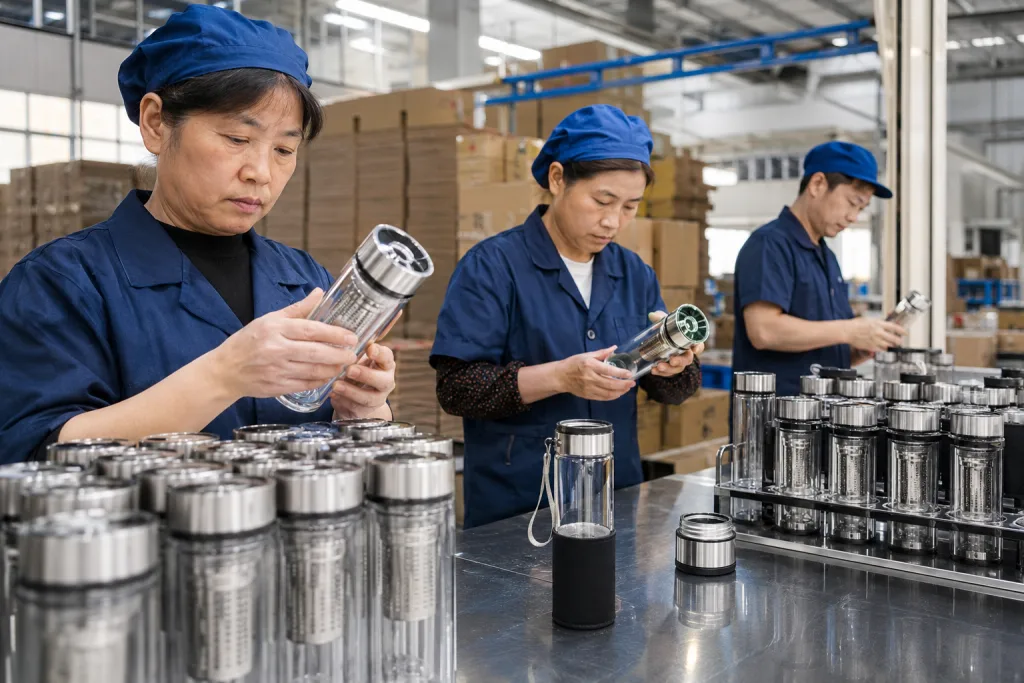
If you are buying from Zhejiang, China, treat a bulk infuser bottle project like a controlled sourcing process, not a design mood board. This is the right place to be strict. A practical RFQ, one approved pre-production sample, and a PO with measurable line items can save 12 days vs 18 days on revision loops alone. On our line in Hangzhou, QC pulled the sample and checked wall thickness with an ultrasonic gauge before pilot run, because 0.3 mm off on a Tritan body is enough to change the feel in hand and the drop result. At BottleForge Industrial in Hangzhou, Zhejiang, we see the same pattern: buyers who specify early usually get better pricing, cleaner packaging execution, and fewer claims after arrival.
Start with a usable RFQ
If your first email says only “please quote custom infuser bottle,” you will get quotes you cannot compare. One factory may price a 650 ml Tritan body with a PP lid and a 0.8 mm infuser basket. Another may quote 700 ml AS plastic with a cheaper seal. Both look clean on a PDF. Only one holds up after 5,000 open-close cycles and daily retail use. We’ve seen this go sideways.
For a serious infuser bottle in bulk request, list the non-negotiables up front. This applies whether you need a bulk fruit infuser bottle for gym retail, a bulk tea infuser bottle for wellness subscriptions, or a custom made infuser bottle for corporate programs. The buyer flagged this before: same photo, two different bottle weights, 168 g vs 196 g. That gap usually tells you the spec was loose.
- Body material: Tritan, borosilicate glass, or 18/8 stainless steel. For wellness brands, Tritan is common because it is BPA-free, lighter than glass, and easier to color match on the line with a Pantone chip.
- Capacity and tolerance: 500 ml, 650 ml, 700 ml, or 1,000 ml; set tolerance at ±3%.
- Wall thickness: Tritan body usually 2.5-3.0 mm. Thin walls cut cost, but the math doesn’t work if the base thread area starts cracking in drop tests from 80 cm.
- Infuser style: full-length fruit rod, bottom basket, or tea strainer. Mesh opening matters if you want a custom tea infuser bottle that can hold fine leaves; QC pulled the sample once and 0.6 mm mesh let too much dust through.
- Lid and seal: PP or stainless cap, food-grade silicone ring, leak test requirement. Ask for the test method, not just “leakproof.” We run upside-down fill tests for 30 minutes.
- Decoration: silkscreen, heat transfer, UV print, laser engraving, or wrap design; include Pantone codes and logo size in mm. A 35 mm logo prints fine. A 12 mm slogan on a curved body often does not.
- Packaging: white box, kraft box, color box, PDQ tray, or Amazon-ready set. State drop-test level and carton size if you have limits; one PO even had a typo on the master carton mark, and it delayed booking.
Add target quantity, target price, destination port, and required standard such as REACH, LFGB, ASTM, or California Proposition 65 if relevant. In Zhejiang, factories that export regularly to Europe and North America usually quote in 2 working days instead of 5 when the RFQ is this specific. This is the wrong question to ask: “What’s your best price?” Ask for bottle weight, tooling cost, decoration method, testing scope, and packing spec line by line. Then you can compare a factory direct infuser bottle quote properly.
PO line items to define at RFQ stage
SKU name, estimated annual quantity, target MOQ, Incoterm such as FOB Ningbo or FOB Shanghai, required compliance list, and target ex-factory date. Add carton mark, barcode type, and whether the insert card is bilingual. Small details matter. If those lines are missing, the first quote is only a guess.
Screen factories before asking samples
Do not pull samples from six random suppliers. Shortlist two or three serious factories and screen them first. Pretty prototypes do not tell you much. What matters is whether the factory can run your customized infuser bottle at scale, hold the same fit on repeat orders, and keep the leak rate under control after 10,000 pcs on the line.
Ask direct questions. A competent distributor infuser bottle source or manufacturer should answer in plain terms, not sales talk. We’ve seen this go sideways fast: one buyer asked for samples first, then found out the factory had no torque tester for the lid.
- Monthly capacity: ask for a real number. For example, 300,000 units/month across sports bottles and infuser lines, not “large capacity.” Ask how that number is split by line, because 300,000 on paper means nothing if only one assembly line runs infuser SKUs.
- MOQ: 3,000 pcs per model per color is a common start point for custom projects; some stock-based programs run 1,000-2,000 pcs with limited options. If a supplier says 500 pcs for full custom color box, bottle body, basket, and lid, the math doesn’t work.
- Lead time: 7-12 days for sample, 25-40 days for bulk. Longer if new molds or holiday congestion. Ask for the split: mold polishing, sample assembly, packaging proof, then mass production. We usually see 12 days vs 18 days depending on whether a new screen print jig is needed.
- Audit status: BSCI, ISO 9001, Sedex, or retailer-specific social compliance if you need it. Ask for the latest report date, not just the logo on a PDF.
- QC system: incoming inspection, in-line QC, final random inspection, AQL level, leak test method, torque check, and carton drop test. QC should be able to show the checklist. If QC pulled the sample and there is no record for a 1.2 m drop test or lid torque range, screen them out.
- Export experience: ask what percentage goes to Europe and North America. A factory used to REACH and barcode control is easier to manage. Ask one practical question: who checks FNSKU or EAN placement on the master carton. The buyer flagged this on us once because the PO had a barcode size typo.
If you are building a custom fruit infuser bottle or customizable tea infuser bottle program, ask whether the infuser parts are made in-house or sourced. Outsourced baskets are not bad by default, but they add one more failure point on fit and finish. We usually check basket thread tolerance in mm and run a hand-feel assembly test at the bench. For startup buyers, this matters because replacement parts turn into service costs you did not budget for.
Practical rule: if a supplier cannot show a clear BOM, a draft dieline, and a basic QC checklist before sampling, they are not ready for your branded launch.
Distributors fruit infuser bottle offers still work for stock items with urgent lead time, but custom logo infuser bottle projects need factory control in most cases. This is the wrong question to ask: “Who is cheapest?” Ask who can explain why silicone shore hardness, thread tolerance, and logo cure time affect complaints after shipment. In Zhejiang, the best partner is often the factory that answers with numbers, photos from the line, and a sample cross-section cut from a failed lid seal.
PO line items to define at screening stage
Approved factory name, audit requirement, inspection standard such as AQL 2.5/4.0, and whether third-party inspection is mandatory before balance payment. Add packaging spec, logo method, and spare-part policy at this stage. One missed PO line can cost a full day later; we ship against the PO, and a single word like “matte” vs “frosted” gets argued in final inspection.
Lock the sample with measurable details
Sampling is where 7 out of 10 new hydration brands slip. The bottle looks good on the desk, then mass production shows up with a different print pass, a 250 gsm carton instead of 300 gsm, or a softer silicone ring from another supplier. We’ve seen this go sideways. Lock the sample to production conditions, not just appearance.
For a bulk infuser bottle program, there are usually three sample stages:
- Reference sample: a stock bottle or close shape used to confirm the concept, capacity, overall size, and rough target price. This is not an approval sample. It just tells us whether the direction is right.
- Pre-production sample: your actual custom logo infuser bottle with the correct color, print method, infuser structure, and a packaging mockup. On our line, this is where QC pulled the sample and checked logo position with a ruler, not by eye.
- Golden sample: the signed, dated control sample held by both you and the factory for production comparison. Put the PO number on it. We once got a golden sample back with one digit wrong on the PO sticker, and the buyer flagged it before sealing approval.
When you review a custom tea infuser bottle or customizable fruit infuser bottle sample, don’t stop at looks. Fill it with water and invert it for 30 minutes. If the material allows, test with hot water too. Open and close the lid 200 times. Remove the infuser and install it again. Check whether the fruit basket rattles, whether the silicone ring sits flat in the groove, and whether the logo scratches after tape testing or 50 dishwasher cycles if you plan to sell it as dishwasher-safe. Simple checks. They catch a lot. On one sample run, the line found a 0.6 mm flash on the infuser thread, and the cap started cross-threading after about 40 cycles.
For borosilicate and Tritan programs, ask for actual dimensions in mm and weight in grams on the sample report. Put the caliper reading and unit weight on paper. A 20 g weight reduction may not sound like much, but on a 5,000-piece order it often means thinner material and a higher breakage rate in transit. This is the wrong question to ask: “Can you make it lighter?” The better question is: “What wall thickness are we approving?” If you are selling a customized fruit infuser bottle at a premium retail price, the math doesn’t work if the bottle feels cheap in hand.
Sample charges vary. A stock sample may cost USD 20-50. A pre-production sample with custom print and box is more often USD 80-200, sometimes refunded against the first bulk PO. If a new mold is needed for a custom made infuser bottle, tooling can run from USD 2,500 to USD 8,000 depending on complexity. We usually tell buyers to spend the extra USD 100 at sample stage if it answers a production question. That is cheaper than reworking 5,000 boxes after the buyer flagged a wrong insert card size.
PO line items to define at sample stage
Sample approval date, Pantone code, logo position with dimensions, body weight tolerance, approved packaging photo, and exact accessory list such as infuser basket, carry strap, cleaning brush, and instruction card.
Build the PO like a control sheet
A purchase order for infuser bottle in bulk should read like a control sheet, not a price approval. Most disputes start with one missing line on the PO. We see it on the line all the time: buyer approved the sample, factory ran the order, then QC pulled the sample and the logo position was 3 mm off from what the buyer expected but never wrote down. If you are buying a distributor tea infuser bottle from stock, the PO can stay short. If you are launching a custom infuser bottle under your own brand, write it tight.
At minimum, include these line items for each SKU:
- Item description: 650 ml Tritan body, PP screw lid, full-length fruit infuser rod, silicone carry loop.
- Color references: body translucent smoke, lid Pantone 7716 C, seal natural silicone.
- Decoration method: one-color silkscreen 45 x 35 mm or laser engraving depth specification for stainless components.
- Packaging: 1 pc/polybag if required, 1 pc/kraft box, 24 pcs/master carton, carton size and gross weight limits.
- Barcode and labeling: UPC or EAN placement, FNSKU if Amazon FBA, carton marks, made-in-China statement.
- Testing: 100% leak test, 1.2 m carton drop test, food-contact compliance, migration testing if requested.
- Spare parts: extra silicone rings at 1%-2% of order quantity.
- Inspection: final inspection to AQL 2.5 major / 4.0 minor unless retailer requires stricter.
For pricing, most factory infuser bottle quotes are on FOB China basis. A basic Tritan fruit infuser bottle bulk program with one-color print and standard box can land around USD 2.20-3.10 FOB. A more premium stainless or glass format with custom color box and accessories can reach USD 3.80-4.80 FOB. If your quote looks too low, check what got cut. We have seen quotes drop USD 0.18 just by reducing box board from 350 gsm to 300 gsm and thinning the bottle wall by 0.2 mm. The math doesn’t work if you still expect the same drop performance and print rub resistance.
Payment terms for newer buyers are commonly 30% deposit, 70% balance before shipment. After 3 to 5 repeat orders with stable volume, some factories will discuss better terms. Startups ask to save USD 0.05 by removing QC steps; this is the wrong question to ask. Returns in Europe or North America cost more, and one leak complaint can kill a launch. We ship plenty of replacement lids because someone skipped the seal compression check at packing.
PO line items buyers forget most often
Barcode symbology, retail inner pack count, silica gel requirement, bilingual instruction insert, mold ownership terms, and tolerance on logo alignment. Add carton weight limit too; one buyer flagged 16.8 kg masters as too heavy for their warehouse team. We have also seen a PO typo on FNSKU placement send 2,400 bottles to relabel. Write these points now, not after the cartons are sealed.
Control production, testing, and inspections
After the deposit lands, your work is not done. This is where orders hold together or get expensive fast. A solid China supplier should issue a production schedule with dated checkpoints: raw material arrival, injection or forming start, printing, assembly, packing, inspection, and vessel booking. We usually run this on a shared sheet and update it every 2 days, because “next week” is not a real plan.
For a custom logo infuser bottle, ask for pre-production photos before the full print run starts. If the logo sits near a curved panel, a 2 mm shift can make the batch look crooked on shelf, and the buyer will flag it at once. For a customized tea infuser bottle, ask the factory to check mesh burrs and edge finishing under a simple magnifier lamp, since rough mesh edges are one of the most common complaints we see from first orders.
QC should be measurable. Not decorative.
- Incoming materials: confirm resin grade, stainless grade if applicable, and check silicone for appearance and odor. QC pulled one sample last month that had a sharp smell right out of the bag, and we stopped the line before assembly.
- In-line checks: verify bottle weight, thread fit, print adhesion, color consistency, and assembly torque. If the weight drifts by 3 g from the signed sample, ask why before you ask anything else. This is the right question.
- Functional tests: run 100% leak test, random hot-water test where applicable, handle pull test, and repeated opening/closing. On screw lids, we usually check open-close cycling at 50 times for spot verification because weak threads do not hide for long.
- Final checks: confirm quantity, assortment, barcode scan, carton drop, packing accuracy, and random visual inspection by AQL. We have seen one PO with the color code typo “BKLA” instead of “BLK,” and it caused mixed-carton confusion at final packing.
If your order is going to retail chains or Amazon, ask for photo evidence of palletization, carton labels, and FNSKU placement. A wrong label is not minor. It can stop inbound processing or trigger relabel fees, and the math does not work once the goods reach destination. Even a distributor fruit infuser bottle order needs carton mark approval before loading; one missed label position on the short side of the carton can turn into a chargeback.
Third-party inspection in China usually costs a few hundred USD per day. Against a rejected container, that cost is small. For orders above 5,000 pcs or for a first-time factory, we usually advise booking it. At BottleForge Industrial, we prefer inspection after at least 80% is packed so the inspector can see product defects and packing defects in the same visit. Earlier than that, you get half the picture.
PO line items to define during production
Set the inspection booking window, acceptance standard, who pays rework and re-inspection, and whether shipment moves if one color fails while others pass. Decide this before the pressure starts on the line. We have seen this go sideways when a buyer assumed mixed approval was fine and the factory assumed the opposite.
Plan freight and after-sales before shipment
Start freight planning before production starts, not after packing. Infuser bottles are light, but they eat cube. Box size changes freight fast. We’ve seen a gift box height increase by 18 mm and carton CBM jump enough to add 15%-25% shipping cost with zero added sell-through. The buyer liked the look. The math didn’t work.
For an infuser bottle in bulk shipment from Zhejiang or elsewhere in China, compare sea freight by cubic meter, not just by unit price. For a new market test, LCL works for 1,000-2,000 pcs if you accept more carton handling. For steady programs, FCL usually gives better carton protection and a lower landed cost. Ask for master carton dimensions early, along with carton gross weight in kg, so your forwarder can calculate pallet count, loading plan, and warehouse handling before the line finishes packing.
Before balance payment, confirm these shipping documents:
- Commercial invoice and packing list
- Bill of lading instructions
- Test reports or declarations of conformity
- Inspection report and shipment photos
- Barcode and carton mark approval records
Write after-sales terms into the PO, especially for a custom infuser bottle or custom tea infuser bottle launch. Do not leave this to email memory. Define what counts as a claim, how fast the buyer must notify you after arrival, and what remedy applies. A workable setup is visible carton damage within 7 days, hidden product defects within 30-45 days from warehouse receipt, backed by quantity counts and photos. QC pulled the sample once on a claim and found the outer carton was fine but the barcode on the inner box did not match the approved file. That kind of issue needs a clear responsibility line. For repeat programs, set a claim threshold and state whether credits go on the next PO or replacements ship with the next order.
If you want repeat business, pick the supplier that keeps records clean. Zero-defect promises are sales talk. What matters is traceability: resin batch, print lot, packing date, even which line ran the order. We’ve seen this go sideways when a PO typo changed the carton mark and nobody caught it before loading. A solid customized infuser bottle partner can pull the record, find the root cause fast, and stop the same problem from hitting the next shipment. That is how wellness brands move from a test order to a real product line.
PO line items to define before shipment
Final ETD, consignee details, shipping mark artwork, claim window, replacement or credit mechanism, and document list required before balance release.
Get a clear infuser bottle quote, not a guess
Send your target quantity, capacity, logo file, and packaging idea. We will reply with practical MOQ, FOB pricing, sample timing, and production notes.
Frequently asked questions
What is the normal MOQ for an infuser bottle in bulk?
For a standard Tritan or plastic-based infuser bottle in bulk, the common MOQ is 3,000 pcs per model per color. If you use an existing mold, standard lid color, and simple one-color logo, some China factories can start at 1,000-2,000 pcs. For a fully custom made infuser bottle with new tooling, expect 5,000 pcs or more to keep unit cost reasonable. Packaging also affects MOQ. A stock kraft box may be possible at 1,000 pcs, while a fully custom color box usually starts around 3,000 pcs. If you are a wellness startup, ask for one body color with two logo versions rather than multiple body colors. That usually gets you to launch faster without inflating inventory risk.
How much does a custom logo infuser bottle usually cost?
A factory direct infuser bottle price depends on material, capacity, decoration, and packaging. As a realistic FOB China range, a 650 ml Tritan custom logo infuser bottle with one-color silkscreen and standard kraft box often lands at USD 2.20-3.10 per piece at 3,000-5,000 pcs. A bulk tea infuser bottle with a finer stainless basket, gift box, and accessory card may move to USD 2.90-3.80. Glass or insulated stainless versions can reach USD 3.80-4.80 or more. If a quote is below USD 2.00, check wall thickness, leak test coverage, seal quality, and carton strength. Low quotes often remove exactly the details that create claims later in Europe and North America.
What compliance and testing should I ask for?
For Europe, REACH and LFGB-related food-contact compliance are common checkpoints, depending on material and market channel. For North America, buyers often ask for FDA-relevant material declarations, Proposition 65 review where needed, and retailer-specific testing protocols. If the item is a kids-oriented bottle, ASTM-related requirements may also matter. On the factory side, ask for migration testing on food-contact components, plus practical production tests: 100% leak test, print adhesion, odor check, and carton drop test from 1.0-1.2 m. If you are buying a customizable tea infuser bottle, confirm mesh edge finishing and corrosion resistance for the infuser basket. Compliance documents are useful, but they do not replace production QC. You need both.
How long does bulk production take after sample approval?
For an existing model with custom color and logo, sample lead time is usually 7-12 days, then bulk production takes about 25-40 days after deposit and final sample sign-off. If your order includes a custom fruit infuser bottle with a new mold, add roughly 20-35 days for tool making and first sample correction. Peak periods in China, especially before Lunar New Year or major holiday shipping rushes, can stretch timelines by 7-15 days. Packaging complexity also matters. A simple white box packs faster than a retail gift set with inserts, sleeves, and barcode labels. If your launch date is fixed, lock artwork, carton marks, and barcode data before the production slot starts.
Should I buy from a factory or from distributors infuser bottle suppliers?
If you need speed and low quantity, distributor infuser bottle suppliers can be useful, especially for stock items at 500-1,000 pcs. If you need a customized infuser bottle with your own Pantone colors, packaging, and repeatable QC, factory sourcing is usually the better route. A factory in Zhejiang or wider China can control molding, decoration, and packing more directly, which matters once you are ordering 3,000 pcs and up. The trade-off is process discipline: you need a proper RFQ, approved sample, and tighter PO details. For wellness brands planning repeat orders or multiple SKUs, factory sourcing usually gives better margin and more control. For one-off event programs, a distributor can sometimes be the practical choice.