Key Takeaways
- Lock 4 decisions first: material, infuser type, decoration, and compliance; this usually cuts quote revisions by 30%+
- Typical MOQ for a custom infuser bottle is 1,000-3,000 pcs, with 25-35 day lead time after sample approval
- Tritan bodies with 0.6-0.8 mm wall thickness balance clarity, durability, and freight cost better than glass for most startups
- Use AQL 2.5, leak testing at 100%, and REACH/LFGB review before deposit, not after production starts
You already know why this category sells: infused water, tea-on-the-go, and giftable wellness SKUs keep moving. The hard part starts after the sample. An infuser bottle customizable enough for your brand gets messy fast if the spec is loose: lid leaks at the 1.2 m drop test, baskets crack at the clip, Tritan turns cloudy after wash checks, logo print shifts 1 mm off-center, and the MOQ on the first quote makes no sense. We’ve seen this go sideways. For a wellness brand or hydration startup, one bad run can freeze cash and drag down reviews for months.
The practical way to buy from Zhejiang or wider China is to lock four decisions early: bottle material, infuser structure, decoration method, and compliance level. Ask those first. This is the right question. Once those are fixed, MOQ, tooling, and lead time stop jumping around, and the math gets clearer on the line. At BottleForge Industrial in Hangzhou, Zhejiang, we usually see buyers save 8% to 15% by choosing the right construction before asking for quotes. Last month a buyer flagged a PO typo on lid color after sampling; catching that before mold sign-off saved 12 days and one rework batch.
Start with the four buying decisions
If you search for an infuser bottle customizable for your brand, China factories will show 20 to 40 shapes in one sheet and say yes before they check tooling. That does not help. The wrong question is “what styles do you have?” Ask which four decisions lock cost, lead time, and claim risk. We’ve seen this go sideways after a buyer approved a nice render, then found the lid mold was shared and the neck size was off by 0.6 mm.
The first decision is body material. For most wellness brands, Tritan is the safest starting point because it is lightweight, BPA-free, and less breakable than glass. A 650 ml Tritan bottle typically lands around USD 2.10 to 3.40 FOB China depending on lid and decoration. On our line, a common single-wall Tritan body runs about 180 g to 220 g, which keeps freight under control. Borosilicate glass looks premium, but freight damage and unit weight are real cost drivers. QC pulled the sample once on a glass run because the outer carton passed drop test at 1 corner, then failed on the second edge hit. Stainless steel works for insulated tea bottles, but it changes the product story from fruit infusion to temperature retention.
The second decision is infuser design. Fruit baskets, full-length tea strainers, and short tea baskets are not interchangeable; each one changes fill volume, cleaning time, and buyer complaints. A bulk fruit infuser bottle needs enough basket volume for citrus, berries, or cucumber slices. In practice, if the basket OD is too wide, sliced lemon jams at the shoulder and the buyer flags it. A bulk tea infuser bottle needs mesh precision, stable fit, and easy cleaning. We usually check mesh opening and lock fit by hand on first-off samples, because a strainer that shifts 1 mm will rattle in transit and feel cheap fast.
The third decision is branding method. A custom logo infuser bottle can use silk screen, heat transfer, laser marking on stainless parts, or molded logo tools. Each option has its own line limit, rub resistance, and setup charge. Silk screen is still the workhorse for MOQ 1,000 pcs; molded logos make sense only if you will reorder enough to amortize tooling. If your color system is strict, ask for Pantone confirmation before mass production, not after the pre-production sample. We had one PO with “Panton 186C” typed on it, and yes, that small typo delayed approval by two days because the buyer’s brand team would not sign off.
The fourth decision is market compliance. Europe and North America are not the same brief. You may need LFGB, REACH, FDA food-contact declarations, ASTM tests for some channels, and retail packaging rules. The bottle is only half the job. If you sell through distributors infuser bottle programs or online marketplaces, carton labeling and barcode rules matter as much as the bottle itself. We ship packs where the insert card passed all copy checks, then the outer carton was missing the country-of-origin line in 4 mm text, and the warehouse held the lot. The math doesn’t work if you save USD 0.03 on packaging and lose two weeks at destination.
- Decision 1: Material and weight target
- Decision 2: Fruit or tea infuser function
- Decision 3: Decoration durability and brand look
- Decision 4: Compliance and packaging level
Choose the bottle architecture carefully
Most sourcing mistakes start here: buyers approve the silhouette and skip the construction. A custom made infuser bottle has three leak-risk zones: lid thread, gasket seat, and infuser connection point. Miss one, and QC pulled the sample for drips after a 30-minute invert test, then the whole item turns into a returns problem.
For a customizable infuser bottle in the 500-750 ml range, ask for the exact structure, not just a rendering. A usable spec sheet should show body diameter, neck finish, wall thickness, gasket material, infuser mesh size, and drop-test requirement, with a neck gauge or thread drawing if the factory has one. For Tritan, 0.6-0.8 mm wall thickness is common. Below 0.55 mm, cost drops, but the sidewall feels cheap in hand and deformation risk goes up. We have seen buyers push for 0.5 mm to save a few cents; the math doesn't work. For borosilicate glass, 2.2-2.8 mm is typical depending on height.
Infuser basket length matters. A custom fruit infuser bottle usually works better with a lower-center or full-length basket so water can move around larger fruit pieces. A custom tea infuser bottle often needs a finer mesh basket, usually 0.35-0.5 mm perforation equivalent, to control leaf leakage. One basket rarely does both jobs well. This is the wrong question to ask if the buyer wants one universal insert. We have seen EU buyers approve a dual-accessory set after the line trial because the extra USD 0.18-0.35 per unit is cheaper than complaint emails about mint leaves slipping through or strawberry pieces blocking flow.
Ask the factory direct infuser bottle supplier to confirm these points:
- 100% leak test method: inverted 30 minutes or air-pressure test
- Carry loop tensile strength: at least 10 kg static load for 1 hour
- Dishwasher recommendation by material and logo process
- Spare gasket availability for after-sales support
- Whether the lid uses PP, ABS, or stainless cap shell
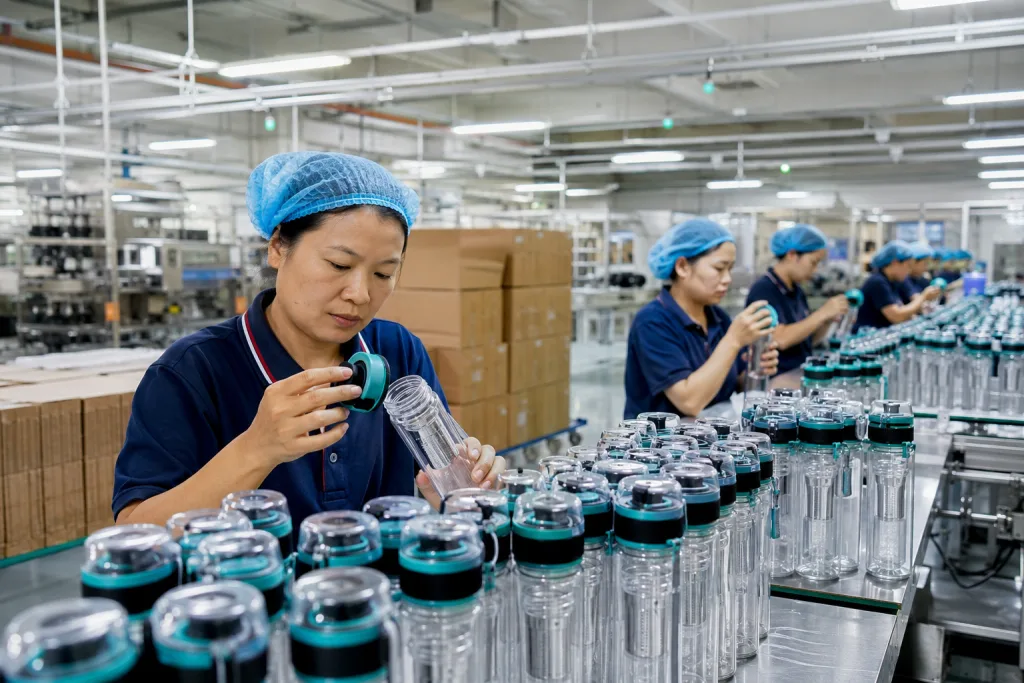
At our Hangzhou, Zhejiang operation, monthly capacity for infuser styles is around 300,000 units across standard and custom programs. That sounds good on paper. It only matters if the architecture is locked before production starts, because once we run molds, gasket hardness, and thread fit on the line, late changes slow shipment fast.
Match MOQ to your launch stage
MOQ is not just a factory rule. It’s how we control part count, setup time, and scrap on the line. A plain stock-color bulk infuser bottle can start at 1,000 pcs. A fully customized infuser bottle with new mold parts, custom color body, printed box, and two accessories may push to 3,000-5,000 pcs. Last month, QC pulled the sample and found the custom basket and box insert were packed from two different lots. That kind of mix-up is why low MOQ promises need checking. If a supplier offers 300 pcs for everything, ask whether they run production themselves or just trade mixed stock.
For hydration startups, “What is your MOQ?” is the wrong question to ask. Ask, “Which features increase MOQ?” That gets you a useful answer fast. In most projects we quote, the main drivers are:
- New mold for lid, basket, or handle
- Custom body color matching instead of clear stock
- Retail gift box with low-volume offset print
- Multi-color silk screen or wrap graphics
- Special finish like soft-touch coating
A realistic pricing ladder for a custom infuser bottle sourced FOB China may look like this for a 700 ml Tritan model with one-color logo:
- 1,000 pcs: USD 2.85-3.35
- 3,000 pcs: USD 2.35-2.85
- 5,000 pcs: USD 2.10-2.55
Tooling for a modified lid can range from USD 1,200 to 4,500 depending on cavity count and finish. We’ve seen 2-cavity tooling stay near the low end, while a cleaner texture spec or tighter thread fit pushes cost up fast. New body molds are higher, often USD 6,000 to 15,000. For most wellness brands, the better path is to keep an existing body, then change the lid color, logo, basket, and packaging first. The math works better. You get a distributor infuser bottle program without tying up cash in a full new mold.
Lead time is usually 7-12 days for pre-production samples, 25-35 days for production after sample approval, and another 3-7 days for final inspection and export booking. Around Chinese New Year, add 10-20 days. We ship faster only if artwork, carton marks, and label files are clean on day one. One buyer lost 4 days because the FNSKU was missing on the PO. If you need FNSKU labeling for Amazon or pack inserts for influencer kits, confirm that before the PI is issued.
Branding methods and retail feel
A custom logo infuser bottle usually gets judged on finish first, not shape. North American buyers look at print edges under store lighting, check whether Pantone color stays consistent batch to batch, and ask if the logo still looks clean after normal washing. We’ve had buyers in wellness, yoga, spa, and corporate gifting reject a nice bottle because the screen edge looked fuzzy at 0.3 mm. Decoration has to match the selling price. That part is simple.
For a customizable fruit infuser bottle or customizable tea infuser bottle, the common branding choices are these:
- Silk screen: lowest setup cost, clean spot logo, best for 1-2 colors, and the line runs faster with fewer touch-up issues
- Heat transfer: full-wrap graphics, stronger shelf impact, but QC pulled more edge-lift samples on full coverage jobs
- Laser marking: ideal on stainless parts, permanent, though some matte finishes make the mark look too light
- Embossed or molded logo: premium retail feel, needs tooling and higher MOQ, usually the buyer pushback comes at the tooling charge stage
Silk screen setup for one color may run USD 40-80 per design, while heat transfer can add USD 0.12-0.35 per unit depending on coverage. If you are building a custom tea infuser bottle for retail shelves, a printed color box often matters more than adding a third ink color to the bottle. This is the wrong question to ask. Buyers spend time debating one extra ink pass, then ignore the box finish that the customer sees first. We’ve seen a matte-laminated box with a clean insert card sell better than a metallic cap insert that added cost and did nothing for use.
Do not skip abrasion and adhesion checks
Ask for a tape test and a simple rub test standard on decorated samples. Ask what tape they use on the line. 3M tape and 20 rubs is a basic check, not some special lab work. If the supplier says the bottle is dishwasher safe, ask whether that applies to the logo too. We ship plenty of custom fruit infuser bottle programs that are hand wash only after branding. That is not a defect, but it needs to be printed on the packaging and instruction insert, or the buyer flags it after the first return wave.
You are not buying a sample. You are buying repeatability. A beautiful approval sample with unstable print control is expensive marketing material, not a product.
If you plan to sell through distributors tea infuser bottle channels, keep artwork areas standard. Distributors like bottle formats they can rerun at 1,000-2,000 pcs without re-engineering each job. We had one PO where the logo area note was typed as 35 mm instead of 53 mm, and the whole approval cycle lost 12 days vs 18 days for a full packaging reset only because QC caught it before mass print. Standard artwork windows save time. The math works.
Compliance, testing, and quality control
If your supplier cannot explain the test scope in plain terms, slow down. This is the wrong question to rush. For Europe, REACH review and LFGB-oriented food-contact compliance usually come up first, and a solid sales engineer should tell you which parts are covered: bottle body, lid, gasket, infuser basket, ink, and carry loop. For the US and Canada, buyers often ask for FDA-related material declarations plus migration documents from the silicone and Tritan component vendors. We had one PO where the buyer flagged a missing lid-gasket declaration after sampling, and it cost 12 days vs 18 days to fix because the sub-supplier answered fast. For kids-oriented use, ASTM checks may enter based on the sales claim and retail channel. BSCI and ISO systems matter if your brand has social compliance or retailer onboarding requirements, especially if the retailer portal asks for factory codes before the first shipment.
On the quality side, set the inspection standard before deposit. Not after. A typical finished goods inspection plan for a bulk infuser bottle or fruit infuser bottle bulk order should include:
- AQL 2.5 for major defects, 4.0 for minor defects
- 100% leak test
- Drop test from 80-100 cm based on material and packaging
- Barcode and carton mark verification
- Assembly torque and thread fit check
- Odor test after 24 hours closed storage
Put the method on paper too. We run leak testing with 0.03 MPa air pressure on some lines, while other models use inverted water hold tests for 30 minutes. If that detail is missing, QC and the buyer will judge the same bottle differently.
For a factory tea infuser bottle or factory fruit infuser bottle project, also inspect weld points or mesh attachment if stainless infusers are used. QC pulled the sample on one 5,000-piece run because the mesh edge had a 1.2 mm burr, and that turns into safety complaints fast. Loose mesh edges create both safety complaints and returns. If the basket twists under normal force, ask for reinforcement ribs or thicker gauge. We’ve seen this go sideways on slim infusers with thin wall tubes. Stainless 18/8 or 304 parts are standard for better corrosion resistance; specify it in writing.
In Zhejiang and other manufacturing clusters in China, component plants are usually split by process. One workshop injects lids, another forms baskets, and the final factory assembles and packs. Normal setup. What matters is whether the final factory owns incoming inspection, in-process checks, and traceability by lot number. Ask for the IQC and OQC checklist, not just a certificate file. On our side, lot coding usually ties back to the injection date, polishing batch, and packing line, which is what you need when one carton out of 800 has mixed-color gaskets.
When factory direct really makes sense
Buyers ask for a factory-direct infuser bottle source, but most are chasing three plain things: clear answers, fast action, and one party who owns the result. Direct buying makes sense when your annual volume is real, your spec does not change every week, and you need tight control over revision cycles. If you are testing a new market with 800 units across four SKUs, do not force a custom run on the line. We have seen this go sideways. A mixed-stock program is usually the better call at that size.
For a distributor fruit infuser bottle or distributor tea infuser bottle program, direct factory buying usually starts to pay off at 3,000-5,000 pcs per style per order, or with repeat orders every 60-90 days. That is the point where custom packaging, carton fit, and color matching stop being theory and start saving money. On our side, this is where we will check carton drop risk and pallet loading, not just bottle cost. You also get straight answers on mold ownership, replacement parts, and replenishment timing. Last year a buyer flagged a lid shade shift against a Pantone chip, and dedicated matching fixed the repeat order issue.
Ask direct questions before placing the PO:
- Who owns the mold if you pay tooling?
- Can the supplier provide replacement lids or baskets separately?
- What is the reorder lead time for the same SKU?
- Can they hold 5% spare components for after-sales support?
- Do they support third-party inspection and video line checks?
A factory infuser bottle supplier with export experience should be comfortable discussing FOB, EXW, and sometimes DDP, but for new buyers FOB Ningbo or Shanghai is usually cleaner. This is the wrong question to skip. If your business model depends on custom logo infuser bottle replenishment under 30 days, check the raw-material stock policy first. Some Zhejiang factories keep standard Tritan resin and common lid colors on hand; some do not unless you give a forecast. We run into this all the time. QC pulled the sample on one repeat order and the bottle was fine, but the buyer's PO had the wrong lid color code typed in.
The best China supply relationships do not start with the cheapest first order. They start with a spec that repeats cleanly, with fewer surprises on the third order than the first. That is what holds up after 2 shipments, not just during quotation.
Get an infuser bottle spec review before you quote
Send your target market, volume, and branding idea. We will recommend the right bottle structure, MOQ, compliance path, and FOB pricing range.
Frequently asked questions
What is a realistic MOQ for a custom infuser bottle?
For an existing mold with custom logo and standard packaging, 1,000 pcs is realistic. If you want a custom color body, upgraded gift box, or a second infuser accessory, expect 2,000-3,000 pcs. A completely custom made infuser bottle with new lid tooling usually starts closer to 3,000-5,000 pcs plus tooling charges from about USD 1,200 to 4,500 for lid parts. If a supplier in China quotes 500 pcs for deep customization, ask whether they are using leftover stock components or outsourcing assembly. Low MOQ is useful only if the specification can be repeated on the reorder.
How long does production take for a customized infuser bottle order?
A normal timeline is 7-12 days for sample development, 2-4 days for artwork confirmation, and 25-35 days for bulk production after final sample approval and deposit. Add 3-7 days for inspection, carton marking, and booking. If your custom tea infuser bottle or custom fruit infuser bottle needs a new tool, add 15-25 days for tooling and first-off sample review. Around peak season or before Chinese New Year in Zhejiang and wider China, lead time can stretch by 10-20 days. If you need Amazon FNSKU labels, inserts, or pallet rules, confirm them before the PI so they do not delay packing.
Which material is best for a wellness brand: Tritan, glass, or stainless steel?
For most wellness brands, Tritan is the safest first launch choice because it gives good clarity, lower freight cost, and better break resistance than glass. A 650-700 ml Tritan custom infuser bottle often lands at USD 2.10-3.40 FOB depending on lid and print. Borosilicate glass feels more premium and photographs well, but unit weight is higher and breakage risk is real in distributor channels. Stainless steel works best for a customized tea infuser bottle with insulation, but it shifts the product story toward temperature performance. If your audience is yoga studios, hydration apps, and corporate wellness kits, Tritan usually gives the best balance of price, function, and damage rate.
What tests should I require before shipping a bulk infuser bottle order?
At minimum, require 100% leak testing, AQL inspection, logo adhesion checks, and packaging verification. A practical plan is AQL 2.5 for major defects and 4.0 for minor defects, plus a drop test from 80-100 cm based on material and pack style. For a bulk tea infuser bottle, inspect mesh edge finishing and fit stability because loose strainers create complaints quickly. Request REACH or relevant food-contact material support for Europe, and supplier declarations for US market requirements. If the order is above 3,000 pcs, a third-party pre-shipment inspection in China is usually cheap insurance compared with a full returns cycle.
Can one infuser design work for both fruit and loose-leaf tea?
Technically yes, but usually not well enough for a premium retail product. A fruit basket needs more volume and stronger flow space around larger pieces like citrus or cucumber. A tea infuser needs finer perforation or mesh to reduce leaf escape. That is why many custom infuser bottle programs use two accessories: one fruit insert and one tea strainer. The added cost is often only USD 0.18-0.35 per unit at 3,000 pcs, which is cheaper than handling negative reviews. If you are building a custom logo infuser bottle for broad wellness gifting, a dual-accessory set is often the safer commercial choice.