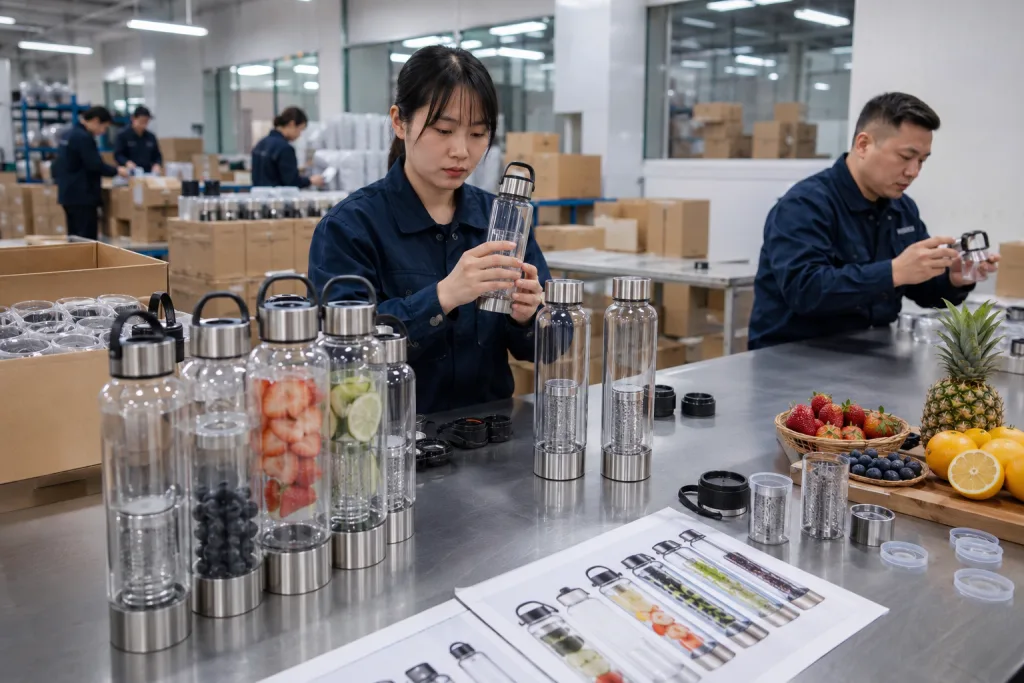
Key Takeaways
- Stock-platform infuser bottle custom projects typically start at 1,000-3,000 pcs, while new mold programs are more often 3,000-5,000 pcs
- Typical FOB China pricing runs about USD 2.10-3.80 for Tritan single-wall infuser bottles and USD 4.80-8.50 for stainless insulated versions at 3,000 pcs
- Logo setup can add only USD 0.05-0.35 per unit, but new cap or infuser tooling often adds USD 1,500-6,000 upfront
- Lead time is usually 7-12 days for sampling and 25-45 days for mass production, depending on decoration, packaging, and test requirements
You usually do not lose money on an infuser bottle because the unit price is high. You lose money because the quote looked clean, but the factory did not split out the real cost drivers: mold status, infuser material, logo method, leak test standard, and carton pack by sales channel. We have seen this go sideways on first orders. One PO even showed a 1.0 mm straw spec while the approved drawing was 1.5 mm, and the buyer flagged it only after sampling.
If you are buying from Zhejiang or another China source, get the cost and lead-time numbers before you release artwork. This is the right question to ask early. A bulk fruit infuser bottle or bulk tea infuser bottle moves faster if we run it from an existing platform, often 12 days for pre-production samples instead of 18 days with new tooling. A custom made infuser bottle with a new mold is a different schedule, different deposit timing, and usually a higher MOQ. You need those numbers upfront so your margin, launch date, and replenishment plan still work.
Where the unit cost really moves
For an infuser bottle custom project, the logo is not what moves the unit cost. Bottle architecture does. Buyers ask us for one clean number, then the quote comes back in five cost blocks: body material, infuser assembly, lid structure, decoration, and packaging. We run quotes this way because the line cost changes fast once one part gets more complex. If you are sourcing from Zhejiang, China, and comparing suppliers, ask for those lines one by one. Last month one PO even had “silcone strap” typed on it, and the supplier still quoted without clarifying the lid build. That is how cost mistakes start.
For a common 650 ml single-wall Tritan factory direct infuser bottle, FOB pricing at 3,000 pcs is usually around USD 2.10-3.20 with a PP or AS infuser basket and one-color silkscreen logo. Move to double-wall stainless steel with a tea infuser and the same size often lands at USD 4.80-8.50 FOB China, depending on 18/8 steel thickness, copper coating, vacuum yield, and powder coating. We have seen 0.1 mm wall thickness change the steel bottle cost enough to kill a target margin. Buyers push back on that point, but the math doesn't work if they want heavier steel, tighter vacuum QC, and the same entry price.
- Body material: Tritan costs more than standard AS or PETG, but it is easier to sell into premium hydration programs. Stainless is where the big jump happens. On our side, the weight check at incoming inspection is usually the first clue if a factory is shaving spec.
- Infuser type: A full-length fruit cage is usually cheaper than a fine-mesh stainless tea basket with threaded retention. QC pulled the sample once because the mesh weld point scratched a finger during assembly. Small part. Big claim risk.
- Lid complexity: A screw lid with carry loop is standard. One-click lids, lock tabs, and silicone straws push up defect risk and labor cost. We have seen this go sideways on leak tests at 0.03 MPa, especially with straw lids that look good in the render and fail on the line.
- Decoration: Silkscreen adds about USD 0.05-0.12. Heat transfer can add USD 0.18-0.35. Laser on steel is often USD 0.08-0.15. This is the wrong question to ask if you only ask “what is logo cost” without checking print area, curvature, and color tolerance.
- Packaging: Plain white box is low cost. Retail gift box with insert can add USD 0.35-1.20 per set. A 1.5 mm paperboard box looks better on shelf, but we ship more master cartons and freight jumps right with it.
A custom logo infuser bottle is straightforward if you stay on an existing mold. A fully customizable infuser bottle with a new cap shape, unique fruit chamber, or patented closure is a tooling job, not a print job. That difference decides whether your quote stays in the low single digits or starts carrying a real development budget. On new tooling, we usually check draft angle and parting line first because a cap that looks clean on screen can turn into a mold revision after the first T1 sample.
MOQ tiers and what they buy
MOQ is where startup plans usually break. The wrong question is “What is your MOQ?” Ask this instead: what MOQ applies to this exact bottle, lid color, logo method, and box spec? At BottleForge Industrial, our monthly output across drinkware programs is over 500,000 units, but a bulk infuser bottle order still does not automatically start at 500 pcs. We run by component sets. If the infuser basket, strap, and lid insert do not match stock, the line stops there.
Typical MOQ tiers for an infuser bottle custom order from a Zhejiang factory look like this:
- 500-1,000 pcs: Usually limited to stock-color bottles, one logo position, plain export carton, no custom retail box. On the floor, this often means one silk-screen pass and a standard 5-ply carton.
- 1,000-3,000 pcs: This is the workable range for a custom fruit infuser bottle or custom tea infuser bottle on an existing mold with custom color and logo. Most buyers in this band accept a stock lid tool and only change the body masterbatch.
- 3,000-5,000 pcs: This is more realistic for a customized infuser bottle with Pantone-matched body, custom strap, insert card, and a mail-ready box. QC pulled the sample on one 3,000-pc run last month because the strap hole was off by 1.5 mm.
- 5,000 pcs and up: This is the better range for new mold amortization and sharper FOB pricing, especially on a fruit infuser bottle bulk distributor program. The math works better once the mold cost is spread across 5,000 pcs instead of 1,000.
If you are a wellness brand testing a SKU, ask for split-color MOQ. Many China factories will accept 3,000 pcs total with 1,000 pcs per color on an existing model. We ship programs like that every season. For distributors infuser bottle programs, carton logic matters just as much. A master carton of 24 or 36 units can save one repack step in your warehouse; an Amazon program usually needs 12-unit inners, barcode stickers, and FNSKU handling. We have seen buyers flag a PO over one small carton marking typo, so this part is not paperwork fluff.
Be careful with low MOQ offers on a custom made infuser bottle. The headline MOQ may be real, but the supplier then boxes you into one stock body color, one stock lid color, and no dedicated leak test lot. We have seen this go sideways. One buyer pushed for 300 pcs, then complained after pre-shipment that there was no separate vacuum leak test sample set and no spare caps. That setup can work for a promo job. It is the wrong fit for a premium hydration launch.
Tooling, samples, and development spend
If you want more than a logo, development spend shows up fast. A standard customizable tea infuser bottle built on an existing body mold often needs no new tooling. You pay sample fees and decoration setup. If you want a new infuser basket geometry, a proprietary cap silhouette, or a branded handle, plan tooling before mass production. On our line, even a 0.3 mm change at the cap thread can mean a new core insert, so this is the wrong place to guess.
Typical development costs in China:
- Pre-production sample on existing mold: USD 50-150 per version, often refundable against bulk order.
- Color-matched sample with packaging mockup: USD 100-250.
- Silkscreen screen charge: USD 20-50 per color per design.
- Laser jig or engraving setup: USD 30-80.
- New plastic cap or infuser mold: roughly USD 1,500-4,000 depending on cavity count and complexity.
- New bottle body mold: often USD 3,000-6,000 for simpler plastic structures; more if multiple threaded components are involved.
For a customized fruit infuser bottle, the infuser deserves more attention than most buyers give it. Slot size controls fruit debris flow. We’ve seen buyers approve a nice-looking basket at T0, then flag it after use because strawberry seeds passed through 1.8 mm slots. Go tighter and cleaning complaints go up, and the injection cycle might move from 18 seconds to 22 seconds. For a customized tea infuser bottle, mesh gauge and edge finishing matter just as much. Fine tea filters are usually stainless 304 mesh, but the rolled edge, burr check, and fit tolerance decide whether the part feels premium or cheap. QC pulled one sample last spring with a sharp mesh edge; it passed appearance, failed touch.
Ask the supplier for a sample plan with dates: 3D drawing approval, hand sample if needed, T0 sample, revised sample, then pre-production sample. Put days on each step. A clean schedule looks more like 3 days for drawing check, 7 days for T0, 5 days for correction, not “soon.” A serious Zhejiang factory should explain that path clearly and tell you which sample is only for shape review and which one is made to production standard on the actual mold. If they cannot explain that, expect surprises later. We’ve seen this go sideways from something as small as a PO typo on lid color code.
Lead-time map from idea to shipment
Lead time for custom infuser bottle sourcing is not one number. It is a chain, and the line stops at the slowest step. We see this on the factory floor all the time: a logo position shifts 3 mm on the PDF, QC pulls the sample again, and the whole plan moves. For stock-platform projects, the schedule is usually controllable. For new tooling, 12 days can turn into 18 days fast if the drawing is still changing.
Existing mold program
- Quote and drawing confirmation: 2-4 days
- Logo and color sample: 7-12 days
- Order deposit to mass production: 25-35 days
- Packaging finalization: add 3-7 days if retail box artwork is not ready
New mold program
- 3D drawing and engineering review: 5-10 days
- Tooling manufacture: 18-30 days
- T0/T1 sampling and revision: 10-20 days
- Mass production after sample approval: 30-45 days
So an existing-model bulk tea infuser bottle order can ship in about 32-47 days from artwork approval. A fully custom made infuser bottle usually takes 63-105 days. Peak season is tighter. From August to November in Zhejiang and other China manufacturing clusters, add another 7-15 days for coating-line slots, carton board supply, and final inspection booking. We run into the same buyer pushback every year: “Why is coating full?” Because every gift-order program hits at once, and the math doesn’t work if booking starts after samples are signed.
Do not count the clock from your first inquiry. Count it from the day all specs are frozen: Pantone, logo position, packaging dieline, barcode list, and test standard.
If you sell on Amazon or through retail chains, build compliance into the plan early. FNSKU labeling, ISTA-minded carton design, and drop-test corrections often add 7 days if left to the last stage. We’ve seen this go sideways over one carton issue: the buyer flagged a 5-ply spec on the PO, but the artwork file still showed the old size. The teams that hit launch dates usually lock packaging artwork early and book testing before mass production starts.
Compliance and quality are not optional
For wellness brands, the bottle touches water, fruit, tea, and your brand name. Compliance needs to be locked in at quotation stage, not after the sample is signed off. For Europe, most buyers ask for material declarations aligned with REACH and food-contact requirements. In North America, we usually see FDA food-contact requirements on the PO, and for children-oriented programs, CPSIA or related testing may apply. If you are building a custom logo infuser bottle line, ask for the exact standard set before sample approval. This is not paperwork for later. We have seen a PO held 12 days because the lid silicone declaration was missing.
On the factory side, practical quality controls matter more than sales language. Ask for the actual control points, the test method, and the record form. QC pulled the sample is nice to hear; seeing the leak-test sheet is better.
- AQL standard: Many buyers use AQL 2.5/4.0 for final random inspection.
- Leak test method: Inverted test, vacuum test, or air-pressure test; duration should be stated.
- Dishwasher guidance: For printed Tritan, many factories will recommend hand wash unless decoration is tested specifically.
- Material certificates: Tritan, PP, silicone, and 304 stainless declarations by component.
- Social compliance: BSCI or equivalent if your retail customer requires it.
For a distributor fruit infuser bottle or distributor tea infuser bottle program, repeat-order consistency is where problems start. Ask for one golden sample kept at the factory and one kept by your team, packed with the approved carton and print file. This cuts color drift and logo-position arguments 6 months later. We have had buyers flag a logo shift of 2 mm on the second order. The line said it was acceptable; the buyer did not. A capable China supplier should also track vacuum retention yield for insulated models and monitor thread-fit tolerance on plastic assemblies with a go/no-go gauge.
The cheapest factory infuser bottle quote often removes checks you assumed were included. This is the wrong question to ask: “Why is your price lower?” Ask what was removed. If the supplier does not mention incoming material checks, in-line leak testing, and pre-shipment inspection, ask directly. We run into this all the time. Silence usually means the steps are weak, skipped, or billed later. Last year, one buyer came back after a 3,000-piece run because the PO typo changed “100% leak test” to “spot leak test,” and the math did not work in their favor.
How to quote your first order accurately
The fastest way to get a usable quote for an infuser bottle custom project is to send a spec pack, not a mood board. We see this every week. If a buyer sends only 3 reference photos from Pinterest, the line can only reply with a wide price spread and soft lead times. If you send dimensions, material callouts, and packing details, we can quote straight and usually close the gap fast.
Your RFQ should include:
- Capacity and target weight: for example 700 ml, 280 g plus or minus 5 g.
- Material request: Tritan body, PP lid, food-grade silicone seal, 304 stainless infuser if needed.
- Use case: fruit infusion, loose-leaf tea, or both. A bulk fruit infuser bottle is not always the same basket design as a bulk tea infuser bottle. We have had buyers flag a basket hole size of 1.8 mm after samples because tea dust leaked through.
- Decoration method: one-color silkscreen, wrap print, UV print, or laser.
- Packaging level: polybag only, white box, color box, or shelf-ready display.
- Compliance needs: REACH, LFGB-style requests, ASTM, retailer protocol, or Amazon prep.
- Order forecast: trial 1,500 pcs, repeat 5,000 pcs quarterly, for example.
If you are a hydration startup, tell the factory your expected reorder rhythm. This is not a small detail. A supplier may sharpen first-order pricing if they see a 12-month volume plan, because we can book resin and carton board with less guesswork. For distributors infuser bottle business, ask for tiered pricing at 1,000 / 3,000 / 5,000 / 10,000 pcs. That is the right way to build margin. We have seen POs delayed because the buyer wrote “5k pcs annual” but meant 5,000 per drop.
Ask one practical question: what is the packed carton size and gross weight? This is where buyers miss money. A 24 pcs master carton at 58 x 38 x 32 cm ships differently from one at 62 x 42 x 35 cm, even if the unit price looks better on paper. Sometimes a bottle that is USD 0.08 cheaper costs more to ship because the lid geometry wastes carton space. The math doesn't work once you move from 1 pallet to 1 container.
A good Zhejiang supplier should give you a quote sheet with MOQ, tooling, sample fee, unit price by quantity, packing details, production days, and payment terms such as 30% deposit, 70% before shipment. We usually add carton marks, net and gross weight, and sample lead time too. QC pulled the sample on one project because the PO typo showed “304 infusor” instead of “304 infuser,” and the buyer had also missed the lid Pantone. Small miss, big delay. If that level of detail is missing, keep asking until it is not.
Get your infuser bottle quote with real numbers
Send your target capacity, material, logo, packaging, and order forecast. We will reply with MOQ, FOB pricing, sample cost, and production timing.
Frequently asked questions
What is the normal MOQ for a custom infuser bottle?
For an existing mold, the normal MOQ is usually 1,000 to 3,000 pcs per model, with 500 pcs possible only on very limited stock-color programs. If you need Pantone body color, custom strap, and printed retail box, expect 3,000 pcs total and often 1,000 pcs per colorway. A new mold custom infuser bottle is more often 3,000 to 5,000 pcs because the factory needs to absorb setup loss and molding risk. In Zhejiang, China, many factories will quote a lower headline MOQ, but the real MOQ changes once you add custom packaging and compliance testing. Always confirm MOQ by bottle, color, logo method, and box type, not just by model name.
How much does a bulk fruit infuser bottle usually cost?
A common 650-700 ml Tritan bulk fruit infuser bottle on an existing mold usually lands around USD 2.10 to 3.20 FOB China at 3,000 pcs with one-color silkscreen logo and plain box. At 1,000 pcs, it may be closer to USD 2.50 to 3.80. Add a premium retail box, and you may add USD 0.35 to 1.20 per set depending on insert structure and print coverage. Stainless insulated versions are much higher, usually USD 4.80 to 8.50 FOB at 3,000 pcs. If your design includes a custom lid or a full stainless tea basket, ask the supplier to separate unit cost from tooling so you can see what changes after reorder.
How long does a custom tea infuser bottle project take?
If you use an existing model, a custom tea infuser bottle can usually move from artwork approval to shipment in 32 to 47 days. That typically includes 7 to 12 days for samples and 25 to 35 days for mass production. If you need a new infuser assembly, lid, or bottle body mold, total timeline becomes more like 63 to 105 days because tooling can take 18 to 30 days, then sample revision another 10 to 20 days. Peak season in China often adds 7 to 15 days. If your project also requires REACH documentation, barcode application, or retailer-specific packaging tests, lock those requirements before the sample stage to avoid extra delay.
What quality checks should I require on a custom logo infuser bottle?
At minimum, require component material confirmation, in-line assembly checks, 100% leak testing on finished bottles, and a final inspection under AQL 2.5/4.0 before shipment. For printed Tritan bottles, ask for adhesion testing on the logo and clear care instructions if dishwasher resistance is limited. For stainless infuser assemblies, confirm 304 grade and ask how mesh edges are finished so they do not deform or feel sharp. If the bottle is for Europe or North America, request the relevant food-contact paperwork up front. A reliable Zhejiang factory should be able to state the leak-test method, sample retention process, and packaging drop-test approach in writing, not just verbally.
Can I start with a low-risk trial order before placing a large distributor infuser bottle order?
Yes, and that is often the right move for a new SKU. The practical approach is to start with an existing mold at 1,000 to 1,500 pcs, one or two colors, one logo position, and simple packaging. That keeps your upfront spend lower while you test sell-through, complaint rate, and refill demand. If the product works, move the second order to 3,000 or 5,000 pcs and improve margin with better FOB pricing. For a distributor infuser bottle program, ask the factory to quote the trial order and the repeat-order price ladder together. That way you know the cost path before launch and avoid redesigning the bottle after your first customer feedback round.