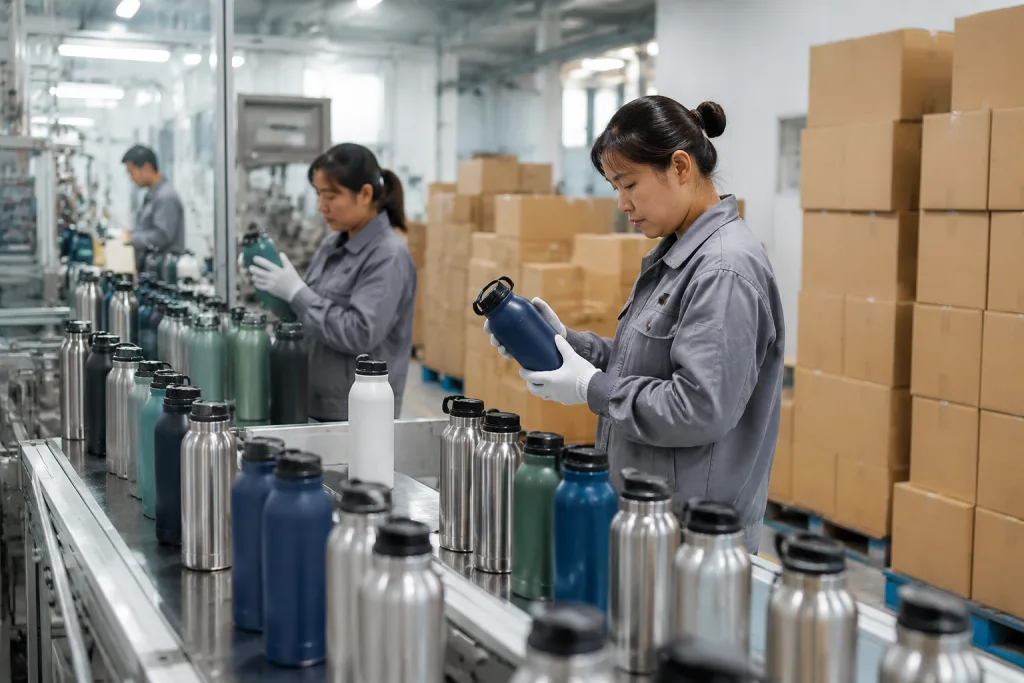
Key Takeaways
- 304 stainless inner and outer is the safe mainstream choice; switching outer wall to 201 can trim USD 0.18-0.35 on 500 ml bottles but changes corrosion risk and brand positioning
- A realistic MOQ for a custom thermos is 1,000 pcs per color per size, with 25-35 day production after sample approval in Zhejiang, China
- Vacuum performance claims should be tied to a test method; for a 500 ml bottle, 12 hours hot above 55°C and 24 hours cold below 10°C is a practical commercial benchmark
- Decoration drives delay more than steel does; laser adds 1-2 days, silkscreen 3-5 days, and Pantone-matched powder coat can add 5-7 days
You can buy a stainless bottle from almost any catalog in China. Easy part. The hard part is reading the spec sheet and knowing which lines will hit sell-through, returns, compliance, and margin. For an in bulk vacuum bottle program in outdoor retail or promotions, small calls like 18/8 vs 18/0, 0.4 mm vs 0.5 mm wall thickness, or powder coat thickness can move landed cost by USD 0.25 to 0.90 per unit. We’ve seen complaint rates shift more than the cost line, especially after QC pulled the sample and found thin coating at the shoulder radius.
At BottleForge Industrial in Zhejiang, China, we see the same pattern on the line: buyers ask for a custom thermos quote, then the real decision starts after the first PDF drawing. This is the wrong question to ask. Price first, spec later usually goes sideways. Whether you need thermos bulk for a chain buyer, distributor thermos inventory, or a customized thermos for campaign gifting, read the spec line by line and ask what each number does to your business. We ship programs where a 0.1 mm change, a logo size note, or even a PO typo on lid color turned into rework and a 12 days vs 18 days delivery gap.
Read the steel line first
On a manufacturer thermos drawing, read the steel callout first. On a mainstream in bulk vacuum bottle, the inner wall should be 18/8 stainless steel, also called SUS304. That is the baseline most outdoor retailers and promo buyers ask for. It holds up well with coffee, tea, light acid drinks, and daily use. If the quote shows 18/0 or SUS430 on the inner wall, stop there and ask why. SUS430 is magnetic, cheaper, and wrong for a quality custom thermos interior. We check this against the coil tag before the line starts; one PO last month said “304 inner” but the vendor sample was stamped 430.
For the outer wall, cost control is more flexible. A lot of supplier thermos programs quote 304 inside and 201 outside. That setup can work on entry-level promo projects where the target price drives the decision. On a 500 ml bottle, changing the outer wall from 304 to 201 often cuts about USD 0.18 to 0.35, depending on the surface finish and steel swings that month. The tradeoff is plain: lower corrosion tolerance once the coating is chipped. We have seen this go sideways in coastal warehouses, where QC pulled the sample after 48 hours of salt spray and found rust bloom at the base seam.
Practical buying rule: if your product will sit in outdoor retail, face e-commerce reviews, or go into repeat corporate gifting, specify 304/304. If it is a short-run promotional thermos for a controlled event, 304/201 may be acceptable. This is the right question to ask early, not after mold sampling, because the math does not work once cartons and labels are already approved.
- Inner wall: SUS304, food contact safe mainstream choice
- Outer wall: SUS304 for premium, SUS201 for cost-down
- Lid contact parts: PP, Tritan, or food-grade silicone should be listed separately
- Compliance: ask for REACH and LFGB or FDA migration paperwork for all food-contact parts
At our Zhejiang factory, we normally quote both options side by side so you can see the true price delta instead of guessing from phrases like customizable thermos or factory thermos premium grade. On MOQ 3,000 pcs, that side-by-side quote usually answers the buyer pushback in one round, and we ship the updated sheet with steel spec, weight in g, and wall thickness in mm.
Wall thickness changes more than feel
Most buyers start with capacity and color. Our thermos team checks wall thickness first. A typical in bulk vacuum bottle body spec is 0.4 mm inner and 0.4 mm outer for standard retail, or 0.5/0.5 mm for heavier-duty outdoor lines. That 0.1 mm looks small on paper. On the line, it changes dent resistance, net weight, welding stability, and freight cost. We see it at the seam welder and again after vacuuming.
A 500 ml bulk thermos in 0.4/0.4 mm may weigh 280-330 g depending on lid design. The same bottle in 0.5/0.5 mm can move to 340-390 g. That is not a cosmetic change. Outdoor retailers usually like the heavier hand feel because the shelf impression is better and QC pulled the sample with fewer transit dents. Promotional brands shipping direct mail or event packs usually push back on grams, and the math doesn't work if you are mailing 10,000 pcs to North America.
What thickness really affects
- Dent resistance: 0.5 mm outer wall handles warehouse knocks better than 0.4 mm. We have seen fork-truck rub marks that left 0.4 mm bodies visibly soft at the shoulder radius.
- Vacuum yield: slightly thicker bodies can improve handling during vacuuming and reduce deformation during production. On our vacuum station, thinner shells show more ovaling if fixture pressure is off by 0.2 mm.
- Freight: 50-70 g extra per unit matters when you ship 20,000 pcs. That adds 1,000-1,400 kg before cartons, pallets, and the buyer will flag it fast.
- Perceived quality: end users often associate heavier with better, even when thermal retention is similar. We have had buyers reject a sample as "too light" even though the heat test passed.
If you buy as a thermos distributor or thermos vendor, ask the factory thermos team for drop test details tied to packaging. This is the right question. A stronger body does not fix a gift box with weak corner compression, and we have seen this go sideways at 76 cm drop test on packed goods. We usually recommend 0.4/0.4 mm for giveaway-driven thermos customized projects and 0.5/0.5 mm for outdoor or premium private label lines. The cost difference on a standard bottle is often USD 0.12 to 0.28, which is cheaper than handling return claims later.
Vacuum spec must be testable
Vacuum insulated by itself means nothing. If you buy thermos custom or thermos bulk, ask for a heat-retention spec with numbers and the exact test method behind it. Good manufacturers thermos paperwork should show initial water temperature, ambient temperature, fill rate, test time, and final temperature. On our line, QC pulled the sample and logged bottle weight before and after fill, because a 95% fill on paper often turns into 92% at the bench.
For example, a sensible commercial spec for a 500 ml in bulk vacuum bottle is: fill with 95°C water to 95% capacity, hold at 20°C ambient, and retain above 55°C after 12 hours. Cold performance can be: fill with 4°C water and remain below 10°C after 24 hours. Those are numbers we can test and repeat. Some premium shapes do better. Still, this is the wrong question to ask if a supplier only says “24 hours hot” on a slim 500 ml bottle without the setup; we’ve seen this go sideways after a third-party lab check.
Ask one question that saves time: what is your hot and cold retention result by model, and how many samples were tested?
Vacuum quality comes down to weld integrity, vacuum level, copper plating on the inner liner in some constructions, and neck design. Shape changes the result fast. A wide-mouth bottle usually drops heat faster than a narrow-mouth body, and a lid with a big pour spout shifts the numbers again. We ship both hiking and gifting programs, and the buyer flagged this more than once: the same 500 ml body with a different lid tested 2°C to 4°C worse at the 6-hour check.
At BottleForge Industrial, our standard in-process check includes vacuum inspection on every unit and retention testing by lot. If you buy 5,000 pcs, request AQL terms in the PO. A common standard is AQL 2.5 for major defects and 4.0 for minor defects. Also ask whether leaking, poor heat retention, and powder-coat flaking are classified as critical, major, or minor. Leave that open, and the math doesn’t work later. We’ve had a PO where “heat retantion” was typed wrong and no defect class was listed, then the inspection report gave the buyer nothing to push on.
Lid construction decides complaint rate
On a lot of custom thermos programs, the bottle body gets the budget and the lid creates the returns. We’ve seen this go sideways. A basic screw cap with a PP inner and silicone gasket is still the safest build if you want a low complaint rate. Push-button and flip-top lids look easier to use, but on the line they add springs, pins, and extra seals. More parts, more leak points. QC pulled one sample last month with a 0.3 mm pin shift, and that was enough to fail after repeat opening.
If you sell into outdoor retail, a simple cap with one primary silicone gasket usually beats a one-hand lid. That is the wrong question to ask, by the way; buyers ask which lid looks better, but the better question is which lid survives 12 months of use without claims. For promo thermos units for office use, a convenience lid can help the program sell, but test it hard before you sign off. We run a 45-degree and 90-degree leak test, upside-down rest for 30 minutes, and 500 open-close cycles on pre-production samples. If a thermos manufacturer says leakproof and shows no cycle data, that’s not enough. One buyer flagged a cap that passed day-one leak testing but started dripping at cycle 312.
- PP lids: lower cost, stable, common in distributor thermos programs; MOQ is usually easier to manage because the mold set is already running
- Tritan lids: clearer appearance, better premium feel, usually higher unit cost by USD 0.20-0.45; buyers like the look, then push back on scratching after carton drop tests
- Silicone gaskets: should be removable for cleaning and replacement; 2 mm cross-section is common on this type of lid
- Tea filter or infuser parts: good for feature value, but add cleaning complaints if mesh is too fine; we’ve had users complain when leaf fragments jam in 0.5 mm mesh
For custom-logo work, also check the top cap insert area. A flat stainless or plastic medallion is easier for laser or epoxy badge branding than a curved top. Simple math. Buyers often ask for thermos customizable lid options after tooling has started, and the math doesn’t work once the mold shop has cut steel. Confirm the lid family early, because new lids can require fresh molds or at least new inserts, with tooling from USD 800 to USD 4,000 depending on complexity. We’ve even seen a PO typo switch a flat insert to a dome insert, and that small mistake cost 9 extra days before sample approval.
Decoration, finish, and retail position
The print method drives more than branding. It changes lead time, carton reject rate, rub resistance, and where the bottle sits at retail. On the line, we usually compare three options for a custom thermos: powder coating, silkscreen printing, or laser engraving. A glossy painted body looks clean on first sample. After 2 weeks in outdoor use, powder coat usually wins on grip and it hides the small handling marks QC pulled near the base ring.
Typical powder coat thickness is around 60-80 microns, and we check it with a dry film gauge. Below that, it scuffs fast. Above that, the coating can chip at the neck or base during assembly, especially around tighter radii under 2 mm. Silkscreen is the budget pick for simple 1-2 color logos, usually adding around USD 0.05 to 0.12 per color per unit depending on size. Laser engraving costs more in machine time, though the mark lasts and you do not get Pantone shift. If the buyer wants a fine serif logo under 1 mm stroke width, this is usually the wrong question to ask—screen and laser behave differently at that size.
Choose decoration by channel
- Outdoor retail: matte powder coat plus laser logo is the safer premium setup; we ship a lot of 18/8 outdoor bottles this way because shelf wear shows less
- Promotional thermos: solid color spray or powder coat plus 1-color screen keeps budget under control; MOQ pressure usually starts at 1,000 pcs per colorway
- Distributor thermos stock: neutral body with a reserved logo zone speeds repeat orders; one buyer even typed the logo position wrong on the PO, so this buffer saved the run
If your brand standards require close Pantone matching, ask what tolerance the thermos factory can hold on textured powder. Some colors shift batch to batch, especially warm grays, dark greens, and bright oranges. We have seen Delta E drift show up after oven cure, even when the pre-spray panel looked right. Request a signed color chip or production sample. For a 3,000-piece order, reworking a color mistake costs more than the sample stage, and we have seen this go sideways after only one approved JPG instead of a physical chip.
At our China plant, laser usually adds 1-2 days, standard silkscreen 3-5 days including curing and inspection, and special soft-touch or ceramic-like finishes can add 5-7 days. We run cross-hatch adhesion checks before packing. That extra time matters if your distributor thermos order has a fixed event ship date, because missing by 3 days is still missing.
MOQ, packing, and freight math
MOQ is where buyers burn 2 or 3 weeks, usually because they ask for too much variation on the first round. For a standard manufacturer thermos on an existing mold, a practical MOQ is 1,000 pcs per size per color, and sometimes 500 pcs if the decoration is simple and we have an open slot on the line. Ask for three colors, two lid types, plus individual name printing, and the catalog MOQ stops meaning much. It turns into a line-efficiency problem. We’ve seen this go sideways after the buyer flagged “same bottle” on the PO, while the cap gasket, spray color, and laser file were all different.
Our normal capacity in Zhejiang is up to 300,000 units per month across stainless drinkware lines, but that does not mean every SKU runs cleanly at small volume. A 500 ml bottle packed 24 pcs per carton might use a carton around 52 x 35 x 27 cm depending on shape. If the net product weight is 320 g, gross carton weight may land near 9.5-10.5 kg after inserts and export carton. These numbers decide pallet count and FBA prep cost. QC pulled the sample last month and found a 3 mm handle offset, which sounds minor until the carton fit changes and the drop-test result moves.
- MOQ for stocked model with logo: 1,000 pcs
- Lead time after sample approval: 25-35 days
- New tooling for custom lid or body: usually 35-60 extra days
- Sample time: 5-7 days for logo sample, 10-15 days for color and packaging set
For thermos distributors and thermos supplier buyers serving North America, request carton marks with item code, color, quantity, gross and net weight, made-in-China statement, and if needed FNSKU labeling instructions. For Europe, check if your importer needs EAN placement on each unit box. This is the wrong question to ask too late. We ship cartons every week where the buyer forgot barcode position, then the warehouse has to relabel by hand. A plain white box saves money, but for retail it often hurts conversion. A good color box may add USD 0.18 to 0.60 and improve shelf readiness enough to justify itself. On our side, the box dieline usually gets checked with a caliper and a 1A drop test sample before mass print.
Compliance paperwork before deposit
If you buy from China long enough, you learn fast: the cheapest sample often turns into the most expensive shipment. Before you pay the deposit on an in bulk vacuum bottle program, lock the compliance path first. For Europe, ask for REACH-related declarations and food-contact testing that match the country you sell into, not a generic paper set. For North America, buyers usually ask for FDA food-contact statements. For school and kids channels, labs often add extra checks even when the bottle is not sold as a toy. We’ve seen this go sideways after the PO was opened because the buyer flagged a lid straw component that was never listed on the test plan.
Review social and quality paperwork early if you sell to chain stores. BSCI audit status matters for a lot of promo and retail accounts, and ISO 9001 still tells you the factory runs document control and corrective action in a disciplined way. It does not prove the bottle is good. This is the wrong question to ask if you stop at the certificate. Ask who pays for third-party testing, which lab they use, and whether the report is tied to your exact model or just a generic 304 stainless material report. On our side, QC pulled the sample and matched lid, paint, silicone, and straw bill of materials line by line before booking the lab slot.
For inspection, write the standard into the PO. AQL 2.5/4.0 is common, but the defect list matters more than the numbers. Be specific. For a bulk thermos order, major defects should cover leakage, failed heat retention against the agreed spec, a sharp burr at the mouth rim, base wobble above the agreed tolerance, obvious color mismatch, and wrong barcode placement. Minor defects can include print offset under 1 mm or small base scratches hidden by the stand ring. We run into buyer pushback here all the time: they approve a golden sample, then send a loose defect standard after production starts. The math doesn’t work.
The best supplier thermos relationship is boring in the right way. Approved sample. Signed spec sheet. Packaging file. Inspection checklist. Shipping mark confirmation before mass production. That routine cuts surprises. On the line, even a 2 mm barcode shift or one typo in the shipping mark can stop a carton from being booked into an Amazon warehouse, so the paperwork matters as much as the bottle.
Send your target spec, not just a logo
Tell us capacity, steel grade, lid type, finish, MOQ, and target price. We will quote the right stainless thermos options from our Zhejiang production lines.
Frequently asked questions
What is a realistic MOQ for a custom stainless vacuum bottle?
For an existing bottle mold, 1,000 pcs per size per color is the most practical MOQ. Some factory thermos programs can accept 500 pcs if you use a standard body, one logo position, and simple packaging, but unit cost will rise. If you want a new lid, base, or body shape, MOQ usually starts at 3,000-5,000 pcs because tooling and production setup must be absorbed. For outdoor retail, it is usually smarter to start with one proven 500 ml or 750 ml model, 2 colors, and one lid. That keeps the first PO manageable while giving enough volume for stable color, packaging, and inspection control.
How much should I expect to pay for an in bulk vacuum bottle?
A standard 500 ml stainless vacuum bottle with 304 inner, 201 or 304 outer, powder coat, and a basic screw lid often lands around USD 2.80-4.80 FOB China at 1,000-3,000 pcs, depending on steel market conditions and decoration. A premium 304/304 bottle with thicker 0.5 mm walls, Tritan lid details, laser logo, and retail gift box can move to USD 4.50-6.80 FOB. Very low quotes usually mean thinner steel, simpler coating, weaker packaging, or a lid with lower durability. Ask suppliers thermos teams to break price into body, lid, decoration, and packaging so you can see where cost is really coming from.
Which decoration method is best for outdoor retail versus promotional use?
For outdoor retail, matte powder coating plus laser engraving is the safest commercial choice. Powder coat at roughly 60-80 microns gives good grip and hides small handling marks, while laser stays readable after years of use. For promotional thermos orders, a 1-color silkscreen on a standard painted or powder-coated bottle is usually the most economical route, often adding only USD 0.05-0.12 per color. If your project depends on exact Pantone matching, ask for a pre-production sample because textured coatings can shift. For metal logos or badges, expect added tooling and 5-7 extra production days.
How do I verify thermal performance before mass production?
Ask the thermos manufacturer for a written test method and model-specific result, not just a brochure claim. A reliable test for a 500 ml bottle is 95°C water filled to 95% capacity, held at 20°C ambient, remaining above 55°C after 12 hours. For cold, 4°C water should stay below 10°C after 24 hours. Request test data from at least 3 samples and include the target in your PO. On pre-production samples, also check leakage, lid torque, wobble, coating adhesion, and 500-cycle open-close durability if the lid has moving parts. These checks catch more real-world failures than a single heat test alone.
What compliance documents should I ask for when importing to Europe or North America?
For Europe, ask for food-contact material declarations and REACH-related compliance paperwork covering stainless steel, PP or Tritan lid parts, silicone gaskets, inks, and coatings. For North America, buyers usually request FDA food-contact statements, and larger accounts may ask for third-party lab reports on the finished bottle or key materials. If you sell to major retailers, also ask whether the supplier has BSCI audit status and ISO 9001 certification. Most important, confirm whether the test reports are generic material reports or specific to your exact bottle model. Model-specific paperwork reduces risk if your customer audits the file later.