Key Takeaways
- Set measurable specs early: 18/8 inner wall, 0.4 mm inner and 0.5 mm outer wall, leak test at 80 kPa, AQL 2.5
- Typical MOQ for a custom bulk travel tumbler is 1,000-3,000 pcs per color, with 25-35 day lead time from Zhejiang, China
- Most repeat defects come from lids, coating adhesion, logo misplacement over ±1.5 mm, and weak export packaging
- FOB pricing for a 20 oz stainless steel custom tumbler often lands around USD 3.20-5.80 depending on lid, finish, and decoration
You are not buying a tumbler. You are buying a promise: no leaks, a coating that holds up, clean logo placement, repeatable color, and an ETA your sales team can trust. Most bad in bulk travel tumbler orders do not start in the warehouse. They start when the RFQ says “20 oz, matte black, custom logo.” That is not a spec. That is a return risk.
For coffee brands and corporate-gift buyers, the expensive mistakes are the dull ones: lids that seep after 200 opens, powder coat that scuffs at carton rub points, mixed stainless grades in one lot, or the wrong print method for daily carry. We run this every week in Zhejiang, and QC pulled a sample last month with a logo shift of 1.8 mm—small on paper, enough for a buyer to flag it. If you define the failure modes before sampling, you buy cleaner and you waste fewer rounds.
Where bulk tumbler orders fail
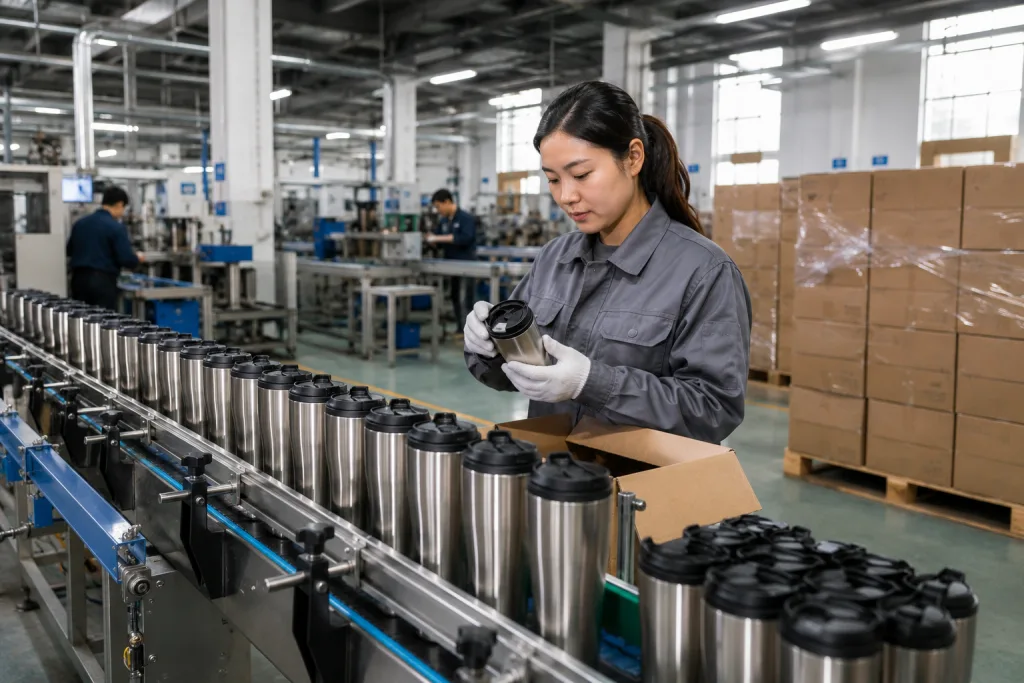
If you source a bulk coffee tumbler or bulk coffee travel mug for resale, promo, or private label, the failures are usually predictable. The product looks simple. It is not. On the line, one SKU can pass through deep drawing, seam welding, vacuuming, powder coating, screen printing, assembly, and drop-pack testing in the same day. Miss one control point—like a lid thread tolerance drifting 0.3 mm—and you pay for it later in claims, rework, or dead stock.
The most common breakdowns we see in Zhejiang, China are these:
- Leakage: poor lid thread tolerance, bad silicone hardness, or a straw-port design that was never built for upside-down transport. We’ve had buyers flag this after a simple 30-minute inverted test.
- Heat retention misses: incomplete vacuum rate, weak copper coating, or inconsistent inner wall thickness. QC pulled the sample and found one batch holding heat 8 hours instead of the approved 12.
- Cosmetic rejects: dust in powder coat, color shift between batches, logo skew over 2 mm, denting at rim after transit. One common find is powder specks caught under the booth light before packing.
- Odor and taste complaints: low-grade plastic lid parts, seal material issues, or poor post-production cleaning. We’ve seen this go sideways when the seal ring was swapped without updating the PO.
- Compliance gaps: missing REACH support, BPA-free declaration without backup, or packaging that fails drop tests for Amazon FBA. The buyer asked for FBA-ready packs, but the outer carton was still 5-ply instead of the tested spec.
A buyer new to a coffee mug manufacturer often focuses only on unit price. This is the wrong question to ask. That is how a USD 3.60 quote turns into a USD 5.20 landed problem after replacements, air shipments, and chargebacks. If you are comparing a coffee mug factory direct source, a coffee mug supplier directory entry, or a coffee mug supplier list from an agent, push them all to quote against the same technical sheet. Ask for material callouts, leak standard, coating adhesion method, logo tolerance, carton spec, and inspection plan. We ship cleaner projects when all suppliers work from one sheet, not three versions with a typo on the logo position line.
You do not control quality by saying “high quality.” You control it by defining what failure looks like before production starts.
Lids are the first return driver
On bulk travel mugs, returns usually start at the lid, not the steel body. On our line, QC pulled 37 complaint photos last quarter; 29 were lid-related. Buyers ask for “leakproof,” but that word covers different jobs: splash resistant on a desk, bag-safe in horizontal carry, or a full inverted seal. Same word, different target. This is the wrong question to ask. Ask how the cup will be used.
What to specify
- Lid style: slider, flip-top, screw cap, straw lid, or 2-in-1. A slider lid is usually spill resistant, not leakproof; buyers flag this after the first bag test.
- Thread engagement: ask for minimum 1.5 turns on screw lids and verify cross-thread resistance. We check this on the torque bench before mass production.
- Seal material: food-contact silicone, typically Shore A 50-60 hardness. If the gasket is too soft, it twists; too hard, and the seal line opens at the lip.
- Leak test: 80 kPa air-pressure test or inverted water test for 30 minutes, depending on design. On straw lids, we usually run the inverted test first because the vent structure tells the story fast.
- Cycle test: 500 open/close cycles for flip lids if this is a daily-use coffee mug custom made program. Hinge pins are where we’ve seen this go sideways.
For a coffee mug customized for commuters, ask the supplier to separate claims on the artwork and carton. If the lid has a straw opening or pressure vent, do not let the sales sheet say “100% leakproof.” We have seen one PO where “leak proof” was printed on the inner box for a vented lid, and the buyer pushed back on the full shipment. The math doesn't work. A careful coffee mug oem manufacturer will mark it as “splash resistant” or “bag-safe with lock” based on the actual lid structure.
Ask who molds the lid. Some coffee mug manufacturers outsource injection parts to a nearby tool shop and only assemble in-house. That is not bad by itself, but sample consistency matters. Approve three lid samples from different cavities if the mold has 4 or 8 cavities. Tolerance drift shows up there first; on one 8-cavity mold, cavity 6 ran 0.18 mm off at the latch and the seal failed only on that lane. For corporate-gift buyers, one bad lid in a boardroom gift set does more damage than a small paint flaw. Treat the lid as the highest-risk component in your bulk travel tumbler program.
Vacuum insulation misses are expensive
A buyer says “20 oz double wall stainless,” and we still have gaps. Too much room. One coffee mug factory quotes the same wording at two cost levels with different steel, different wall thickness, and a different vacuum process. If you need a reliable in bulk travel tumbler, lock down the spec: steel grade, wall thickness, vacuum standard, and the retention target. We’ve seen a PO marked “SS inside” and the line had to stop for 3 hours because nobody defined 201 or 18/8.
For mainstream premium orders, the safe baseline is 18/8 stainless steel for the inner wall and usually the outer wall too. A common build is 0.4 mm inner wall and 0.5 mm outer wall. Some low-cost offers drop below that. The saving is often $0.03 to $0.08 per unit, and the math doesn’t work if dent claims start after arrival. Buyers push back on this point, then QC pulled the sample and you could feel the sidewall flex by hand.
Heat retention needs to be written as a test condition, not a sales phrase. Example: 95°C hot water filled to 90% volume, measured after 6 hours and 12 hours at 20-22°C ambient. For a good 20 oz vacuum tumbler, we usually expect above 60°C at 6 hours, depending on lid design and fill loss at the thread. Cold retention should be checked with ice water over 12 or 24 hours. We run this with a calibrated probe thermometer, and a 2°C reading error will start arguments later.
Failures here usually come from:
- low vacuum extraction rate at the pump stage
- incomplete sealing at the vacuum point
- missing or uneven copper coating on the inner outer-wall surface
- microleaks missed during line testing
Ask the coffee mug supplier how they inspect vacuum. This is the right question. Some factories only do a hot-water spot test on a few pieces per lot. Better plants add vacuum gauges or a dedicated leak-check station on the line. Our plant in Zhejiang, China runs up to 600,000 units per month across drinkware categories, and we track vacuum stability by batch, not just by final carton. One unstable lot is enough to trigger chain-store complaints 12 days after receipt, not 18 days, once stores start daily use.
If your order is a coffee mug private label or coffee mug private labeling project, keep the retention claim on packaging conservative. Promise what you can defend after transit, real use, and sample variation. We’ve seen this go sideways after a drop test from 76 cm changed lid fit by 0.3 mm and the buyer flagged the heat-loss result.
Coating and logo problems start early
The next failure point is appearance. On coffee mug promotional products, buyers usually care more about finish and logo than one extra hour of heat retention. That is normal. Decorative defects are also the easiest ones to prevent if the spec is tight before the line starts.
Start with the finish. Powder coat is durable and cost-effective, but one powder does not behave the same across all colors and textures. Matte black hides weld marks and hook marks better than pale pastel or gloss white; we see this on the curing rack every week. If you need a Pantone-like corporate color for a coffee mug custom or coffee mug customizable project, ask the factory exactly how they match it: mixed powder batch, spray ratio, or painted coating. This is the right question to ask. Color tolerance should be tied to an approved sample under D65 lighting, not only a screen proof.
Then define the decoration method:
- Silkscreen: low cost, good for simple 1-2 color logos, but weaker against abrasion and dishwashing. We usually run this for MOQ 1,000 where the buyer wants to control budget.
- Laser engraving: sharp and durable, ideal for premium coffee mug customized branding on powder-coated steel. QC pulled the sample once because the laser power burned too deep on a thin wall body.
- Heat transfer or 360 wrap: good for graphic-heavy coffee mug promotional work, but check seam alignment carefully. On tapered bodies, even a 2 mm shift gets flagged fast.
Common misses are logo skew, print pinholes, weak adhesion, and location drift on tapered bodies. We have also seen POs with the logo axis typoed against the lid vent instead of the seam, and that sends the whole fixture setup off. Your PO should state logo position tolerance, usually ±1.5 mm, and whether the print references the handle equivalent axis, seam, or lid orientation mark. For large orders, require a pre-production sample with the real decoration fixture, not only a hand-made mockup. We’ve seen this go sideways.
For coating durability, ask for cross-hatch adhesion test and a simple abrasion or alcohol rub standard. If tumblers will be sold through retail, ask for pack-off inspection focused on rim chips and bottom edge rub. Those two spots fail first in transit. The math doesn't work if a coffee mug factory direct quote looks cheaper but 4% of units arrive with carton-rub damage. We ship enough of these to know. Better inner bagging and cell dividers usually cost less than replacement stock, and QC should check the rim with a 500 lux light before cartons are sealed.
Bad specs create false low prices
We see this every week: 7 RFQs for coffee mug in bulk, 7 different assumptions, and buyers try to compare them line by line. One supplier prices an individual white box, another packs 24 pcs in egg-crate dividers. One runs Tritan slider parts, another quotes standard AS plastic. One includes laser logo, another prices a one-color silkscreen at 30 mm wide on the opposite side of the seam. Buyers call China unpredictable. That is the wrong question to ask. The problem is scope that was never written down.
If you want clean pricing from a coffee mug supplier or coffee mug manufacturer, send a short spec sheet with technical points, not a two-line PO note. We run quotes faster when the drawing shows the basics, even if it is just a marked-up PDF from the buyer.
- capacity in ml and oz, with brimful and usable fill if important
- body material and thickness
- lid type and leak expectation
- finish: powder coat, spray paint, electroplating, or bare stainless
- logo method, size, colors, and location tolerance
- packaging: polybag, white box, color box, gift set, master carton burst strength
- test requirements: REACH, LFGB if needed, FDA contact declaration, BPA-free statement
- inspection plan: AQL 2.5 major / 4.0 minor is common for drinkware exports
For North America and Europe, buyers often add BSCI, ISO 9001 process control, and social compliance records. For Amazon, add FNSKU label placement, carton weight limit, and drop resistance from the start; QC pulled the sample once because the outer carton was 23.5 kg and the buyer cap was 22 kg. For a coffee mug custom made gift campaign, call out the insert card, barcode, and assortment ratio by color. We have seen this go sideways over one typo on a PO: 60/40 black-white became 40/60 in packing.
A real example: a 20 oz stainless travel tumbler with powder coat, slider lid, one laser logo, and white box may quote at USD 3.20-4.10 FOB China at 3,000 pcs. The same body with lock lid, custom color box, spare straw, and wrap print can move to USD 4.60-5.80 FOB. Neither quote is wrong. They are different products, and the math doesn't work if you compare them as if they came off the same line. Your job is to remove hidden assumptions before tooling, sampling, and deposit.
Packaging failures waste good production
You can make a good bulk coffee mug and still lose the order on packaging. That happens. On our line, most dents show up after production, not during it, and QC pulled the sample from the drop-test corner more than once to prove it. Thin rims, narrow bases, and painted surfaces get hit first when master cartons are loose or the pallet pattern is wrong.
For standard export packaging, ask for the full stack-up: PE bag, tissue or foam sleeve if needed, individual box dimensions, pieces per master carton, carton size, gross weight, and carton board grade. For a 20 oz tumbler, many buyers target master carton gross weight under 12-14 kg. That number matters on the warehouse floor. One packer lifting 15 kg cartons all shift will stack slower, and we’ve seen this go sideways in drop tests from 76 cm. If you sell through e-commerce, ask for stronger single-unit packaging and check corner crush resistance with an edge crush tester, not just a photo.
Failure points to watch:
- Rim dents: poor fit in inner box or no top buffer. A 3 mm gap at the top is enough for the rim to kiss the box wall in transit.
- Bottom chips on coating: no base pad or friction during transport. The buyer flagged it on black powder coat first because every chip shows.
- Mixed accessories: lids, straws, and brushes packed loose and counted inaccurately. We’ve had a PO with the brush qty typed wrong by 1,000 pcs.
- Barcode issues: wrong carton marks, missing FNSKU, unreadable ink after humidity exposure. If the ink smears after 24 hours in a damp container, the math doesn’t work.
A coffee mug distributor should also ask about palletization if shipping to EU or North America distribution centers. This is the right question. Standard pallet height, slip sheets, stretch wrap gauge, and carton overhang decide whether the load arrives square or crushed. We ship loads where 10 mm carton overhang is already a risk point, and warehouses have rejected coffee mug promotional products because carton labels were placed across tape seams and would not scan.
If your project includes a premium coffee mug custom gift box, test assembly speed too. Pretty packaging that adds 20 seconds per unit will slow output fast. On one Zhejiang hand-pack line, 8 workers can finish 2,400 sets in a shift with a simple insert, but a rigid box with ribbon and EVA tray adds 5-7 days and creates more rework points. Good packaging is not just protection. It also controls throughput.
How to control production before shipment
After the spec is locked, the job is simple to say and hard to run: hold the factory to the approved version. We see the same control points whether you place the order with a coffee mug factory, coffee mug distributors, or a coffee mug supplier list from your sourcing team. On our line, the first mismatch usually shows up in the lid gauge or logo position jig, not in the final carton.
Use a staged approval flow:
- 1. Technical sample: check body shape, lid fit, capacity, and hand feel. We usually verify capacity with a graduated cylinder, and a 30 oz tumbler that comes out short by 8-10 ml should be flagged at this stage.
- 2. Pre-production sample: made with actual coating and actual logo process. If the order uses powder coating plus silk print, approve that exact build; don’t sign off on a plain steel mockup and expect the same result later.
- 3. Packaging approval: box artwork, barcode, carton marks, pack-out method. The buyer flagged this more than once: one digit wrong in the PO barcode, and 2,000 boxes became dead stock.
- 4. During-production check: spot-check coating, logo, and lid fit at 20-30% completion. QC pulled the sample from the middle of the run, not the first 20 pcs, because first-off samples often look better than the rest.
- 5. Final inspection: AQL based, with leak, vacuum, appearance, count, and packaging checks. We ship only after the vacuum hold time and drop-test standard are signed against the inspection report.
For custom drinkware, AQL matters because zero-defect expectations on mass production are not realistic. This is the wrong question to ask. The right question is which defects stop shipment. A lid that leaks is major. A 0.5 mm print shift usually is minor. A sharp edge on the rim may be critical. We’ve seen this go sideways when the buyer says “good quality” but never defines defect limits before mass production starts.
Lead time should be tied to approvals, not just to deposit date. A typical custom bulk travel tumbler order runs 7-10 days for samples, then 25-35 days for production after deposit and sample sign-off. MOQ is often 1,000 pcs for standard shapes, but some colors, special lids, or gift sets need 3,000 pcs. In Zhejiang, China, before holiday peaks, add buffer around September to January. Last-minute color changes in October can turn 25 days into 32 days fast, because the coating queue gets packed.
The most practical move is naming one decision-maker on your side. Not a committee. We’ve had orders delayed 12 days because brand approved Pantone, sales changed the slogan, and packaging sent a new carton mark in a different email thread. A factory can make steel and plastic parts to spec. It cannot fix buyer-side indecision. Tight control on your side matters just as much as QC in China.
Send your tumbler spec sheet for a real quote
If you have a target price, logo file, or rough idea, we will turn it into a production-ready specification and honest FOB proposal from Zhejiang, China.
Frequently asked questions
What is a realistic MOQ for a custom in bulk travel tumbler order?
For a standard 20 oz stainless steel travel tumbler with one logo, the realistic MOQ is usually 1,000 pcs per model and around 500-1,000 pcs per color, depending on the coating line setup. If you want a special lid, custom-molded accessory, or gift box, MOQ often moves to 3,000 pcs because packaging and component purchasing become less flexible. Very small trial orders are possible on stock colors, but your unit price can rise by 10-20%. If a coffee mug factory direct source in China offers very low MOQ with full custom color, confirm whether they mean from existing inventory, not fresh production. Ask for MOQ by body, by color, and by print method separately.
How much does a bulk coffee travel mug usually cost FOB China?
A normal FOB China range for a 20 oz vacuum stainless travel tumbler is USD 3.20-5.80, based on 3,000 pcs. At the lower end, you are usually looking at a standard body, powder coat, simple slider lid, and one-color silkscreen or laser logo with white box packing. At the higher end, add a lock lid, custom color box, wrap print, extra accessories, or stricter testing and inspection. If you see a price below USD 3.00, check steel grade, wall thickness, lid resin, and packaging. Many coffee mug manufacturers quote low by assuming thin material, no special carton protection, or a less durable decoration method.
What tests should I require before shipping a coffee mug private label order?
At minimum, require leak testing, capacity verification, appearance inspection, logo adhesion check, and carton drop review. For materials, ask for food-contact declarations and REACH support for Europe; some buyers also ask for LFGB depending on channel. A practical final inspection standard is AQL 2.5 for major defects and 4.0 for minor defects. For thermal claims, define a hot-retention test such as 95°C fill, 6-hour measurement at 20-22°C ambient. If the product goes to Amazon or a retail DC, add barcode scan check and packaging verification. On lid-heavy models, ask for an open-close cycle test of 300-500 cycles to catch weak hinge or seal wear.
Which logo method is best for coffee mug promotional products?
It depends on use case and budget. For the best durability on powder-coated stainless steel, laser engraving is usually the safest choice. It resists abrasion well and gives a premium look, especially for corporate gifts and branded coffee programs. Silkscreen is cheaper and fine for simple promotional use, but it is more vulnerable to scratching and harsh cleaning. Heat transfer or wrap printing works when you need complex graphics, but alignment control is more demanding on tapered tumblers. For most bulk travel tumbler orders over 1,000 pcs, ask for at least one decorated pre-production sample and define logo placement tolerance at ±1.5 mm so you avoid avoidable branding disputes.
How long does production take from sample approval to shipment?
For standard custom drinkware from Zhejiang, China, sample time is commonly 7-10 days, assuming your artwork is ready and no new tooling is needed. Mass production typically takes 25-35 days after deposit and sample approval. If the order includes custom packaging, multi-color assortments, or hand-packed gift sets, add 5-7 days. Peak season can stretch schedules, especially before major holidays and Q4 retail shipments. The safest approach is to lock artwork and packaging early, then ask the factory for a dated production schedule covering coating, printing, assembly, inspection, and booking. If any supplier promises 15 days for a fully customized coffee mug in bulk order, verify whether they actually have components in stock.