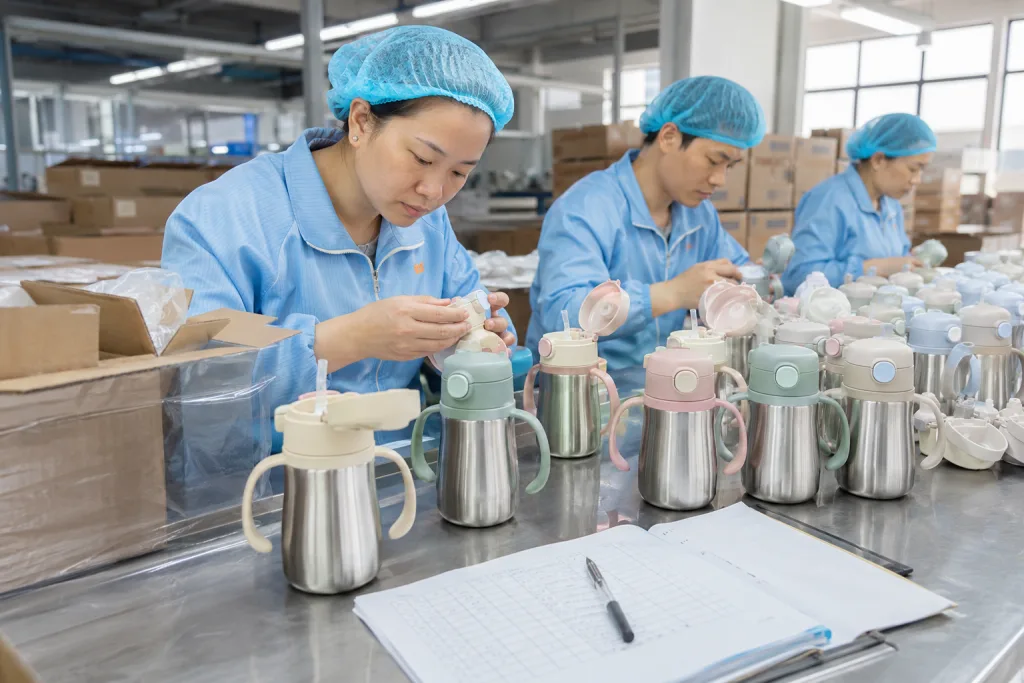
Key Takeaways
- For most toddler SKUs, MOQ starts at 3,000 pcs per color, with 35-45 day production after sample approval
- 18/8 stainless bodies with 0.4-0.5 mm wall thickness reduce dent claims better than thin 0.3 mm bodies
- AQL 2.5 for major defects and 4.0 for minor defects is a practical inspection baseline for bulk drinkware orders
- Third-party testing for REACH, LFGB, CPSIA, and phthalates can add USD 600-1,500 per SKU, but usually costs less than one packaging recall
Buying an in bulk toddler bottle is a different job from buying a generic sports bottle. Toddlers use it. Parents judge it. Retailers and compliance teams check every weak point. A price gap of USD 0.30 looks good on a sheet, then disappears after one failed 1.2 m drop test, a leaking straw on the line, or a carton rework because the PO print said 260 ml instead of 280 ml. If you also buy bulk canteen, bulk drinkware, or bulk growler lines from China, you know this already: a 0.5 mm spec miss gets expensive fast once we run production.
The practical way to source from Zhejiang, China is to lock four decisions early: material platform, lid system, compliance scope, and order structure. This is the right place to be strict. We have seen buyers spend 30 days on samples that QC pulled in week one for odor, bite-valve fit, or cap torque outside spec. Get those four items right and MOQ, tooling, decoration, and lead time are workable. Get them wrong and the math doesn't work.
Start with four buying decisions
Most purchasing mistakes start early. Buyers argue over a 35 mm logo or carton marks, then leave the bottle build undefined. For an in bulk toddler bottle, lock four decisions first. This is the right question to ask.
- Body material: single-wall stainless, double-wall vacuum stainless, Tritan, or glass with sleeve. For toddler use, we usually see single-wall or vacuum stainless win because drop risk on the line and at retail matters more than shaving a few cents off unit cost.
- Drinking system: straw lid, spout lid, sippy lid, or open sport cap. Straw lids move fast. They also generate the most leak claims and cleaning complaints. QC pulled one sample last month where the bite valve slit was off by 0.4 mm, and that was enough to trigger seepage in a tilt test.
- Compliance scope: EU retail, North American retail, or online-only. The document pack and test plan change by market. We have seen buyers ask for FDA only, then add LFGB after sampling, and that costs time.
- Order structure: one SKU in depth or several colors and decorations across the same mold set. This drives MOQ, setup cost, and schedule. A 3-color run on one mold set sounds simple, but the line loses hours on changeover and carton swaps.
Skip these four calls and every China quote looks comparable on paper, which is where buyers get burned. A factory in Zhejiang quoting USD 2.10 may be pricing 0.3 mm body thickness, basic PP lid resin, and no test budget. Another quoting USD 2.55 may include 18/8 stainless, food-grade silicone, and a spare straw packed in the unit box. Those are different specs, different risk, and different claim rates. We have seen this go sideways over a PO typo on lid material alone.
At BottleForge Industrial, typical capacity is 600,000 units per month across stainless and plastic drinkware lines in Zhejiang, China, but capacity does not fix a vague RFQ. Your RFQ should state the intended age group, target fill volume, thermal expectation, packaging type, and compliance market before you ask for the best wholesale drink bottle pricing. If the buyer flagged “keep warm” with no target, we still have to ask whether that means 4 hours or 8 hours, and that gap alone can swing the build from single-wall to vacuum.
You are not buying a bottle shape. You are buying a defect rate, a compliance risk level, and a replenishment model.
Choose the safest material platform
Material choice sets the first hard trade-off: cost, drop performance, insulation, and where the item sits on the shelf. For toddler programs, we usually run 3 material routes that cover about 80% of RFQs. This is the right place to get specific early, because once the buyer signs off on body material, lid fit, drop test target, and retail price all move with it.
Single-wall stainless steel
This is usually the cleanest entry point if you want decent durability without pushing cost too far. A 12 oz body in 18/8 stainless with 0.4-0.5 mm wall thickness is common. On our line, QC checks the rim curl and wall gauge with a caliper before painting, because a 0.1 mm drift shows up later in lid fit. FOB China pricing at 5,000 pcs is often around USD 1.85-2.60 depending on lid complexity and decoration. It will not keep drinks cold for 12 hours. No surprise there. But it survives drop abuse better than most plastic options and gives the brand a more premium shelf story.
Vacuum stainless steel
If your brand sells through specialty retail or premium DTC channels, double-wall vacuum bottles are easier to justify. Expect FOB pricing around USD 2.80-4.60 for a 10-14 oz toddler bottle at 3,000-5,000 pcs. You get insulation and stronger shelf appeal, but the bottle gets heavier and the line has more weld points to inspect. We have seen buyers ask only about heat retention; that is the wrong question to ask. Ask the packed weight too. A few chains have flagged toddler bottles that felt too heavy once the straw lid and silicone boot were assembled, and QC pulled the sample straight from carton drop test for that reason.
Tritan or PP-based plastic
Plastic can lower cost by USD 0.40-1.20 per unit versus stainless, but parents in Europe and North America are often cautious. We have had buyers push back on odor after first hot-water rinse, even when the resin passed spec on paper. If you go this route, ask for resin declarations and migration test planning early. Also ask which resin grade the factory will run, not just “Tritan” or “PP,” because that shortcut has gone sideways on more than one PO.
Where do related categories fit? If you also source canteen wholesale, wholesale drinkware, or growler wholesale programs from the same supplier, check whether the factory truly specializes in child-use lids. We see this all the time: a factory is good at bulk canteen, beer tumbler bulk, or alcohol flask wholesale bulk, the metal body comes out fine, then the straw system leaks at 15 kPa pressure test or the bite valve opens too tight for a 3-year-old. Body forming and child-safe lid engineering are different jobs. The safest choice is usually a factory with proven child-use tooling history, not just drinkware wholesale volume.
Lids decide your complaint rate
On toddler bottles, the lid is where margin gets eaten. Fast. The body is simple. The lid carries your leak risk, bite-through risk, cleaning complaints, and warranty returns. On our line, QC pulled one sample with a 0.3 mm flash on the spout seat and the whole issue started there.
For B2B buying, compare lids on five checkpoints:
- Leak performance: run an upside-down water test for 30 minutes, then check pressure change after hot filling if applicable. We ship samples only after this pass.
- Straw retention: set a pull-force target and verify it in internal testing, so the straw does not detach too easily. Buyers have flagged loose straws after carton drop tests.
- Hinge life: 2,000-5,000 open-close cycles for flip lids is a practical benchmark. We usually run this on a cycle rig, not by hand.
- Cleaning access: removable straw and gasket design matters more than visual style. A nice-looking lid that traps milk residue will come back as a complaint.
- Parts count: more parts means more assembly time and more field failures. The math doesn't work if the lid needs 7 hand-fit pieces at MOQ 3,000.
A lid with seven components may look smart on a drawing, but every extra gasket creates one more chance for a miss on the line. We’ve seen this go sideways. One missing silicone ring in final assembly is enough to turn a clean PO into a claims batch. That is why experienced buyers often pick a simpler two-piece straw system over a showy mechanism.
If your current supplier mainly produces canteen bulk, wholesale canteen, growler bulk, beer growler wholesale bulk, or alcohol flask in bulk orders, ask to see toddler-specific aging and leak test records. This is the right question to ask. A factory can be strong in beer tumbler wholesale bulk or wholesale growler production and still outsource the lid; that is usually where control gets soft. Ask for silicone hardness data, usually in the 50-60 Shore A range for gaskets, plus fit tolerance consistency from cavity to cavity. We check this with a durometer and cavity-marked samples.
Request 20-30 pre-production samples across multiple cavities, not just one golden sample. We prefer 24 pieces from 4 cavities so you can see variation early. A single hand-built sample from China proves appearance. It does not prove repeatability. Last month a buyer flagged a PO typo on straw length, but the bigger problem was cavity #3 running loose.
Compliance is not one checkbox
For toddler products, compliance starts before mass production. We ask for target market at RFQ stage, sometimes right on the first PO draft because one buyer typed "kids bottle" on the artwork file and "general drinkware" on the order sheet. That mismatch causes trouble. If you sell into the EU, ask about REACH, LFGB where applicable, and packaging requirements. For North America, the exact mix can include CPSIA-related review, phthalates limits for soft components, and retailer-specific protocols. If the item is marketed for child use, your documentation standard should rise accordingly. This is the wrong question to ask: not "is it food safe?" but "what standard does this exact SKU need in this exact market?"
Ask suppliers for a document pack list, not just a sentence saying the product is food safe. QC pulled the sample and checked the silicone straw spec on one project because the drawing showed 60 Shore A, while the vendor cert was for a different compound. A useful pack usually includes raw material declarations, prior test reports on comparable models, stainless grade confirmation, coating information, and factory audit status such as BSCI or ISO 9001. If coatings are used, confirm the paint system and whether it has prior migration or heavy metal screening history. We have seen factories send a nice PDF set, then switch a soft part sub-supplier on the line. Paper alone is not enough.
Testing cost is a budget line, not a surprise. Third-party lab testing commonly runs from USD 600 to USD 1,500 per SKU depending on market and scope. We usually tell buyers to book this before tooling sign-off, not after the 3,000-piece MOQ is already running. That sounds painful on a 3,000-piece MOQ, but compare it with one refused shipment or one retailer chargeback. The math works. One failed report can hold a full container.
For inspection, set your quality plan in writing. AQL 2.5 major and 4.0 minor is common for drinkware bulk orders, though some buyers tighten to 1.5 major on toddler lines. Define major defects clearly: leakage, sharp edges, detached handle, missing vent, wrong warning label, failed logo adhesion, and odor. On our side, the leak check is usually done with an air-pressure fixture, and QC will flag burrs over about 0.2 mm around the spout or handle joint. Without a defect list, your inspector and your factory will interpret quality differently. We have seen this go sideways fast.
Zhejiang factories are used to broad drinkware categories, from beer growler in bulk and beer tumbler in bulk to alcohol flask wholesale and wholesale drinkware gift sets. The line can run all of that. Toddler bottles need a narrower lens. A bite valve, a vent path, or a drop-test point changes the review standard, even if the body is still 304 stainless. Treat them as a child-use program, not just another stainless SKU.
MOQ, tooling, and price logic
Buyers ask for the lowest MOQ, then push back on price. That math doesn't work. MOQ is tied to steel coil buying, Pantone color changeover on the lid injection press, print setup, and carton pack-out efficiency. On our line, a 304 stainless body order under 3,000 pcs often carries the same setup hours as 5,000 pcs, so the unit price stays stubborn.
For a standard in bulk toddler bottle using an existing mold, practical MOQ in China usually looks like this:
- 3,000 pcs per model for stainless body with one standard lid color
- 5,000 pcs if you want multiple Pantone lid colors split across small runs
- 1,000-2,000 pcs sometimes possible for plain stock colors, though decoration is limited and unit cost goes up; we usually pack these in shared master cartons to keep the line moving
Tooling is a separate cost bucket. If you need a fully custom lid, straw, or handle, mold cost runs from USD 3,000 for a simple insert revision to USD 15,000 or more for a new multi-part injection system. New tooling usually adds 20-30 days before sample approval. Last month QC pulled the sample because the straw port was off by 0.4 mm, and that kind of issue is why custom tooling needs real time.
Decoration changes your numbers fast. One-color silkscreen is cheap and quick. Laser engraving on coated stainless holds up well, but you lose color. Heat transfer wrap looks stronger at retail, yet it adds USD 0.20-0.45 per unit and can tighten cure time on the drying rack. For toddler lines, most buyers stay with 1-2 color print plus a retail-ready carton; fewer variables, fewer rejects. We've seen this go sideways when a buyer asked for three decoration effects on a 3,000 pc run.
If you bundle categories such as bulk growler, wholesale growler, canteen wholesale, or beer tumbler wholesale into one supplier relationship, ask a direct question: can they consolidate production without slipping your toddler bottle ship date? We ship mixed drinkware programs all the time, but toddler bottles need dedicated QA control, not shared attention with a beer growler bulk order. A strong metal factory can improve full-container economics across drinkware wholesale categories, though only if the toddler line has its own inspection gate and AQL 2.5 plan. The buyer flagged this on one PO after a carton mark typo delayed loading by 2 days.
Plan lead time backward from launch
The safest way to run a toddler bottle program is to count backward from shelf date or Amazon FBA check-in date. Buyers miss this all the time. In our Hangzhou line, the delay is usually not steel forming; it is artwork approval sitting 4 days in someone's inbox while the Pantone chip and barcode size are still under review.
A realistic timeline for an existing model looks like this:
- 3-7 days for quotation and spec alignment
- 7-12 days for pre-production samples with basic logo
- 3-10 days for sample review and revisions on your side
- 35-45 days for mass production after approval and deposit
- 5-7 days for final inspection and export document preparation
If you need new tooling, add 20-30 days. Tooling sounds simple on paper. On the factory floor, one lid mold polish issue at 0.15 mm around the straw port can push first shots back 3 days, and QC pulled the sample twice last spring for flash on the bite valve. If your launch lands before summer or holiday gifting season, add buffer. Stainless and packaging suppliers in China run tight then, and we've seen carton vendors move from 12 days to 18 days on a repeat box.
Ask your supplier what actually controls the critical path. This is the right question. A lot of buyers focus on bottle body output, but the line usually waits on lid injection, painting cure time, retail box approval, or test report release. We ship plenty of Zhejiang orders FOB Ningbo and FOB Shanghai, but confirm the Incoterm early and lock the carton loading plan early too. If your pallet height cap is 1.6 m or Amazon needs FNSKU on the master carton, the math doesn't work if you leave it to the last week.
For repeat orders, good factories can cut production lead time to 25-35 days when components and packaging are unchanged. That is why unnecessary annual redesigns create more trouble than value. We run faster on stable SKUs because the gasket, color box, and drop-test setup stay the same, and the buyer is not flagging a new cap texture after mass production starts.
If you also buy alcohol flask bulk, alcohol flask wholesale bulk, wholesale canteen, or beer growler wholesale programs, you may want to roll every reorder into one container. Sometimes that works. Sometimes it holds the one item you needed first. We have seen this go sideways when a buyer combined a toddler bottle reorder with a growler program and then the PO had one wrong carton mark, so the whole booking slipped. The right answer comes from your sales calendar first, freight savings second.
What to lock before the PO
Before you issue a purchase order, lock the details that usually blow up later. We see this on the line all the time: PO says “blue lid,” sample says Pantone 2905 C, carton file shows 2915 C. Then the buyer flagged it after 8,000 pcs were packed. Smart buyers attach a one-page control sheet to the PO and get sign-off from both sides.
Your control sheet should include:
- Model code, capacity tolerance, and net weight tolerance
- Body material grade, wall thickness, lid resin, and silicone spec
- Color references by Pantone number and finish type
- Approved artwork file version and decoration position drawing
- Leak test standard, drop test height, and insulation target if applicable
- Carton marks, barcode format, warning copy, and country-of-origin marking
- AQL standard, sampling plan, and rework approval rules
For toddler bottles, add one more line: spare parts policy. Decide if each unit ships with a spare straw or gasket, or if spare sets ship at 1-2% in bulk pack. This sounds small. It is not. On one 5,000-unit order, QC pulled the sample and found the straw cut length was 3 mm short on one cavity, so the spare ratio saved the buyer from a pile of after-sales claims. If you skip this line, we've seen this go sideways.
A first order should also include a pre-shipment photo approval point. Ask for photos of packed cartons, inner trays, logo placement, and random assembled units pulled from 3 different production hours. That last part matters because mixed lids usually do not show up in the first 20 minutes. It is a simple control step, and it catches wrong packaging or mixed parts before we ship and before the container is sealed.
If your supplier also offers canteen bulk, growler wholesale, beer tumbler wholesale, or alcohol flask wholesale categories, that is fine. Zhejiang factories often run 4 product groups under one roof. Still, keep your toddler bottle spec separate and documented. This is the wrong question to ask: “Can you make drinkware?” The better question is whether the factory can repeat the same toddler bottle 3 orders later with the same lid torque, the same print position, and the same carton mark after a PO typo changed “straw set” to “strap set.” Brands that source well in China do not just push the first quote down. They define the product clearly enough that the factory can make the same item every time.
Get a workable toddler bottle sourcing plan
Send your target market, volume, and price range. We will review material, lid risk, MOQ, and lead time before you commit to sampling.
Frequently asked questions
What is a realistic MOQ for an in bulk toddler bottle order?
For an existing toddler bottle model, 3,000 pcs per SKU is a normal starting point in China. If you want one body color, one lid color, and a simple 1-color logo, some factories can work with that efficiently. If you split across 3-4 Pantone colors or use custom retail packaging, the effective MOQ usually rises to 5,000 pcs because lid injection, print setup, and box runs become less efficient. For stock colors, you may see 1,000-2,000 pcs offers, but the unit price is usually 8-15% higher and customization is limited. If the lid or handle needs a new mold, expect separate tooling charges from about USD 3,000 upward.
Which material is best for toddler bottles: stainless or plastic?
For most B2B buyers, 18/8 stainless is the safer long-term choice. A single-wall 12 oz stainless body with 0.4-0.5 mm thickness gives better dent resistance and a more premium retail message than thin plastic, while avoiding breakage issues found with glass. Plastic can save roughly USD 0.40-1.20 per unit depending on resin and lid style, but it often triggers more buyer questions around odor, staining, and migration testing. Vacuum stainless is good for premium channels but adds weight and cost, often landing at USD 2.80-4.60 FOB China. If your target price is tight, single-wall stainless usually balances durability, compliance, and margin best.
How do I reduce leakage complaints on toddler straw bottles?
Start by treating the lid as the highest-risk component. Ask for a 30-minute inverted leak test, hinge cycle testing of 2,000-5,000 cycles, and cavity-to-cavity sample checks before production approval. Confirm silicone hardness, gasket seating, and straw retention force. You should also request 20-30 samples from multiple cavities rather than one hand-built approval sample. In production, define leakage as a major defect under AQL 2.5 or tighter. Many complaints come from overdesigned lids with too many parts, so simpler 2-4 component straw systems are often more reliable than complex flip mechanisms. Finally, check packaging fit. A compressed straw or misaligned cap in the box can create leak claims even when the mold is good.
What compliance documents should I ask for when sourcing from China?
Ask for a document pack, not a generic food-safe statement. For Europe, that often includes REACH-related information, LFGB planning where applicable, raw material declarations, stainless grade confirmation, and packaging compliance details. For North America, review child-use positioning, soft-component phthalates risk, and retailer-specific protocols if you sell through chain stores. Also ask for prior comparable test reports, coating declarations, and factory certifications such as BSCI or ISO 9001. Third-party testing usually costs around USD 600-1,500 per SKU depending on scope. That should be budgeted before production. If a factory hesitates to share the basic material and test framework, that is a warning sign.
How long does bulk toddler bottle production usually take?
For an existing model with approved artwork, typical production is 35-45 days after deposit and final sample approval. Sampling itself usually takes 7-12 days, and many buyers lose another 3-10 days internally reviewing samples, packaging, and labels. Final inspection and export documentation add about 5-7 days. If you require new lid tooling or major packaging development, add 20-30 days before mass production starts. Repeat orders can be faster, often 25-35 days, if the lid color, print method, and carton are unchanged. From Zhejiang, China, most exporters ship FOB Ningbo or FOB Shanghai, so leave enough time for booking space, especially before summer and holiday peaks.