Key Takeaways
- For a 500 ml stainless custom thermos, practical MOQ is usually 1,000-3,000 pcs per color, with repeat orders often starting at 500 pcs
- 18/8 inner and outer steel with 0.4-0.5 mm wall thickness gives a better balance of dent resistance, weight, and FOB cost than thinner builds
- Standard production for a customized thermos is typically 25-35 days after sample approval, with 7-10 days for pre-production samples from Zhejiang, China
- AQL 2.5 for major defects and 4.0 for minor defects is a realistic inspection baseline for thermos bulk export orders
You can buy an in bulk thermos that looks the same on paper and still get different landed results: dent rates at receipt, heat retention drift, logos peeling, cartons over 18 kg, or a lid that starts leaking after two weeks in the field. We see this on the line. The quote was built from a photo instead of a spec sheet, so key points never got locked—wall thickness in mm, lid structure, carton pack count, even drop-test target. If you sell to outdoor retail or run promo programs, get the line-by-line details before you approve tooling, color, and packaging.
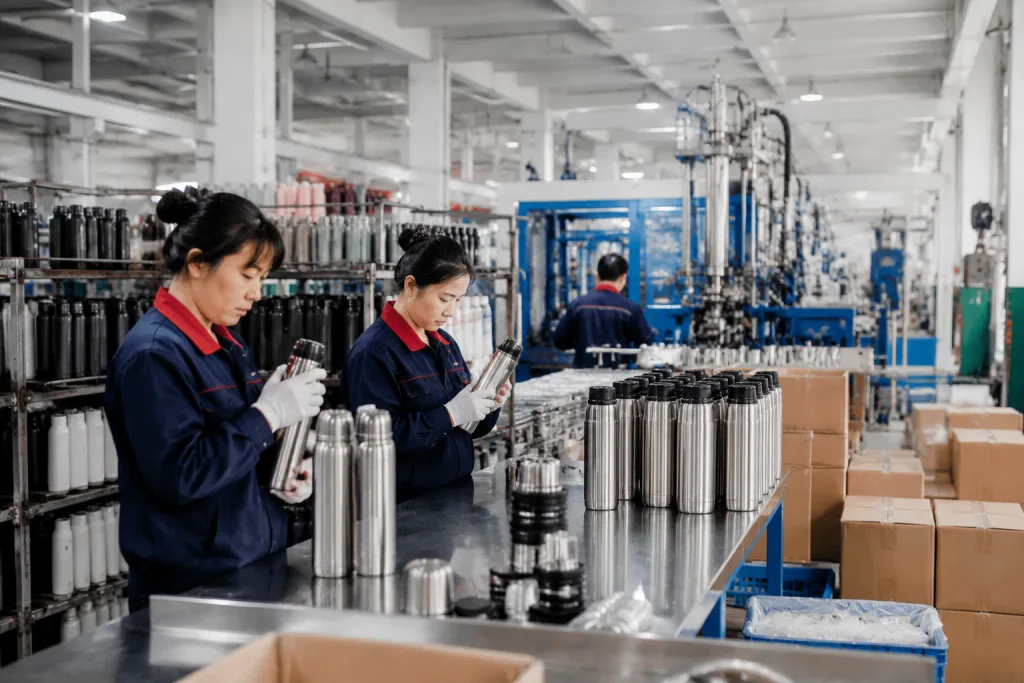
At BottleForge Industrial in Hangzhou, Zhejiang, we ship to Europe and North America every week, and QC pulled samples last month where two offers used the same rendering but different inner wall thickness. The math doesn't work if you ignore that. A stainless custom thermos is not hard to make, but the wrong coating, vacuum level, or carton count can add 8% to freight cost or push complaint rates to 2x. The right questions are plain: what steel, what vacuum level, what test standard, what MOQ, and what lead time we can actually hold.
Start with steel grade
The first line on an in bulk thermos spec sheet should be material, not color. We see buyers start with Pantone, then find out the quote only says “stainless steel.” That is where trouble starts. For most retail and promo programs, the standard callout is food-contact 18/8 stainless steel, also listed as SUS304, on the inner wall. If the supplier quote does not show the grade, ask again and get it printed on the PI. We have seen one PO say “SS inside,” and QC pulled the sample because that wording means nothing on the line.
For outdoor retail, 304 inner plus 304 outer is the safe commercial build. It stands up better to acidic drinks and gives you a cleaner file for REACH and LFGB-related testing. Some projects switch the outer wall to 201 to save around USD 0.15-0.35 per unit on a 500 ml bottle. That saving is real. So is the tradeoff. SUS201 is more likely to show surface rust in wet or salty use, and premium buyers push back fast when they see freckles near the base seam. We have seen this go sideways after a 48-hour salt spray check.
- Inner wall: SUS304 is the normal requirement.
- Outer wall: SUS304 for better durability; SUS201 only for cost-sensitive promotional thermos runs.
- Lid contact parts: PP, Tritan, or food-grade silicone should also be specified by grade.
Ask the manufacturer to confirm steel thickness as well. This is not a small detail. Common builds run from 0.35 mm to 0.5 mm. The cheapest quotes often drop the outer wall to 0.3 mm to cut weight and cost, but that bottle dents faster in FBA handling and distributor carton drops. For a 500 ml unit, 0.4/0.4 mm is the mainstream build we ship every week. If you want a tougher outdoor feel, use a 0.5 mm outer wall. The hand feel is better, dent complaints drop, and the added weight is usually 40-70 g with about USD 0.12-0.22 FOB added. Some buyers ask only for the lowest unit price; this is the wrong question to ask.
If you are comparing manufacturers thermos offers from China, compare material grade and thickness before you compare price. A USD 0.20 saving can disappear fast in claims.
Vacuum insulation and heat retention
The next line that matters is the vacuum structure. A proper bulk thermos should be double-wall vacuum insulated. If you want stronger heat retention, add copper coating on the outside of the inner liner inside the vacuum chamber. Buyers often ask for “12 hours hot, 24 hours cold.” That is the wrong question to ask unless the test condition is written down. On our line, QC pulled two 500 ml samples last month that both passed “12 hours hot” under different internal methods, and the gap at 6 hours was 5°C.
A workable spec looks like this: 500 ml bottle, filled with 95°C water, ambient 20°C, temperature after 6 hours not lower than 68°C. For cold retention: filled with 4°C water, ambient 20°C, temperature after 12 hours not higher than 10°C. Ask your thermos suppliers to state the method on the quote or PI. Different factories in Zhejiang and other parts of China run different internal standards, so headline numbers are not apples to apples. We have seen buyer POs that just said “keep hot long time,” and that is how claims turn into disputes.
What affects real retention
- Vacuum quality and leak rate
- Copper coating inside the vacuum chamber
- Neck design and stopper structure
- Lid gasket material and compression
- Body diameter and fill volume
Wider-mouth customized thermos designs are easier to clean and better for ice. They also lose heat faster than narrow-neck models in most cases. For outdoor retailers selling hiking or winter-use products, 2°C after 6 hours can decide whether the item gets repeat orders. For promotional brands, user convenience often matters more, so a wider mouth can be the better commercial choice. We checked this on 2 neck sizes last season, 42 mm vs 55 mm, and the wider opening dropped faster in the boil test.
Ask for a boil test and a vacuum test report on your pre-production sample. Good thermos manufacturers also run a 100% vacuum check during production, often with a vacuum inspection machine right beside the packing line. If they cannot explain the inspection process, that is a red flag. The math does not work on a 20,000-piece thermos bulk order if 1.5% fail vacuum—that is 300 weak units going into your channel. We have seen this go sideways after final inspection looked clean but field returns started at store level.
Body dimensions, weight, and wall thickness
Dimension lines on a spec sheet look dull. They drive shelf fit, carton count, and how the bottle feels at retail. A 500 ml in bulk thermos is commonly around 70-75 mm diameter and 240-265 mm height, depending on lid style and whether we run a flush cap or a carry-loop cap. Those few millimeters decide if it drops into a standard cup holder, fits a backpack side sleeve, or sits cleanly in a retail planogram. On our line, QC checks height with a digital caliper at the first-off sample because a 3 mm drift has already caused a fit claim before.
Weight matters too. Buyers often ask for the lightest option. This is the wrong question to ask. In a stainless custom thermos, lower weight often means thinner steel, weaker base impact resistance, and a cheap hand feel. For a 500 ml vacuum bottle, a realistic range is 280-360 g. Below that, check the steel gauge and base construction carefully; we have seen 0.3 mm outers dent during drop testing from 80 cm. Above that, you may be paying for extra metal that adds freight but does not improve daily use. We have had buyers flag a 20 g increase on a PO, then accept it after handling the sample next to the lighter version.
Channel decides the build. Outdoor accounts usually want a steadier base and a thicker outer wall because dents turn into returns fast. Promotion orders for distributors thermos projects often lean toward lower shipping cost and easier event handling, especially at 3,000 pcs MOQ where carton cube starts to hurt. The spec should match the sales channel on purpose. If it does not, we have seen this go sideways after the first container lands.
- 0.4 mm outer wall: balanced choice for most programs; this is what we ship most often on 500 ml vacuum bottles
- 0.5 mm outer wall: better dent resistance, higher FOB and freight; the line also runs slower because forming pressure needs adjustment
- Base pad: silicone or TPR pad reduces noise and scratching; a 1.5 mm pad also helps hide small base marks from handling
- Mouth diameter: 35-55 mm changes cleaning convenience and retention; buyers often push for wide mouth, then complain the lid looks bulky
Carton planning starts here too. If the bottle is 8 mm taller because of a decorative lid cap, your master carton may drop from 24 pcs to 20 pcs. That can raise sea freight cost per unit by 6-10% depending on the lane. The math does not work if the taller cap adds shelf appeal but wipes out carton efficiency. A smart thermos vendor checks unit dimensions against carton cube before mass production. We use a carton drop-in mockup and confirm outer carton size before releasing tooling changes.
Surface finish and logo application
This is where custom thermos orders fail. A buyer signs off Pantone and logo position, then skips coating type, adhesion spec, and print wear standard. We’ve seen this go sideways. On the line, the bottle looked fine at first packout, then QC pulled the sample after a cross-hatch tape test and the logo edge lifted. For a customizable thermos, surface finish does more than dress up the bottle. It changes grip, scratch resistance, dishwasher tolerance, and color match from lot to lot.
The common options are spray paint, powder coating, electroplating, plus a few special finishes like rubber paint or ceramic-look coating. For outdoor retail, powder coating is usually the safer call. We run 60-80μm film thickness on standard powder coat, and that gives better hand feel and scratch resistance than basic spray paint. For promo programs with a hard target price, spray paint can save USD 0.08-0.20 per unit, but it marks faster in carton rub tests. Buyers ask for the cheapest finish first. This is the wrong question to ask.
Logo methods that buyers actually use
- Silkscreen: low setup cost, good for simple 1-2 color logos; best fit when the artwork is clean and the logo area is flat
- Heat transfer: works for multi-color graphics, but check edge durability; the buyer flagged peeling once on a full-wrap design near the seam
- Laser engraving: durable premium look, no ink wear-off; common on outdoor SKUs and gift programs
- Digital print: good for short runs or detailed artwork; cost moves with coverage and quantity
For rugged outdoor use, laser engraving or a tested high-adhesion screen print is the practical route. For event giveaways and distributor campaigns, silkscreen usually gives the best cost-to-visibility ratio. Ask for tape test results, abrasion test data, and dishwasher warning language if the product is not dishwasher safe. We normally show 3M tape test photos and a rub test sample at approval stage, because a pretty pre-production mockup means nothing if the logo starts wearing after 200 cycles.
On MOQ, most suppliers thermos programs in China need 1,000 pcs per color for standard powder coat bottles with one logo. New molds, unusual lids, or all-over transfers can push MOQ to 3,000 pcs. At our Zhejiang facility, standard stainless thermos capacity is up to 300,000 units per month depending on finish mix, but artwork approval still drives the ship date more than machine output. Last month one PO had the logo width typed as 35 mm instead of 53 mm, and that single typo held sample signoff for 2 days.
Lid construction decides complaint rate
You can spec perfect steel and a clean coating, then lose the order on the lid. On bulk thermos projects, the cap assembly drives most leak claims, especially with a push button, flip straw, tea filter, or carry handle. Every extra part adds tolerance stack-up. On our line, QC pulled a sample last month where the pin sat off by 0.3 mm, and that was enough to fail the seal.
For a classic stainless thermos for outdoor retail, the safest choice is still a screw lid with a silicone gasket and a simple PP inner structure. Not fashionable. Low complaint rate. It leaks less and usually survives drop testing better at 1.2 m. Push-button lids sell well for commuting and promo channels, but the spring force, pin fit, and sealing face need tighter control on the line. Buyers ask for the look first; this is the wrong question to ask if returns are the bigger cost.
- Simple screw cap: lowest leak risk, easiest to inspect with a basic vacuum or inverted test
- Flip lid: convenient, moderate leak risk, watch hinge fit and latch wear after repeated opening
- Push-button stopper: best user convenience, highest complaint risk if tolerances drift by even 0.2 mm
- Bamboo or metal top trim: strong visual upgrade, watch moisture, glue quality, and trim alignment after packing
At sample stage, ask your thermos supplier for three checks: inverted leak test for 30 minutes, hot water pressure leak check, and at least 500 open-close cycles for functional lids. For retail programs, 1,000 cycles is better. We run this before mass production, not after the buyer flagged it. Also ask if replacement gaskets can be supplied, with gasket hardness confirmed. That matters for long-life outdoor SKUs and sustainability claims.
If your buyer brief says “premium customized thermos,” do not approve a lid from renderings alone. Ask for one real assembled sample. We ship out of Zhejiang, and we keep seeing the same mistake: buyers spend 12 days on body artwork and 20 minutes on the lid review. Then complaints land after launch. The math doesn't work. The lid is where complaint rate starts.
Packaging, compliance, and inspection
Packaging belongs in the product spec. It is not a last-minute packing note. For thermos manufacturers shipping to Europe and North America, we usually run polybag + white box, color box, PDQ display, or mailer-ready packs. If you sell on Amazon or DTC, tell the manufacturer thermos team before sampling, not after the PO. FNSKU labels, suffocation warnings, barcode position, and drop-test-ready box structure need to be locked before the line starts; on one 500 ml project, QC pulled the sample because the barcode sat 12 mm too close to the box edge.
A standard export setup for a 500 ml thermos bulk order may be 1 pc/white box, 24 pcs/master carton, with gross carton weight kept under 14 kg. That number matters. Go heavier and warehouse handling gets rough; one buyer in Canada flagged 15.8 kg cartons after a manual unload. Go lighter and carton cost climbs fast. If your product includes a tea strainer, cleaning brush, or gift tube, recalculate carton cube and freight before approval. We have seen the math go sideways on accessory kits.
Compliance points to put on the PO
- REACH where applicable for EU market
- LFGB or food-contact migration testing if required by your market
- FDA-related food-contact expectations for the US market
- ASTM/CPSIA review if the item is positioned for children
- BSCI or equivalent social compliance if your brand requires it
- ISO 9001 process control is useful, but not a substitute for product testing
Write inspection terms into the order. Do not leave them in email. AQL 2.5/4.0 is common for drinkware export. Define critical defects as leaking, vacuum failure, wrong logo, or sharp burrs; the sharp-burr point matters because we still check the rim and thread area by hand after polishing. Major defects can include obvious dents, coating skips, and color mismatch outside approved tolerance. Minor defects cover light cosmetic marks in less visible areas. Buyers sometimes ask only for “good quality.” This is the wrong question to ask.
Lead time also needs to be practical. For standard supplier thermos items, pre-production sample approval usually takes 7-10 days. Mass production is commonly 25-35 days after deposit and artwork confirmation. From August to November, China factory schedules often stretch by 7-15 days, especially for powder-coated and gift-box-packed SKUs. We ship plenty in that window, but the line gets tight, and one typo on a PO color code can cost 3 days on artwork reconfirmation alone.
Send your thermos spec for a real factory review
Share capacity, lid style, logo file, target price, and market. We will flag risk points, MOQ, lead time, and practical options from our Zhejiang production team.
Frequently asked questions
What is a realistic MOQ for a custom stainless in bulk thermos order?
For a standard 350-750 ml stainless custom thermos using an existing mold, MOQ is usually 1,000 pcs per color and design. If you want a plain stock bottle with one laser logo, some thermos suppliers can accept 500 pcs. If you need a new lid mold, gift box, or full-wrap artwork, expect 2,000-3,000 pcs. Repeat orders are easier. Once your packaging and print setup are established, many China factories will discuss 500-1,000 pcs for top-up production. The right MOQ depends on finish, logo method, and carton configuration, not just bottle size.
How much should I budget for a 500 ml bulk thermos FOB China?
For a 500 ml double-wall vacuum bottle in SUS304 inner and outer, standard powder coating, and one-color silkscreen logo, a normal FOB China range is about USD 2.80-4.20 at 3,000 pcs. Add USD 0.10-0.25 for laser engraving, USD 0.20-0.45 for a color box upgrade, and more for complex lids. If the quote is under USD 2.50, check steel grade, wall thickness, vacuum performance, and packing details carefully. Promotional thermos prices can go lower with 201 outer steel or lighter builds, but that usually means a weaker product for outdoor retail.
What tests should I require before approving mass production?
At minimum, ask for a leak test, vacuum retention test, coating adhesion test, and food-contact material report. For functional lids, request 500-1,000 open-close cycles. For outdoor or e-commerce channels, add carton drop testing and a basic salt-spray review for coated metal trim if used. Your pre-production sample should match final print position, coating, and packaging. For inspection, many buyers use AQL 2.5 for major defects and 4.0 for minor defects. If the customized thermos will enter the EU, align testing with REACH and your importer’s food-contact requirements.
How long does production take for customized thermos orders from Zhejiang, China?
For an existing model with confirmed artwork, pre-production samples usually take 7-10 days. Bulk production is typically 25-35 days after sample approval and deposit. If you add a new mold, allow 20-30 extra days for tooling and sample revision. Peak season in Zhejiang, China often stretches standard orders to 35-45 days, especially when you use powder coating, gift packaging, or multiple logo positions. If you need shipment before a trade promotion or holiday season, lock artwork early. Delays usually come from approval loops and packaging changes, not bottle forming itself.
Which logo method is best for an outdoor retailer versus a promotional campaign?
For outdoor retail, laser engraving is usually the safest long-term option because it does not chip like ink and it supports a more premium look. Powder coat plus laser is a solid spec for hard use. For promotional campaigns, one-color silkscreen is often the most cost-efficient if your logo is simple and the run is 1,000 pcs or more. Heat transfer works when you need multi-color graphics, but ask for abrasion testing first. If your thermos distributor channel values appearance over long-term abuse, silkscreen is fine. If you expect daily field use, choose durability first.