Key Takeaways
- For a 500ml custom thermos, MOQ is commonly 1,000 pcs per color, with new mold work adding 20-35 days and USD 1,500-8,000 depending on lid complexity
- 304 inner and outer steel fits most bulk thermos orders, while 316 inner adds corrosion resistance for tea, coffee, and sports use at roughly 8-15% higher body cost
- A reliable heat-retention target for a vacuum flask is 60°C+ after 6 hours from 95°C fill; ask for the exact test method, not just '12 hours hot'
- AQL 2.5 for major defects and 4.0 for minor defects is a practical shipment standard for thermos bulk orders going to Europe and North America
You can source an in bulk thermos flask from almost any trading page in 10 minutes. Easy. The hard part starts after deposit: bottles leaking after a 1.2 m drop, vacuum loss showing up after six months, or logo print scratching off when QC pulled the sample with a coin-rub test on the line. Outdoor retailers and promo brands usually learn this on the first reorder, when two same-looking bottles ship with different performance and the buyer flagged it after customer returns hit 3%.
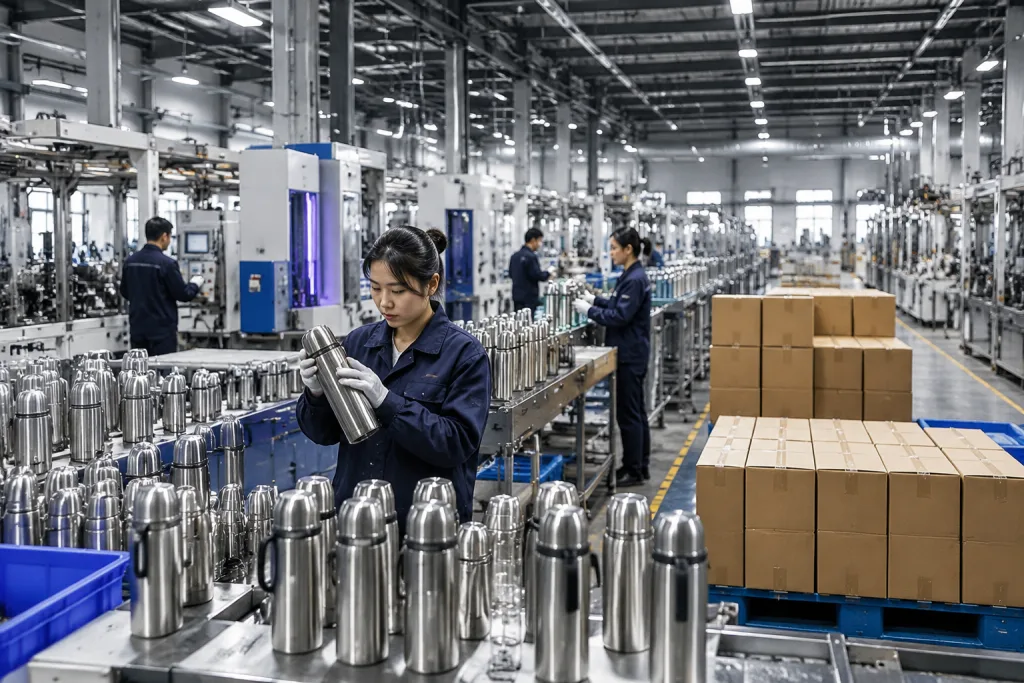
A proper stainless spec sheet shows where the risk sits. This is the right question to ask. Steel grade, wall thickness in mm, vacuum hold hours, lid resin, gasket hardness, print method, carton count, AQL level, and lead time all change landed cost and complaint rate. At BottleForge Industrial in Hangzhou, Zhejiang, China, we build around 600,000 units per month, and buyers who send clean specs early—down to 0.4 mm vs 0.5 mm body thickness or a 24 pcs master carton—usually get smoother launches. We’ve seen this go sideways from one PO typo.
Start with the body spec
For an in bulk thermos flask, the body drawing matters more than the glamour shot. Start with capacity, height, diameter, net weight, steel grade, and wall thickness. For a 500ml stainless vacuum bottle, we usually run about 70mm diameter, 250-270mm height, and 280-340g, depending on the base, lid, and surface finish. Shelf fit is where deals get won or lost. If the buyer needs the bottle to sit in outdoor retail shelves, car cup holders, backpack side pockets, or a rigid gift box insert, 3mm on diameter decides it. We have seen a PO kicked back over a 72mm body that would not clear a 70mm die-cut tray.
For steel, the practical baseline is food-contact SUS304 on the inner wall. On the line, a lot of programs run 304 inside with 201 or 304 outside. If you want fewer corrosion complaints and a cleaner long-term product position, use 304 outside too. For coffee, tea, acidic drinks, and hard daily use, a 316 inner wall is worth discussing. It usually raises body cost by about 8-15%, but it cuts rust claims in rough channels. This is the wrong question to ask: “Can you just quote stainless steel?” We have seen supplier listings in Zhejiang use that wording with no mill certificate attached. Ask for the actual grade, mill cert, and contact declaration. QC pulled one sample last season where the PO said 304, but the vendor sheet only said “SS inner.” That is not enough.
Wall thickness is not decoration. Common ranges are 0.35mm to 0.5mm for the inner wall and 0.4mm to 0.5mm for the outer wall. Thicker is not always better; the math does not work if the bottle feels solid in hand but freight jumps on a 20,000-piece order. A 0.5/0.5 build gives a heavier, premium feel, yet it adds weight and shipping cost. A 0.35/0.4 build works for promotional thermos programs, though it will dent easier if cartons take a hit. For outdoor retail, 0.4mm inner and 0.45mm outer is a sensible middle ground. We check this with a micrometer after forming, because a 0.05mm drift shows up fast on dent resistance.
- Entry promotional thermos: 304 inner, 201 outer, 0.35/0.4mm
- Mainstream custom thermos: 304/304, 0.4/0.45mm
- Premium customized thermos: 316 inner, 304 outer, reinforced base pad
If a thermos manufacturer cannot provide a body section drawing with tolerances, treat that as a warning sign. We ship from drawings, not pretty renders.
Vacuum performance and what claims mean
Most buyers ask, “How many hours hot and cold?” Fair question. The better question is how the test was run. We’ve seen bulk thermos claims built on friendly lab setups, not line reality. Ask for the fill temperature, ambient temperature, test duration, and the acceptance point. A common internal standard for a 500ml manufacturer thermos is 95°C water filled at 20°C room temperature, then checked at 6 hours and 12 hours with a digital probe thermometer. For cold retention, a lot of factories run 4°C water or ice water and record the result at 6 or 12 hours.
For a solid vacuum flask, 60°C or above after 6 hours is a fair hot-retention target in 500ml, and 45-50°C after 12 hours is a good mark. For cold, under 10°C after 6 hours in standard room conditions is the usual line. Size matters. Bigger bottles usually hold temperature better. Wide-mouth bodies usually lose heat faster than narrow-neck bodies because the opening is larger; on the line, a 55mm mouth almost always tests weaker than a 38mm neck in the same body height. This is the wrong question to ask if someone only wants the highest hour claim with no test condition behind it.
The vacuum process affects yield as much as performance. Good thermos suppliers should talk about leak testing, vacuum inspection, and aging before packing. We usually recommend 100% air-tightness testing and vacuum performance sampling per lot. In our shop, QC pulled the sample after aging and checked vacuum loss before carton drop. If the bottle uses copper coating on the inner outer-wall surface for insulation improvement, ask if that is standard spec or limited to certain SKUs. Buyers miss this point, then flag a sample later when the mass run performs lower. We’ve seen this go sideways.
Do not approve copy that says “keeps hot 24 hours” unless the factory gives a method sheet. Without a method, the claim is a sales line, not a QA line.
If your custom thermos goes to North America promotional channels, be careful with inflated claims because end buyers compare actual drinking temperature, not lab wording. We ship into that channel, and the pushback is usually simple: “User says it was warm, not hot, by lunch.” The best supplier thermos partners under-claim a little and hit the number lot after lot.
Lid assembly decides complaint rates
On most bulk thermos orders, the lid drives more after-sales claims than the stainless body. We ask buyers to review the lid type, resin grade, gasket material, thread engagement in mm, pour function, and dishwasher warning before sampling starts. Common builds on the line are simple screw caps, cup-cap plus stopper, push-button pour lids, flip lids, and sports caps with a carry handle. Outdoor chains usually pick the simple stuff. Promo brands often ask for one-hand lids because the shelf look is better, then the buyer flags leaks or button jams 3 months later. More parts, more risk. That’s the part people skip.
For resin, food-contact PP is still the standard workhorse. Tritan shows up when the customer wants a clear part, though less often on classic vacuum flasks. Silicone gaskets need food-grade material and stable hardness, often around Shore A 50-60. If the gasket groove is 0.3 mm too shallow or the silicone cross-section drifts batch to batch, leaks show up after carton vibration in transit. We’ve seen this go sideways. QC pulled the sample, turned it upside down for 30 minutes, and found seepage at the thread start. A real thermos factory should run torque checks and inverted leak tests on filled samples.
Practical lid questions to ask
- What is the lid resin and can you provide REACH and food-contact declarations?
- What torque range is used in production, for example 8-12 kgf·cm?
- Is the gasket glued, press-fit, or overmolded?
- How many open-close cycles were tested: 500, 1,000, or more?
- Can replacement lids be ordered later, and what is the MOQ?
If you are buying distributors thermos stock for multiple markets, go with a conservative lid. This is the wrong question to ask: “Which lid looks newest?” The better question is which lid survives mixed users, mixed languages on care labels, and a 3,000-piece reorder without spare-part headaches. A simple cup-cap thermos customized with color and logo often gives a lower return rate than a button lid with springs and pins. Less exciting. Better business.
For premium custom thermos projects, ask for a drop test with filled bottle from 80cm to 100cm on plywood over concrete. We run this with 3 filled samples per colorway because dark pigments and translucent parts do not always behave the same. You will see fast if the hinge cracks, the button pops, or the outer cup thread deforms after impact.
Surface finish, logo, and carton reality
Decoration looks easy on a screen. On the line in China, this is where custom thermos jobs slip. Start with the finish: spray paint, powder coating, brushed steel, electroplating, rubber paint, water transfer, or wrap film. For outdoor channels, powder coating is usually the better value. It hides fingerprints, gives more grip, and stands up better to abrasion than glossy spray. Typical dry film thickness is around 60-90 microns. We check it with a coating thickness gauge, not by eye. Ask for the cross-hatch adhesion result and the internal abrasion standard. If a supplier gets vague here, the buyer should push back.
Match the logo method to the finish and the order size. Silkscreen works for 1-2 spot colors and keeps setup cost under control. Laser engraving lasts and works well on powder-coated or painted bodies if the underlayer contrast is set right; QC pulled a sample last month where the logo looked gray because the paint stack was off by one pass. Heat transfer handles multi-color artwork, but the line setup gets slower. A customized thermos with a wraparound print can look strong, but if your order is only 1,000 pcs split into five colors, the math doesn't work.
Typical pricing for a 500ml vacuum body from Zhejiang, China under FOB terms can look like this:
- Basic 304/201, simple lid, spray finish: USD 2.40-3.10
- 304/304, powder coat, silkscreen logo: USD 3.20-4.30
- 316 inner, carry handle lid, laser logo, retail box: USD 4.60-6.20
MOQ usually starts at 1,000 pcs per model and color for standard custom-logo runs. For stock colors with laser engraving, some thermos manufacturers accept 500 pcs. Carton pack counts are often 20 or 24 pcs per master carton, with gross weight kept under 12-14kg so warehouse staff can handle it without trouble. We ship plenty of these. If you need Amazon FBA prep, put barcode labeling, polybag rules, and carton dimension limits on the PO before mass production starts. We have seen this go sideways over one small typo in the carton mark.
A thermos custom job usually fails quietly when the packaging spec is vague. Ask for carton size, drop test standard, barcode position, and whether inner dividers are standard or optional. This is not a small detail. One buyer flagged it only after production because the master carton came out at 63cm and missed their warehouse limit.
Compliance paperwork you actually need
Not every buyer needs the same compliance file. Any serious thermos supplier should still know the base set. For Europe, ask for REACH, LFGB where relevant, and packaging compliance details. For North America, buyers usually ask for FDA-relevant food-contact declarations, California Proposition 65 screening depending on the sales channel, and CPSIA or ASTM checks if the item sells as a kids product. Adult outdoor bottles carry a lower compliance burden than children’s drinkware, but you still need traceable material records. We keep heat numbers by coil lot and match them to the 304 stainless PO; last month QC pulled a sample because the lid silicone hardness was off by 3 Shore A.
Factory audits matter too. BSCI gets asked for a lot by promotional brands and retail importers. ISO 9001 shows some process discipline, though it does not prove perfect output. What counts is whether the thermos manufacturer can show incoming material inspection, in-process checks, final random inspection, and corrective action records. This is the wrong question to ask if a buyer only says, “Do you have ISO?” Ask what the line actually records: wall thickness at 0.4 mm, vacuum hold results, torque checks on the stopper, and what happened when an inspection finding failed.
Use AQL with numbers, not vague quality promises. A practical shipment standard for manufacturer thermos orders is AQL 2.5 for major defects and 4.0 for minor defects, with critical defects at zero tolerance. Define major defects clearly: leakage after a 30-minute inverted test, wrong logo position by 2 mm, wrong steel grade declaration, a sharp edge at the cup rim, vacuum failure, or a missing accessory. Define minor defects the same way: one small paint dust point under 0.5 mm, carton scuff, or slight color delta within approved tolerance. We have seen this go sideways when the PO said “mat silver” and the approved sample was brushed silver.
If you buy from suppliers thermos catalogs in Zhejiang or other China sourcing hubs, ask for recent test reports, then check whether the report matches your actual SKU. A report for a different lid or a different inner coating is not enough. The paperwork should follow the production sample you approve. The buyer flagged this on a 5,000-piece order once: the report covered a flip lid, but the shipped bottle used a screw cap with a different PP grade, so the math did not work.
Lead time, MOQ, and tooling tradeoffs
Most bulk thermos delays start with missed decisions, not the actual production clock. For a standard in bulk thermos flask on an existing mold, we usually quote in 3-7 days, finish the pre-production sample in 5-10 days, and run mass production in 25-35 days after deposit and artwork approval. From August to November, add 7-15 days because coating lines and carton suppliers are stacked. On our floor, one late PMS color confirmation can hold the spray booth for 2 days. Plan 45-60 days door-to-port if you want the order to move cleanly.
MOQ follows the spec. A stock-body, stock-lid thermos promotional order with one logo may start at 500-1,000 pcs. Once you ask for custom colors on both body and lid, special packaging, and mixed sizes, factories usually want 1,000 pcs per color or 3,000 pcs total so the line stays efficient. This is where buyers push back, but the math doesn't work at 200 pcs per SKU when QC still needs the same setup and checks. New tooling changes that fast. A custom lid mold can cost USD 3,000-8,000 and add 25-35 days. A new body mold may be USD 1,500-4,000 if the geometry is close to an existing platform, more if the base and neck are fully new. We also check fit on a go/no-go gauge before cutting steel; 0.3 mm off at the thread can turn into a leak complaint later.
For outdoor retailers, a stable platform often beats a fully bespoke one. We’ve seen this go sideways when a buyer spends 40 days on a new silhouette, then finds the carry handle fails a 15 kg hang test. Use a proven body, change the finish, add a better handle, improve the packaging, and keep spare lids available. For promotional buyers, simplify SKUs. Five colors in 200 pcs each sounds flexible, but it often means 12 days vs 18 days on the line once color changeovers, scrap, and carton sorting start piling up. QC pulled the sample on one order last year because two navy lids were half a shade off the approved chip.
Ask your thermos vendor or thermos distributor partner a plain question: what part of this spec is likely to delay production? That is the right question. A solid answer should mention paint curing time, lid component sourcing, laser fixture setup, or carton approval, and sometimes the buyer flagged a typo on the PO that stopped the print file release for a full day. If the answer is "no problem" to everything, you probably are not getting the full picture.
Send your thermos spec and get a practical review
Share target capacity, steel grade, lid type, logo method, MOQ, and ship date. We will flag cost and quality risks before you place the order.
Frequently asked questions
What MOQ should I expect for an in bulk thermos flask order?
For a standard 500ml stainless vacuum flask using an existing mold, MOQ is usually 1,000 pcs per model per color. Some thermos suppliers in China can do 500 pcs if you choose stock colors and laser engraving only, but unit cost rises and carton efficiency gets worse. If you need custom paint, printed packaging, or mixed accessories, 1,000-3,000 pcs is more realistic. New lid tooling changes the math completely. A custom lid often needs 3,000 pcs minimum to justify setup, plus mold cost from about USD 3,000 to 8,000. If your launch volume is uncertain, start with a proven stock-body custom thermos and put your budget into finish, logo, and retail packaging instead of fresh tooling.
Is 304 steel enough, or should I pay for 316 inner steel?
For most bulk thermos projects, 304 inner and 304 outer is the sensible baseline. It handles water, coffee, and tea well, keeps costs controlled, and meets the expectation of most Europe and North America buyers. Move to 316 inner steel if your channel is more demanding: outdoor use, acidic drinks, heavy daily use, or a premium custom thermos position where fewer corrosion claims matter more than a 8-15% body cost increase. I would not pay for 316 only because a catalog says 'medical grade.' I would pay for it if your end user is rough on products and your brand cannot tolerate rust complaints. Always ask for the exact steel declaration and not just the word 'stainless.'
What heat-retention spec is realistic for a 500ml thermos?
A realistic QA target for a good 500ml vacuum flask is 60°C or above after 6 hours when filled with 95°C water at about 20°C ambient. After 12 hours, around 45-50°C is a solid commercial result for a standard narrow-mouth bottle. Bigger capacities may perform slightly better; wide-mouth designs usually perform worse. Be careful with sales claims like '24 hours hot.' Those can be technically true under favorable test conditions but still disappoint real users. Ask your thermos manufacturer for the exact test sheet: starting temperature, ambient temperature, fill volume, measurement point, and sample count. If they cannot provide that, the claim is not robust enough for packaging or retail copy.
Which logo method is best for outdoor retail and promotional use?
For outdoor retail, laser engraving on powder-coated stainless is usually the safest long-term choice. It resists abrasion better than standard silkscreen and gives a cleaner premium look. For promotional thermos programs where price matters and artwork is one or two spot colors, silkscreen is still practical and cost-effective, especially above 1,000 pcs. Heat transfer is useful for complex multi-color art, but setup is slower and scrap risk is higher if the bottle shape has tight curves. A good rule is simple: if the item will be used hard, go laser; if it is event-driven and budget-sensitive, silkscreen works. Ask for an adhesion or abrasion test result and approve a decorated pre-production sample before mass production.
How do I reduce leakage and defect risk before shipment?
Write the inspection standard into the PO. At minimum, require 100% leak testing, random vacuum-performance sampling by lot, and final inspection at AQL 2.5 major / 4.0 minor. Define major defects clearly: leakage, vacuum failure, wrong logo, wrong color, damaged thread, or missing parts. Ask for filled and inverted leak testing, not just empty assembly checks. For lids with buttons or flip parts, request cycle testing of 500-1,000 opens. For packaging, confirm carton drop resistance and barcode placement before the run starts. If the goods are shipping from Zhejiang, China to North America or Europe, insist on pre-shipment photos of palletization and carton marks as well. Most complaint spikes come from vague specs, not from one dramatic factory error.